
Locations
Chicago
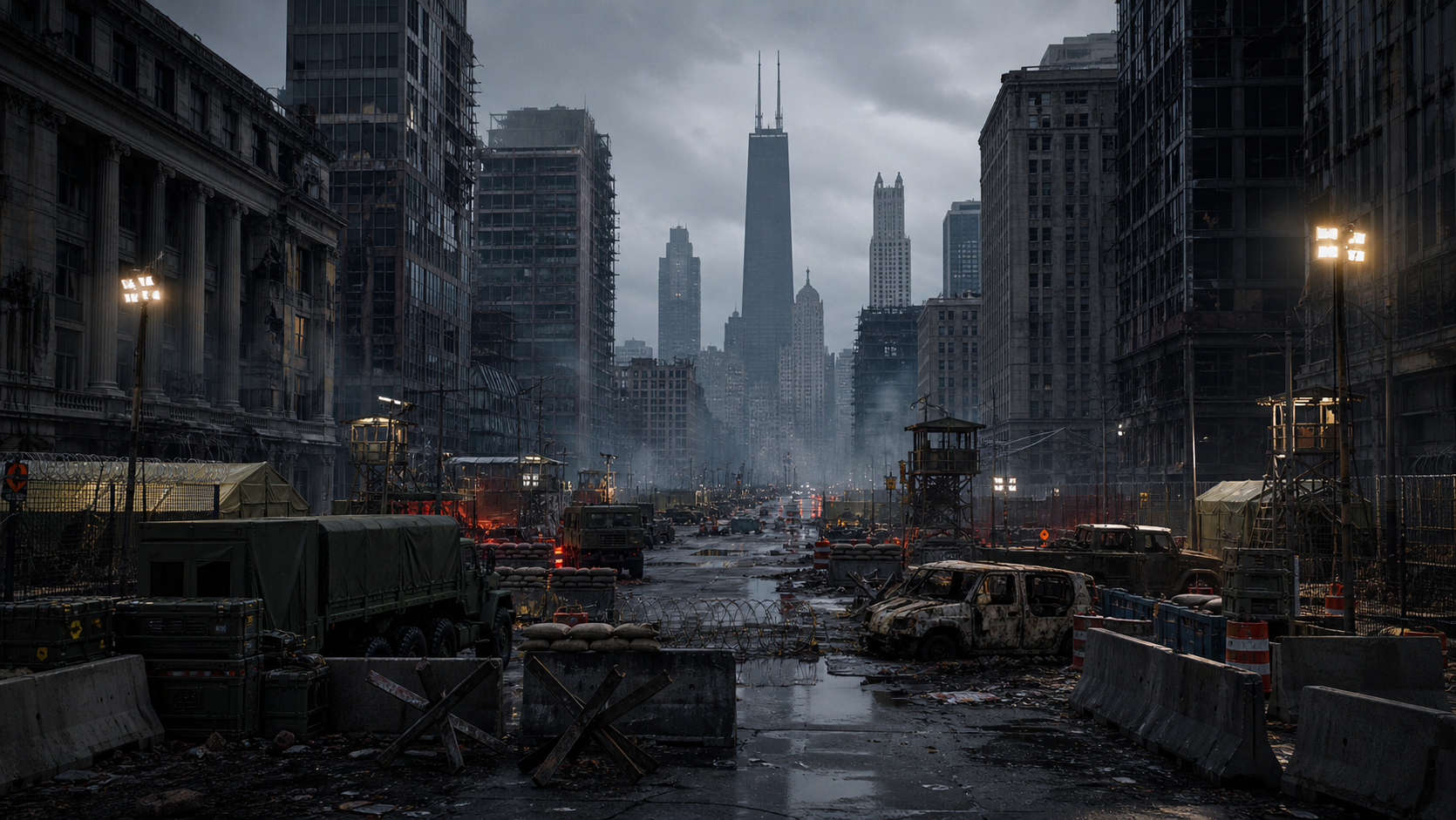
Chicago is the first major American metropolitan outbreak documented in the main Extinction Cycle and later the site of Safe Zone Territory 15 during the Resistance of Tyranny crisis. Its initial collapse begins when Building 8 scientist Jim Pinkman transforms aboard Flight 193 from San Nicolas Island. The aircraft lands at O'Hare International Airport, allowing the VX-99 and Hemorrhage Virus combination to move from a classified accident into a civilian transportation hub. Secondary cases reach Northwestern Memorial Hospital, where CDC personnel initially describe the incident as an isolated microbreak before the speed and violence of infection overwhelm containment.
Quick Facts
- Role
- Locations
- Aliases
- chicago, Safe Zone Territory 15, SZT 15, ROT Chicago Crisis
Overview
Within roughly forty-eight hours, Chicago's National Guard perimeter fails and the city becomes the public image of the American catastrophe. Dr. Kate Lovato experiences the loss personally when her brother Javier, a professor at the University of Chicago, calls while transforming. His death helps drive her determination to identify the engineered agent and develop a countermeasure.
Years later, rebuilt authorities designate the Chicago region Safe Zone Territory 15. The city again becomes a biological battlefield when Andrew Wood and the Resistance of Tyranny use the Hemorrhage Virus against protected communities. Reed Beckham and Jim Flathman are caught in the renewed outbreak, while the threat to President Jan Ringgold's cousin Emilia gives the attack both personal and political leverage. Chicago's two crises bookend the series' warning that containment fails when pathogens, infrastructure, and public trust are treated as separate problems.
Location information
- Field: Location; Detail: Chicago, Illinois, United States
- Field: Initial outbreak date; Detail: April 2015
- Field: Initial entry point; Detail: Flight 193 and O'Hare International Airport
- Field: Early medical site; Detail: Northwestern Memorial Hospital
- Field: Origin carrier; Detail: Dr. Jim Pinkman, Building 8 scientist
- Field: Principal early investigators; Detail: Dr. Chad Roberts and Dr. Ted Lucas of the CDC
- Field: Principal personal connection; Detail: Javier, brother of Dr. Kate Lovato and professor at the University of Chicago
- Field: Initial defenders; Detail: Airport security and law enforcement, hospital personnel, police, National Guard, and emergency agencies
- Field: Early outcome; Detail: Hospital breach, mass panic, failed perimeter, and metropolitan collapse within the opening days
- Field: Postwar designation; Detail: Safe Zone Territory 15
- Field: Later antagonist; Detail: Andrew Wood and the Resistance of Tyranny
- Field: Later principal figures; Detail: Reed Beckham, Jim Flathman, Jan Ringgold, Emilia, and Mayor Kaylor
- Field: Principal works; Detail: Extinction Horizon and Extinction War
Background: Building 8 and Flight 193
Chicago's outbreak cannot be separated from Building 8. Pinkman works inside the classified San Nicolas Island laboratory where VX-99 and the modified Hemorrhage Virus are handled. A robotic arm breaks a vial during laboratory work. The automated system releases a decontamination mist, and Pinkman enters in protective equipment to clean the area and recalibrate the machinery.
While discarding glass, he damages a glove but sees no obvious injury. He assumes the sample has been neutralized. The absence of an immediately visible exposure becomes one of the origin chain's decisive errors. Pinkman leaves the facility carrying infection before anyone recognizes that the decontamination process may have weakened the virus without making it harmless.
He boards Flight 193 for Chicago as part of a planned journey that will ultimately return him to work connected with the West African Ebola response. While the aircraft is over Iowa, he wakes in the lavatory with bleeding, altered lips and teeth, abnormal hunger, and rapidly changing senses. Memories of the broken vial return as his remaining self-control fails.
Pinkman attacks two Navy personnel aboard the flight as it descends. The aircraft still reaches Chicago. A crisis that might have remained on an isolated island has crossed the country inside normal aviation procedure, and the first responders at O'Hare do not possess a warning adequate to the biological and physical threat arriving with it.
O'Hare International Airport
O'Hare is the point where one infected carrier becomes a metropolitan emergency. Airport and Homeland Security personnel respond to an apparently violent passenger without knowing that blood, vomit, bites, and direct contact can transmit an agent with an extraordinarily short symptomatic interval.
The response follows familiar assumptions. Armed officers can stop an attacker, identify casualties, and transfer bodies or patients into medical custody. Those steps are dangerous when an exposed responder may begin hemorrhaging and attacking colleagues before an epidemiological interview can be completed.
The airport also creates a national uncertainty. A major hub connects passengers, baggage handlers, flight crews, ground transport, hotels, and connecting routes. Even after authorities identify the Chicago incident, they cannot immediately prove who has left the exposure chain or how many people encountered contaminated material.
The early record focuses on the cases moved from O'Hare rather than providing a complete airport manifest. What matters for continuity is the breach of scale. Building 8 contains known personnel inside a remote secure site. O'Hare receives an altered human as an ordinary arriving passenger and distributes the consequences into civilian systems.
Northwestern Memorial Hospital microbreak
CDC physician Chad Roberts is sent to Chicago after field work in Guinea. At Northwestern Memorial Hospital, he and fellow CDC physician Ted Lucas examine what officials still call an isolated microbreak. Samples are prepared for transport to Atlanta so the CDC can sequence the agent and begin treatment work.
The quarantine wing holds three early dead from the airport chain, including the transformed passenger and Homeland Security personnel. The bodies display anatomy and violence inconsistent with ordinary Ebola. Roberts notes bleeding, self-mutilation, cannibalistic behavior, hallucination, and an incubation interval that appears almost instantaneous.
The hospital is highly capable by ordinary standards but not prepared for this combination of Biosafety Level 4 contagion and physically enhanced patients. Isolation procedures assume that restraints, doors, protective clothing, and a controlled clinical team will limit movement. The altered patients can break restraints, sprint on all fours, project contaminated blood, and continue attacking through injuries.
A female patient escapes restraint and attacks officers in the quarantine corridor. A Taser fails to create reliable control. She vomits infected material into an officer's face and bites him. Roberts recognizes that the wing is lost and seals it, leaving Lucas and others inside. The decision may slow spread within the building, but it cannot reverse exposures already created at the airport, during transport, and in the hospital.
Northwestern supplies two critical forms of evidence. Biological samples travel toward the Atlanta CDC, and witnesses describe transformation as something faster and more violent than the public label of Ebola suggests. It also demonstrates how an institution can follow its emergency plan and still fail because the emergency has changed the meaning of every assumption in that plan.
Public information and mass panic
News coverage rapidly uses the language of a zombie apocalypse. The comparison conveys visible violence but obscures important facts. The infected are alive, fast, adaptive, contagious, and capable of physical changes beyond the familiar fictional model. Calling them zombies encourages the public to apply rules that may not work.
The sensational language also accelerates panic. Residents attempt to leave, families search for one another, hospitals receive frightened people, and authorities must decide whether to close routes or preserve evacuation corridors. A correct warning could save lives, but an imprecise warning can send millions into the same streets.
Chicago becomes the first American city through which the public understands that the outbreak is not contained overseas or on one military base. The visible failure changes behavior across the country before scientific personnel can explain VX-99, the Hemorrhage Virus, or the origin program.
National Guard perimeter and collapse
Illinois activates the National Guard as federal emergency assets and military units move toward the city. The perimeter is intended to contain infection, support evacuation, and preserve order. It fails quickly because the threat has already crossed the boundary through ordinary movement and because people inside can transform after reaching checkpoints or shelters.
The infected also attack with a speed and climbing ability for which crowd-control and quarantine formations are not designed. A perimeter can stop vehicles or redirect pedestrians. It cannot reliably distinguish a frightened uninfected person from someone in the final minutes before transformation, nor can it cover every vertical and underground route of a large city.
By April 21, roughly forty-eight hours after the documented Chicago crisis begins, the city is described as a post-apocalyptic wasteland. The sick fill the metropolitan area, uninfected people are being killed, and the Guard line has fallen. The national military still has aircraft and deployable formations, but Chicago shows that those assets are not the same as local control.
Once hospitals, emergency communications, police response, roads, and public trust fail together, adding troops does not restore the individual systems quickly enough. Each failure amplifies the others.
Javier and Kate Lovato
Javier is a professor at the University of Chicago and Kate Lovato's younger brother. During the initial response, Kate works at the Atlanta CDC while repeatedly trying to reach him. The geographical distance makes her professionally useful and personally powerless. She can analyze samples from Chicago but cannot extract her own family member from it.
Javier eventually calls while symptoms are progressing. He describes extreme hunger and the sensation of something burrowing behind his eyes. Kate tells him to reach a hospital and ask for sedation even while understanding that the city is collapsing and no proven treatment exists.
Their final exchange retains moments of recognition before screams and altered sounds overtake his speech. The line goes silent while Kate listens. No recovered body or separate rescue is documented, but the transformation and loss are clear enough that she and those around her treat Javier as dead.
His death has continuing scientific and emotional consequences. Kate's work is not motivated only by abstract survival counts. Every genome comparison and countermeasure trial is also an attempt to stop the process she heard taking her brother. Later weapons raise moral concerns precisely because the enemy population is made from people like Javier, whose humanity did not vanish at the first symptom.
Chicago as an outbreak model
Several features make Chicago central to later doctrine:
The lesson is not that airports or hospitals cause the disaster. They perform essential functions under conditions created by secrecy and inadequate warning. Building 8 knows it handles an engineered threat, but the people at O'Hare and Northwestern encounter the consequences without that knowledge.
- Aviation transfer: One hidden exposure carries a classified laboratory accident into a civilian hub.
- Clinical amplification: Medical care concentrates infected, exposed personnel, samples, and responders inside one facility.
- Information lag: Public descriptions change more slowly than the infected bodies and behavior.
- Perimeter failure: A geographic cordon forms after the threat has already moved through several networks.
- Personal dispersal: Families, workers, and travelers leave or attempt rescue before a common operating picture exists.
Connection to the Survival branch
The Extinction Survival series supplies a separate family perspective connected to Chicago. George Gringleman and his wife Mitzi are in the city while their sons Gary and Gavin remain at Lost Valley in California. The boys search radio, telephone, and news channels for information as reports from Chicago worsen.
This branch does not alter Pinkman's origin role or the main-series chronology. It widens the consequence. To Kate, Chicago contains Javier. To the Gringleman brothers, it contains their parents. To national command, it is a containment zone. The same city is therefore experienced as a scientific warning, military problem, and source of unresolved family absence.
The connection also helps explain Gary's later dedication to radio infrastructure. Communications cannot guarantee reunion, but they can prevent other communities from living inside the same silence that surrounds the first days of Chicago.
Safe Zone Territory 15
After the first extinction war, surviving authorities consolidate population into defended territories rather than immediately restoring every old municipal boundary. Chicago becomes associated with Safe Zone Territory 15. The designation indicates an organized postwar security and administrative system, not proof that every street of the former metropolis has been cleared and repopulated.
Safe zones attempt to solve the problem the first perimeter could not. They control entry, maintain armed defense, organize food and medical care, and connect residents to a wider government. Years of survival create routines that can make catastrophe feel historical.
That stability remains dependent on trust. Residents must believe screening, medicine, supply convoys, and national authorities protect them. A human adversary who understands those procedures can attack the system more effectively than a visible horde at a wall.
Chicago safe-zone territory shattered by ROT biological terror.
Safe Zone Territory 15 is the post-war safe zone whose infection turns Chicago into a nightmare replay of the early outbreak.
Extinction War shows ROT using the Hemorrhage Virus as a political weapon. SZT 15 becomes a proof point that safe-zone labels cannot protect civilians when humans choose to restart extinction.
Reed Beckham and Jim Flathman survive on Chicago rooftops.
Emilia Ringgold gives the crisis a presidential family stake.
The attack feeds the George Washington and Zumwalt crisis.
The topic connects outward through the following people, groups, places, events, and lore concepts.
SZT 15 matters because it is human evil using biological memory. The Variants are horrible, but ROT's choice to weaponize infection is deliberate political terror.
Resistance of Tyranny attack
In Extinction War, Andrew Wood and the Resistance of Tyranny use the Hemorrhage Virus against safe-zone territories as part of a campaign to destabilize Ringgold's government. Chicago and Safe Zone Territory 15 become one of the principal crisis locations.
The attack deliberately recreates the fear of 2015. People who have rebuilt lives inside controlled territory confront bleeding, rapid infection, and violence they believed the postwar system could prevent. The objective extends beyond killing. If residents believe Ringgold's government caused, concealed, or failed to stop the attack, trust between territories can collapse and secessionist claims become easier to sustain.
Reed Beckham and Jim Flathman are stranded amid the renewed violence in Chicago, moving through streets and elevated positions while infected people and surviving monsters turn the safe zone into hostile terrain. Their situation reverses the promise of reconstruction. Veterans who helped end the first war must survive the old threat inside a place officially defined by safety.
President Ringgold's cousin Emilia is also endangered, giving the crisis personal leverage over the national leader. Ringgold must respond as president rather than allowing family fear to replace the wider responsibility to all attacked territories.
Mayor Kaylor's betrayal is connected to the Safe Zone 15 political crisis. Local authority, access, and knowledge can make an insider more dangerous than an enemy outside the perimeter. The episode reinforces the original Chicago lesson: infrastructure cannot protect a population when the people controlling access conceal the biological threat or use it as a political weapon.
Government and ethical consequences
The two Chicago outbreaks differ in origin. The first emerges from a classified research accident and unknowing carrier. The later attack is intentional biological terror by a human political movement. Their effects overlap because both exploit networks of trust.
This history shapes postwar law. Quarantine and centralized control may be necessary, but Building 8 proves that secrecy can create the danger authorities later invoke to justify emergency power. Local autonomy can protect communities, but Kaylor's role shows that a local leader can betray them. The answer cannot be permanent trust in one office. It requires evidence, oversight, redundant communications, and the ability to isolate compromised commands without abandoning civilians.
Chicago also rejects the idea that biological victory is final. Countermeasures reduce Variant populations, and safe zones rebuild society, but a preserved pathogen can reopen the wound. Scientific custody and public legitimacy become continuing national-security functions.
Narrative significance
Chicago is where the private sin of Building 8 becomes public catastrophe. The city never receives a meaningful chance to consent to the risk created on San Nicolas Island. Its airport, hospital, first responders, and residents absorb consequences hidden from them until physical transformation makes secrecy impossible.
Javier gives that scale a human center. He is not a general, operator, or laboratory decision-maker. His final call turns the virus into a family death occurring in real time and follows Kate into every later scientific decision.
The return to Chicago in Extinction War tests whether reconstruction has learned enough. The city possesses walls, administration, and a place in a wider political order, yet human extremists can still weaponize biology and accusation together. Survival requires institutions capable of recognizing that the next outbreak may be engineered not only in a laboratory but also as propaganda.
Important connections
- Jim Pinkman: Building 8 scientist whose hidden exposure carries the outbreak to Flight 193 and Chicago.
- O'Hare International Airport: Civilian hub where the transformed carrier enters the metropolitan response system.
- Northwestern Memorial Hospital: Early quarantine and sampling site whose breach demonstrates the threat's speed.
- Chad Roberts and Ted Lucas: CDC physicians who investigate the microbreak and provide early medical evidence.
- Javier: University of Chicago professor and Kate's brother, lost during the city's collapse.
- Kate Lovato: Scientist whose personal loss in Chicago strengthens her commitment to stopping the outbreak.
- Safe Zone Territory 15: Postwar administrative and defensive form of the Chicago region.
- Andrew Wood and ROT: Human extremist network that deliberately reinfects safe territories.
- Jan Ringgold and Emilia: President and family member linked to the later political and personal stakes.
- Mayor Kaylor: Local authority associated with the betrayal of Safe Zone 15.
- Reed Beckham and Jim Flathman: Survivors caught inside the renewed Chicago biological crisis.
Chronology and consequences
- Extinction Horizon - Building 8 exposure, Flight 193, O'Hare, Northwestern microbreak, Javier's final call, failed National Guard perimeter, and the city's early collapse.
- Lost Valley - Gringleman family separation and the Survival branch's distant view of the Chicago disaster.
- Extinction End and Extinction Aftermath - Transition from first-war devastation toward safe-zone reconstruction.
- Extinction War - Safe Zone Territory 15, ROT biological attack, Beckham and Flathman's survival, Emilia's danger, and political betrayal.
- Dark Age sequence - Later Allied States governance inherits the security and legitimacy problems demonstrated in Chicago.
Cobo Center
Cobo Center is the central Detroit shelter location in "From the Ashes." After Operation Reaper devastates the city, civilians shelter inside the complex while the Michigan Army National Guard holds a perimeter outside. The building becomes a trap when infected infiltrate or overrun the structure, turning the exhibit halls and shelter spaces into slaughter sites.
In the story text, the relevant recurring use is Cobo Center, the Detroit shelter and battle site. I did not find evidence that Cobo is a separate named character in this story.
Arvin Malone and Melissa begin the story as civilian refugees connected to Cobo Center. Sergeant Lesley Cole and the National Guard defend the perimeter. Staff Sergeant Matthew Hedley's Ranger team eventually reaches the location, links up with Cole's survivors, and enters the building to rescue whoever remains.
By the time Hedley enters, the halls are filled with the bodies of refugees. Only a tiny number of survivors are recovered. The evacuation attempt turns into a vehicle escape toward the riverfront and the Detroit Princess. After the rescue, Raptors strike Cobo Center again, destroying the complex and the infected mass within it.
Continue Exploring
Connected Universe
Characters
Groups and Factions
Sources
- Extinction Horizon: Flight 193, O'Hare, Northwestern Memorial Hospital, the National Guard perimeter, and Kate Lovato's family connection.
- Extinction War and branch continuity: Safe Zone Territory 15, the Resistance of Tyranny attack, and the Gringleman family connection.
- Extinction War, Extinction War - Prologue
- Extinction War, Extinction War - Chapter 1