
Lore and Worldbuilding
Safe Zone Territories
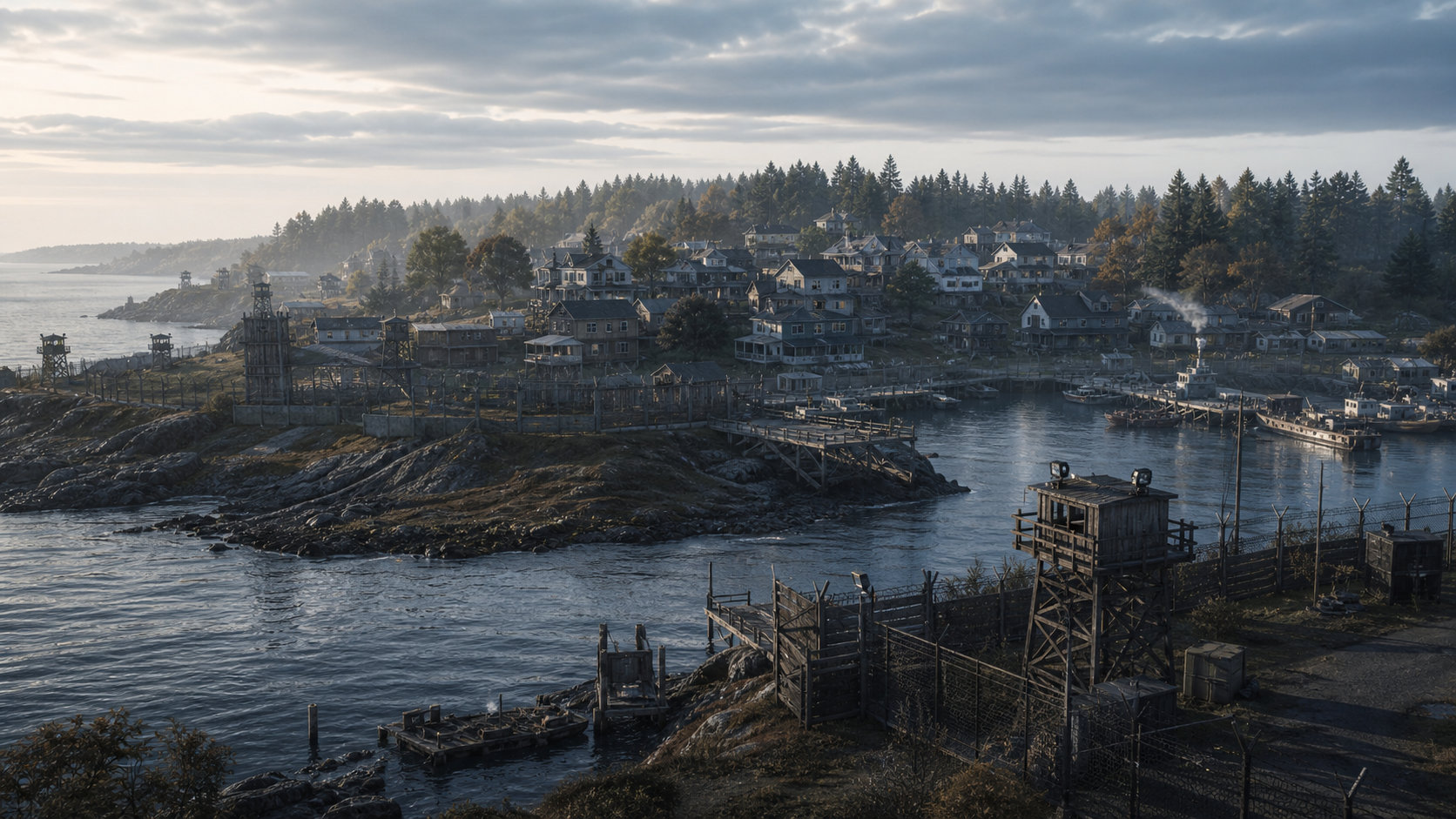
Safe Zone Territories are the post-Operation Extinction attempt to turn surviving territory into governed, defended, livable space. They represent Ringgold’s rebuilding strategy before the Allied States outpost system fully matures, and they become the target of Andrew Wood’s ROT terror campaign.
Quick Facts
- Role
- Lore and Worldbuilding
- Aliases
- safe-zone-territories, lore/safe-zone-territories, lore-safe-zone-territories
Overview
Safe Zone Territories are the first large-scale governmental answer to the immediate post-Extinction crisis. They are designed as fortified strongholds where survivors rescued from ruined cities can receive housing assignments, food, medical treatment, and protection. They represent the bridge between wartime survival and the later outpost system of the Allied States. The SZTs are ambitious. The government constructs more than seventy-five of them across the country, with at least one in each state. They are meant to hold the rescued population while juvenile Variants are cleared from major cities and while the government tries to reassemble national legitimacy. The SZT network is also unstable from the beginning. It is built in a country with shattered communications, exhausted soldiers, ruined transportation, starving civilians, and political factions waiting for advantage. In theory, the SZTs are sanctuaries. In practice, they become pressure vessels.
- Abbreviation: SZT
- Type: Early post-war survivor stronghold network
- Known scale: More than seventy-five strongholds, at least one in each state
- Core services: Housing assignments, food, medical treatment, evacuation intake, local security
- Key incidents: SZT 15, SZT 19, SZT 61, SZT 68, SZT 79
Purpose and administration
Each territory functions as a local civic unit under national authority. Survivors are evacuated to the nearest stronghold, processed, housed, fed, and treated. Mayors and local officials matter because they mediate between national command and local fear. The system depends on the idea that the federal government can still provide order after the collapse of the old world. Security measures are extensive, but they are imperfect. The government worries about remaining infected, juveniles, and people living outside the walls. The fact that the Hemorrhage Virus can appear in individual cases inside marked SZTs terrifies leadership because it means containment is not complete. The territories also depend on communications. When SZT 15 goes dark, the silence is itself an emergency. A territory that cannot speak may already be lost, and the government must decide whether to risk troops in a potentially compromised zone.
Notable territories
- SZT 15: The Chicago territory becomes one of the most important crisis points. It is tied personally to Ringgold because her cousin Emilia lives there, and it later becomes central to Andrew Wood's biological-terror strategy. - SZT 19: A Los Angeles territory whose street-level conditions show the brutal poverty of early safe-zone life, including bartering, limited power, rationing, malnourished civilians, and children wandering without adequate protection. - SZT 61: New Orleans declares sovereignty, becoming a symbol of the national fragmentation Ringgold fears. Its vulnerability also becomes part of the ROT missile and blame campaign. - SZT 68: Charlotte remains important as a loyalist rallying point during the ROT crisis, where Davis, Blade, and Beckham seek support. - SZT 79: Panama City is being cleared and prepared for construction, showing how the government creates new territories by destroying or sanitizing old city space.
Political fragmentation
The SZT system reveals that survival does not automatically create unity. New Orleans secedes, other territories threaten the same, and old political divisions return despite the near-extinction of the human race. Ringgold initially believes the war has created allies out of old enemies, but the SZT crisis proves that old-school politics survive catastrophe. The crisis worsens because the territories are dependent and resentful at the same time. They need food, medicine, military aid, and national coordination, but local leaders can also claim that Washington cannot protect them. This makes the SZTs vulnerable to ROT propaganda and false-flag manipulation. The political weakness of the SZTs foreshadows the later conscription debate. Communities that feel abandoned or attacked become more open to aggressive leaders, while leaders committed to measured reconstruction must defend patience in a population shaped by fear. ROT and the weaponization of trust The Resistance of Tyranny understands that the SZTs are not merely physical strongholds. They are symbols of Ringgold's promise. Wood attacks that promise by using the Hemorrhage Virus, misinformation, stolen ships, and compromised officials. His goal is not only to kill people, but to make survivors believe the government is either powerless or murderous. The attack on SZT 15 shows the human side of that strategy. Wood claims the territory was easier to compromise than Ringgold believed, and he describes manipulating officials and using hostages or threats to compel cooperation. The safe zone is defeated not by a frontal assault alone, but by coercion, betrayal, and fear. The SZT period is therefore one of the most politically dangerous in the canon. Variants threaten the body. ROT threatens the state. The SZTs sit between those forces and expose how hard it is to rebuild law when terror still works. Legacy The later outpost system is partly a correction of SZT weaknesses. It is more integrated with food production, rail, manufacturing, and local sustainability. It also appears to replace some of the emergency logic of the SZTs with a more durable civic structure. Even so, the SZTs remain important because they show the first attempt to restore ordinary life. Their failures do not make them meaningless. They define what the Allied States must learn: a strong wall is not enough without trust, logistics, honest leadership, and political resilience.
Chronological Role
SZTs matter most in Extinction Aftermath and Extinction War, where Wood infects and manipulates them to make Ringgold appear tyrannical. Safe territory is not truly safe if a mayor can be compromised, a vial can be smuggled in, or a stolen missile can restart the Hemorrhage Virus.
Key Scenes and Turning Points
- Safe Zone Territory 15 becomes the proof that a protected community can be infected through human betrayal.
- Mayor Kaylor’s compromise shows Wood attacking legitimacy through local leadership, not only missiles.
- Wood uses missiles and broadcasts to make Ringgold appear responsible for the devastation.
- The SZT crisis becomes the bridge between Operation Extinction victory and the later Allied States outpost system.
Why It Matters
They want to know what scene introduced it, which characters were changed by it, what later page it leads to, and why the detail is worth remembering.
Continue Exploring
Connected Universe
Books and Stories
Sources
- Extinction Aftermath: SZT 15, Mayor Kaylor, Emilia Ringgold, ROT broadcast.
- Extinction War: New Orleans/SZT 61 missile crisis and ROT propaganda.
- Dark Age: evolution from SZTs into the broader Allied States outpost system.