
Missions and Operations
Chicago ROT and Beckham-Flathman Survival Mission
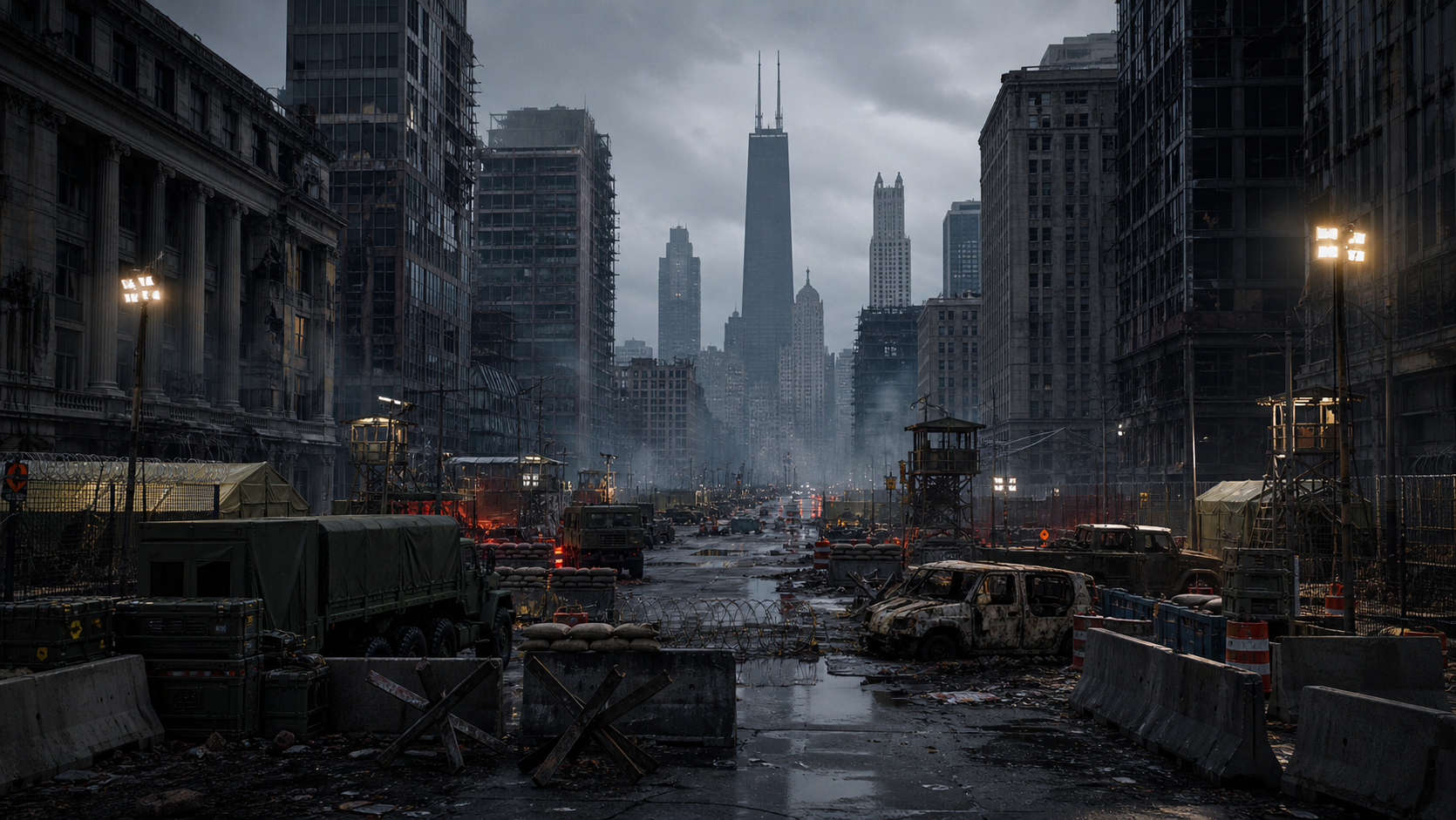
The Chicago ROT and Beckham-Flathman Survival Mission is an improvised urban escape and reconnaissance episode during the Resistance of Tyranny biological attacks in Extinction War. Reed Beckham and Lieutenant Jim "Ten Lives" Flathman become separated from organized support after being thrown from a Black Hawk over the Chicago area. Stranded above a city where Safe Zone Territory 15 has been destabilized by renewed Hemorrhage Virus infection, they must descend from a rooftop, read an environment occupied by several generations of enemy, and survive long enough to reconnect with the wider campaign against Andrew Wood.
Open the interactive Chicago ROT and Beckham-Flathman Survival Mission view
Quick Facts
- Role
- Missions and Operations
- Aliases
- chicago-rot-beckham-flathman-survival
Overview
The episode differs from a conventional mission because neither man begins with a stable objective, complete team, or functioning extraction plan. Their immediate task is survival. Observation then turns that survival into intelligence work. Birds, trees, rooflines, open blocks, and changes in sound become warning systems. Suppressed fire and controlled movement matter more than taking territory. Beckham's severe war injuries and damaged prosthetic equipment make every obstacle consequential, while Flathman's experience at Outpost 46 provides the practical continuity needed to keep two isolated veterans moving.
Chicago also gives the episode historical weight. The city was the first major American metropolitan center destroyed by the original outbreak. Its postwar reconstruction as Safe Zone Territory 15 promised that institutions had learned from that disaster. ROT's deliberate reinfection turns the same landscape into proof that a biological weapon can attack memory, confidence, and political legitimacy at once. Beckham and Flathman are therefore not only escaping monsters. They are moving through the collapse of a public promise.
Mission information
- Field: Event; Detail: Chicago ROT and Beckham-Flathman Survival Mission
- Field: Type; Detail: Improvised urban survival, reconnaissance, and escape
- Field: Era; Detail: Postwar ROT crisis, after reconstruction of Safe Zone Territory 15
- Field: Location; Detail: Chicago area and Safe Zone Territory 15, Illinois
- Field: Principal survivors; Detail: Reed Beckham; Lieutenant Jim "Ten Lives" Flathman
- Field: Initial condition; Detail: Separated from organized forces after being thrown from a Black Hawk
- Field: Primary adversaries; Detail: Newly infected civilians; surviving Variants; Alphas; juvenile remnants; ROT-created disorder
- Field: Principal antagonist behind the crisis; Detail: Andrew Wood and the Resistance of Tyranny
- Field: Civilian and political stakes; Detail: Population of Safe Zone Territory 15; Emilia; confidence in Jan Ringgold's government
- Field: Methods; Detail: Observation, rooftop and street movement, stealth, suppressed fire, mutual support, improvised route selection
- Field: Immediate objective; Detail: Survive, avoid encirclement, and regain contact with the broader loyalist response
- Field: Outcome; Detail: Beckham and Flathman endure the city crisis and reconnect their local struggle to the counter-ROT campaign
- Field: Primary work; Detail: Extinction War
Chicago's first collapse
Chicago enters Extinction Cycle history at the beginning of the original catastrophe. Jim Pinkman's hidden exposure in Building 8 follows him aboard Flight 193, and the aircraft reaches O'Hare International Airport after he transforms. Airport responders and medical personnel encounter a contagion that does not behave like the disease label available to them. The infected are fast, violent, physically altered, and capable of spreading the agent through direct exposure before ordinary epidemiological procedures can catch up.
Cases reach Northwestern Memorial Hospital, where the attempt to treat and isolate the first patients becomes another amplification point. A National Guard perimeter cannot contain a threat already moving through aviation, health care, roads, homes, and frightened crowds. Within the opening days, Chicago becomes both a ruined city and the national image of failed containment.
That earlier history changes the meaning of the later mission. Beckham and Flathman are not entering an anonymous abandoned metropolis. They are moving through a place whose name already signifies the moment the old United States understood that catastrophe had arrived. Every renewed infection carries the memory of that first failure.
Safe Zone Territory 15
After the first extinction war, surviving authorities do not immediately restore every former city. They consolidate population and resources into defensible settlements and territories. The Chicago region becomes associated with Safe Zone Territory 15, an organized community connected to the wider postwar government.
The safe-zone designation represents more than a wall. It implies screening, guarded access, food distribution, medical oversight, communications, and a relationship with national command. Residents have accepted rules and concentration of authority in exchange for protection from the conditions outside. Their daily lives demonstrate that the first catastrophe did not eliminate the possibility of civil society.
That arrangement also creates vulnerability. A safe territory depends on trusted officials, secure biological material, reliable warnings, and procedures that cannot be turned against the population. Mayor Kaylor's betrayal and ROT's biological campaign show how an authorized insider or human conspirator can bypass defenses built mainly to stop visible enemies at a perimeter.
Resistance of Tyranny biological warfare
Andrew Wood's Resistance of Tyranny attacks the postwar order through political accusation and deliberate violence. ROT presents centralized government as illegitimate while employing methods that make civilian self-government harder to preserve. Its use of the Hemorrhage Virus is the clearest contradiction. The faction claims to resist oppression, yet it turns protected civilians into weapons against their families and neighbors.
The Chicago attack is designed to produce more than casualties. It recreates the symptoms and panic of outbreak day inside a community whose reason for existing is protection from that event. A wall cannot reassure residents once the threat is already among them. National leaders cannot restore trust with a speech while people are transforming in streets and shelters. The biological strike therefore damages both bodies and the perceived competence of Jan Ringgold's administration.
Emilia's danger gives the crisis an additional personal dimension because of her connection to Ringgold. The president must respond to a mass attack while someone from her own family is at risk. ROT can use that connection to intensify pressure, but the wider emergency prevents Ringgold from treating one relative as the only life that matters.
Reed Beckham
Reed Beckham enters the Chicago crisis with a reputation built during the first extinction war. He helped lead Team Ghost through operations in laboratories, cities, tunnels, and Variant strongholds. By the postwar period, however, that history is written into his body. Severe injuries have left him dependent on prosthetic equipment, and the later Chicago ordeal damages that equipment further.
His condition changes the mechanics of urban survival. A curb, ladder, broken stairwell, roof gap, or hard landing can become a major problem even for a healthy operator. Beckham cannot assume that the artificial systems supporting his movement and grip will remain intact. When he loses the use of a prosthetic hand during the episode, the loss affects balance, weapon handling, climbing, and the ability to recover from a fall.
The injury does not remove him from command, but it prevents the story from treating veteran reputation as immunity. Beckham survives by accepting present limitations, adjusting technique, and relying on Flathman. His judgment remains valuable precisely because it is separated from the fantasy that experience makes a person physically invulnerable.
Jim "Ten Lives" Flathman
Jim Flathman brings a different history to the partnership. His nickname, "Ten Lives," reflects repeated survival rather than literal invincibility. Before the Chicago crisis, he commands at Outpost 46 near Deadwood and works closely with Staff Sergeant Bosse. That side continuity establishes him as a leader accustomed to failing defenses, ammunition pressure, uncertain communications, convoy problems, and Operation Liberty's urban ambitions.
Flathman's experience complements Beckham's. Beckham carries the strategic memory of Team Ghost and the original Variant war. Flathman understands how a smaller post can survive while the larger plan breaks around it. In Chicago, neither man has his customary team. They must create a temporary two-person command relationship from professional trust and immediate necessity.
The nickname gains thematic force because Chicago continually tests whether his remaining luck has run out. His survival is not passive fortune. It depends on observation, restraint, and the willingness to support an injured partner instead of pursuing an individual escape.
Separation from the Black Hawk
Beckham and Flathman are thrown from a Black Hawk and left behind in the Chicago danger zone. The separation strips the situation to essentials before either man can impose a conventional plan.
Air mobility normally allows a team to bypass infected streets and move between secure points. Once that advantage disappears, the city becomes a vertical maze. Roofs offer observation and temporary distance from street-level threats, but they can also become traps. Descending exposes the men to buildings whose rooms, stairwells, and exits have not been cleared. Remaining above leaves them visible and dependent on routes that may end at an impossible gap.
The loss also creates informational isolation. They cannot assume friendly forces know exactly where they landed, whether their radios will reach support, or whether an apparent movement below belongs to civilians, ROT fighters, or infected. The mission becomes improvised because the first requirement is to learn what survived the aircraft incident and what kind of city now surrounds them.
Rooftop assessment
The rooftop opening converts the city into an observation problem. Beckham and Flathman cannot afford to fire at every distant movement or descend into the first apparently quiet block. Noise can reveal their position, and a visible route can conceal threats inside buildings or under cover.
They use environmental behavior as a substitute for absent reconnaissance assets. Birds taking flight may reveal movement before a creature becomes visible. Disturbed branches can mark passage through overgrown lots. A sudden silence can be as important as a sound. Rooflines provide longer views, but they also expose how much of Chicago has become a mixture of human ruin and returning vegetation.
This method matters because the enemy is not uniform. A newly infected resident may behave differently from an old Variant that has spent years hunting in the ruins. An Alpha may direct or coordinate other creatures. Juvenile remnants can create threats distinct from full-grown forms. The men must identify patterns rather than rely on one set of outbreak-day rules.
Old and new enemies
ROT's attack overlays a new outbreak on top of an ecosystem formed after the first war. The result is more dangerous than either condition alone. Recently infected civilians bring unpredictability, emotional recognition, and fresh contagion into spaces already shaped by surviving Variant behavior.
Old Variants have had time to occupy structures and adapt to a less populated city. They know dark interiors, tunnels, roofs, and routes between cover. Alphas make that environment potentially coordinated rather than random. Juvenile remnants indicate that the biological enemy has continued to reproduce or persist through stages that human forces do not fully control.
Newly infected people carry a different moral burden. They may have been residents of a functioning safe territory only minutes earlier. Beckham and Flathman cannot treat their transformation as an ancient condition detached from politics. Each one is evidence that a human faction deliberately reopened the catastrophe.
Chicago as a changed ecosystem
The city is no longer only concrete and steel. Vegetation has reclaimed neglected ground, birds use abandoned structures, and open blocks can function like parts of a wildlife preserve. This natural recovery does not make the area peaceful. It creates cover, obscures old lines of sight, and supplies indirect evidence of approaching danger.
The environment also complicates maps. A route that existed before the outbreak may be blocked, exposed, or occupied. A building that once offered shelter may contain nests or structural damage. Streets designed for traffic can become killing lanes. Beckham and Flathman have to interpret the current landscape instead of moving through a remembered city.
Their attention to animal behavior shows the merger of military fieldcraft and post-apocalyptic ecology. Technology has failed or become unreliable, but the environment continues to react to movement. Survival depends on reading those reactions without assuming they explain everything.
Stealth and suppressed fire
The two men favor concealment and controlled engagement. Suppressed fire reduces the acoustic signature of necessary shots, but it does not make combat silent or consequence-free. Every engagement can still reveal direction, leave evidence, consume ammunition, and force movement.
Their objective is not to clear Chicago. That distinction disciplines every choice. Killing a visible creature may be unnecessary if it can be bypassed. Holding a building has little value if no relief force is coming. A route is useful only if both men can complete it and if it does not end in an exposed position.
This form of fighting reverses the logic of Operation Liberty, which attempted to impose large-scale control on cities. Beckham and Flathman survive by refusing the illusion that two veterans can dominate the urban environment. They observe, choose narrow objectives, and leave threats untouched when engagement would increase risk.
Loss of Beckham's prosthetic hand
Damage to Beckham's prosthetic hand is a decisive practical setback. A prosthesis is not an ornamental reminder of an old wound. It is part of the system through which he climbs, stabilizes equipment, manipulates doors, and protects himself during movement. Losing it in an already damaged city changes what routes remain possible.
Flathman must account for that change without turning Beckham into cargo. Beckham continues to contribute judgment and combat experience, while accepting help where the injury demands it. Their cooperation prevents pride from becoming another threat.
The moment also links the present conflict to the accumulated cost of the earlier war. ROT has not returned Beckham to the same starting point he occupied in 2015. It has forced an already injured survivor to pay again. His endurance is therefore not a restoration of an untouched hero but continuation by someone whose body records earlier victories.
Two-person command
Isolation removes the formal support that normally separates planning, security, navigation, medical response, and communications. Beckham and Flathman must divide attention between those tasks. One observes while the other moves. One covers while the other negotiates an obstacle. Each must be ready to challenge a dangerous assumption because there is no larger staff to catch an error.
Beckham's reputation does not erase Flathman's local command experience, and Flathman's nickname does not replace Beckham's strategic judgment. The relationship is practical rather than ceremonial.
That cooperation has wider meaning in the ROT conflict. Wood's movement depends on splitting survivors into rival claims of loyalty. Beckham and Flathman demonstrate a smaller alternative: authority can be shared through competence, trust, and responsibility for another person's survival.
Reconnection with the wider conflict
The Chicago episode remains linked to the larger loyalist struggle even while communications and geography isolate its protagonists. Every observation about new infection, surviving Variants, and urban conditions can help explain what ROT has created. Surviving long enough to report is therefore an operational contribution.
Reconnection also prevents the episode from becoming a private adventure detached from civilian suffering. Beckham and Flathman are trying to return to a response capable of helping others, exposing Wood, and defending Ringgold's government against a manufactured legitimacy crisis. Their escape preserves experienced leaders at a moment when the postwar order can afford few losses.
The exact value of their observations lies in context rather than a single discovered object. The city shows that ROT can combine preserved biological material, compromised local authority, and the terrain of old Variant occupation. Any counterattack that assumes only one of those threats will fail.
Failure of rear-area assumptions
Safe Zone Territory 15 is supposed to be protected space. The mission demonstrates that the category "safe" can describe policy and intention without guaranteeing physical reality. Once an insider or organized faction introduces infection, defenders face the same uncertainty as people outside the walls, but with denser population and stronger expectations of security.
Value of environmental observation
The episode makes surveillance a human skill rather than a piece of equipment. Birds, vegetation, sound, elevation, and the absence of ordinary activity form a warning network. None provides certainty alone. Together they allow isolated survivors to reduce surprise.
Limits of tactical reputation
Both men are experienced, but experience supplies judgment rather than protection from gravity, injury, contagion, or ambush. Beckham's damaged prosthesis and the loss of the helicopter emphasize that material conditions remain decisive. Their reputations matter because they know how to adapt, not because the story exempts them from risk.
Mixed-threat doctrine
Chicago contains biological, military, political, and ecological threats at the same time. A newly infected civilian may reveal ROT activity. An old Variant may exploit the confusion without serving ROT. A local official may possess legitimate access while acting as a collaborator. Loyal responders must distinguish these categories under pressure.
Political and ethical consequences
The crisis damages the moral claim behind ROT's name. Deliberately infecting civilians does not liberate them from central authority. It eliminates their agency and turns their bodies into attack vectors. Wood's strategy treats terror as evidence that the government cannot protect anyone, even though his own faction created the danger.
Ringgold's administration faces the opposite problem. It cannot rely on good intentions or earlier victory as proof of competence. If safe territories are vulnerable to preserved pathogens and insider betrayal, the government must improve biological custody, local oversight, redundant warnings, and evacuation planning without transforming every community into a prison.
Beckham and Flathman's survival gives the loyalist side witnesses whose credibility rests on direct exposure. Their account links the political conspiracy to physical consequences in Chicago. That link is important because ROT also fights through narrative. The faction benefits when each safe-zone failure appears isolated or naturally caused.
Narrative significance
The mission turns Chicago into a circular setting. The city that announced the original extinction event becomes the site where human extremists try to restart it. Reconstruction has changed the institutions around the virus, but it has not removed the temptation to use fear as political power.
Beckham embodies the long cost of that cycle. He returns as an older and severely injured survivor, carrying both skill and accumulated damage. Flathman connects the main narrative to the Outpost 46 branch, showing that leadership developed in a supporting story can become essential beside one of the central figures.
Their two-person journey also scales a national crisis down to bodily choices. They must decide when to move, when to wait, when to fire, and how to help one another across terrain that neither can control. Those decisions make the collapse of Safe Zone Territory 15 legible without reducing it to a casualty number.
Important connections
- Reed Beckham: Injured veteran whose strategic experience and prosthetic limitations shape the route through Chicago.
- Jim "Ten Lives" Flathman: Outpost 46 commander and Beckham's survival partner.
- Outpost 46: Flathman's earlier command environment and the principal side-continuity link.
- Chicago: Site of both the first major American metropolitan outbreak and the later ROT biological attack.
- Safe Zone Territory 15: Rebuilt Chicago-area community whose compromise turns reconstruction into a battlefield.
- Andrew Wood: ROT leader responsible for the wider biological and political campaign.
- Resistance of Tyranny: Human faction that weaponizes the Hemorrhage Virus and public distrust.
- Jan Ringgold: President whose government and family are pressured by the safe-zone attacks.
- Emilia: Ringgold's cousin and one of the personal stakes attached to the Chicago crisis.
- Mayor Kaylor: Local official associated with betrayal inside Safe Zone Territory 15.
- Operation Liberty: Earlier large-scale city campaign whose failures contrast with the pair's restrained survival methods.
- ROT infiltration of the USS George Washington: Parallel front in Wood's effort to seize military assets and legitimacy.
Chronology and consequences
- Extinction Horizon - Establishes Flight 193, O'Hare, Northwestern Memorial Hospital, and Chicago's original collapse.
- "Outpost 46: Deadwood" in Missions from the Extinction Cycle, Volume 2 - Establishes Flathman's command style, Outpost 46, and the Operation Liberty connection.
- Extinction Aftermath - Develops the postwar government, safe territories, ROT, and the conditions leading to renewed conflict.
- Extinction War - Contains the ROT biological campaign, Safe Zone Territory 15 crisis, and Beckham-Flathman survival episode.
- Dark Age sequence - Inherits the political, frontier, and security consequences of compromised safe zones.
Continue Exploring
Connected Universe
Books and Stories
Characters
Locations, Events, and Lore
Sources
- Extinction War, Extinction War - Prologue
- Extinction War, Extinction War - Chapter 1