
Politics and Society
Government After the Extinction War
Open the interactive Government After the Extinction War view
Quick Facts
- Role
- Politics and Society
Overview
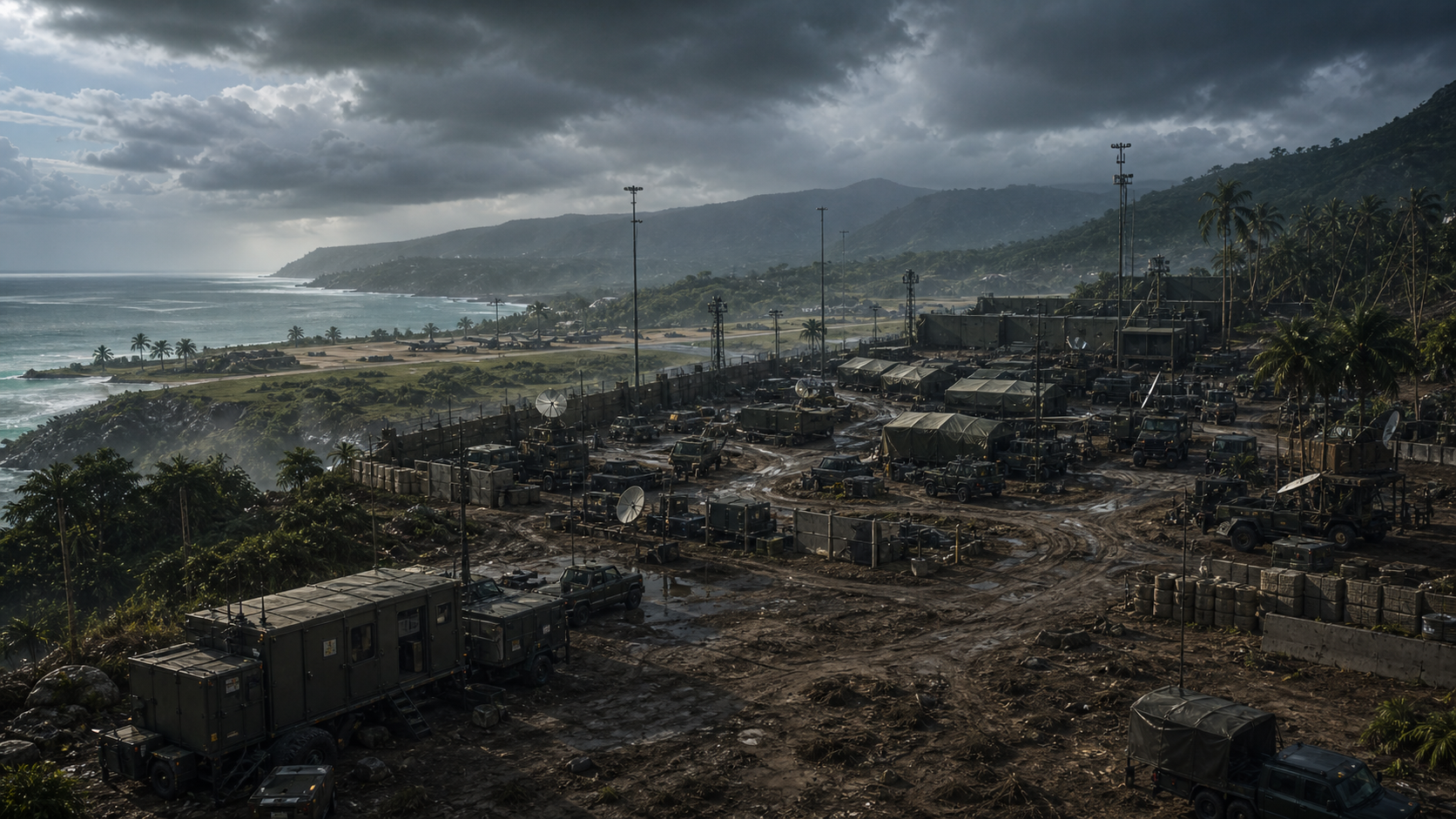
Government after the Extinction War refers to the surviving national and regional institutions that develop from Jan Ringgold's emergency presidency into the Allied States during the postwar and Dark Age periods of the Extinction Cycle. The system retains recognizable offices such as the presidency, vice presidency, cabinet, military command, elections, local administrations, and protected continuity facilities. It operates across a radically changed country in which most major cities are abandoned, population is concentrated in fortified outposts and Safe Zone Territories, transport corridors require armed defense, and military logistics often exceed civilian administrative capacity.
The government's central problem is not simply survival. It must convert emergency authority into legitimate rule without losing the ability to respond to Variants, collaborators, separatists, and biological attacks. Ringgold builds a collaborative model around civilian responsibility, George Johnson's Central Command, scientific expertise, local outposts, and symbolic national continuity. The model survives the first postwar crises but remains vulnerable to compromised mayors, ROT propaganda, secession pressure, the Freedom Party's militarized alternative, and Azrael's New Gods. Ringgold and Vice President Dan Lemke die during the Dark Age conflict, disrupting ordinary succession and pushing Reed Beckham and Mark Cornelius toward a possible unity arrangement.
Government information
- Field: Successor polity; Detail: Allied States
- Field: Foundational leader; Detail: President Jan Ringgold
- Field: Principal military leader; Detail: George Johnson, head of Central Command
- Field: Continuity candidate; Detail: Vice President Dan Lemke
- Field: Major opposition leader; Detail: Retired General Mark Cornelius of the Freedom Party
- Field: Later unifying figure; Detail: Reed Beckham
- Field: Administrative geography; Detail: Fortified outposts, Safe Zone Territories, surviving regional settlements, defended routes, and national command sites
- Field: National institutions; Detail: Presidency, vice presidency, cabinet, Central Command, intelligence and scientific offices, elections, continuity bunkers, and local administrations
- Field: Major facilities and symbols; Detail: PEOC, Greenbrier continuity center, Plum Island, outpost headquarters, national ceremonies, flags, memorials, and later namesakes such as the USS Jan Ringgold
- Field: Principal internal threats; Detail: ROT, compromised officials, secession, military overreach, private armed power, propaganda, and biological infiltration
- Field: Principal external threats; Detail: Surviving Variants, New Gods, Scions, Chimeras, webbing networks, raiders, and hostile frontier zones
- Field: Political parties; Detail: New America Coalition and Freedom Party
- Field: Primary works; Detail: Extinction End, Extinction War, and the Dark Age sequence
From emergency continuity to a state
The pre-outbreak United States government does not survive intact. Elected officials, agencies, courts, bases, records, and communications are destroyed or isolated. Secret military programs also discredit portions of the surviving command. VX-99, Building 8, Colonel Gibson, General Kennor, and Colonel Zach Wood demonstrate that institutional survival alone does not guarantee lawful or humane government.
Ringgold's legitimacy develops through continuity of office and conduct under crisis. As senior leadership disappears, she assumes executive responsibility and refuses to let hidden military officers define the national interest without civilian judgment. Her administration inherits bunkers, military networks, scientists, and emergency authorities built by people she may not trust. It must use those assets while correcting the culture that created the catastrophe.
The end of the first Variant war does not restore old borders or population distribution. The government can claim national continuity, but it cannot administer every county or city. Its practical territory consists of places it can communicate with, supply, defend, and persuade to remain within the common system. The later name Allied States reflects this negotiated geography: a union of surviving regions and outposts rather than an unchanged continental state.
Civilian responsibility
Ringgold treats civilian authority as responsibility rather than ceremonial superiority. She delegates operations to qualified commanders but retains the duty to set ethical and political boundaries. When a military plan could kill civilians, abandon allies, or concentrate unreviewed power, the decision cannot be hidden inside technical language.
This approach is shaped by direct experience with command failure. Kennor uses strategic necessity to justify catastrophic operations. Wood seeks to control Kryptonite and decide which parts of the world receive protection. Ringgold's government cannot promise that every decision will be correct, but it can reject the idea that secrecy automatically makes a decision legitimate.
Hope as an operational resource
Ringgold repeatedly treats hope as a condition of organized survival. Refugees who believe every institution is predatory will not share food, accept quarantine, or send children to common schools. Soldiers who believe the state values only their combat use will not remain loyal. Communities that see no future beyond walls will fragment into private defenses.
Symbols therefore have practical value. Flags, medals, memorials, ceremonies, restored government buildings, Plum Island's scientific recovery, and the later USS Jan Ringgold tell survivors that sacrifice belongs to a continuing civic story. The symbols work only when matched by food, security, and fair authority. Otherwise they become propaganda.
Collaboration with expertise
The administration depends on people who know more than the president in their domains. Johnson directs military operations. Kate Lovato Beckham and other scientists interpret biological threats. Engineers, pilots, physicians, farmers, intelligence personnel, and local administrators maintain systems that executive orders cannot replace.
Ringgold's role is to connect those experts and resolve conflicts among their priorities. Government exists in the negotiation among those needs.
Military-civilian balance
The Allied States depends on armed force more heavily than the old civilian state. Military aircraft move officials and medicine. Soldiers defend farms and reactors, clear roads, escort convoys, and maintain communications. Central Command holds information that no local mayor can gather alone.
George Johnson represents the strongest version of military service within civilian limits. He coordinates large operations and understands that delay can kill people, but his authority operates within Ringgold's political framework. Their relationship is a correction to the Kennor and Wood eras, when officers converted emergency information into unilateral control.
The balance remains fragile because logistics create political power. A commander who controls helicopters, fuel, ammunition, and trained troops can pressure settlements without formally abolishing civilian office. Cornelius's Galveston network later demonstrates that a regional leader with contractors, aircraft, vehicles, and petroleum access can become a national political actor.
Good postwar government therefore needs soldiers such as Beckham and Johnson while maintaining the right to question them. Beckham's value comes partly from refusing unlawful or strategically reckless assumptions, not from obeying every order without judgment.
Outposts
Outposts concentrate population behind barriers that can be defended and supplied. They include residences, farms, clinics, workshops, armories, schools, communication systems, and local leadership. Their layouts reflect the continuing threat: gates, mines, dogs, patrols, sensors, drills, and fallback positions are part of ordinary civic life.
The outpost system solves a scale problem. A reduced national government cannot protect widely scattered households across the former country. Concentration allows scarce doctors, machinery, power, and guards to serve more people. It also makes a successful breach catastrophic because an attacker reaches much of a region's population at once.
Safe Zone Territories
Safe Zone Territories extend the model into larger governed areas with local officials and links to national command. They provide a level between one settlement and the Allied States. Local leaders can adapt food, policing, and defense to regional conditions while receiving supplies and intelligence from the center.
The system depends on trust. Mayor Kaylor's betrayal at SZT 15 shows that one compromised official can expose a stronghold from within. Walls designed against external creatures do not stop an authorized person from manipulating access, information, or readiness.
Frontier and independent settlements
Large parts of the former United States remain outside routine government control. Some contain Variants or raiders; others contain independent families and communities that survived without national help. The Allied States must decide whether relationship with those groups is voluntary alliance, incorporation, military occupation, or abandonment.
The Freedom Party's reclamation platform sharpens this question. A national map may label territory lost, but people living there may not regard themselves as subjects awaiting recovery. Lawful expansion requires more than clearing hostile creatures.
Law and emergency power
The postwar record shows recognizable elections and offices but does not provide a complete constitutional settlement. It is not established which prewar statutes remain enforceable, how courts operate across all territories, or how emergency orders are reviewed. Government combines inherited forms with practical adaptations.
Quarantine, conscription, relocation, weapons control, and biological research create the hardest legal issues. Each can be necessary under some conditions and abusive under others. The first war proves that officials can call an experiment national security while hiding catastrophic risk. The later state therefore needs transparency and oversight precisely when rapid action is most tempting.
Local autonomy complicates enforcement. An outpost may follow national defense protocols while using its own rationing and civic rules. Too much central control can provoke secession; too little can allow collaborators or corrupt mayors to convert public resources into private power.
Reconstruction economy and public services
Government cannot survive as an armed command attached to bunkers. It must help produce food, repair power, reopen transport, educate children, treat injuries, preserve records, and create work that is not purely military. Outposts require seeds, livestock, water systems, machine parts, and technical knowledge as urgently as ammunition.
Defended corridors and ships reconnect regional economies. Fuel remains strategically valuable because it powers aircraft, generators, farm equipment, and convoys. Scientific facilities such as Plum Island require specialized supplies that ordinary settlements cannot manufacture. National coordination is useful when it moves these scarce resources according to public need rather than factional loyalty.
The population is the scarcest resource. A trained physician, pilot, mechanic, or farmer may be impossible to replace. That reality supports rescue missions and careful manpower policy, but it can also encourage government to treat people as assets whose movement and labor are controlled. Reconstruction legitimacy depends on preserving personhood inside resource planning.
Parties and elections
Dark Age introduces a formal contest between the New America Coalition and the Freedom Party. The Coalition is associated with Ringgold's record, Lemke's candidacy, gradual reconstruction, targeted operations, and caution about frontier war. The Freedom Party under Cornelius advocates conscription, a larger force, and aggressive reclamation or destruction of hostile cities.
The election demonstrates recovery. Citizens can argue over policy rather than accept a single emergency ruler indefinitely. It also demonstrates vulnerability. Fear after an outpost attack can move polls quickly, and command of armed personnel gives some political figures power beyond speeches or votes.
Cornelius leads Lemke in polling during the pre-crisis period. His support is not evidence that the public rejects democracy. Many voters believe the existing government has failed to finish the war. The Coalition must defend patience when every frontier death can be shown as the price of delay.
ROT and the attack on legitimacy
The Resistance of Tyranny under Andrew Wood understands that the government's most important asset is trust. ROT weaponizes the Hemorrhage Virus against safe zones and attempts to frame Ringgold for attacks. The objective is not only casualties. It is to make communities believe the president has betrayed them.
If successful, the operation would cause local leaders to close routes, reject national medicine, withhold troops, or secede. A biological strike becomes a constitutional weapon. The government must defeat the perpetrators while proving its own innocence to people who have reason to fear secret programs.
Ringgold's response shows why legitimacy cannot be created by force alone. Soldiers can arrest or kill ROT members, but only evidence, conduct, and continued service can restore confidence. The crisis also warns that political language about tyranny can be used by an organization practicing coercion and mass murder.
Secession and regional power
The Allied States is an alliance under pressure, not a territory whose unity can be assumed. Regions controlling food, fuel, ports, or armed forces can threaten departure if national policy conflicts with local interests. The government must distinguish legitimate bargaining from actions that expose other communities to attack.
Cornelius's Galveston base illustrates both danger and value. His private and regional capacity can compete with Central Command, yet the same capacity becomes essential when the New Gods attack. A durable state must integrate powerful regions without pretending they have no leverage and without allowing them to become independent armies answerable only to one leader.
New Gods crisis
Azrael challenges government more fundamentally than ROT. He does not merely claim Ringgold is corrupt or ineffective. His ideology claims ordinary humanity is obsolete and that transformation into the New Gods is the only meaningful future. Captivity, webbing, biological hierarchy, and conversion become alternatives to citizenship.
Outpost attacks reveal that the enemy has used the recovery period to organize underground and within abandoned territory. The crisis validates demands for stronger security while exposing the limits of conventional mobilization. Scientists must interpret the webbing network, elite teams must reach specific nodes, and local defenders must hold walls against specialized creatures.
Ringgold's refusal of Azrael is a defense of human political equality against biological caste. The government's value is not that it can promise immortality or superior bodies. It is that people remain persons rather than material assigned to a prophet's hierarchy.
Succession crisis and coalition future
Ringgold's death removes the figure who held civilian, military, scientific, and symbolic networks together. Lemke's execution destroys the expected electoral succession. The government cannot simply announce that ordinary constitutional sequence has continued unchanged.
Cornelius survives the Galveston conflict and has demonstrated both political ambition and willingness to fight beside national forces. Reed Beckham emerges as a possible public leader able to connect veterans, scientists, families, outposts, and Ringgold's moral legacy. Their proposed or developing alignment suggests a unity response to the broken succession.
The arrangement is not proof that the Freedom Party platform wins intact. Reed's experience with Operation Liberty makes him wary of mass force without intelligence, while Cornelius's experience with hidden enemies makes permanent retreat unacceptable. A coalition would have to combine security with the civilian legitimacy Ringgold defended.
Governmental legacy
The postwar government succeeds in preserving more than a chain of command. It rebuilds enough normal life for elections, families, schools, scientific work, and policy disagreement to exist. Its failures show that institutions remain penetrable and that emergency power can return in new forms.
Ringgold's greatest legacy is a standard rather than an unbroken institution: leaders must accept responsibility, share authority with expertise, preserve human dignity, and understand hope as part of security. The Allied States after her death must decide whether that standard can survive without the person who embodied it.
Important connections
- Jan Ringgold: Emergency president and foundational Allied States leader.
- George Johnson: Central Command figure maintaining military capability under civilian government.
- Dan Lemke: Vice president and Coalition candidate whose death breaks the expected succession.
- Mark Cornelius: Freedom Party leader and Galveston power broker who becomes a necessary wartime ally.
- Reed Beckham: Veteran and possible unifying political figure after the Dark Age crisis.
- Kate Lovato Beckham: Scientific authority whose work demonstrates the need for expert independence and oversight.
- Outposts and Safe Zone Territories: Distributed administrative and defensive basis of the state.
- ROT: Human extremist movement that attacks both bodies and political legitimacy.
- Azrael and the New Gods: Rival biological order challenging the premise of human government.
- New America Coalition and Freedom Party: Electoral expressions of gradual reconstruction and aggressive reclamation.
Chronology and consequences
- Extinction End - End of the first extinction war, consolidation of Ringgold's leadership, and foundations for recovery.
- Extinction War - Safe-zone government, ROT biological terror, regional trust, military-civilian cooperation, and reconstruction pressures.
- Extinction Shadow - Allied States introduction, mature outpost era, election, Lemke-Cornelius contest, and return of organized threat.
- Extinction Inferno, Extinction Ashes, and Extinction Darkness - New Gods war, Galveston, deaths of Ringgold and Lemke, and transition toward a Reed-Cornelius unity future.
- Extinction Aftermath and connected postwar stories - Additional context for reconstruction institutions and the memory of first-war decisions.
Continue Exploring
Connected Universe
Books and Stories
Locations, Events, and Lore
Sources
- Extinction End
- Extinction End, Chapter 1, Kate prisoner sequence
- Extinction End, Ringgold infirmary and Plum Island report sequence
- Extinction War
- Extinction War, Prologue, Chicago rooftop sequence
- Extinction War, ROT and safe-zone infection arc
- Extinction Cycle: Dark Age Box Set, Dark Age box set