
Missions
Team Ghost's Greatest Missions Ranked: From Building 8 to the Dark Age War
A spoiler-heavy ranking of Team Ghost's greatest Extinction Cycle missions, including Building 8, New York, Raven Rock, Greenland, Europe and the Dark Age war.
·
Category: Missions
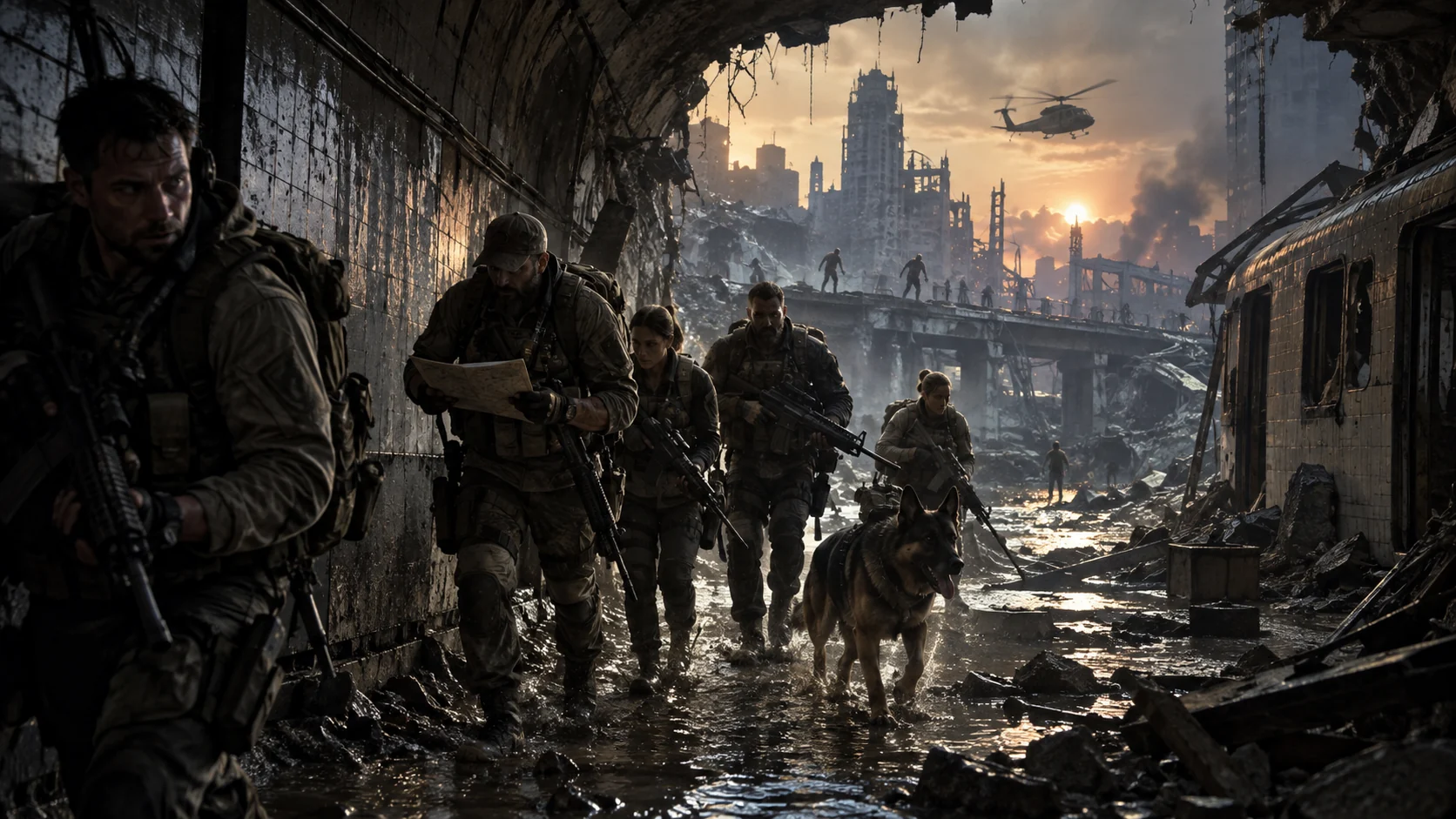
Team Ghost survives by adapting faster than the intelligence available to it, not by relying on one fixed doctrine.
There are easier ways to measure Team Ghost than counting successful operations.
Count the names that disappear from the roster.
Count how many times Reed Beckham receives incomplete intelligence.
Count the missions that begin with one objective and end with the team trying to escape a city, bunker, laboratory or Variant nest that no planner fully understood.
Team Ghost is the military spine of the Extinction Cycle because the unit keeps being sent where ordinary doctrine stops working. Building 8 is not simply another black operation. New York is not a normal urban fight. Raven Rock is not a routine supply mission. Greenland is not just a demolition raid. The Dark Age campaigns are not simply counterinsurgency.
Each mission forces Ghost to relearn what the enemy is.
This ranking looks at the greatest Team Ghost missions across the main novels, Extinction Lost and the Dark Age continuation. "Greatest" does not mean cleanest or most successful. It means the operations that best define the unit through tactical difficulty, strategic importance, sacrifice and lasting consequences.
Ranking criteria
Each mission receives weight in five areas:
- Mission difficulty: terrain, intelligence gaps, enemy strength and logistics.
- Strategic impact: what changes if Ghost succeeds or fails.
- Cost: casualties, injuries and consequences for the team.
- Character impact: how the operation changes Reed, Fitz, Horn, Chow, Riley, Rico, Dohi or later members.
- Series importance: whether the mission changes the direction of the larger Extinction Cycle.
Quick ranking
| Rank | Mission | Era | Why it matters |
|---|---|---|---|
| 12 | Extraction of the Atlanta scientists | Early outbreak | Brings Kate Lovato and Michael Allen deeper into the military survival effort |
| 11 | Plum Island defense and recon operations | Extinction Age era | Turns a refuge into an offensive base and tests trust inside command |
| 10 | The Jinx recovery in New York | Extinction Age | Shows Ghost's loyalty and the Variants' evolving pack tactics |
| 9 | Raven Rock supply mission | Extinction Age | Classic high-risk logistics raid with strategic survival value |
| 8 | The New York tunnel escape | Extinction Age | Forces Ghost to survive with almost no ammunition while Variants hunt them underground |
| 7 | The juvenile specimen campaign | Extinction End era | Links field operations directly to Kate's race to understand a new Variant generation |
| 6 | Greenland bioweapon mission | Extinction Lost | Exhausted Ghost enters an isolated secret facility against an unknown Variant threat |
| 5 | European reconnaissance and France campaign | Extinction Aftermath / Lost era | Expands the war beyond America and provides intelligence for the next stage of operations |
| 4 | Chicago and Extinction War | Extinction War | Reed fights through a city, human enemies and renewed infection while physically devastated |
| 3 | Eight years of postwar Variant hunting | Between War and Dark Age | Turns Ghost from crisis unit into the Allied States' permanent frontier force |
| 2 | Investigation of the vanished outposts | Extinction Shadow | Discovers the enemy the Allied States did not know existed |
| 1 | The war against Azrael and the New Gods | Dark Age | Ghost helps prevent an engineered rival civilization from replacing humanity |
12. Extracting the scientists from Atlanta
The Atlanta phase is easy to overlook because the franchise quickly escalates into larger military operations, but it represents the moment when the soldier and science storylines become inseparable.
Kate Lovato and Michael Allen are trying to understand an outbreak whose biology is changing faster than public-health systems can respond. Team Ghost brings the direct combat experience that the laboratory teams lack.
The mission's tactical challenge is familiar in outline: enter a compromised facility, locate survivors and extract them.
The enemy changes everything.
Ghost is operating without the comfort of understanding the pathogen. Protective assumptions are already failing. Infected people move with speed that trained soldiers do not expect. Every close encounter risks exposure.
The strategic result is enormous because Kate becomes one of the central figures in humanity's scientific response.
This mission ranks last only because later operations become more complex. In terms of long-term consequences, saving the scientists may be one of the most valuable things Team Ghost ever does.
11. Plum Island defense and reconnaissance
Plum Island begins as refuge and becomes a war base.
That transition is essential to Team Ghost's evolution.
A safe zone that only waits behind walls will eventually run out of ammunition, food, medicine or luck. Lieutenant Colonel Jensen recognizes that the survivors have to move from defense toward active reconnaissance and salvage.
For Reed, the missions around Plum Island are also political.
Colonel Wood does not trust Ghost. Reed does not trust Wood. Command decisions are filtered through old secrets connected to Building 8 and VX-99.
The result is a perfect Extinction Cycle problem: the enemy outside the fence is dangerous, but incomplete information inside the fence can be just as dangerous.
Ghost learns to operate in a world where mission planning includes evaluating whether the people issuing orders are telling the truth.
That lesson shapes Reed for the rest of the series.
10. The Jinx recovery in New York
This is not a strategic success story.
It is one of the clearest demonstrations of what Team Ghost believes it owes its own people.
Variants seize Jinx and drag him away through the ruined streets. Reed immediately pursues.
From a strictly tactical perspective, the decision is dangerous.
Beckham knows the team is exhausted, low on ammunition and surrounded by a growing horde. He also knows that opening fire draws more Variants into the fight.
But leaving Jinx is almost impossible for Ghost psychologically.
The Variants seem to understand that instinct. They isolate a member and force the team deeper into the kill zone.
Ryan kills the creatures dragging Jinx, and Ghost reaches him, but the operator's neck wound is fatal.
Why rank a failed rescue among the team's greatest missions?
Because it defines the cost of loyalty.
Ghost's strength is that every member believes the others will come back for him.
The same strength can be exploited by an intelligent predator.
9. Raven Rock supply mission
Raven Rock is a reminder that apocalypse warfare is often about supplies rather than glory.
Plum Island is running low on food, ammunition and medicine. The survivors need cancer drugs and other critical material. A FEMA stockpile near the Raven Rock complex offers a possible solution.
The mission is dangerous precisely because it sounds practical.
There is no world-saving device at the end of the route.
There are stockpiles.
That is what makes the operation important.
A military force without medicine and ammunition is temporary. A safe zone without food is a countdown.
Ghost flies into an area that reconnaissance suggests may be relatively quiet, but quiet territory in Extinction Cycle is never reassuring. Abandoned installations can conceal Variants, human threats or both.
The mission illustrates a central truth of collapse: strategic survival depends on logistics.
The team can win every firefight and still lose the war if the warehouse is empty.
8. The New York tunnel escape
The tunnels beneath Manhattan strip Team Ghost down to the fundamentals.
Reed Beckham is injured. The team is low on ammunition. Variants are tracking them underground while firebombing shakes the city above.
There is no elegant plan.
There is movement.
Beckham leads the survivors through sewers and storm drains while the Variants test distance, follow through darkness and exploit the enclosed terrain. Grenades, smoke and sidearms become precious because there is no resupply and no easy extraction.
The mission is one of the best demonstrations of Reed's command style.
He does not need a perfect plan to lead.
He needs to keep generating the next survivable decision.
The tunnel escape also highlights the Variant advantage. Underground, helicopters and heavy weapons mean almost nothing. The enemy's enhanced senses and climbing ability become more important than human technology.
Ghost survives because discipline remains when equipment fails.
7. The juvenile specimen campaign
By the later original books, the Variants have changed enough that yesterday's countermeasures are no longer sufficient.
Juveniles represent a new generation with armor and physical traits that make them harder to kill. Kate and the scientific teams need specimens and biological data.
That means soldiers have to go where the science is.
This is one of the most distinctive features of Extinction Cycle warfare. Field operations and laboratory research form a loop.
Scientists identify a question.
Ghost or another strike team retrieves the evidence.
Scientists build a countermeasure.
The enemy changes.
The cycle begins again.
A specimen mission can therefore matter more than destroying a thousand Variants because the information gained may change every future battle.
Ghost's ability to operate as the physical extension of Kate's research effort is one of the reasons humanity survives.
6. The Greenland mission in Extinction Lost
Extinction Lost gives Team Ghost one of its most atmospheric missions.
The unit has barely returned from France before being rerouted toward Greenland. Fitz and the others are exhausted and injured. Instead of rest, they receive another classified objective involving an old Nazi facility later repurposed by the surviving government as a laboratory.
The mission contains every ingredient that makes Ghost stories work:
- terrible weather
- incomplete intelligence
- an isolated target
- a secret laboratory
- a bioweapon that may not be behaving as expected
- rumors that sound absurd until the team reaches the objective
Fitz leads Ghost with Rico, Stevenson, Tanaka and Dohi while Apollo remains part of the unit's legend.
Their orders are not simply to investigate.
They must infiltrate the facility, deal with whatever is inside and destroy the weapon and the base.
The strategic stakes are smaller than the final war, but the mission perfectly captures the franchise's tone: military competence entering biological horror with almost no margin for error.
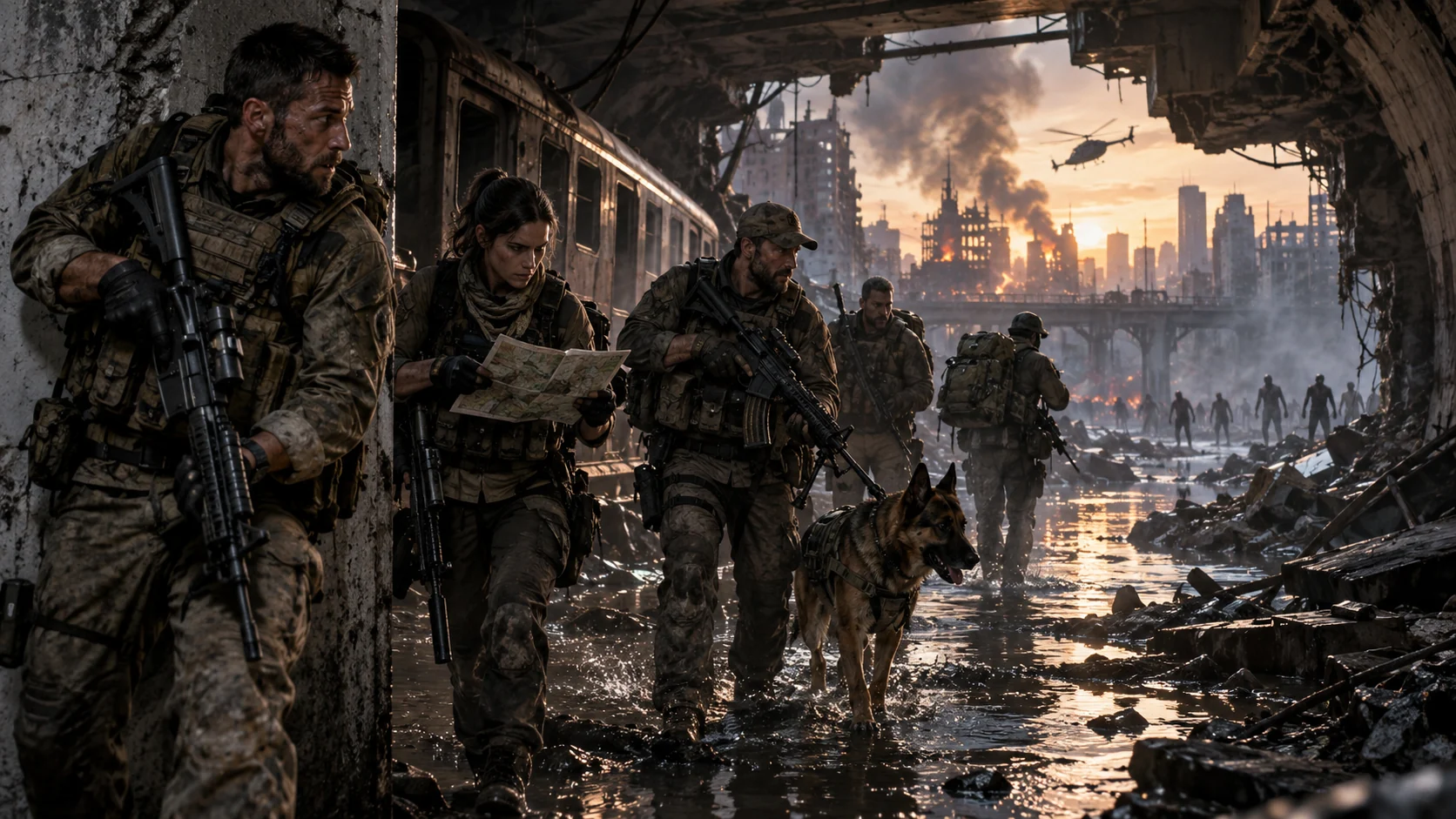
Team Ghost repeatedly shifts from laboratories and tunnels to cities, wilderness and international combat zones.
5. European reconnaissance and the France campaign
The war becomes global long before the characters can emotionally process what happened at home.
European operations force Team Ghost to function inside a broader coalition and against Variant populations that have evolved under different conditions.
The France mission becomes particularly important because Ghost gathers intelligence needed for Operation Reach and the next stage of the war.
By the time Fitz's team is sent to Greenland in Extinction Lost, the operators have been back from France only about twenty hours.
That detail captures the operational tempo.
There is no reset between books for the people inside the story.
They finish one mission carrying injuries and sleep deprivation directly into the next.
The European campaign also changes the scale of the Extinction Cycle. The Hemorrhage Virus is not an American disaster with foreign footnotes.
Cities, militaries and governments across the world are fighting their own versions of the same evolutionary war.
Team Ghost becomes one of the few units capable of moving between those theaters and bringing knowledge back.
4. Chicago and the Extinction War
By Extinction War, Reed Beckham barely resembles the physically intact operator who entered Building 8.
He has lost part of an arm and leg. He is battered, infected by grief and still moving through hostile territory.
Chicago brings together almost every threat the franchise has developed:
- surviving Variants
- newly infected humans
- hostile political forces
- shattered infrastructure
- uncertainty about Kate and other loved ones
- Reed's own severe injuries
The Resistance of Tyranny has restarted infection in safe-zone territory, proving that biological weapons remain useful to humans even after the original apocalypse.
That is what elevates Chicago above earlier city fights.
Team Ghost is no longer fighting only an outbreak.
It is fighting people who have learned how to use the outbreak as strategy.
The distinction points directly toward Dark Age, where Azrael takes the same concept even further.
3. Eight years of postwar Variant hunting
This "mission" is actually a campaign made of dozens of missions the reader does not see in full.
That is why it ranks so high.
The Dark Age recap explains that Team Ghost spends the eight years after Extinction War hunting surviving Variants and rescuing human prisoners from enemy territory.
Think about what that means.
The Great War ends, but Ghost does not.
The unit becomes a permanent instrument of the Allied States.
Its job shifts from preventing immediate extinction to making reconstruction possible.
Every rescued prisoner adds population to a civilization where people are the rarest strategic resource.
Every destroyed Variant nest makes a road or region safer.
Every mission produces intelligence about how the remaining creatures are changing.
Fitz's leadership during this period matters because he turns Ghost from Reed Beckham's wartime team into an institution that can outlive any one commander.
That may be the unit's greatest achievement.
2. Investigating the vanished outposts in Extinction Shadow
Dark Age begins by breaking the assumption that the Allied States understands its enemy.
A settlement with hundreds of people is attacked or emptied under circumstances that do not match the military's expectations.
A SEAL team has already investigated and failed to explain what happened.
Team Ghost arrives with Fitz, Rico, Dohi and newer operators.
The evidence is wrong for ordinary raiders.
It is wrong for starving Variants.
The attackers are more sophisticated.
That investigation becomes strategically enormous because the problem is not one missing community.
It is the discovery of a hidden enemy network.
Red biological webbing, tunnels and coordinated attacks suggest communication and planning on a scale the Allied States did not know existed.
Ghost's mission changes from searching for survivors to diagnosing a national-security threat.
This is reconnaissance at its most important.
They are not trying to win a battle.
They are trying to understand which war has already begun.
1. The war against Azrael and the New Gods
No Team Ghost mission is more important because no enemy asks a larger question.
Azrael does not merely want to kill survivors.
He wants to replace ordinary humanity with his engineered New Gods.
His forces include Scions capable of using rifles, human collaborators, trainable Thralls and elite Chimeras. He understands military systems, technology and political power.
That makes the Dark Age endgame fundamentally different from Building 8.
At Building 8, Ghost enters a secret created by humans and discovers monsters.
In Dark Age, Ghost enters a war created by monsters who understand humans.
Fitz, Reed, Horn, Kate and their allies fight not simply for territory but for the right to determine what post-apocalyptic civilization will become.
The final victory allows the Allied States to continue rebuilding. The later christening of the USS Jan Ringgold confirms that the result is larger than one battlefield.
The country still has a future.
That makes the New Gods campaign Team Ghost's greatest mission.
What makes Building 8 the most important mission anyway?
It may rank outside the top five in tactical success, but Building 8 is the mission without which the rest of the list does not exist.
Ghost is sent to San Nicolas Island to retrieve a sample from Dr. Medford's research.
The facility officially does not exist.
Reed's team receives a classified briefing while already in transit. The CDC's Pat Ellis accompanies them. The operators are told they are entering a Level 4 biological environment but do not know the real history of VX-99.
The objective sounds simple: enter, retrieve the research and leave.
Instead, Ghost walks into the origin point of the apocalypse.
Panda, Tenor and Edwards are killed. Reed's trust in command is permanently damaged. The team learns the enemy's speed and brutality before most of the country understands what a Variant is.
Building 8 is not Team Ghost's greatest victory.
It is Team Ghost's creation myth.
Reed Beckham versus Fitz as Team Ghost commanders
The missions also reveal how the unit changes under different leaders.
Reed Beckham
Reed leads through instinct, responsibility and refusal to abandon people. His strength is rapid judgment under incomplete intelligence. His weakness is that loyalty can pull him into risks, as the Jinx pursuit demonstrates.
Joe Fitzpatrick
Fitz inherits a unit with mythology already attached to it. His challenge is different. He has to preserve standards while incorporating new operators and maintaining missions across years rather than weeks.
Dark Age shows Fitz thinking not only about the current team but about the dead who came before it.
Reed builds Ghost's wartime identity.
Fitz turns it into an institution.
The Team Ghost mission formula
The best Ghost operations usually contain the same structure:
Incomplete intelligence
Command never knows enough.
A scientific unknown
The enemy has changed or the biological objective is uncertain.
Geographic confinement
Labs, tunnels, islands, bunkers and ruined cities prevent easy retreat.
A human complication
Political leaders, collaborators or civilians create choices that bullets cannot solve.
A cost
Even success usually leaves someone injured, dead or permanently changed.
That formula keeps the missions from becoming repetitive despite constant firefights.
The real problem is always uncertainty.
Frequently asked questions
What was Team Ghost's first major Extinction Cycle mission?
The defining first mission is the Building 8 operation on San Nicolas Island, where Ghost is sent to retrieve Dr. Medford's research from a secret biological facility.
Who leads Team Ghost?
Reed Beckham is the defining leader during the original series. Joe "Fitz" Fitzpatrick leads Team Ghost in the postwar and Dark Age era.
What happens at Building 8?
Ghost enters a compromised Level 4 facility connected to VX-99 research. The mission reveals the true nature of the emerging threat and kills several original team members.
What is the Raven Rock mission?
Ghost participates in an operation to recover vital supplies from a FEMA stockpile near the Raven Rock complex when Plum Island is running low on food, medicine and ammunition.
Is Extinction Lost about Team Ghost?
Yes. Extinction Lost is a Team Ghost short story featuring a mission to Greenland involving an old secret facility and an experimental anti-Variant weapon.
Does Team Ghost continue after Extinction War?
Yes. Dark Age states that Ghost spends the next eight years hunting surviving Variants and rescuing human prisoners.
What is Team Ghost's most important Dark Age mission?
The campaign against Azrael and the New Gods is the largest because its outcome determines whether the Allied States survives as a human civilization.
Final ranking verdict
Team Ghost's greatest missions are not the ones where the team kills the most Variants.
They are the missions where the information changes.
Building 8 teaches Ghost what a Variant is.
New York teaches it that Variants can hunt tactically.
Raven Rock teaches that logistics can decide survival.
The specimen missions teach that science and combat cannot be separated.
Greenland and Europe teach that the war is global.
Chicago teaches that humans can weaponize the apocalypse against one another.
Dark Age teaches that the enemy can build a system of its own.
That progression is why the New Gods war takes the top spot.
By then, Team Ghost is no longer simply the unit sent into the unknown.
It is one of the institutions that keeps the Allied States from disappearing into it.
Canon and source notes
Mission details are drawn from Extinction Horizon, Extinction Age, Extinction End, Extinction Aftermath, Extinction Lost, Extinction War and the four-book Extinction Cycle: Dark Age continuation. Some broad campaigns include multiple linked operations rather than a single officially named mission.
Recommended next pages
- lore new york tunnel escape
- lore plum island specimen mission
- lore paris european campaign
- series reading order
- Every Extinction Cycle Variant Ranked From Least to Most Dangerous
- Every Major Extinction Cycle Character Death Ranked by Impact
- What Happens After Extinction War? The Allied States and Dark Age Explained
- Browse all Extinction Cycle editorials
Sources and editorial scope
- Canon treatment
- Independent fan analysis grounded in the supplied Extinction Cycle source audit and clearly separated from compared franchises or real-world science.
- Spoiler scope
- Full spoilers through Extinction Cycle: Dark Age