
Event Arcs
Paris and the European Campaign
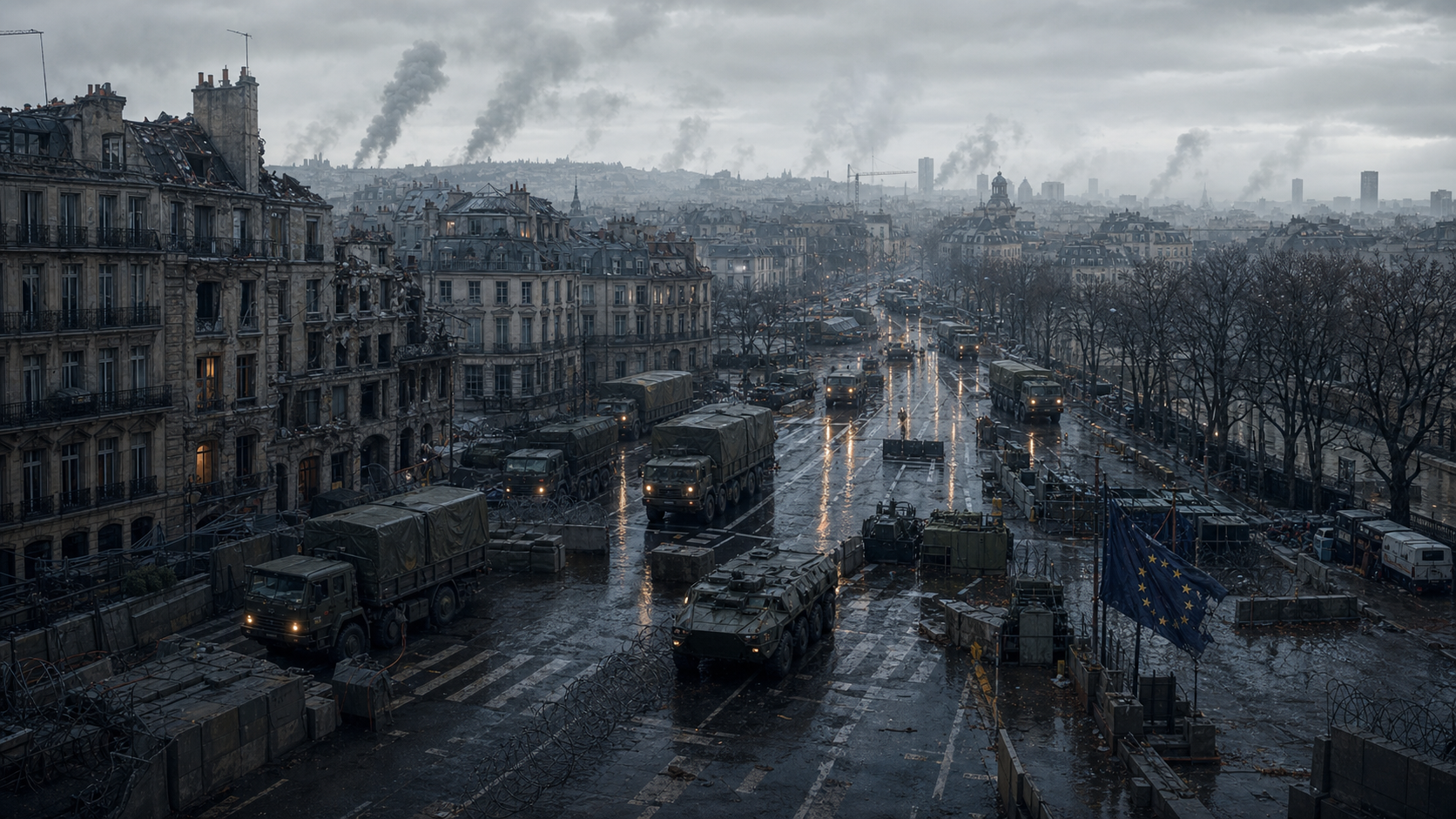
Paris and the European Campaign is the collective name used for the post-Operation Extinction military arc in which surviving American and European forces continue the war against regionally evolved Variants across France, Rome, Greenland, and the wider European theater. The page title uses Paris as the geographic anchor for a continental campaign rather than identifying one fully documented, self-contained Battle of Paris. Its narrative purpose is to show that success in the United States does not end the species war and that Europe develops its own surviving commands, enemy forms, missions, and losses.
Quick Facts
- Role
- Event Arcs
Overview
The campaign also marks a transition within Team Ghost. Reed Beckham is physically damaged by the original war and no longer able to carry every field mission. Joe Fitzpatrick assumes command of a reconstituted team that includes Jeni Rico, Yas Dohi, Blake Tanaka, Hugh Stevenson, and military working dog Apollo. Their operations connect the American victory to European Unified Forces, naval logistics, and missions against evolved forms such as Reavers, Black Beetles, Pinchers, Wormers, and cold-adapted hybrids.
Extinction Lost begins after Team Ghost returns from an exhausting intelligence mission in France. Within twenty hours, the team is redirected from the main European front aboard the USS Forest Sherman toward Greenland, where a converted laboratory and an unknown bioweapon threaten to create another catastrophe. The diversion demonstrates the basic condition of the European campaign: too few surviving forces must confront too many regional threats, often with incomplete intelligence and no reserve.
Campaign information
- Field: Type; Detail: International postwar military campaign and continuity arc
- Field: Primary theater; Detail: Continental Europe, with associated missions in France, Rome, and Greenland
- Field: Chronological position; Detail: After Operation Extinction and before the eight-year Dark Age time jump
- Field: Principal allied forces; Detail: Team Ghost, European Unified Forces, surviving United States naval and aviation assets, local military remnants
- Field: Principal field leader; Detail: Master Sergeant Joe Fitzpatrick
- Field: Core Team Ghost roster; Detail: Fitzpatrick; Jeni Rico; Yas Dohi; Blake Tanaka; Hugh Stevenson; Apollo
- Field: Associated European figure; Detail: Sergeant Piero Angaran
- Field: Major enemy forms; Detail: Reavers and other regionally specialized Variants and hybrids
- Field: Strategic themes; Detail: International cooperation, regional evolution, leadership succession, force exhaustion, containment of abandoned weapons research
- Field: Primary works; Detail: Extinction Aftermath; Extinction Lost; Extinction War
- Field: Continuity note; Detail: "Paris" functions as a campaign label; the novels give their most detailed direct evidence through the France-to-Greenland transition
Background
Operation Extinction changes the global balance but does not restore the old world. Countermeasures can kill or suppress many Variants, yet devastated communications, destroyed governments, isolated military units, and regional mutations prevent a uniform victory. Europe contains dense cities, underground infrastructure, old military sites, remote islands, and populations separated by collapsed borders. Every region has experienced the same originating disaster through different terrain and institutional failure.
The surviving forces face two simultaneous tasks. They must eliminate or contain Variant populations that have adapted beyond the early outbreak model, and they must prevent abandoned human weapons programs from causing a second biological disaster. The Greenland mission illustrates both problems. VX9H9 was deployed after the outbreak, Kryptonite followed, and both appeared to work in much of the territory. One region remained anomalous because a former German site, later converted into a government laboratory, housed research into another weapon intended to kill juveniles.
The campaign begins from scarcity. The European Unified Forces still possess command and combat capability, but their available teams are committed across a vast front. When three joint strike teams, about thirty personnel, disappear while investigating the Greenland facility, there is no large replacement formation ready to deploy. Colonel Bradley reroutes the Forest Sherman and assigns Team Ghost, supported by Marines and Black Hawk crews, to destroy the weapon and the facility from within.
Europe after the first American victory
The European theater does not reproduce the American campaign in different scenery. Variant evolution is responsive to climate, prey, shelter, and local human intervention. Urban ruins conceal forms suited to buildings and underground spaces. Cold regions produce heavily furred creatures. Winged Reavers can attack aircraft and migrate beyond expected ranges. Human survivors and military remnants also adapt unevenly, creating pockets of organized resistance beside places where no functioning command remains.
Rome provides the campaign with a civilian-soldier perspective through Piero Angaran and Antonio LoMaglio. Their struggle takes place amid a city whose historical monuments survive as shells around hunger, juveniles, flying threats, and failed rescue or military efforts. Antonio's death leaves Piero carrying guilt and memory through a theater that can otherwise become an abstract map of targets. Europe matters because people still belong to its ruined places even when governments describe those places as sectors.
France becomes important in the transition to Fitz's later command. Immediately before the Greenland operation, Team Ghost has returned from an intelligence mission in France that is described as vital to the next stage of the war, Operation Reach. Fitz has a wounded shoulder. Dohi wears a chest brace. Apollo has been injured at the Basilica of St. Therese in Lisieux. The rest of the team is visibly exhausted. Their condition establishes that the French mission was neither ceremonial nor a clean victory.
The supplied record does not give a scene-by-scene Paris operation.
Team Ghost's transfer of leadership
The European campaign is inseparable from the shift from Beckham to Fitzpatrick. Beckham created the team's wartime identity through Building 8, New York, Plum Island, and Operation Extinction. His accumulated injuries and the end of the first American campaign make indefinite frontline command impossible. Fitz carries the name forward rather than founding an unrelated unit.
Apollo makes that continuity visible. The dog remains emotionally associated with Beckham, but Beckham sends him with Fitz. To outside personnel, Fitz and Apollo have already become legends distorted by retelling. Crew Chief Hector Webb has heard that Fitz killed the Bone Collector with his bare hands and that Apollo ate the creature's heart. The exaggeration matters because surviving militaries need symbols, yet the real team boarding the Greenland helicopters is wounded, sleepless, and human.
Rico, Dohi, Tanaka, and Stevenson bring distinct skills. Rico records experience and uses humor without losing discipline. Dohi combines tracking with close attention to terrain and evidence. Tanaka carries a blade and operates as part of the close team formation. Stevenson provides automatic-weapons capability and the physical steadiness of an experienced operator. Apollo contributes scent detection and continuity with the earlier team. Fitz must turn those strengths into decisions while measuring himself against what Beckham would have done.
This succession is not frictionless. Leadership means ordering a team forward after allied units disappear, deciding when a missing member can no longer be searched for, and continuing a mission even when the available intelligence suggests the target has already destroyed larger forces. The European front makes Fitz responsible for losses that no reputation can prevent.
French operations and Operation Reach
The France mission immediately preceding Extinction Lost is an intelligence-gathering operation. Its results are important enough to the next campaign phase that the team is redeployed with little recovery time. The reference record identifies Lisieux and the Basilica of St. Therese as one site where Fitz and Apollo are injured. It also associates the French theater with specialized forms described by the team as Black Beetles, Pinchers, Wormers, and other abominations.
Soldiers name enemies so they can communicate quickly under pressure. The vocabulary records what operators encounter before laboratories can provide a complete biological classification.
Operation Reach represents the strategic ambition behind the campaign: surviving commands want to move from defending isolated territories to reaching into enemy-held areas, collecting intelligence, and dismantling remaining threats. France supplies information, but the Greenland diversion shows how quickly a planned offensive can be interrupted by an uncontrolled laboratory, missing strike teams, or an evolved population outside expected distribution.
The Greenland diversion
The USS Forest Sherman is pulled away from the main European front and carries Team Ghost to within helicopter range of Greenland. The mission is approximately six hundred miles west of the front. Three Black Hawks deploy Team Ghost and two supporting Marine elements toward an Inuit fishing village near the hidden facility.
The flight is attacked by Reavers. These large winged Variants have armored bodies, fleshy wings, talons, and a spiked tail capable of impaling a person. They coordinate around a helicopter, pluck Marines from an open door, enter the troop compartment, and attack the cockpit. Fitz kills one with a shot from his MK11, but one aircraft and its embarked Marines are lost before the force reaches the target.
On the ground, the village appears empty. Snow conceals tracks, weather limits visibility, and the enemy defeats normal tracking assumptions. Stevenson disappears without a clear shot or warning. Supporting teams are destroyed or separated. Sergeant Mapes survives long enough to describe attackers that appear neither fully human nor ordinary Variant and that use weapons, concealment, traps, and displayed bodies as warnings.
The entrance to the laboratory is marked by human and Variant corpses fixed on poles. The display communicates territorial control. Inside and around the site, Team Ghost confronts the consequences of human research layered over a preexisting military installation. The objective remains destruction of the weapon and facility, because bombing from outside might bury rather than neutralize the agent.
The mission extends the European campaign geographically but also clarifies its doctrine. The enemy cannot be studied only as infected anatomy. Regional populations may learn, build social rules, use weapons, and define outsiders as threats. Human laboratories remain dangerous even when their original governments no longer function. A successful campaign therefore requires biological science, cultural observation, intelligence, and disciplined destruction of materials that cannot be safely recovered.
Allied command and naval logistics
The European Unified Forces are a coalition born from collapse rather than a restored continental government. Their inability to support every mission is not simple cowardice or incompetence. Surviving forces must defend population centers, ships, laboratories, airfields, and supply routes while responding to evolved forms spread across multiple climates.
American naval assets provide mobility that fixed bases cannot. The Forest Sherman can move operators, helicopters, fuel, weapons, and command staff along the front. It can also be diverted, leaving whatever mission it was supporting with fewer resources. Every redeployment carries an opportunity cost.
The relationship between Team Ghost and the European command is cooperative but strained by scarcity. Team Ghost receives intelligence and broad objectives from higher command, yet the operators must make immediate choices with incomplete information. The team is valuable precisely because it can enter sites where a larger formation would be slow, visible, or unavailable.
The campaign also proves that national labels matter less than functional networks. Ships, surviving governments, local fighters, American operators, and European commanders cooperate because no one country can map or contain the surviving threat alone.
Enemy evolution in the European theater
European threats demonstrate divergent adaptation rather than a simple ladder in which every Variant becomes the same advanced form. Reavers exploit airspace and can destroy helicopters, reducing one of humanity's most important mobility advantages. Cold-adapted bodies use fur and altered physiology. Other forms exploit tunnels, armor, narrow movement, or local prey.
The France and Greenland missions also show behavior that cannot be explained by hunger alone. Bodies are displayed. Traps are prepared. Outsiders are stalked without immediate attack. Weapons are used. Human and Variant corpses can both serve as territorial messages. Such behavior complicates the moral and tactical boundary between infected predator, transformed community, and organized enemy force.
These developments prepare the later Dark Age conflict without making the European populations identical to Azrael's New Gods. The New Gods add a centralized ideology, named ranks, transformation program, collaborators, and living communications network. The European campaign supplies earlier evidence that regional evolution and social organization are already possible.
Relationship to the American crisis
While Fitz operates overseas, reports suggest political and security trouble in the United States. The Republic of Texas crisis and Andrew Wood's campaign demonstrate that humanity can lose naval assets, safe zones, and legitimacy to human enemies even while international teams fight Variants abroad.
This split creates a strategic trap. Pulling Team Ghost home weakens the European front. Leaving it overseas removes one of the most capable units from the American crisis. Fitz's international success makes him and the team symbolically important, while their distance limits their ability to protect people such as Ringgold, Beckham, Kate, and the recovering American government.
The European campaign therefore belongs to the same continuity as ROT rather than functioning as a detached adventure. Both arcs concern fragmented authority after apparent victory. Europe shows the cost of unfinished biological war. ROT shows the cost of assuming human political conflict has become secondary.
Principal participants
- Joe Fitzpatrick: Field commander of the post-Beckham Team Ghost and the main American operator in the European campaign.
- Apollo: Military working dog and living link between Beckham's original command and Fitz's successor team.
- Jeni Rico: Team Ghost operator whose observations, writing, humor, and combat discipline contribute to team cohesion.
- Yas Dohi: Tracker and field interpreter of terrain, signs, and abnormal enemy behavior.
- Blake Tanaka: Close-combat-capable Team Ghost operator and veteran of the France-to-Greenland transition.
- Hugh Stevenson: Automatic rifleman whose disappearance in Greenland illustrates the campaign's ability to defeat even an experienced team without warning.
- Piero Angaran: European survivor-soldier who gives the continental war a personal perspective centered on Rome.
- Antonio LoMaglio: Piero's companion and a defining European loss.
- European Unified Forces: Coalition command that coordinates remaining European military capacity and joint missions.
- USS Forest Sherman personnel: Naval and aviation support that makes the Greenland mission possible.
Consequences and significance
The campaign establishes that Operation Extinction is a turning point, not a universal ending. Humanity can win enough territory to plan offensives while still lacking control of remote laboratories, abandoned cities, and mutated populations. Recovery proceeds unevenly, and a threat suppressed in one climate may flourish in another.
For Team Ghost, Europe turns inheritance into practice. Fitz cannot preserve Beckham's legacy by copying him. He must lead a different roster against forms and institutions Beckham never faced. Apollo's presence gives continuity emotional weight, but the team's wounds and losses prevent nostalgia from becoming invulnerability.
The arc also widens the moral geography of the franchise. Rome, France, Greenland, and the European front are not scenery around an American war. They contain their own dead, survivors, commands, mistakes, and forms of adaptation. The United States remains a principal narrative center, but species survival is necessarily international.
Connections and chronology
- Extinction End - Operation Extinction creates the conditions for an outward campaign and leaves Beckham physically diminished.
- Extinction Aftermath - Expands the European theater through Rome, Piero, Antonio, and postwar military action.
- Extinction Lost - Opens after the France intelligence mission and follows the Forest Sherman diversion to Greenland in detail.
- Extinction War - Connects the overseas theater to ROT, the American government crisis, and the later settlement order.
- Extinction Cycle: Dark Age - Shows the world years after the campaign, when regional threats and organized evolution reappear in a new form.
Continue Exploring
Connected Universe
Books and Stories
Characters
Groups and Factions
Sources
- Extinction Aftermath, Extinction Aftermath - Chapter 1
- Extinction Lost, Extinction Lost - Chapter 1
- Extinction Lost, Extinction Lost - Chapter 2
- Extinction Lost, Extinction Lost - Chapter 3
- Extinction Lost, Extinction Lost - Chapter 4
- Extinction Lost, Extinction Lost - Chapter 5
- Extinction War, Extinction War - Chapter 3
- Extinction War, Extinction War - Chapter 19
- Extinction War, Extinction War - Chapter 25
- Extinction War, Extinction War - Epilogue