
Factions, Locations, and Outposts
What Happens After Extinction War? The Allied States and Dark Age Explained
What happens eight years after Extinction War? Explore the Allied States, its outposts, government, military, Team Ghost and the New Gods.
·
Category: Factions, Locations, and Outposts
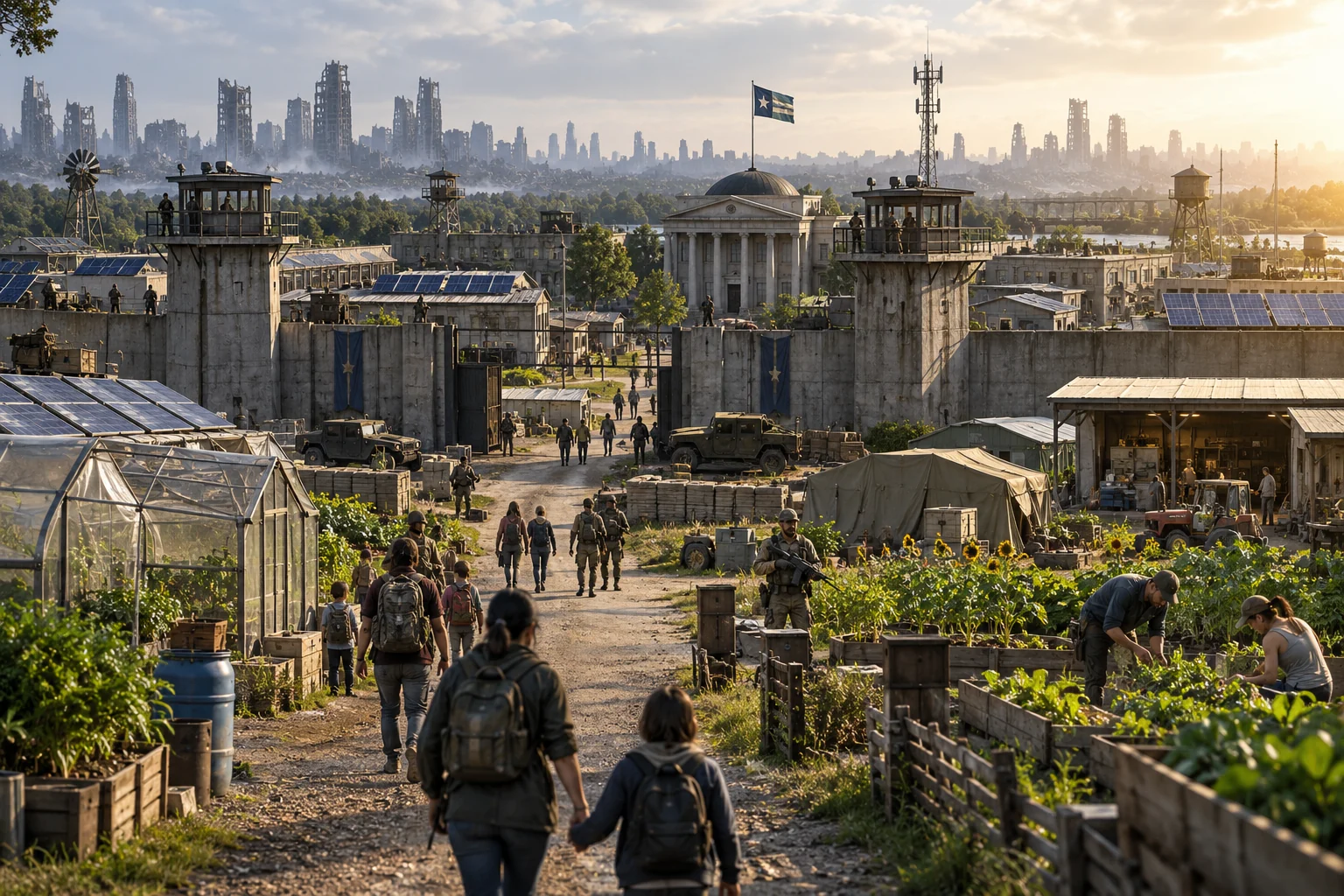
The Allied States represents a shift from scavenging and emergency defense toward agriculture, manufacturing, power and government.
The most important thing to know about the world after Extinction War is that humanity does not go back to normal.
It builds something new.
Eight years after the original seven-book Extinction Cycle concludes, the surviving American population lives in a successor nation called the Allied States. Roughly one hundred defended outposts hold most of the population. The Midwest and East Coast contain the largest concentrations of survivors. Much of the West remains badly damaged. Agriculture, manufacturing, electricity and military capacity have returned, but none of them can be taken for granted.
Reed Beckham and Kate Lovato are married and raising their son. Parker Horn and his daughters remain close to them. Joe Fitzpatrick leads Team Ghost on missions beyond the safe zones. President Jan Ringgold has spent years trying to turn emergency survival into functioning government.
From a distance, it looks like humanity has won.
That is exactly when Extinction Cycle: Dark Age begins.
The surviving Variants have not disappeared. Human collaborators remain in the shadows. And an intelligent faction led by Azrael has spent years using the science behind the original outbreak to engineer something new: Scions, Chimeras and a movement that calls itself the New Gods.
Dark Age is therefore not simply "Extinction Cycle eight years later."
It is the part of the story that asks whether people who survive an extinction event can actually rebuild a civilization strong enough to survive the next one.
The official time jump: eight years after Extinction War
The Dark Age historical recap places the sequel eight years after the events of Extinction War.
That gap is crucial.
A one-year time jump would still be an emergency story. Eight years is enough time for children to grow up, soldiers to retire, infrastructure to be restored, political institutions to stabilize and collective memory to begin changing.
People born after the outbreak do not remember the old United States.
People who were children during the Great War may remember fragments rather than systems.
Adults who survived have had years to turn wartime improvisation into routine.
That creates an entirely different kind of vulnerability.
During the original Extinction Cycle, everyone knows the world is ending.
During Dark Age, many people believe the worst is over.
What are the Allied States?
The Allied States are the successor government formed by survivors of the United States after the Great War of Extinction.
The name is revealing.
This is not presented as the old federal system simply continuing without interruption. The population is too small, the geography too damaged and the infrastructure too fragmented for that fiction to hold.
Instead, surviving settlements are linked politically and militarily.
The word "Allied" suggests cooperation among communities that could otherwise operate independently.
That is exactly the kind of structure a post-collapse country would need.
Each outpost has to maintain local security, food, water and basic services. The national government has to provide the things isolated communities cannot efficiently create alone: military coordination, intelligence, long-range transportation, scientific research, large-scale manufacturing and political legitimacy.
The Allied States exists because surviving alone is no longer enough.
How many outposts are there?
The Dark Age recap states that survivors have migrated into approximately one hundred outposts.
Most are located in the Midwest and East Coast.
The West Coast is described as largely abandoned because of the severity of destruction during the war.
This changes the map of political power.
Before the outbreak, American population and economic activity were distributed across enormous metropolitan regions on both coasts. Afterward, survivability matters more than historical importance.
An intact agricultural region can be more valuable than the ruins of a famous city.
A defensible harbor can matter more than a former financial center.
An outpost with reliable electricity and clean water may possess more strategic value than hundreds of square miles of empty territory.
The Allied States is therefore best understood as a network rather than a fully repopulated continental country.
Why the Midwest matters
The Midwest has several advantages in a post-apocalyptic recovery.
Food production is the most obvious.
A civilization cannot rebuild around scavenged canned goods forever. It needs seed, soil, machinery, storage, livestock, fuel and people who know how to run agricultural systems.
The Dark Age recap specifically notes the restoration of agriculture as one of Ringgold's major achievements.
That means surviving farming regions become the foundation of national power.
The Midwest also offers lower pre-collapse population density than many coastal megacities. Fewer people can mean fewer initial Variants and less catastrophic urban destruction.
The tradeoff is transportation. Farms are useful only if food can reach outposts.
That requires roads, trucks, fuel, maintenance and security.
Restoring agriculture therefore implies that the Allied States has also rebuilt pieces of logistics infrastructure.
Why the East Coast matters
The East Coast combines surviving population centers, ports, military installations and political continuity.
Outpost Portland becomes especially important because Reed, Kate and their extended family live in that region. Peaks Island is secure enough that Kate can maintain a laboratory and the community can support a relatively stable daily life.
The coast also matters for naval recovery.
By the end of Dark Age, the Allied States is capable of returning a repaired vessel to service and christening it the USS Jan Ringgold.
That is far more significant than one ship.
A functioning navy implies:
- ship repair facilities
- trained sailors
- fuel reserves
- ammunition
- radar and communications
- navigation expertise
- supply chains
- command structures
The ship is proof that the Allied States is becoming a state rather than merely a collection of fortified camps.
What happened to the West Coast?
Dark Age describes the West Coast as largely abandoned because of the severity of wartime destruction.
This does not mean no one survives there.
Expanded-universe stories such as the Extinction Survival series show enclaves and long-term communities in California. But the main Dark Age political center has shifted away from the region.
That makes sense strategically.
A government rebuilding with limited people cannot restore every city at once. It has to concentrate resources where population, agriculture, transportation and defensibility overlap.
Abandoned territory becomes a frontier.
It can contain Variants, raiders, isolated human settlements, old military facilities and valuable salvage.
For Team Ghost, those areas remain mission territory.
For the Allied States, they represent both danger and future expansion.
What did President Jan Ringgold rebuild?
The historical recap credits Ringgold's administration with restoring four foundational systems:
- basic infrastructure
- agriculture
- manufacturing
- the energy grid
That list is basically a blueprint for civilization.
Infrastructure
Roads, bridges, water systems, ports and communications determine whether outposts can function as one country.
Agriculture
Food production ends dependence on scavenging and allows population stability.
Manufacturing
Factories and workshops replace the one-way consumption of pre-collapse stockpiles. Ammunition, tools, replacement parts, medical supplies and construction materials can be produced rather than merely found.
Energy
Electricity multiplies everything else. It supports hospitals, refrigeration, laboratories, communications, water treatment and industry.
The Allied States becomes viable because these systems reinforce one another.
Why rebuilding electricity is such a major achievement
It is easy for modern readers to treat electricity as a single service.
It is actually a network of generation, transmission, maintenance and control.
A post-collapse government cannot simply "turn the grid back on."
Power plants require operators. Transmission lines require repairs. Substations need parts. Fuel must be delivered. Demand must be balanced. Local systems need protection from attack.
The fact that the Allied States has restored an energy grid means years of engineering work have succeeded.
That makes Dark Age's opening peace more credible.
People are not living in caves with assault rifles.
They are living in a damaged but increasingly technological society.
What daily life looks like eight years later
Kate Lovato's opening scenes in Dark Age are revealing because they are ordinary.
She can sit near the water with coffee.
Coffee is being grown in Florida again.
That tiny detail says a lot.
Coffee is not essential to survival. If a society can produce and distribute it, the economy has moved beyond bare subsistence.
People can also live in permanent homes, raise children and maintain laboratories.
Reed is still security-conscious, but he is not sleeping every night in body armor.
The safe zones have sensors, barriers and military protection.
Life is not normal by pre-war standards, but normality is returning in pieces.
What happened to Reed Beckham?
Reed survives the Great War with permanent physical injuries.
By Dark Age, he lives with Kate and their eight-year-old son on Peaks Island near Outpost Portland. He uses prosthetics and remains legally blind in one eye, although Kate's medical work has helped improve his condition.
His life is therefore both peaceful and visibly postwar.
He has a family and a home.
He also carries the war in his body.
Ringgold continues encouraging him toward political responsibility, suggesting that his role in the new country may need to extend beyond special operations.
That is a logical evolution.
Reed spent the original series learning how dangerous it is when leaders make decisions without understanding the people who execute them.
Dark Age asks whether he is willing to become one of those leaders himself.
What happened to Kate Lovato?
Kate remains one of the most important scientists in the Allied States.
Her guilt has not disappeared.
She continues to associate the Variant catastrophe with the bioweapon research she helped develop. Ringgold has reminded her that she did what was necessary to save humanity, but survival does not erase responsibility.
Kate's laboratory work in the postwar period shows another transition.
During the original saga, science is emergency warfare.
In Dark Age, science has to support a society.
Medical care, research, public health and long-term recovery matter alongside Variant biology.
Then the New Gods appear and drag her back into the original nightmare.
What happened to Team Ghost?
Team Ghost never really stopped fighting.
The Dark Age recap says the unit has spent eight years running missions into enemy territory to hunt remaining Variants and rescue human prisoners.
Master Sergeant Joe "Fitz" Fitzpatrick leads the team.
That makes Ghost one of the Allied States' most important continuity institutions.
Governments changed.
Presidents came and went.
The old military was nearly destroyed.
Team Ghost survived as a culture.
Its mission also changed.
During the Great War, Ghost often fights to prevent immediate extinction.
Afterward, it functions more like a frontier special-operations unit: intelligence, rescue, counter-Variant missions and threats beyond the safe zones.
Why the Allied States thinks the Variant threat is ending
By the opening of Dark Age, many surviving Variants appear to be starving and dying.
This is biologically consistent with the franchise's rules.
Variants have enormous metabolic needs. As prey disappears, sustaining large populations becomes difficult.
That creates optimism.
The military can reasonably believe the old enemy is becoming an ecological remnant rather than an existential force.
The mistake is assuming the old enemy is the only enemy.
Enter Azrael and the New Gods
Azrael changes the postwar balance because he understands the science that created the Variants and believes it should be used deliberately.
The original outbreak is a disaster.
Azrael's project is a program.
He uses genetic engineering to create Scions with enhanced strength, senses and predatory anatomy while preserving enough intelligence to communicate and use weapons.
He also commands human followers and trainable Variant Thralls.
This is the nightmare the Allied States did not prepare for.
Walls designed to stop feral monsters are less effective against soldiers carrying rifles.
Military intelligence designed to track starving Variant packs is less useful against an ideological movement using captured vehicles, collaborators and planned operations.
Dark Age begins when the threat moves from ecology back into politics.
What are Scions?
Scions are the New Gods' engineered soldiers.
They resemble Variants in important ways but are not simply members of the old infected population.
Azrael's program deliberately transforms people.
Scions can retain speech, use firearms, follow command structures and operate tactically. Physical modifications can include claws, enhanced low-light vision, altered facial anatomy and extreme strength.
This makes them fundamentally different from the enemy Team Ghost spent years learning to fight.
A soldier can predict a charging Variant.
A Scion may shoot from cover.
What are Thralls?
Thralls are more primitive Variants incorporated into the New Gods' military system.
Their danger comes from organization.
A wandering Variant is a predator.
A trained pack deployed at a chosen target is a weapon.
The New Gods can use Thralls as shock troops while Scions and human collaborators handle more complex missions.
This combined-arms structure is one reason the New Gods become capable of threatening entire outposts.
What are Chimeras?
Chimeras appear as elite engineered combatants within the New God hierarchy.
By the final Dark Age battles, they can use firearms and melee weapons while acting as guards and disciplined fighters.
The naming itself reflects the theme of deliberate biological mixture.
They are not an evolutionary accident.
They are products.
That is what makes them more disturbing than ordinary Variants.
How secure are the outposts really?
The outposts are safer than the world outside, but safety creates dependence.
A fortified city requires:
- perimeter walls
- sensors
- electricity
- ammunition
- food deliveries
- trained defenders
- medical screening
- maintenance crews
Attack any one system and the others become harder to sustain.
The New Gods understand this.
Their campaign is dangerous because it targets the networks that make postwar civilization possible rather than merely attacking isolated people.
Politics after the apocalypse
Dark Age also brings elections back into the story.
Ringgold's term is nearing its end, and Vice President Dan Lemke is positioned as a likely successor because of the administration's rebuilding record.
That detail is important.
An election means the Allied States believes it can transfer power through institutions rather than force.
That is a remarkable achievement after years of emergency rule.
It also creates vulnerability.
Political disagreement can be exploited. Leaders can be targeted. Fear can make people question democratic processes.
The New Gods do not need to kill every citizen if they can break faith in the government.
Is the Allied States democratic?
The books present elections, presidents, vice presidents and senators, indicating a reconstructed representative system.
It is not identical to the pre-war United States.
Population distribution and emergency history have changed too much.
But the attempt to preserve representative government is central to Ringgold's legacy.
That is why Azrael's ideology is such a direct threat.
He offers hierarchy based on biological superiority.
The Allied States offers legitimacy based on civic institutions.
The war is therefore political as well as military.
Why Ringgold matters more after Extinction War
Ringgold's greatest achievement is not simply surviving the original war.
It is proving that the state can do something other than issue orders and launch weapons.
Her administration restores food systems, energy and manufacturing.
That is what creates legitimacy.
People follow a government because it can keep the lights on, protect roads, maintain hospitals and give children a future.
Dark Age makes Ringgold a nation-builder.
Her later death matters because it tests whether the Allied States depends on one person or has become a true institution.
The meaning of the USS Jan Ringgold
The final scene of Dark Age centers on the christening of a repaired ship named for Ringgold.
The vessel is described as a patchwork of repairs.
That image summarizes the Allied States better than any map.
The country is not restored to its original strength.
Neither is Reed.
Neither is Kate.
Neither is Team Ghost.
But damaged systems can still work.
The ship returns to service because enough people retained the knowledge, tools and cooperation required to repair it.
That is what civilization is.
What happened to the rest of the world?
Dark Age makes clear that many countries are still clawing their way out of anarchy.
The Allied States is not operating in a fully restored international order.
Global trade is limited. Political borders matter less where population centers disappeared. Communications and transportation remain constrained.
This opens enormous worldbuilding possibilities.
Every surviving region would have experienced a different balance of Variant density, military collapse, geography and access to resources.
The Extinction NZ stories already demonstrate how different the same catastrophe can look from another national perspective.
The postwar world is therefore a patchwork of recovery levels.
Could the Allied States eventually become the United States again?
Possibly, but the books do not require that outcome.
The Allied States may be more than a temporary name.
Political identity changes when an entire generation grows up with different institutions, borders and population centers.
A child born in Outpost Portland may think of the Allied States as the normal country and the United States as history.
The more interesting question is whether the new society preserves the values survivors wanted to save.
Dark Age treats that as more important than restoring an old label.
Frequently asked questions
How long after Extinction War does Dark Age take place?
Eight years.
What is the Allied States?
It is the successor nation formed by surviving American communities after the Great War of Extinction.
How many outposts are in the Allied States?
The historical recap describes approximately one hundred outposts.
Where do most survivors live?
Most Allied States outposts are concentrated in the Midwest and East Coast. The West Coast is largely abandoned because of wartime devastation, although survivor enclaves exist in expanded-universe stories.
Are Reed and Kate married?
Yes. They live near Outpost Portland with their son Javier Riley.
Who leads Team Ghost?
Fitz leads Team Ghost during the Dark Age era.
Are the Variants gone?
No. Surviving Variants remain, and Team Ghost has spent years hunting them. Dark Age reveals that the greater threat is the deliberate engineering of new Variant-like soldiers.
Who are the New Gods?
They are Azrael's movement, combining engineered Scions, Chimeras, human collaborators and Variant Thralls under an ideology of biological superiority.
Does Jan Ringgold survive Dark Age?
No. Her legacy becomes central to the ending, and a repaired Allied States Navy vessel is named the USS Jan Ringgold.
Final explanation
What happens after Extinction War is more interesting than a simple epilogue.
Humanity stops running long enough to begin rebuilding systems.
That means agriculture instead of scavenging.
Manufacturing instead of salvage.
Power grids instead of generators.
Elections instead of permanent emergency rule.
Naval ships instead of stranded hulks.
Families instead of temporary survivor groups.
The Allied States is the proof that the Great War was worth surviving.
Dark Age then tests that proof.
Azrael offers a different answer to extinction: abandon ordinary humanity and engineer something stronger.
Ringgold, Reed, Kate, Fitz, Horn and the people of the outposts choose the harder path.
They remain human and rebuild anyway.
The final ship is patched.
The country is patched.
The survivors are patched.
But they are moving forward.
That is what happens after Extinction War.
The apocalypse becomes history, and history becomes the foundation of a new civilization.
Canon and source notes
The Allied States population structure, approximate number of outposts, geographic concentration, Ringgold-era reconstruction and eight-year time jump are stated in the historical recap at the beginning of Extinction Cycle: Dark Age. The concluding symbolism of the USS Jan Ringgold comes from Extinction Darkness, the fourth Dark Age novel.
Recommended next pages
Sources and editorial scope
- Canon treatment
- Independent fan analysis grounded in the supplied Extinction Cycle source audit and clearly separated from compared franchises or real-world science.
- Spoiler scope
- Full spoilers for the Dark Age continuation