
Worldbuilding Themes
Outpost System
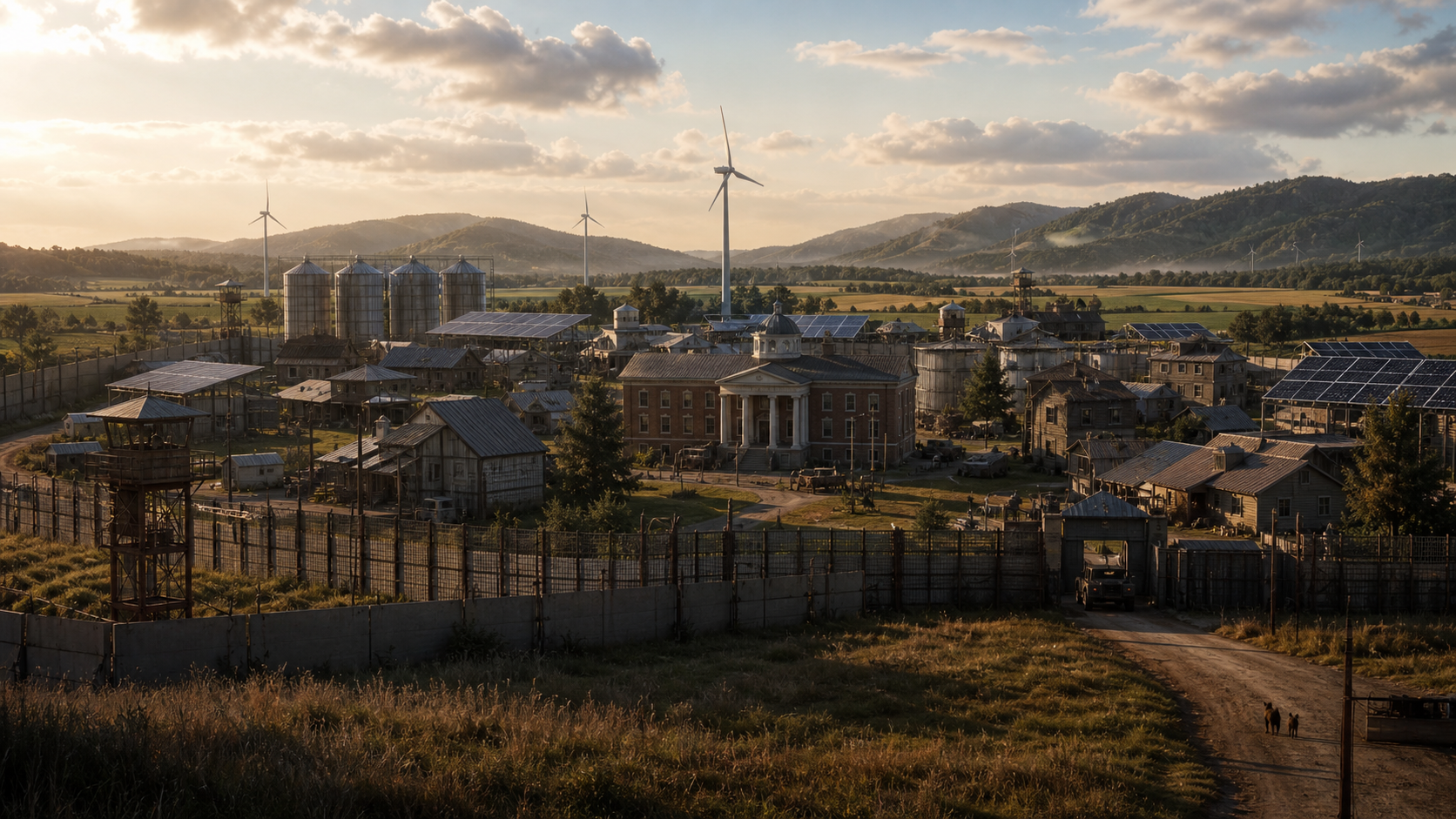
The outpost system is the basic civic architecture of the post-war Allied States. By the Dark Age era, eight years after Extinction War, the surviving population has consolidated into roughly one hundred fortified outposts, most of them located in the Midwest and along the East Coast. The West Coast is largely abandoned because of the severity of wartime damage, leaving the outposts as islands of order surrounded by frontier ruins, lawless zones, and Variant territory. The outposts are more than refugee camps. They are miniature towns, military posts, farms, trade nodes, schools, clinics, and symbols of the rebuilt state. Their purpose is not simply to keep people alive for another day. They are designed to restart civilization in a form small enough to defend and structured enough to grow. The system grows out of earlier safe-zone policy. During the first reconstruction period, the government used Safe Zone Territories, or SZTs, to concentrate survivors and distribute food, housing, and medical care. In the later Allied States, that survival network matures into a more permanent outpost civilization. Outposts are smaller than old metropolitan regions but more sustainable, with local production and local command woven into national logistics.
Quick Facts
- Role
- Worldbuilding Themes
Overview
- Type: Post-war settlement and defense system
- Era: Established after the Great War of Extinction and expanded by the Dark Age period
- Primary function: Shelter, food production, security, governance, and reconstruction
- Notable examples: Outpost Portland, Peaks Island, Outpost Turkey River, Outpost Patapsco Valley, Tulsa,
- Galveston: Major threats
Origins and development
The first major philosophical statement of the outpost model comes after the main American victory, when President Jan Ringgold promises to rebuild. Plum Island is transformed from a secret Medical Corps laboratory and military installation into a civilian outpost with shelters, community gardens, docks, government buildings, fences, and guard towers. The symbolism is explicit: the same ground associated with bioweapon secrecy becomes a site of community repair. By the Dark Age period, the model has expanded. The historical recap describes survivors moving into about one hundred walled-off cities, with Ringgold and her administration restoring basic infrastructure, agriculture, manufacturing, and the energy grid. This creates the Allied States as a network rather than a single rebuilt capital. Survival depends on redundancy: many strong communities instead of one vulnerable metropolis. The outpost system is also a response to the failures of pre-war urban life. Cities are hard to clear, easy for Variants to infiltrate, and full of underground routes. The government therefore accepts that some former cities must remain abandoned or controlled indirectly while fortified settlements preserve the population.
Physical design and daily life
Outposts vary by geography, but the Turkey River example provides the clearest snapshot of the standard model. It has a circular walled compound, a twenty-foot steel wall, bridges and gates, guard towers, razor-wire fences, sensors, minefields, working dogs, livestock areas, fields beyond the walls, wind turbines, solar panels, a general store, a post office, town hall defenses, and regular patrols. Daily life is not purely military, but the military is always visible. Food production is central. Turkey River produces corn, beans, grain, and other crops that are shipped by rail to other outposts. The settlement has enough food for its own residents and functions as part of a wider supply web. This makes agricultural outposts strategically valuable and also vulnerable. A prosperous outpost becomes a target for raiders, collaborators, political campaigns, and enemy reconnaissance. Peaks Island and Outpost Portland represent a more coastal and civic version of the model. Peaks Island is surrounded by sensors, soldiers, sailors, and trusted community members. Kate Lovato runs a lab at the community health center, which also contains an underground safehouse. The combination of school, science, military security, and family life shows how outposts blend normalcy with siege doctrine.
Security doctrine
Outpost security is layered. The outer world is monitored by patrols, dogs, thermal equipment, fences, mines, watchtowers, and controlled gates. Civilians are generally expected to remain inside after dark. The assumption is that the enemy may not present itself as a traditional army. A single wounded stranger, a hidden collaborator, a camouflaged Variant, or a compromised official can collapse the wall from within. Turkey River demonstrates both the strength and weakness of this doctrine. The outpost has advanced defenses and battle-hardened personnel, but the attack reveals that a clever enemy can exploit routines, compassion, and assumptions about the frontier. The massacre proves that the outpost system gives humanity breathing room, not invulnerability. Team Ghost becomes the mobile arm of the system. Instead of sending large armies into every ruined city, Ringgold favors surgical missions to hunt Variants and rescue prisoners. The outposts hold territory while elite teams push into the frontier when a threat becomes active.
Political meaning
The outpost system is also a map of political legitimacy. The old United States is gone, but Ringgold uses outposts to make the Allied States tangible. Citizens can see a wall, a school, a farm, a clinic, a rail shipment, a guard post, and a local command structure. That visibility matters because the apocalypse destroyed trust as much as infrastructure. The danger is that local loyalty can become stronger than national loyalty. Safe Zone Territories already showed this problem when some territories threatened sovereignty or aligned with ROT. Outposts inherit the same pressure. The election-era debate over conscription exposes the outposts as a political constituency. Communities attacked by Variants are more likely to support aggressive policies. Outposts with younger populations fear the cost of renewed war. The system is therefore both a shelter network and the electoral body of the Allied States.
Narrative function
The outposts allow the series to move from extinction survival into civilization design. In the original outbreak, the key question is whether any humans can live. In Dark Age, the question becomes what kind of society those humans will build. The outpost system embodies the answer and the uncertainty: it is practical, hopeful, militarized, fragile, and morally contested. Every outpost is a test case. Turkey River tests complacency. Portland tests family and science under guarded peace. Galveston tests national defense. Tulsa tests Variant ideology and conquest. The system turns geography into theme, asking whether walls can protect humanity without also shrinking its future.
Continue Exploring
Connected Universe
Books and Stories
Characters
Sources
- Extinction End
- Extinction End, Chapter 1, Kate prisoner sequence
- Extinction End, Ringgold infirmary and Plum Island report sequence
- Extinction War
- Extinction War, Prologue, Chicago rooftop sequence
- Extinction War, ROT and safe-zone infection arc
- Extinction Cycle: Dark Age Box Set, Dark Age box set