
Politics and Society
Conscription Debate
The Allied States is not a restoration of the old United States at its former population, borders, or industrial capacity. It is a compressed republic organized around roughly one hundred defended outposts, primarily in the Midwest and along the East Coast. Agriculture, manufacturing, energy, rail links, schools, and elections have returned in limited form. Large regions, especially in the West and in ruined urban centers, remain beyond routine government control.
Quick Facts
- Role
- Politics and Society
Debate information
- Field: Issue; Detail: Compulsory military service and mass frontier reclamation
- Field: Era; Detail: Dark Age election cycle, about eight years after the first war
- Field: Proposed age range; Detail: Men and women ages eighteen through thirty
- Field: Supporting faction; Detail: Freedom Party
- Field: Principal supporter; Detail: General Mark Cornelius
- Field: Opposing or cautious faction; Detail: New America Coalition and Ringgold administration
- Field: Principal continuity candidate; Detail: Vice President Dan Lemke
- Field: Existing alternative; Detail: Fortified outposts, patrols, and selective missions by elite units
- Field: Key populations affected; Detail: Tasha Horn, Jenny Horn, Timothy Temper, Bo, and the broader postwar generation
- Field: Historical warnings; Detail: Operation Liberty, command overconfidence, ROT, demographic collapse
- Field: Later complication; Detail: The New Gods prove that the hidden threat is real while Galveston destroys the expected political succession
Postwar background
Ringgold's administration treats consolidation as survival policy. Concentrating people inside outposts makes food distribution, medical care, education, defense, and political representation possible. Team Ghost and other specialized forces respond to confirmed Variant threats rather than attempting to occupy every abandoned city.
The model has costs. Outpost residents live behind walls and know that attacks can still come from tunnels, hidden nests, collaborators, or lawless territory. Independent survivors remain outside the formal system. Ruined cities contain old resources as well as danger. To people who have suffered repeated attacks, consolidation can feel less like patience than permanent retreat.
The presidential transition makes that dissatisfaction politically actionable. Ringgold is nearing the end of her term, and Lemke is expected to continue her reconstruction program.
Security through initiative
The Freedom Party argues that fixed defense allows the enemy to choose the time and place of attack. Variants, collaborators, and raiders can use abandoned cities, tunnels, military facilities, and remote communities as bases. Each outpost massacre appears to confirm that walls alone cannot solve the problem.
From this perspective, mass mobilization is an attempt to regain initiative. A larger army could clear routes, seize strategic sites, destroy nests, protect engineers, and hold territory after elite teams move on. Conscription spreads the burden beyond a small number of aging veterans and professional units repeatedly sent into danger.
The argument has emotional power. The cities belonged to the dead and to the society survivors remember. Leaving them to creatures and collaborators can appear to ratify defeat. Reclamation promises dignity as well as security.
Demographic and institutional argument
The first-war military was devastated. Elite formations cannot patrol an entire continent, and veteran leaders will age out of field service. The Freedom Party can therefore argue that training a new generation is necessary even if no immediate offensive occurs. A state that cannot replace its defenders may be only one coordinated attack away from collapse.
Compulsory service also creates standardized training, a reserve, and a shared civic obligation. In a charitable interpretation, the policy is not simply a demand for cannon fodder. It is an attempt to make defense a national institution rather than a burden carried by the same families and units.
Cornelius's appeal
Cornelius supplies the platform with military credibility. He understands large operations and speaks to voters who believe civilian caution has become strategic paralysis. His reputation allows the party to present coercive policy as disciplined necessity rather than panic.
The New Gods crisis later proves one part of his warning correct: quiet territory does not mean an enemy has disappeared. The evolved threat has used the shadows to organize. That vindication of diagnosis does not automatically validate every proposed remedy.
Preservation of population
The anti-conscription argument begins with demography. The Allied States has only a fraction of the old population. Young adults are not an abundant resource. They are farmers, technicians, parents, medical trainees, teachers, builders, and the people required to keep outposts viable. Moving them into a mass army can weaken the society the army is supposed to protect.
Casualties carry effects beyond the battlefield. Losing a trained electrician may disable power repair. Losing agricultural workers may reduce food production. Losing prospective parents or caregivers can damage a generation already thinned by the outbreak. A prewar state might replace such losses through large institutions. The Allied States often cannot.
Targeted force
Ringgold's administration is not pacifist. Outposts maintain soldiers, patrols, dogs, sensors, mines, walls, and emergency procedures. Team Ghost undertakes dangerous missions against direct threats. The disagreement concerns scale, coercion, and the threshold for entering frontier territory.
Selective operations place highly trained people against defined targets and reduce the number of civilians converted into soldiers. They also allow leaders to gather intelligence before committing large forces. Operation Liberty supplies the historical warning: overwhelming firepower can fail when command misunderstands the enemy and the terrain.
Lemke's political problem
Lemke represents continuity with a successful administration, but continuity is difficult to campaign on after an outpost falls. Patience can be portrayed as weakness. Every attack forces him to defend not merely a policy but the time the policy requires.
His position also depends on public trust in institutions. Voters must believe that targeted teams, intelligence systems, and outpost defenses are finding the real threats. The New Gods' hidden organization exposes weaknesses in that confidence.
The postwar generation
The proposal's age range turns abstract manpower into named characters. Tasha and Jenny Horn survived the first war as children, endured the loss of their mother, and grew up inside military protection. Timothy Temper survived New York and later becomes a field figure in Dark Age. Bo and other young people represent communities that have known walls, drills, and inherited trauma for most of their lives.
Kate's opposition is shaped by seeing these individuals rather than a demographic category. Conscription would ask people already robbed of ordinary childhood to pay again for the failures and unfinished wars of older leaders. The policy might train them to defend their homes, but it might also normalize the assumption that their lives exist to replace the dead.
Javier Riley Beckham is younger than the immediate draft cohort, but his name and upbringing clarify the long-term question. He is named for Kate's brother Javier and for Alex Riley, carrying memory into a postwar future. If militarization becomes permanent, children like Javier inherit citizenship primarily as preparation for service.
The pro-conscription response is that young people cannot be protected by pretending danger belongs only to their parents' generation. Tasha, Jenny, Timothy, and their peers already live within a threatened state. Training and organized service may be safer than leaving them unprepared during the next outpost collapse.
Frontier cities
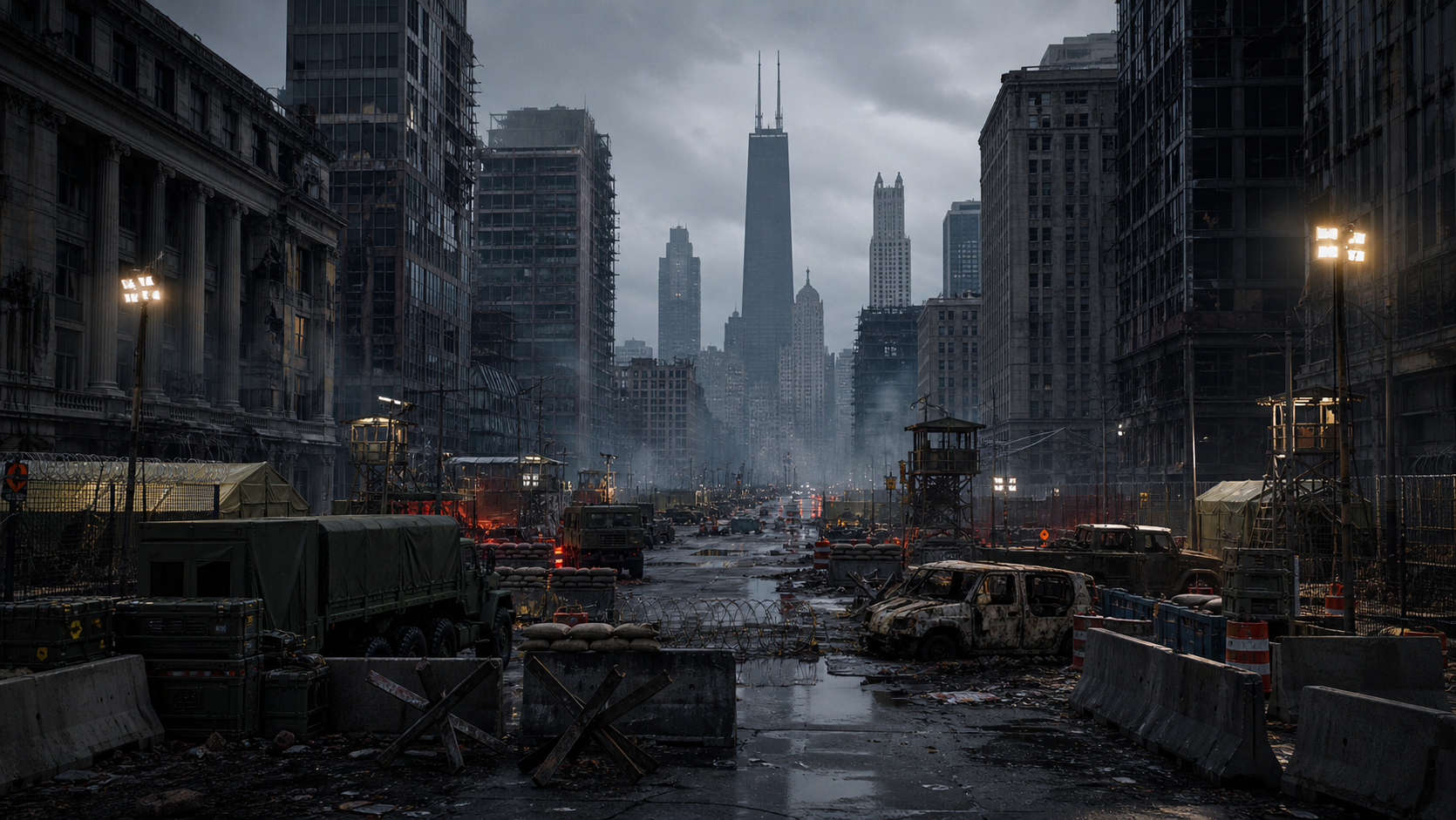
Ruined cities are not empty targets. They may contain Variants, webbing, collaborators, prisoners, independent families, salvage, records, and infrastructure. A policy of bombing or forced reclamation risks killing the people it claims to recover. A policy of permanent avoidance allows hostile organizations to use terrain the government does not monitor.
The debate therefore depends on intelligence. Conscription can provide numbers but not certainty about whom those numbers will fight. Targeted teams provide knowledge but may be too small to hold cleared territory. A sustainable policy likely requires reconnaissance, negotiation with independent survivors, engineering, quarantine, and governance as well as combat.
Training and equipment
Drafting people does not instantly create an army. Recruits require instructors, weapons, ammunition, protective equipment, food, medical support, transport, and competent officers. Each resource competes with civilian reconstruction. Rapid expansion can also place inexperienced personnel under leaders promoted faster than judgment develops.
The first war demonstrated that poorly understood missions can waste even trained troops. The Freedom Party's platform must therefore be evaluated not only by desired force size but by the Allied States' ability to equip and command it.
Internal security
Human collaborators complicate compulsory service. A mass intake can give infiltrators access to bases, routes, communications, or weapons. Refusing service can also become politically suspect, encouraging a government to treat dissent as disloyalty.
Ringgold's supporters fear authoritarian drift because emergency powers tend to outlast the emergency. Cornelius's supporters fear that procedural restraint will give infiltrators and monsters time to destroy the state. Both concerns are supported by prior events: secret command helped create the biological catastrophe, while ROT proved that human extremists can weaponize the virus against survivors.
Legal and political questions
The available material identifies the proposal and factions but does not supply a full conscription statute, exemption system, appeals process, service term, or legislative history. Those absences are important. The morality of a draft would depend heavily on implementation.
Questions left open include how medical disability is assessed, whether parents or essential workers receive exemptions, whether service includes civilian reconstruction, how independent settlements are treated, and what penalties apply to refusal. Prewar Selective Service rules cannot be assumed to have survived the extinction event unchanged.
Political legitimacy is therefore part of the policy itself. A draft imposed through transparent law, limited terms, review, and equal obligations would differ from forced recruitment by military decree. The Dark Age debate is alarming because the state's emergency and electoral systems remain fragile enough that the boundary could move quickly.
Operation Liberty
Operation Liberty attempted to retake major cities with armor, bombing, and mass troop movement before command understood how surviving Variants used darkness and underground terrain. In New York, the force became bait for an enemy hidden in tunnels and buildings. The operation is the clearest warning against treating reclamation as a problem solved by numbers and firepower.
Operation Extinction and targeted missions
Other operations demonstrate the opposite risk. Elite teams and specialized weapons can achieve decisive objectives, but they concentrate responsibility on a small group and can leave territory ungoverned after the strike. Ringgold's approach works only if the state can identify threats before they reach outposts.
ROT
The Republic of Texas crisis shows how grievance, propaganda, and biological terror can emerge from human political conflict. A militarized state may suppress such threats, but coercive politics can also create the resentment and secrecy on which extremist movements feed.
Effect of the New Gods war
The rise of Azrael and the New Gods transforms the debate. Cornelius is correct that the frontier contains an organized enemy. Outposts are not facing random remnants. Webbing, Scions, Chimeras, masterminds, and collaborators form a threat capable of coordinated war.
At the same time, the crisis demonstrates why mass manpower alone is insufficient. Scientists must decode the network, specialists must identify nodes, and elite teams must operate against targets whose biology is not widely understood. The enemy can also attack from within and below, reducing the advantage of a larger conventional army.
The emergency pushes political rivals into cooperation. Cornelius becomes necessary to national defense, while Ringgold's refusal of Azrael establishes that military strength must remain tied to freedom. Lemke's execution destroys the planned continuity succession and prevents the election debate from reaching an ordinary resolution.
Resolution and legacy
The novels do not establish that the original Freedom Party draft proposal is enacted exactly as proposed. The end of Dark Age creates a different political landscape. Ringgold and Lemke are gone, Galveston has become a national trauma, and Reed Beckham moves toward public leadership in cooperation with Cornelius.
That alignment does not prove Reed adopts every Freedom Party plank. It represents a synthesis forced by crisis: the Allied States needs Cornelius's willingness to confront external threats and Reed's firsthand knowledge of command failure, sacrifice, and Ringgold's civic ideals.
The debate remains important because its question survives the election. A recovered society must defend itself, but defense can consume the freedom, population, and future it exists to preserve. Dark Age does not solve that problem with the discovery that one faction was wholly right. It shows that Cornelius correctly recognizes hidden danger and that Ringgold correctly recognizes the danger of spending citizens without limits.
Connection map
- Mark Cornelius and the Freedom Party: Support compulsory service and aggressive frontier reclamation.
- Jan Ringgold and the New America Coalition: Defend gradual reconstruction, civilian legitimacy, and targeted force.
- Dan Lemke: Intended continuity candidate whose death prevents an ordinary succession.
- Reed Beckham: Veteran whose experience makes him skeptical of both hidden enemies and overconfident mass operations.
- Kate Lovato Beckham: Scientist and parent who frames the draft through its cost to named young people.
- Tasha, Jenny, Timothy, and Bo: Members of the generation directly affected by the proposed age range.
- Operation Liberty: Historical warning against city reclamation without adequate intelligence.
- New Gods: Evidence that frontier danger is real, but also that specialized science and intelligence are indispensable.
Continue Exploring
Connected Universe
Sources
- Extinction Shadow: the Freedom Party proposal, Ringgold and Lemke opposition, and the danger to the postwar generation.
- Extinction Cycle: Dark Age: frontier-city policy, the New Gods war, Galveston, and the changed political landscape after Ringgold.
- Extinction Edge and Extinction Age: Operation Liberty as the historical warning behind the later debate.