
Canon-grounded daily-life reconstruction
A Day in the Allied States: What Normal Life Looks Like After the Extinction War
Ordinary routines reveal how defended settlements have become a functioning society rather than a chain of temporary shelters.
·
Category: Factions, Locations, and Outposts
Source Boundary: This Is a Canon-Grounded Reconstruction, Not a Missing Chapter
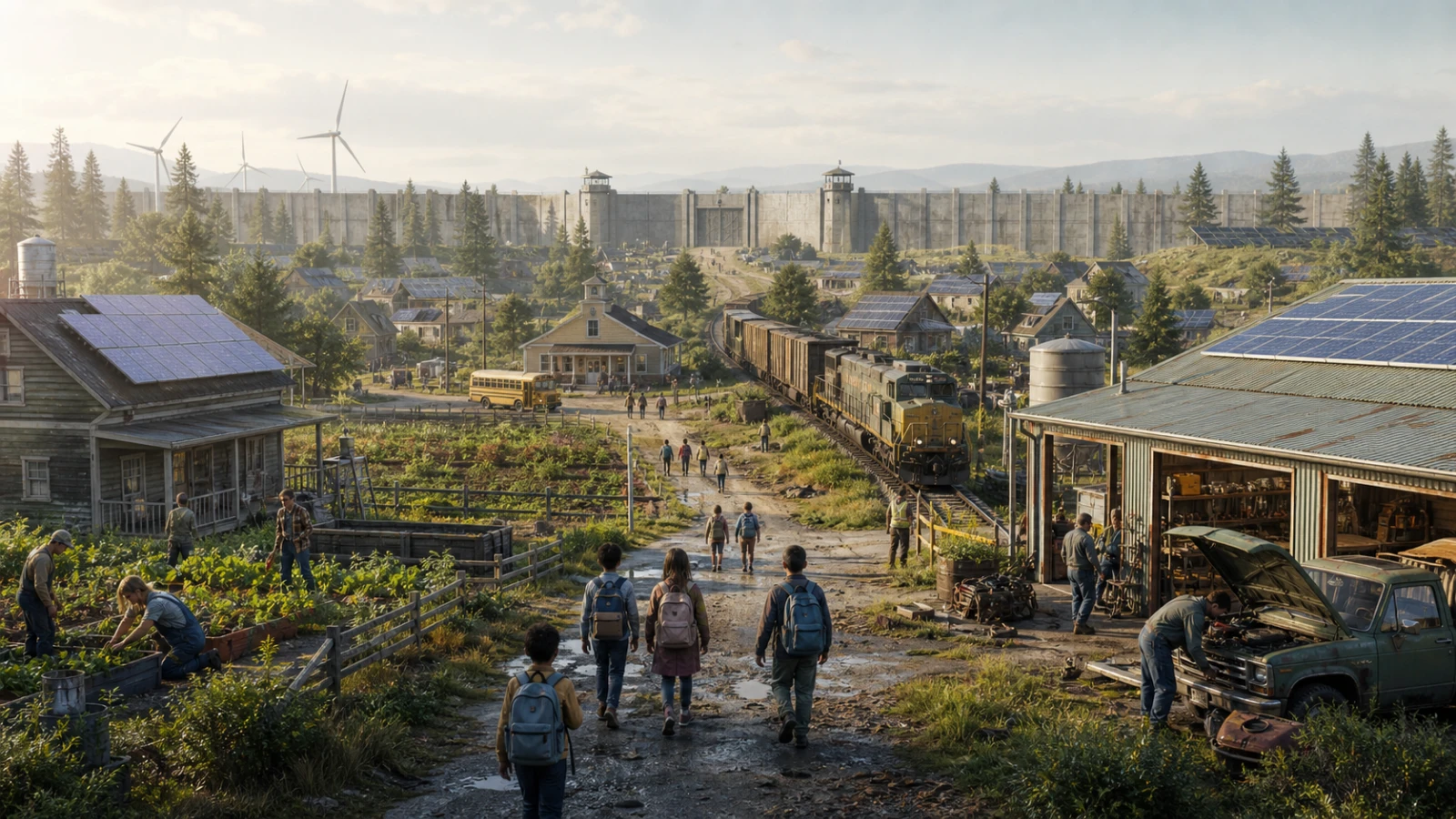
The Dark Age books do not provide one continuous chapter following an ordinary resident from breakfast through bedtime. This article therefore uses a different method. It reconstructs a plausible day from concrete source details the series does provide: the Allied States exists eight years after Extinction War; roughly one hundred outposts are concentrated largely in the Midwest and East Coast; basic infrastructure, agriculture, manufacturing, and portions of the energy grid have returned; Turkey River functions as an agricultural outpost; Peaks Island and Outpost Portland contain homes, school activity, labs, shelters, and ferry connections; rail moves food; political elections matter again; and Team Ghost still conducts frontier missions beyond the safer zones.
Where the books give a fact, this article treats it as fact. Where the article moves from those facts into a day-in-the-life scene, it labels that move as reconstruction rather than canon quotation.
That boundary is important because the most interesting thing about Dark Age is not one undocumented breakfast. It is the evidence that breakfast is possible again.
6:00 A.M.: Waking Up in a World With Electricity Again
The first miracle of ordinary life in the Allied States is routine.
Eight years earlier, a survivor's morning might have begun with movement, hunger, or the sound of an attack. By Dark Age, many residents wake inside defended communities with functioning homes and at least partial access to restored utilities. Ringgold's administration can speak about power grids, manufacturing, farms, orchards, oil operations, and future cellular service because the country has moved beyond the stage where every watt of electricity is an emergency.
That does not mean every house feels prewar. Reconstruction is uneven. The West Coast remains largely abandoned. Outposts differ by role and geography. But the existence of a functioning electrical system changes human psychology profoundly. Lights can come on without immediately feeling like a tactical error. Refrigeration becomes possible. Clinics can store supplies more reliably. Workshops can maintain equipment. Families can build routines around clocks rather than alarms.
A plausible resident of Peaks Island or another mature safe zone begins the day with awareness of security but not necessarily terror. The walls, patrols, sensors, soldiers, and local rules are part of the background architecture of life.
That is the central achievement of the Allied States: danger has not disappeared, but it no longer occupies every second of consciousness.
7:00 A.M.: Breakfast Is National Security
Food is one of the clearest places where the Dark Age world reveals its maturity.
Turkey River is described as an agricultural outpost of roughly three hundred residents producing grain, corn, and beans for wider Allied States distribution. The important detail is not only what it grows. It is that production moves outward by rail.
That single fact tells us that food has become a national system again.
An ordinary breakfast in an Allied States community therefore represents far more than calories. It represents protected fields, seed management, farm labor, rail crews, fuel, guard duty, storage, distribution priorities, and confidence that distant communities will continue cooperating.
This is a major shift from early apocalypse logic. In the original crisis, food is what people can carry, recover, ration, or defend. In Dark Age, food becomes policy.
Who gets surplus? Which outpost specializes in what? How much production stays local? What happens when a rail corridor becomes unsafe? An attack on Turkey River is frightening partly because it threatens a community and partly because it threatens the network that community supports.
The breakfast table is therefore one of the Allied States' most important victories. It is proof that people have become interdependent again.
8:00 A.M.: School, Childhood, and the Generation That Did Not Fight the First War
The most profound evidence of reconstruction is the existence of children who do not remember the original catastrophe.
The Dark Age source material explicitly notes that some children under eight have never seen a Variant directly. That fact is astonishing inside the Extinction Cycle world. It means an entire early childhood can occur behind functioning defenses.
Peaks Island also shows school activity as part of ordinary community life.
A school in the Allied States would do more than teach reading and mathematics. Even without inventing a detailed curriculum, it is reasonable to infer that postwar education exists inside a society where emergency knowledge remains culturally important. Children grow up hearing stories of the Great War of Extinction, Team Ghost, lost cities, and the dangerous regions beyond the safer network.
This creates a generational tension. Parents and veterans remember what happened when society collapsed. Children may experience walls, checkpoints, guards, and occasional drills as normal civic infrastructure rather than emergency improvisation.
That is exactly why complacency becomes possible.
The original generation understands security as survival. The next generation can experience security as background.
This is not a moral failure. It is the goal of rebuilding. But it changes how seriously future warnings are received. The safer childhood becomes, the more important institutional memory becomes.
9:00 A.M.: Work Returns, and With It Specialization
A functioning society is one in which most people do not spend all day fighting.
Dark Age repeatedly shows the return of specialization. Farmers farm. Scientists work in labs. Guards guard. Administrators manage local and national systems. Stores exist. Transport operates. Engineers and mechanics maintain what has been rebuilt.
This is a more important accomplishment than another successful firefight.
During collapse, everyone becomes some version of survivor. Reconstruction allows people to become workers again.
An ordinary resident may repair machinery, manage food storage, teach, work at a clinic, process logistics, maintain a ferry, support energy infrastructure, staff a local shop, or perform administrative duties connected to the outpost.
Specialization increases productivity, but it also increases dependence. A farmer can focus on crops because someone else is watching the wall. A scientist can focus on tissues because someone else is maintaining electrical power. A teacher can focus on students because a larger system has accepted responsibility for external defense.
That mutual dependence is civilization.
It is also vulnerability. The more specialized society becomes, the more damaging a failure in one node can be.
Noon: Clinics, Medicine, and the Difference Between Surviving and Living
Medical care changes meaning after reconstruction.
In the first war, medicine is often emergency medicine. People are bleeding, infected, exhausted, and operating without stable systems. Dark Age can support laboratory teams, protected scientific facilities, and more ordinary healthcare because the state has recovered infrastructure.
A local clinic in a mature outpost is therefore part of civic legitimacy. It handles the ordinary illnesses and injuries that never stopped existing simply because Variants appeared. It may also remain integrated with the security environment, because infection history and exposure risk still shape procedure.
This dual role is important. People need healthcare that does not treat every patient as a possible extinction event, but the society cannot completely forget that biological catastrophe once destroyed the old world.
Kate Lovato's continuing importance reflects the high end of that system. She is not simply the emergency scientist from the outbreak anymore. She works inside a rebuilt scientific network capable of sustained research.
The existence of routine medicine is another quiet victory. People can seek care for reasons that are not apocalyptic. That is what normal life actually means.
1:00 P.M.: Transportation Reconnects the Country
The Allied States is not one giant fortress. It is a network.
That means transportation is strategic infrastructure.
Turkey River moves agricultural production by rail. Peaks Island has ferry connections. Ringgold's government discusses restored vehicle production. Team Ghost and other military elements move between theaters. Refugees and supplies depend on controlled routes.
For an ordinary citizen, this means movement can exist again without automatically becoming an expedition.
A ferry schedule, a freight arrival, a rail shipment, or a maintained road has enormous social value. It lets people visit, trade, work, relocate, and imagine geography as something other than danger.
At the same time, every transportation link creates a security problem. Roads have to be patrolled. Rail lines can be disrupted. Ferries connect protected populations to broader movement networks. Vehicles consume fuel and require maintenance.
The original apocalypse destroyed mobility by making every journey uncertain. The Allied States rebuilds mobility by turning uncertainty into a managed system.
That process is one of the main reasons the country can become a country rather than a collection of safe islands.
3:00 P.M.: The Wall, the Guard Tower, and the Price of Normality
Turkey River's defenses are a reminder that ordinary life exists because extraordinary security remains in place.
The source material describes a twenty-foot steel wall, guard towers, razor wire, sensors, minefields, and dog patrols. Solar panels and wind turbines stand beside these defenses.
That combination captures Dark Age perfectly: renewable power beside minefields, agriculture behind steel, stores and local routines inside a military perimeter.
An ordinary resident may not spend the day thinking about the wall. A guard does.
By mid-afternoon, watches have changed, patrol reports have accumulated, sensors have been checked, and local security leadership has made countless small judgments about what is normal.
This is the invisible labor behind normality.
Most successful security work produces nothing dramatic. A dog patrol finds nothing. A sensor does not trigger. A gate checks a traveler without incident.
People remember the attacks. They rarely remember the thousands of quiet hours that prevented them.
That asymmetry helps explain why postwar populations can eventually grow impatient with security rules. The better the system works, the more excessive it may appear to people who never experienced its failure.
5:00 P.M.: Stores, Trade, and the Return of Choice
The existence of stores and local commerce may look like minor worldbuilding, but it marks a psychological shift from ration survival to civic life.
Choice is part of civilization.
A person who can decide what to buy, repair, trade, or save is living inside an economy rather than a distribution line.
The Allied States is not portrayed as having recreated the full consumer society of the old United States. That would be implausible and unsupported. But manufacturing, agriculture, oil operations, transportation, stores, and local government show that exchange and production have moved beyond emergency ration logic.
This creates inequality and politics too. Who has access to scarce manufactured goods? Which outposts receive new vehicles? Which regions are worth investing in? Economic questions return as soon as survival is stable enough to permit them.
That is another sign of success.
People arguing over ordinary resources is frustrating. It is also evidence that they have enough future to argue about allocation rather than immediate death.
7:00 P.M.: Politics Comes Home
Dark Age includes presidential politics, policy disagreement, conscription debates, and competing ideas about territorial recovery.
This is one of the clearest signs that emergency government has become political society.
A citizen who follows the coming election is doing something unimaginable during the first weeks of the outbreak. He or she is evaluating not whether a leader can survive tonight, but what kind of country should exist next year.
Dan Lemke and Mark Cornelius represent competing political possibilities. Questions about military service and expansion matter because different generations experience the postwar order differently.
Veterans may see conscription as necessary insurance.
Parents may see it as asking children who never experienced the first war to pay for old fears.
Expansionists may see abandoned territory as a national obligation.
Others may see it as strategic overreach.
These are democratic questions produced by survival.
The books' return to politics is therefore not a distraction from apocalypse. It is the proof that the apocalypse has been survived long enough for legitimacy to matter again.
Nightfall: When the Alarm Sounds
The ordinary day changes instantly if an alarm sounds.
That is the part of Allied States life no breakfast table can erase.
Guards move. Civilians follow shelter procedures. Communications shift from ordinary traffic to emergency priority. Families who may have spent years without direct Variant contact are reminded that the walls are not symbolic.
A resident who has never seen a Variant may suddenly inherit the fear that shaped the older generation.
This is where the Dark Age premise becomes so effective. The society is rebuilt enough that attack can once again feel like violation rather than normal environment.
The difference between an early-outbreak survivor and a Dark Age citizen is not courage. It is expectation.
The early survivor expects disaster.
The Dark Age citizen expects the system to prevent disaster.
When the system fails, the psychological shock is deeper because the person had something resembling normality to lose.
Final Verdict: Normal Life Is the Allied States' Greatest Victory
The Allied States' greatest achievement is not the number of Variants killed.
It is the recovery of ordinary time.
Morning, school, work, lunch, transport, stores, elections, evening, sleep.
That sequence sounds mundane only if you forget what had to happen before it became possible again.
Dark Age is powerful because the rebuilt world contains enough normality to make renewed extinction frightening in a new way. Humanity is no longer defending only biological existence. It is defending schedules, classrooms, farms, ferries, clinics, marriages, elections, and the confidence that tomorrow can be planned.
That is what victory means after the Extinction War.
Not safety forever.
The return of a life in which danger is important without being everything.
FAQ
Is this day-in-the-life account a missing canon chapter?
No. The chronology is an editorial reconstruction built from source-supported details about Allied States infrastructure, outposts, schools, farms, rail, ferries, clinics, security, and politics.
What makes life in the Allied States feel normal again?
Routine does: electricity, breakfast, school, specialized work, transport schedules, stores, healthcare, elections, and the expectation that tomorrow can be planned.
Where should readers go for the broader reconstruction history?
Use the existing outpost and reconstruction map for geography, and the Dark Age eight-year-gap guide for the larger political and historical transition.
Canon source note
The reconstruction is grounded in the opening Dark Age material, especially Extinction Shadow, and the site's chapter-indexed records for the Allied States, Turkey River, Peaks Island, Outpost Portland, national infrastructure, and the Lemke-Cornelius election. Inferred day-to-day details are labeled as reconstruction rather than quoted canon.
Editorial note
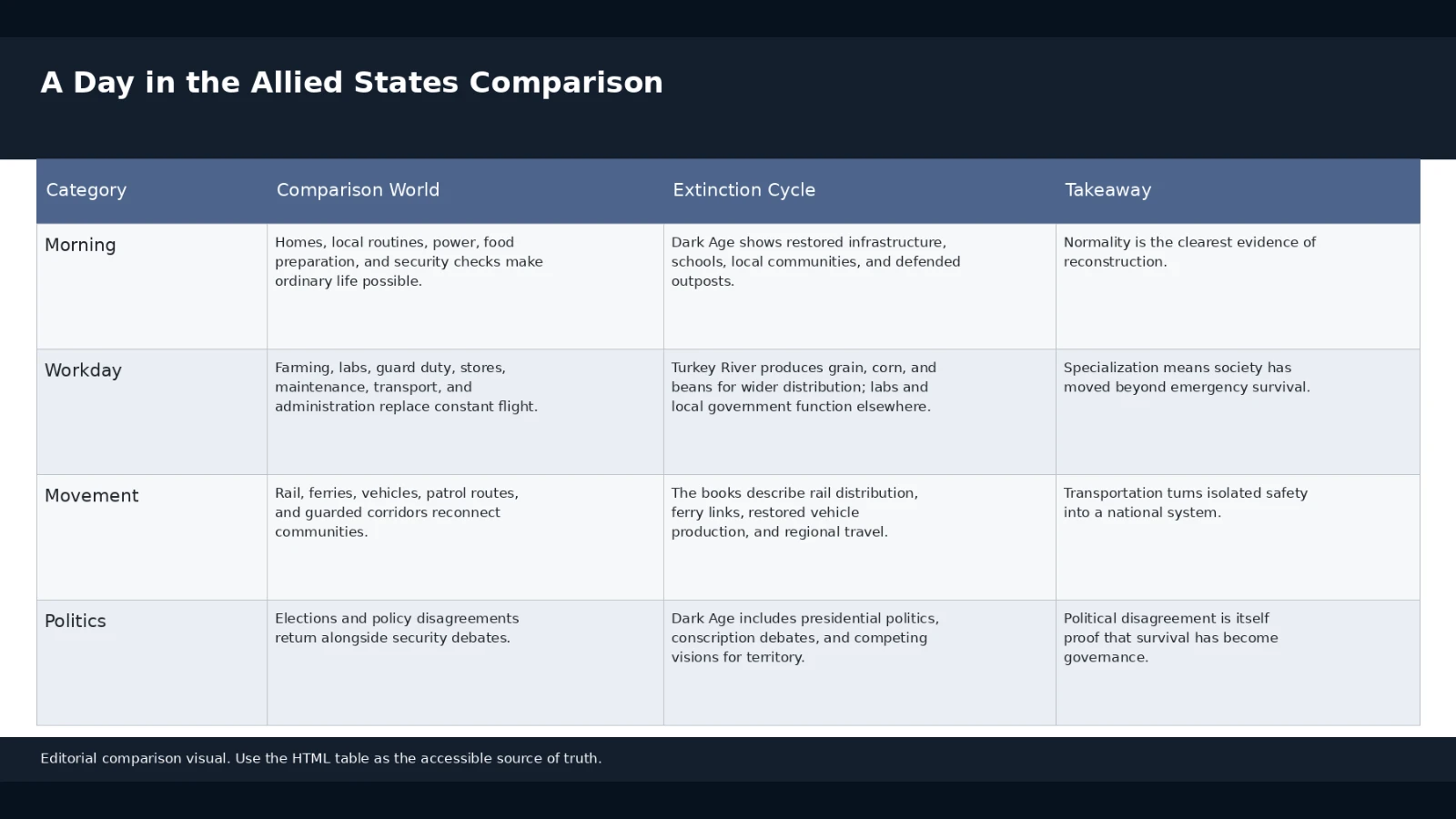
This independent fan reconstruction uses original generic artwork and a submitted editorial summary chart. It is not a missing chapter, does not reproduce official book art, and distinguishes stated facts from plausible daily-life inference.
Recommended next pages
Source and canon pack
- Canon treatment
- Dark Age opening material and current chapter-indexed site records establish the infrastructure, communities, security, transport, and politics. The hour-by-hour sequence is explicitly labeled as editorial reconstruction.
- Primary wiki source plan
- Dark Age, Allied States, Turkey River, Peaks Island, Outpost Portland, infrastructure, agriculture, transport, school, clinic, commerce, and election records.
- Spoiler scope
- Broad Dark Age worldbuilding and political spoilers; inferred daily-life scenes are labeled as reconstruction rather than quoted canon.
- Safety boundary
- Unofficial canon-grounded analysis. No official book artwork, named-character likenesses, invented quotations, real emergency instructions, advertising, or affiliation claims are published.
- Program article ID
- EC-42
- Scheduled publication
- 2026-08-26T18:53:00-04:00