
Survival geography and reconstruction
Outposts, Safe Zones, and Reconstruction Map
Map the Extinction Cycle’s refuges, safe zones, and Allied States outposts from Plum Island and Chicago to Turkey River, Galveston, and El Paso.
·
Category: Factions, Locations, and Outposts
Spoiler warning: Full setting, attack, political, and reconstruction spoilers follow for the original series, Extinction War, Extinction Cycle: Dark Age, and selected expanded-universe branches.
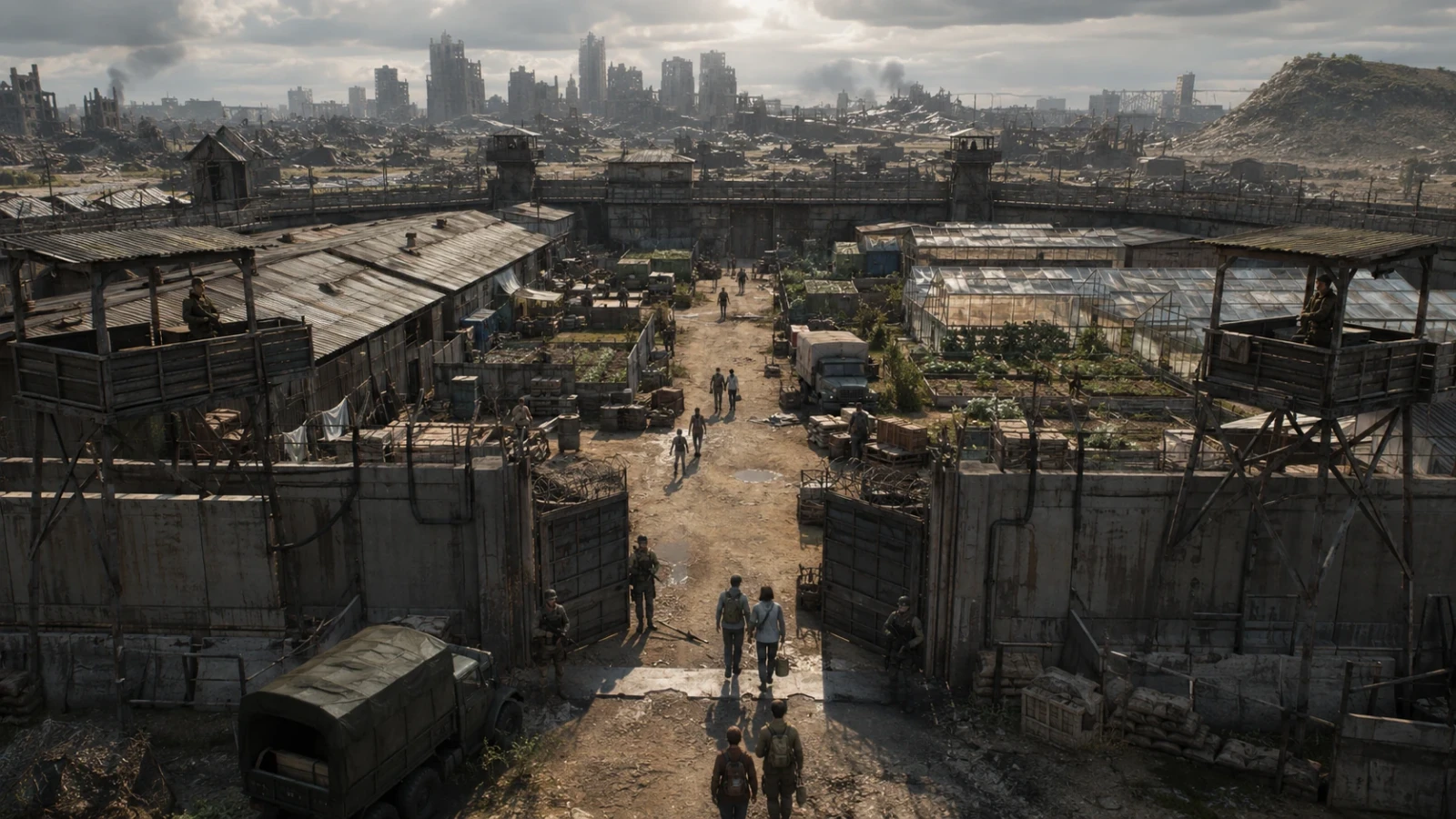
The geography of the Extinction Cycle changes almost as dramatically as the Variants themselves.
At the beginning of the catastrophe, survival is local, improvised, and temporary. A military base, a laboratory, a ship, a bunker, an island, or a remote facility can become "safe" simply because the infected have not reached it yet. By the middle of the original saga, the surviving government is trying to turn scattered refuge into organized territory. Safe-zone systems appear, military and civilian authorities attempt to protect surviving populations, and the war becomes as much about controlling geography as destroying infected hordes.
By the time of Extinction Cycle: Dark Age, the scale has changed again.
Eight years after Extinction War, the former United States has become the Allied States. The surviving population has consolidated into approximately one hundred walled outposts, concentrated mainly in the Midwest and on the East Coast. Much of the West remains too damaged or thinly populated to support the same recovery. President Jan Ringgold's administration has spent those years restoring basic infrastructure, agriculture, manufacturing, and portions of the energy grid. Team Ghost still travels beyond protected territory to hunt Variants and rescue prisoners, but most civilians now live inside a network designed to do something the early safe houses never could: support a society for years rather than keep a handful of people alive for another night.
That shift from refuge to reconstruction is one of the most important transformations in the entire series.
The story stops asking only, "Can this position survive the next attack?"
It begins asking harder questions.
Where does food come from?
How is it transported?
Which settlements receive fuel, medicine, weapons, and spare parts first?
How do refugees enter an outpost without bringing infection or infiltrators with them?
Who commands the soldiers guarding a community?
Who governs the civilians living behind the wall?
What happens when a settlement is agriculturally rich but politically divided?
What happens when one outpost falls and every community depending on its rail line suddenly has less food?
And what does "the country" mean when most of the old country is empty?
The resulting geography is not simply a collection of safe places. It is a survival system.
The settlement network can be followed across the original series, the postwar Dark Age era, and selected expanded-universe locations that show alternative approaches to rebuilding.
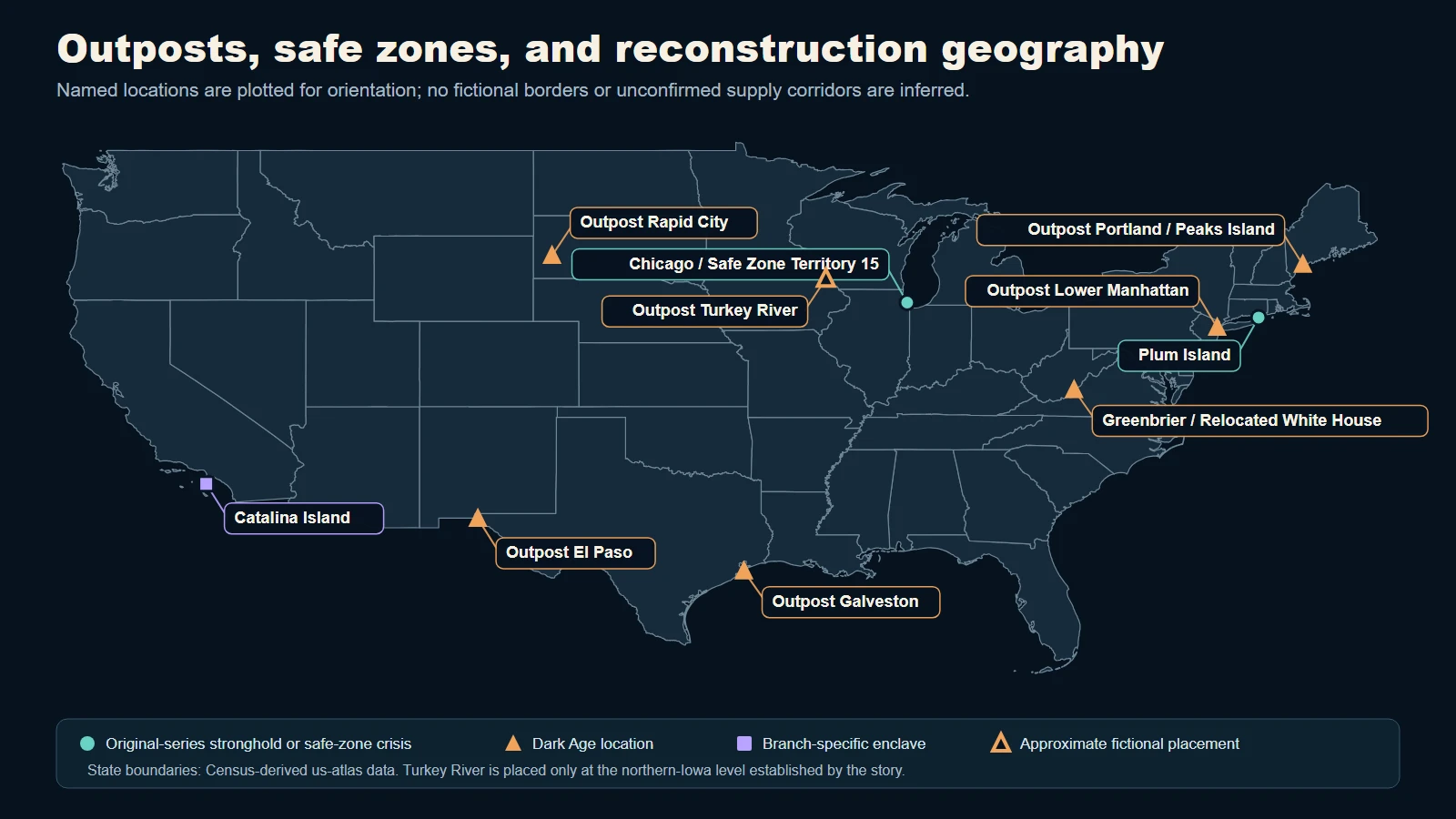
Map note: Some Extinction Cycle locations are real-world places used directly in the books, including Plum Island, Chicago, Rapid City, Portland, Peaks Island, Galveston, El Paso, Lower Manhattan, and the Greenbrier. Other settlements, most notably Outpost Turkey River, are fictional communities described by region rather than exact coordinates. Any approximate point on the accompanying map is labeled as approximate and should never be presented as a canon street-level location.
The Four Geographic Stages of Survival
The broad settlement history of the Extinction Cycle can be understood in four stages.
Stage One: Improvised refuge
During the outbreak, almost any defensible location can become temporary shelter. Military installations, homes, fire stations, tunnels, ships, research facilities, remote camps, and islands all serve as refuges. Their defining characteristic is uncertainty. The people inside do not know whether outside rescue exists, whether supply lines will return, or whether the shelter will remain viable.
Stage Two: Strategic strongholds and safe zones
As surviving authorities understand the scale of the disaster, refuge becomes more organized. Facilities such as Plum Island combine research, military security, command, and civilian protection. Naval assets become mobile strongholds. Later, surviving government territory is organized into safe-zone systems. These areas are more ambitious than shelters because they attempt to preserve populations and governmental control, not merely hide from infection.
Stage Three: Allied States outposts
After the Great War of Extinction, survivors consolidate into a national outpost network. The Dark Age series introduction states that roughly one hundred outposts exist eight years after Extinction War, mostly in the Midwest and East Coast. This is a deliberate demographic and economic geography. Agriculture is rebuilt in the Midwest. Manufacturing returns in the East. Walled settlements, rail connections, military protection, sensors, communications, and regional command create an interconnected state.
Stage Four: Reconstruction under pressure
The final stage is not a return to the old United States. It is the attempt to build something durable from what remains. Children grow up inside walls. Elections return. Refugees continue arriving. Trade resumes. Coffee from Florida reaches Maine. Canadian military officers coordinate with Allied States commanders. At the same time, Variants, collaborators, raiders, political rivalry, damaged infrastructure, and shrinking strategic depth demonstrate how fragile the recovery remains.
The map of the Extinction Cycle therefore becomes a map of dependence.
Every wall protects something.
Every road connects something.
Every outpost that goes dark creates consequences far beyond its perimeter.
Improvised Refuge: Safety Before There Was a System
Early in the outbreak, no national settlement strategy exists because no one understands how much of the nation still exists.
The first survivors operate inside fragments of the old world.
Fort Bragg matters because military families and soldiers initially expect the base to represent security. The Atlanta research infrastructure matters because scientists are still trying to understand the biological catastrophe. Ships matter because water temporarily separates survivors from the chaos on land. Individual fire stations, homes, roofs, and tunnels become shelters simply because their occupants are alive inside them.
But improvised refuge has a basic weakness: it does not solve supply.
A building can stop an infected person.
It cannot manufacture antibiotics.
A bunker can buy time.
It cannot grow food indefinitely.
A ship can escape a city.
It still requires fuel, maintenance, ammunition, clean water, trained crews, and somewhere to go.
This is why the series quickly evolves away from the fantasy of the perfect isolated hideout. Survival requires networks.
That truth becomes especially clear in the Extinction Survival branch. Communities such as Lost Valley, the Palomar survivors, Catalina Island, and surviving military enclaves eventually communicate, trade, relocate people, and share expertise. In Warrior's Fate, the Palomar group faces the reality that remaining in place will lead to starvation or Variant discovery. Their relocation toward Catalina is not merely an escape. It is a recognition that a scientifically useful group cannot preserve itself without joining a broader system.
Catalina later develops into a functioning enclave with local government, livestock, a makeshift hospital, a sheriff, and trading relationships with other surviving colonies and military remnants. The branch is distinct from the main Allied States storyline and remains separately marked on the map. Yet it reinforces the same larger point: long-term survival is regional and cooperative.
The lone fortress eventually runs out of something.
Plum Island: From Secret Facility to National Stronghold
Plum Island is one of the clearest transitional locations in the original series.
Before the outbreak, the facility is part of the secret world surrounding VX-99 research. Once the Hemorrhage Virus escapes and the crisis becomes existential, the same secure infrastructure is repurposed. Colonel Gibson views Plum Island as an emergency research center capable of receiving scientists, equipment, military protection, and live specimens. The facility becomes part laboratory, part command post, part quarantine site, and part refuge.
That combination makes Plum Island more than a safe house.
It is a strategic stronghold.
Scientists such as Kate Lovato require security because the cure and countermeasure effort cannot happen in the street. Soldiers require scientists because gunfire alone cannot solve a biological problem that keeps changing. Government leaders require both because any surviving political authority depends on stopping the disease and protecting what population remains.
Plum Island also illustrates why strongholds remain vulnerable.
Security depends on layered systems, human judgment, intelligence, and control of access. A fortified research center is valuable precisely because it concentrates scientists, leaders, technology, and irreplaceable expertise. That makes it a target.
In geographic terms, Plum Island represents the first major attempt to concentrate surviving national capability in one defensible location.
In political terms, it represents continuity.
The state may be shattered, but command, science, and military power are still trying to act like a state.
Safe-Zone Territories: Protecting Civilians at Scale
By Extinction War, protected territory has become more formal.
Chicago is especially important because the opening conflict includes newly infected people from Safe Zone Territory 15. The Resistance of Tyranny does not merely attack soldiers. It deliberately restarts infection inside protected territory.
That changes the meaning of a safe zone.
A perimeter is no longer only a barrier between infected and uninfected territory. It becomes a political promise.
People inside a safe zone believe the government can keep infection outside.
They believe screening works.
They believe military patrols can protect them.
They believe the wall represents a meaningful division between the catastrophe and whatever remains of ordinary life.
The Resistance of Tyranny demonstrates how fragile that promise can be. By weaponizing the Hemorrhage Virus against protected populations, human enemies turn security infrastructure into a psychological weapon. If a safe zone can be infected from inside, then the wall does not merely fail physically. It fails symbolically.
This is one of the major bridges between the original series and Dark Age.
The Allied States outpost system is built after humanity learns that defended territory is essential.
But it is also built in the shadow of what happened when safe territory proved penetrable.
The Allied States: Rebuilding by Consolidation
The postwar map is not an attempt to reclaim every former American city equally.
The Dark Age introduction is explicit: roughly one hundred outposts exist, most in the Midwest and East Coast, while the West Coast remains largely abandoned because of the destruction caused by the war.
That geography reflects survival economics.
The Midwest offers agricultural land.
The East offers population centers, ports, remaining industrial capacity, and manufacturing infrastructure.
The surviving government consolidates people around areas that can produce food, manufacture necessities, and be defended.
The result is not a restored fifty-state nation in the old sense.
It is a network of fortified nodes.
Between those nodes lie damaged roads, abandoned towns, Variant territory, raider routes, collaborator encampments, and frontier.
This distinction matters because a map shaded as though the entire Allied States is continuously controlled would be misleading. The books describe outposts and corridors, not the seamless repopulation of every county between them.
The Allied States is therefore best visualized as an archipelago on land.
The walls are islands.
Rail lines, roads, aircraft, ships, and communications are the bridges.
Outpost Turkey River: The Agricultural Heart of the Network
Outpost Turkey River provides the clearest detailed picture of ordinary postwar life.
The community lies in northern Iowa, although its exact fictional coordinates are not established. It is controlled by Allied States authorities under Commander Justin Bell, with veterans such as retired Master Sergeant Cedric Long helping guard the settlement.
Turkey River is heavily defended.
The community is circular and surrounded by a twenty-foot steel wall. Its defensive system includes guard towers, razor wire, sensors, minefields, soldiers, working dogs, and armed positions. Inside, residents have homes, businesses, a general store, a post office, solar panels, and a communal area.
The most important feature, however, is not the wall.
It is the corn.
Turkey River has clear water and fertile land. The outpost produces grain, corn, and beans in quantities far beyond the needs of its roughly three hundred residents. Much of that food is shipped by rail to the nearly one hundred other Allied States outposts.
That fact transforms Turkey River from a safe settlement into strategic infrastructure.
If Turkey River falls, the loss is not three hundred people and one defensive position.
The loss is food moving across the network.
This is why the settlement is also a political hotspot. President Ringgold and Vice President Dan Lemke visit. Mark Cornelius, Lemke's rival and leader of the Freedom Party, is scheduled to visit as part of the succession campaign. Agricultural abundance creates political importance because food distribution is power.
Turkey River also demonstrates the danger of reconstruction success.
Many residents, especially children born after the Great War, have never seen a Variant. Some guards have spent years dealing mostly with human raiders. Routine makes the extraordinary threat feel historical.
Then the outpost's security assumptions collapse.
The Dark Age story begins by turning one of the nation's safest agricultural communities into proof that the enemy never stopped adapting.
Outpost Rapid City: The Frontier Problem
Rapid City, South Dakota sits at a different strategic point.
When President Ringgold tells Beckham and Horn that Outpost Rapid City has gone offline shortly after Turkey River, Horn immediately identifies its importance: Rapid City sits near the frontier with the West.
That short exchange reveals the political geography of the Allied States.
The country has a frontier.
This is not just a poetic way to describe damaged territory. It means the government's practical control weakens toward the largely abandoned West. An outpost near that boundary serves as an early-warning position, a population center, a logistical stop, and a line beyond which rescue becomes more difficult.
When a frontier outpost goes dark, leaders do not know whether they are seeing a communications failure, an isolated attack, or a wider invasion.
That uncertainty creates one of reconstruction's recurring problems.
The outpost network is only as intelligent as its communications.
A silent settlement forces the national command to spend aircraft, troops, fuel, and time simply learning what happened.
Outpost Portland and Peaks Island: What Recovery Looks Like
Outpost Portland and nearby Peaks Island show a more mature form of postwar life.
Reed Beckham, Kate Lovato Beckham, their son Javier Riley, Parker Horn, and Horn's family live within this protected Maine community. Peaks Island is described as lying in the heart of a safe zone protected by advanced sensors, soldiers, sailors, and trusted neighbors. A community health center doubles as Kate's laboratory, and a hidden underground safehouse provides a final line of defense.
The physical security is significant.
The social details are more revealing.
Kate can sit near the water in the morning.
Javier attends school.
Coffee grown in Florida reaches Maine.
Refugees arrive almost every day.
Those details show an economy and society moving beyond emergency survival.
Coffee is not strategically essential in the same way as grain or ammunition. Its presence demonstrates trade, agricultural specialization, transportation, and enough stability for people to value ordinary comforts again.
Refugees reveal the opposite side of the recovery.
Even eight years after the war, people elsewhere are still fleeing poverty, starvation, and violence. Outpost Portland is safer than many parts of the world, so its success produces a continuous humanitarian burden.
Every new arrival needs screening.
Every family needs food.
Every additional resident affects housing, medicine, sanitation, security, and employment.
A successful outpost attracts people.
That means success creates its own logistical problem.
Portland's later attack also demonstrates that advanced sensors and safe-zone status do not eliminate vulnerability. Fires, explosions, communications loss, and evacuation toward shelters quickly return residents to the habits of the first war.
Reconstruction can make catastrophe less frequent.
It cannot make catastrophe impossible.
The Greenbrier: Government Needs a Place to Exist
The Allied States is not only a collection of local communities.
It also attempts to preserve national government.
The Greenbrier in West Virginia becomes associated with the relocated White House and continuity of federal leadership. Cedric Long's service history includes security duty there before he is transferred to Turkey River.
This matters geographically because government itself requires infrastructure.
A president cannot coordinate a dispersed nation from an abstract concept.
National leadership requires secure rooms, communications, military links, intelligence, staff, transportation, and redundancy.
The Greenbrier therefore functions differently from Turkey River.
Turkey River feeds the network.
The Greenbrier coordinates it.
Its value is political and administrative rather than agricultural.
That distinction is essential for the settlement map. Population and defensive strength alone do not determine a location's importance. Some places matter because losing them would damage national command.
Galveston: Command, Refugees, and the Southern Shift
Galveston becomes increasingly important as the Dark Age conflict reshapes the Allied States.
The Texas island supports military command functions, refugees, a makeshift runway along Seawall Boulevard, and a command information center established by General Mark Cornelius in the old Harbor House Hotel. The CIC contains computers, radios, drone and scout imagery, maps of surviving outposts, and live feeds from the remaining network.
Galveston is also a political location.
Cornelius is not simply a general. He is the leader of the Freedom Party and a major national rival to the Ringgold-Lemke political order. That means the same place can simultaneously function as a military hub, refugee destination, and political power base.
Later, Canadian officers arrive with seismic detection equipment recovered through Team Ghost operations. Galveston becomes part of an international defensive system, not merely a local Texas settlement.
By the later stages of the conflict, Ringgold tells Beckham that remaining defenses and evacuations are being concentrated around twenty-five surviving outposts, mostly in the Southeast from Florida to Texas.
The national map is shrinking again.
That is one of the clearest examples of how a war can reverse reconstruction.
The first postwar years expand a network.
A renewed Variant war compresses it.
Outpost El Paso: Rebuilding Defense on the Western Edge
Outpost El Paso shows a different version of strategic vulnerability.
The outpost incorporates Briggs Army Airfield and sits beneath the Franklin Mountains. During the cited Dark Age sequence, Lieutenant Riggs is responsible for organizing defensive operations. S.M. Fischer and his team arrive to help reinforce the position after severe Variant attacks.
The surrounding city bears the damage.
Filled-in tunnel craters mark recent Variant movement.
Broken homes and vehicles show the consequences of attack.
Guard towers sweep the darkness with spotlights.
The significance of El Paso is not that it represents comfortable recovery.
It represents defended persistence.
The outpost exists in a difficult geographic position with direct exposure to the western threat environment. It requires air mobility, engineering, fortified positions, and outside assistance.
It also illustrates another logistical reality: outposts do not all possess the same resources.
A national network may call every settlement an Allied States outpost, but equality of name does not produce equality of capability.
Some grow food.
Some hold airfields.
Some coordinate government.
Some absorb refugees.
Some survive because another outpost sends engineers, weapons, aircraft, or supplies.
Outpost Lower Manhattan: Reclaiming a City Is Not the Same as Making It Safe
The appearance of Outpost Lower Manhattan in the later Dark Age material demonstrates how far reconstruction has advanced.
Manhattan was once one of the most dangerous symbols of the extinction catastrophe. Team Ghost fought through its streets and underground spaces while Variants turned the city into hunting ground.
Later, survivors establish an outpost there.
That is an extraordinary political statement.
Reclaiming Lower Manhattan says that civilization is no longer willing to survive only in remote strongholds. It is trying to occupy the old centers of national life again.
But the price is high.
When the outpost is attacked, S.M. Fischer and his engineers help hold defenses long enough for evacuations. Commander Amber Massey later speaks at Fischer's memorial, and the loss becomes part of a broader national story about sacrifice.
Urban reconstruction multiplies both opportunity and risk.
A city offers buildings, transportation infrastructure, ports, power systems, communication nodes, and symbolic value.
It also offers tunnels, ruins, blind approaches, old underground networks, and an enormous perimeter to secure.
The question is no longer whether a city can be entered.
It is whether a city can be kept.
Catalina Island: A Branch-Specific Alternative
Catalina Island belongs to the Extinction Survival branch, not the core Allied States storyline, and the map therefore separates it from Allied States locations.
Its importance is comparative.
The Catalina community demonstrates how survivors can build local institutions without reproducing the exact Allied States model. By the later Extinction Survival timeline, the island supports residents, livestock, a makeshift hospital, local governance, and trade with other colonies and surviving military groups. Rayford "Porky" Shader serves as acting sheriff and ambulance driver, while his wife works as the island veterinarian.
Housing capacity exceeds population.
The community has room to grow but remains dependent on trade, skills, and outside relationships.
This branch also shows colonies coordinating military resources. Catalina personnel participate in wider operations, and surviving forces from places such as Twentynine Palms trade with other communities.
In other words, there is more than one way to rebuild.
The Allied States creates a federal outpost system.
The Survival branch shows a looser network of enclaves, colonies, veterans, scientists, trade, and local councils.
Both systems reach the same conclusion.
Isolation is temporary.
Networks are survival.
Settlement Comparison
| Location | Era | Geographic role | Control | Primary survival function | Major vulnerability |
|---|---|---|---|---|---|
| Plum Island | Season 1 | Offshore New York stronghold | Military, scientific, government authorities | Research, command, quarantine, refuge | Concentration of irreplaceable people and resources |
| Chicago / SZT 15 | Season 1 | Protected urban territory | Surviving government safe-zone system | Civilian protection and territorial control | Infection can be weaponized from inside the system |
| Turkey River | Dark Age | Northern Iowa agricultural node | Commander Justin Bell / Allied States | Grain, corn, beans, water, rail exports | Food dependence makes it a strategic target |
| Rapid City | Dark Age | South Dakota frontier node | Allied States | Western warning and frontier security | Isolation and communications loss |
| Portland / Peaks Island | Dark Age | Maine coastal safe zone | Allied States and local security | Civilian life, science, medicine, refugees | Refugee pressure and high-value civilian concentration |
| Greenbrier | Dark Age | West Virginia federal command node | Allied States federal leadership | Presidency and national coordination | Command concentration |
| Galveston | Dark Age | Texas southern command hub | Allied States, with Cornelius as major military-political figure | CIC, refugees, staging, regional defense | Political competition and wartime concentration |
| El Paso | Dark Age | Western Texas defensive outpost | Allied States local command | Airfield, engineering, frontier defense | Repeated attacks and limited local resources |
| Lower Manhattan | Dark Age | Reclaimed urban outpost | Allied States | Urban recovery, strategic presence | Dense ruined terrain and evacuation complexity |
| Catalina Island | Survival branch | Southern California island enclave | Local community and military veterans | Refuge, livestock, trade, local government | Resupply, population, specialist dependence |
Why Agriculture Becomes a Military Problem
One of the most important facts in the postwar settlement system is that food production is geographically concentrated.
Turkey River is the clearest example.
Its residents grow far more than they eat. The surplus leaves by rail and feeds other outposts.
This arrangement is efficient.
It is also dangerous.
A self-sufficient village can lose a neighbor and continue eating.
An interconnected state can lose a major agricultural node and experience shortages hundreds of miles away.
That is the central paradox of reconstruction.
Networks create strength by allowing specialization.
Networks also create cascading failure.
A farm settlement can focus on food because another outpost handles manufacturing.
A manufacturing center can focus on tools because rail lines deliver grain.
A scientific community can focus on research because soldiers protect it.
A coastal outpost can receive refugees because inland communities produce surplus.
The system becomes stronger than isolated enclaves precisely because each place no longer has to do everything.
But once specialization appears, logistics becomes a national security issue.
Rail, Roads, Airfields, Ships, and Communications
The original outbreak destroys the assumption that transportation is ordinary.
In the reconstructed world, transportation is strategic infrastructure.
Rail matters because bulk food has to move between outposts.
Aircraft matter because teams need to cross Variant territory quickly.
Airfields such as the one inside Outpost El Paso become strategic assets.
Ships remain important for military mobility and coastal operations.
Communications matter because an outpost going silent forces commanders to assume the worst.
The disappearance of communications from Turkey River and Rapid City produces an immediate national crisis because silence destroys situational awareness.
This is why the outpost network cannot be understood as dots on a map.
The lines between the dots are just as important.
Rail corridors, air routes, naval links, and evacuation movements remain less completely documented than the settlements themselves. Treating an inferred connection as a confirmed route would make the network appear more precise than the books support.
Refugees and the Politics of Safety
Outpost Portland receives refugees almost daily.
Galveston also receives displaced people.
The later conflict forces Ringgold's government to reroute evacuations toward a shrinking group of remaining outposts.
This creates a difficult political reality.
A protected settlement is morally valuable because it can save people outside its walls.
But every person admitted increases demand.
Food.
Housing.
Medical care.
Security screening.
Employment.
Sanitation.
Education.
Fuel.
The same population growth that strengthens a society can strain it.
Refugee screening is also not merely administrative. The Extinction Cycle includes collaborators and repeated examples of human enemies working alongside Variant forces. A gatekeeper must therefore distinguish desperate civilians from deliberate infiltrators without turning the settlement into a place that has abandoned the values it claims to preserve.
That is a political problem, not simply a tactical one.
Elections Return Before the World Is Fully Safe
Turkey River demonstrates one of the strangest signs of recovery: politicians campaign there.
Ringgold and Lemke visit.
Cornelius is expected.
The outpost produces food, so it matters economically.
Its residents vote and matter politically.
That is a profound change from the opening books.
In the outbreak, legitimacy comes from whoever can keep people alive.
In the Allied States, legitimacy begins to return to institutions, elections, parties, and civilian authority.
But military danger has not disappeared.
That creates tension.
How much power should commanders have?
How aggressively should the government reclaim western territory?
How many resources should remain committed to defense when people want housing, trade, schools, and ordinary life?
How should leaders respond when a security crisis erupts during a political succession?
The Freedom Party and the Ringgold-Lemke establishment do not merely disagree about personalities. They represent competing visions for how a recovering nation should use scarce power.
Reconstruction therefore creates political conflict because there is finally enough stability for people to disagree about the future.
That is progress.
It is also dangerous.
Why Defeating Variants Is Not the Same as Winning
A war can end with an enemy defeated.
Reconstruction does not have a comparable finish line.
A Variant nest can be destroyed.
A rail system requires maintenance every year.
A wall can be built.
A child still needs school.
A generator can be repaired.
Fuel must arrive again next month.
An election can be held.
The losing side still has to believe the government is legitimate.
This is the deeper reason the postwar map matters.
The Extinction Cycle begins as a biological and military apocalypse.
It becomes a story about whether institutions can survive catastrophe.
The Allied States outpost system is not simply a collection of forts.
They are experiments in civilization.
Turkey River tests whether agriculture can be protected.
Portland tests whether ordinary family life and scientific work can coexist with refugee pressure.
The Greenbrier tests whether federal government can still coordinate a dispersed nation.
Galveston tests whether military command and political rivalry can share the same strategic space.
El Paso tests whether the frontier can be defended without draining the rest of the network.
Lower Manhattan tests whether lost cities can become inhabited territory again.
The system succeeds only when all of these functions reinforce one another.
The Reconstruction Map as a Story Map
The geographic arc of the series can be summarized simply.
At first, people hide where they can.
Then they defend what they have.
Then they organize territory.
Then they connect settlements.
Then they begin rebuilding institutions.
Then the enemy learns how to attack the connections.
That final step is what makes Dark Age more than a second Variant war.
The danger is no longer only that monsters can kill people.
The danger is that they can break the systems that allow people to live as a society.
Destroy an agricultural outpost and hunger spreads.
Destroy communications and fear spreads.
Attack a refugee hub and displacement spreads.
Undermine an election and distrust spreads.
Overrun a frontier post and strategic depth disappears.
This is why a settlement map is one of the most useful ways to understand the second era of the Extinction Cycle.
The map shows where people live.
The network shows why those places matter.
Final Takeaway
The safest place in the Extinction Cycle is never truly a place.
It is a system that works.
Walls matter.
So do farms.
Sensors matter.
So do rail lines.
Soldiers matter.
So do doctors, engineers, teachers, mechanics, farmers, administrators, elected leaders, and civilians willing to trust one another enough to rebuild.
Plum Island proves that a secure facility can preserve science and command.
Safe Zone Territory 15 proves that protected territory can be turned against itself.
Turkey River proves that food can become strategic infrastructure.
Rapid City proves that the frontier remains dangerous.
Portland and Peaks Island prove that recovery can produce family life, schools, medicine, trade, and refugee responsibility.
The Greenbrier proves that government needs a physical center.
Galveston proves that military coordination and politics cannot be separated forever.
El Paso proves that surviving outposts do not possess equal resources.
Lower Manhattan proves that reclaiming the old world is possible but never cheap.
Catalina Island, in the Survival branch, proves that local enclave networks can reach similar conclusions through a different political structure.
Together, these locations trace the central geographic evolution of the series:
shelter becomes stronghold, stronghold becomes safe zone, safe zone becomes outpost, and outpost becomes society.
The Variants nearly destroy humanity.
Reconstruction asks whether humanity can do the harder thing after surviving them.
Live together again.
FAQ
How many outposts are in the Allied States?
The Dark Age introduction states that survivors have consolidated into approximately one hundred outposts eight years after Extinction War. Most are concentrated in the Midwest and East Coast, while the West Coast remains largely abandoned because of wartime destruction.
Where is Outpost Turkey River?
The story places Outpost Turkey River in northern Iowa. Its exact fictional coordinates are not established, so map placement should remain approximate. It is an important agricultural community that exports grain, corn, and beans by rail to other Allied States outposts.
Where do Reed Beckham and Kate Lovato live after the war?
They live in the Outpost Portland and Peaks Island safe-zone community in Maine with their son Javier Riley. Peaks Island is protected by advanced sensors, soldiers, sailors, and an underground safehouse connected to the community health center and Kate's laboratory.
What happened to safe zones before the Allied States outposts?
The original series shows protected safe-zone territory before the eight-year reconstruction period. In Extinction War, the Resistance of Tyranny attacks the safe-zone system by deliberately spreading renewed infection, demonstrating that walls and protected territory can be undermined from within.
What is the most important agricultural outpost?
Outpost Turkey River is one of the clearest strategic food-production nodes described in detail. Its fields produce enough grain, corn, and beans to support its own roughly three hundred residents and provide rail shipments to the broader outpost network.
Why is Galveston important in Dark Age?
Galveston becomes a southern military and political hub. General Mark Cornelius operates a command information center there, refugees arrive through the settlement, military planning is coordinated from the island, and outside allies including Canadian officers participate in defense discussions.
Is Catalina Island part of the same Allied States outpost system?
Catalina Island is important in the Extinction Survival branch and remains branch-specific rather than being silently merged into the core Allied States chronology. It provides a useful comparison because its survivors develop local government, livestock, trade, medical care, and security through a more decentralized enclave system.
Why does reconstruction create new problems after the Variants are defeated?
Because long-term survival depends on interconnected systems. Agriculture, rail transport, fuel, medical capacity, refugee screening, communications, manufacturing, elections, and legitimacy all create dependencies. Losing one important settlement can therefore affect communities hundreds of miles away.
Primary Source Basis
The geographic reconstruction rests on the following story foundations rather than unsourced map assumptions.
- Extinction Horizon and the original main-series arc for Plum Island, military-scientific refuge, early strongholds, and continuity of government.
- Extinction War for Chicago, renewed infection inside safe-zone territory, the Resistance of Tyranny, and the transition toward postwar political geography.
- Extinction Cycle: Dark Age, especially the introduction and Extinction Shadow, for the eight-year reconstruction period, approximately one hundred outposts, the Midwest and East Coast concentration, Outpost Turkey River, Rapid City, Outpost Portland, Peaks Island, the Greenbrier, and postwar institutions.
- Later Dark Age material for Galveston, Outpost El Paso, Lower Manhattan, shrinking surviving outposts, refugee movement, Cornelius, national politics, and regional defense.
- Walt Browning's Extinction Survival series, especially Warrior's Fate, for Catalina Island and the decentralized California enclave network.
Map Accuracy Note
The accompanying geographic map distinguishes:
- Named real locations: the pin can be placed at the real-world city, island, or facility.
- Named real region with unspecified outpost boundary: the pin represents the city or region, not a claimed canon gate coordinate.
- Approximate fictional placement: the books establish a broad region but not a precise coordinate. Outpost Turkey River is the clearest example.
- Branch-specific location: part of an expanded-universe branch and not automatically equivalent to an Allied States outpost.
Exact coordinates, settlement boundaries, populations, controllers, and supply routes remain unspecified wherever the books do not provide them.