
Eight years between wars
The Dark Age Eight-Year Gap Explained
See what changes during the eight years before Extinction Cycle: Dark Age, including the Allied States, outposts, Team Ghost, families, politics, and Variant threats.
·
Category: Chronology and Continuity
How the Extinction Cycle moves from a civilization barely surviving the Great War of Extinction to a rebuilt society with outposts, farms, elections, schools, industry, families, and a dangerous belief that the worst is over.
Spoiler warning: Full spoilers follow for the end of Extinction War and major setting developments across all four Extinction Cycle: Dark Age books.
The most important fact about the eight-year gap before Extinction Cycle: Dark Age is easy to miss because the sequel series quickly begins destroying things again.
Humanity actually rebuilt.
The world at the opening of Extinction Shadow is not simply the old apocalypse with older characters. It is not a collection of survivors sleeping in bunkers beside burned cities. It is not eight years of Reed Beckham, Parker Horn, Joe Fitzpatrick, and Kate Lovato waking up every morning to fight the same war in the same ruins.
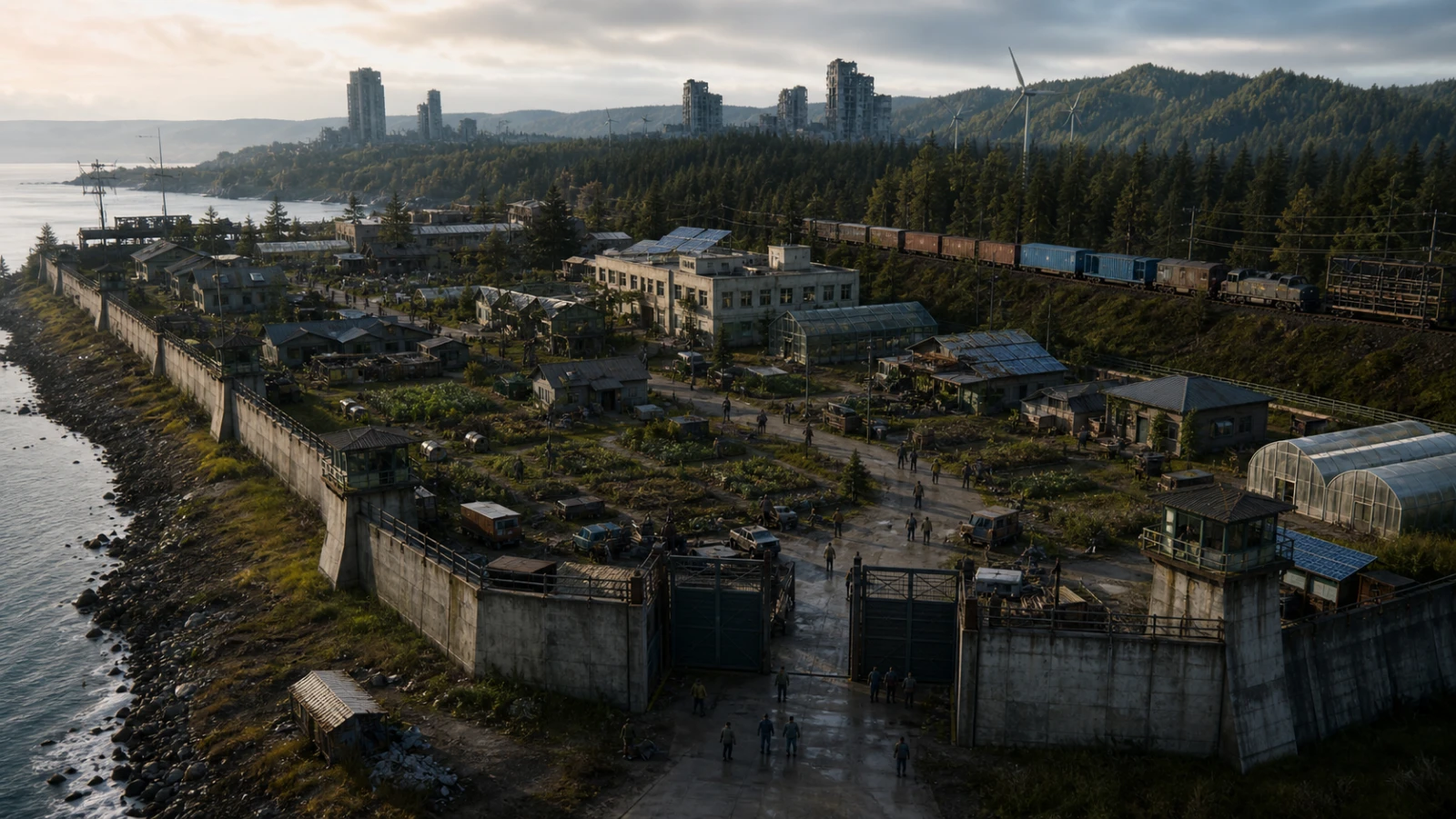
The Great War of Extinction ends with humanity still alive, barely. Eight years later, a new political entity called the Allied States governs much of the surviving American population. Roughly one hundred fortified outposts are concentrated mostly in the Midwest and East Coast. The West Coast is largely abandoned because of the destruction from the original conflict. Agriculture is functioning again. Manufacturing has returned. Parts of the electrical grid have been restored. Oil operations are active. Rail moves food between settlements. Telecommunications engineers are nearing the return of personal cellular service. Children attend school. Families eat dinner together. Political parties campaign for national office.
That is the civilization Dark Age attacks.
The distinction changes the meaning of the sequel. In the original series, a Variant attack means one more piece of a collapsing country has failed. In Dark Age, an attack can destroy a food-producing community that supplies other outposts, influence an election, expose a strategic security failure, displace refugees, disrupt trade, and shatter public confidence in a government that has spent eight years promising that recovery is real.
The central tension is therefore not simply whether the Variants survived.
It is whether civilization survived long enough to become vulnerable in new ways.
The Eight-Year Gap at a Glance
| Area | At the end of the original war | At the opening of Dark Age |
|---|---|---|
| Political order | Government survives in emergency form after catastrophic losses | The Allied States operates as a functioning national government with a president, vice president, parties, polls and an upcoming election |
| Population geography | Survivors are scattered among ships, military installations, safe zones and damaged settlements | Much of the population has consolidated into roughly one hundred defended outposts, mostly in the Midwest and East Coast |
| Economy | Survival supply chains dominate | Farms, factories, oil production, vehicles, rail shipment and energy production are functioning again |
| Daily life | Quarantine, evacuation, rescue and war | Schools, family homes, local stores, ferries, community meals, jobs and political campaigns exist alongside security routines |
| Team Ghost | Reed Beckham's era ends through catastrophic injuries; the unit is rebuilt under Joe Fitzpatrick | Fitz has led Team Ghost for years on frontier hunts, Variant kills and prisoner rescues |
| Reed Beckham | Physically devastated by the endgame and struggling to survive | Retired, married to Kate, raising Javier Riley on Peaks Island, still nationally respected and increasingly pulled toward politics |
| Kate Lovato Beckham | Scientist at the center of the biological war | Scientist, teacher, mother and local civic figure with a lab inside the Outpost Portland safe zone |
| Variant picture | Multiple forms survive a war of bioweapons and military campaigns | The public and much of the military believe remaining Variants are isolated, starving remnants, while the true threat has become more organized |
| Public psychology | Extinction feels immediate | Security feels normal enough for some children to have never seen a Variant, creating a dangerous gap between memory and belief |
The eight-year gap is not empty chronology. It is the period in which emergency survival becomes institutions.
The Gap Begins With a Victory That Does Not Feel Like One
By the end of the first great conflict, humanity has avoided literal extinction, but the victory is ruinous.
The original war destroys cities, military formations, families, governments and much of the infrastructure that connected the United States. The campaign against increasingly dangerous Variant forms forces commanders into strategies that would have been unthinkable before the outbreak. Reed Beckham survives, but the cost is written into his body. He loses a hand, part of a leg, and much of the vision in his right eye. His physical condition marks the end of the period when Team Ghost can simply remain Reed Beckham's field unit.
That transition matters because the gap is also a succession story.
Joe Fitzpatrick inherits the operational burden. Extinction Aftermath, Extinction Lost, and the European campaign show Team Ghost becoming something larger than the original six-man team. Under Fitz, it is no longer defined only by the men who entered Building 8. The unit becomes an institution that can survive replacements, changing theaters and commanders.
The source material does not provide a complete annual ledger of all eight postwar years. It does, however, give the endpoints clearly. Team Ghost continues operating throughout the gap, running missions into frontier and lawless territory to hunt Variants and rescue prisoners. By the opening of Dark Age, Fitz is not a newly appointed commander. He is the veteran head of a standing response organization that has spent years dealing with the remnants everyone else wants to believe are fading away.
That continuity is one reason the gap works. Civilization rebuilds because the war is no longer everywhere, but the war never disappears for the people assigned to patrol its edges.
Society Changes From Survival to Routine
The clearest evidence of the gap is not a new weapon or political office.
It is breakfast.
It is coffee.
It is school.
It is a ferry schedule.
On Peaks Island near Outpost Portland, Kate can walk the shoreline in the morning. Her family lives in a house close to the water. Javier Riley Beckham is eight years old and goes to school. Kate teaches and works in a laboratory. Parker Horn lives nearby with Tasha and Jenny. Jake Temper and his son Timothy are part of the same community circle. Families share dinners. Teenagers worry about school, cooking, friendships and the future.
Those details are strategically important because they prove the world has moved beyond temporary shelter.
Coffee is growing in Florida again. People can buy groceries. There are town hall meetings. Workers commute between Peaks Island and Portland by ferry. The community health center serves multiple roles, including medicine, science and emergency protection. Residents keep bug-out bags, run drills and know where shelters are, but the existence of those drills does not cancel out normal life. It enables it.
This is the deepest contrast with the original outbreak era.
During the first war, normal life is what characters remember losing. In Dark Age, normal life is what characters have managed to build.
The new danger is that people can begin treating that normality as permanent.
Geography Changes: Survival Becomes Consolidation
The Allied States is not a restored copy of the prewar United States.
Its geography reflects what the war destroyed.
The Dark Age introduction explains that most survivors have migrated into approximately one hundred outposts, concentrated largely in the Midwest and East Coast. The West Coast is mostly abandoned because of the scale of destruction there. Later scenes reinforce that many major urban centers remain decaying wastelands or frontier zones rather than fully reclaimed cities.
This consolidation is one of Jan Ringgold's most consequential achievements.
Protecting a widely scattered population after the war would have been nearly impossible. By concentrating survivors in defensible areas, the government can use limited soldiers, food, machinery and infrastructure more efficiently. The surviving country becomes smaller in practical terms, but more governable.
Outpost Turkey River demonstrates what that strategy looks like on the ground.
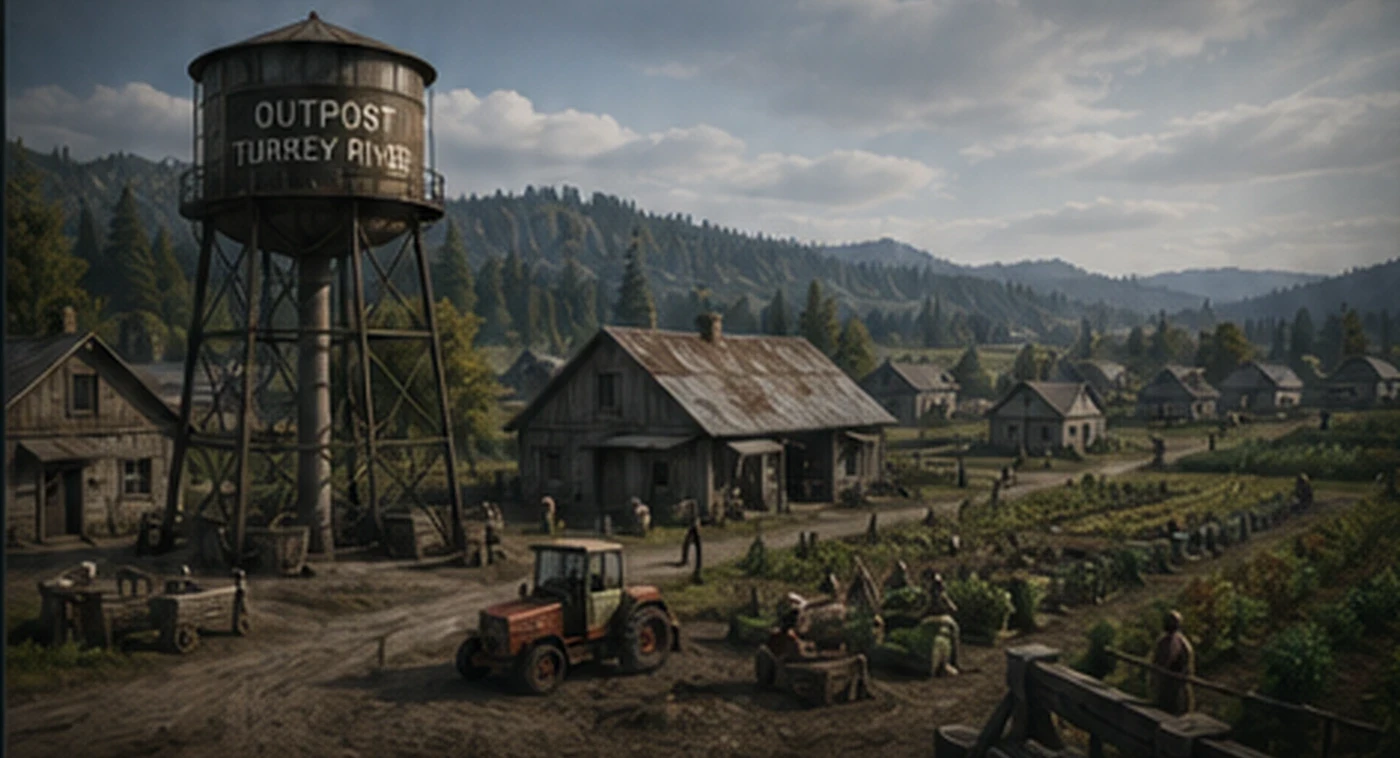
The northern Iowa settlement has around three hundred residents. It is surrounded by a twenty-foot steel wall, guard towers, razor wire, sensors and minefields. German Shepherds are used on patrol. Solar panels sit on roofs. Wind turbines provide power. The surrounding land produces grain, corn and beans, much of which moves by rail to other Allied States outposts.
This is not a bunker.
It is a town integrated into a national system.
That is why its disappearance at the beginning of Dark Age is so destabilizing. Losing three hundred people is horrific on its own. Losing one of the important agricultural communities supplying other outposts is also a logistical event. It threatens harvests, rail shipments and faith in the security architecture protecting the entire nation.
The first war teaches people how to survive isolation.
The gap teaches them how to depend on each other again.
That dependence becomes a new weakness.
The Economy Returns, and With It New Strategic Targets
President Ringgold's later reflection on her administration makes the scale of reconstruction unusually concrete.
Factories are operating again. An old General Motors plant has produced thousands of new vehicles. Farms and orchards are feeding the country's citizens. Wind and solar energy support agricultural production. Part of the electrical grid has been rebuilt. Telecommunications engineers are close to restoring a cellular network for personal use. Texas oil operations fuel the expanding economy.
That is much more than survival.
It is a functioning recovery economy.
Each restored system also creates a target list.
If food is local and people scavenge independently, destroying one farm hurts one group. If a major agricultural outpost exports grain to a network of settlements, attacking it creates cascading shortages.
If most movement occurs by foot, a destroyed rail line matters less. Once the Allied States relies on trains, trucks, fuel and industrial production, transportation security becomes national security.
If everyone lives by candlelight, destroying an electrical substation changes little. Once homes, farms, command centers and communications depend on restored power, infrastructure sabotage becomes strategic warfare.
The gap therefore changes what victory means for humanity and what intelligent enemies need to attack.
The New Gods and their collaborators do not have to kill every survivor individually if they can break the systems holding those survivors together.
Government Changes From Emergency Command to Politics
One of the strongest signs that civilization has genuinely returned is that people once again have the luxury of disagreeing about how it should be governed.
Jan Ringgold's administration has survived long enough for constitutional politics, or at least a recognizable postwar version of national politics, to re-emerge. Her second term is ending. Vice President Dan Lemke is running to succeed her. Retired General Mark Cornelius leads the Freedom Party and challenges the governing coalition.
Polling matters.
Campaign visits matter.
Endorsements matter.
Oil production gives private figures political leverage. Military policy becomes an election issue. Citizens debate whether abandoned cities should be retaken or left to the remaining Variants.
That would be absurd during the opening weeks of the outbreak.
Eight years later, it is exactly what recovery looks like.
The central political dispute also reveals the generational cost of rebuilding. Cornelius and the Freedom Party support a far more aggressive reclamation strategy, including conscription of young adults and major offensives into abandoned territory. Ringgold and her allies prefer a more measured policy, using Team Ghost and other specialized forces to eliminate threats that directly endanger outposts rather than spending the postwar generation in another continental campaign.
Neither side is debating whether Variants are dangerous.
They are debating what a recovering nation owes the territory it lost, what level of risk citizens should accept, and how much military sacrifice the next generation should be forced to bear.
That is a postwar political argument, not an outbreak argument.
And it becomes explosive once attacks such as Turkey River appear to prove that the government's restraint may have allowed the enemy to survive.
Defense Changes From Desperate Firepower to Layered Security
The original war contains enormous amounts of military force, but much of it is reactive. Units move into cities with incomplete intelligence. Bases fall. Aircraft evacuate survivors. Scientists race to understand threats that mutate faster than plans can adapt.
Eight years later, the defense problem looks different.
Outposts have walls, towers, controlled gates, sensors, infrared equipment, dogs, minefields and standing guard rotations. Peaks Island sits inside a protected safe zone with soldiers, sailors, surveillance and an underground safehouse. Communities conduct drills. Weapons are stored for emergencies. Security jobs become routine enough that some guards have never fought a Variant at close range.
That last fact is the warning.
A mature defense system can make the danger invisible to the people benefiting from it.
Turkey River's guards are relaxed because attacks have become uncommon. Cedric Long, a veteran of the original war, has seen enough to remain suspicious, but many younger defenders know Variants mostly through training and stories. The settlement appears strong precisely because its systems have worked for years.
Then the enemy bypasses them.
This is one of Dark Age's most effective reversals. Better defenses do not make the sequel safer. They make the breach more alarming.
When a crude barricade fails in the first war, the tragedy is expected.
When a fortified outpost with steel walls, towers, sensors, dogs and minefields goes dark almost without warning, the failure becomes evidence that the threat model itself is wrong.
Team Ghost Changes From a Legendary Unit to a Permanent Institution
Reed Beckham's original Team Ghost begins the series as an elite special operations team.
Eight years later, Team Ghost is also a piece of national infrastructure.
Joe Fitzpatrick has led the unit through years of frontier hunts, prisoner rescues and missions into abandoned territory. The roster has changed. Veterans have died. New operators have joined. Some would not have qualified for the old peacetime version of Delta Force, but the postwar world values combat experience that can no longer be replaced through a massive military pipeline.
The team's mission has also changed.
During the original outbreak, Team Ghost often operates as the sharp end of a collapsing national response. In the gap, it becomes the specialized force that handles what the outpost system cannot. When Variants raid a settlement, kidnap civilians or appear in lawless territory, Ghost goes after them.
That arrangement reinforces public confidence.
It also hides strategic danger.
If every surviving Variant encounter is treated as a local hunt, then a pattern of isolated incidents may never be recognized as preparation for a larger war.
Fitz understands this danger better than most because his team keeps seeing the frontier directly. The public sees fewer attacks. Ghost sees the places where the attacks still happen.
By the time the disappearances at Turkey River force national attention, the enemy has had years to develop outside the assumptions governing the Allied States.
Reed Beckham Changes From Operator to Husband, Father and National Symbol
Reed's circumstances may be the clearest character measure of the gap.
At the end of the original war, his body has been devastated. He has lost a hand and part of a leg, and his right eye is badly damaged. He has spent years defining himself through Team Ghost and direct action.
By Dark Age, he is retired.
He is married to Kate Lovato Beckham. They live on Peaks Island with their son Javier Riley. Reed wears prosthetics and continues dealing with the physical legacy of the war, but his life is no longer structured around deployment cycles.
His new mission is family.
That does not make him politically irrelevant. It does the opposite.
Reed has become a national hero whose scars carry symbolic authority. Jan Ringgold repeatedly tries to draw him toward politics. She sees value in his public legitimacy at a moment when the Allied States must decide whether to continue cautious reconstruction or return to large-scale war.
Reed resists that future because he understands the cost of becoming useful to the country again.
That tension only works because the gap gave him something to lose that is larger than his own life.
In the first war, Reed risks death because that is his profession.
In Dark Age, returning to national service risks the peaceful life he spent eight years earning.
Kate Lovato Changes From Emergency Scientist to Builder of Civil Life
Kate's arc is equally important because reconstruction is not merely military.
She remains a scientist, but on Peaks Island she is also a mother, teacher and member of a local community. Her lab exists inside a functioning civilian environment rather than an isolated wartime research fortress.
That change captures the gap in miniature.
During the original war, scientific work is inseparable from extinction-level emergency. In Dark Age, science has been folded into civic life. It coexists with education, family meals and neighborhood routines.
Kate also carries the guilt of the original bioweapon catastrophe. Recovery does not erase it. The world around her becomes better, but she knows exactly how fragile biological assumptions can be.
Her early confidence that quiet means the Variants are dying is therefore meaningful. Even one of the people most qualified to fear mutation has begun to believe the evidence of eight quieter years.
When the new threat breaks that confidence, the sequel is not merely proving an inexperienced public wrong.
It is proving the experts wrong too.
The Children Show What Eight Years Really Mean
Nothing demonstrates the gap better than the next generation.
Javier Riley Beckham is born after the Great War of Extinction. He is eight years old when Dark Age opens. He idolizes his father and Parker Horn and wants to become a soldier, but he knows the first war through stories, scars, school and inherited mythology rather than memory.
Tasha and Jenny Horn are different.
They remember enough for ordinary sounds to trigger old fear. Branches scraping a house can still sound like claws. The war is historical to Javier and psychological to them.
Timothy Temper and Bo Tufo occupy related positions as children of survival moving toward adulthood in a rebuilt country.
The political debate over conscription becomes concrete because these are the people a new government could send back into dead cities.
That is the moral test of the gap.
If the adults rebuild only so their children can fight the same war again, what exactly did the victory accomplish?
School therefore matters as much as a guard tower.
A child studying literature or mathematics is proof that the country expects a future.
That expectation is what Dark Age puts at risk.
The Variant Threat Changes Most in the Space Nobody Is Watching
The public story of the gap is that the Variants are losing.
Attacks are less frequent. Remaining first-generation creatures are believed to be starving in abandoned territory. Some observers speculate about breeding underground, but day-to-day damage appears manageable. Team Ghost and other specialized teams can eliminate isolated threats before they become national emergencies.
This perception is not irrational.
It is based on eight years of visible improvement.
The mistake is assuming visible decline means strategic defeat.
The Dark Age arc reveals that intelligent enemies have not simply been waiting to die. Human collaborators remain active. Hidden bases survive. Specialized Variant forms and the New Gods represent a threat that can plan, exploit human prisoners, build organizations and coordinate attacks on a scale the Allied States does not anticipate.
The first war teaches humanity to fear biological evolution.
The gap gives the enemy time for social and strategic evolution.
That is more dangerous.
A monster that is merely stronger can be met with a stronger weapon.
An enemy that understands communications, politics, supply lines and public fear can attack civilization itself.
Public Security Becomes a Belief System
The opening of Dark Age repeatedly shows people living inside assumptions created by successful reconstruction.
At Turkey River, veterans and younger guards treat most nights as quiet. Residents have stores, homes, community meals, livestock and harvest schedules. The danger beyond the wall is real, but it has become background reality rather than immediate terror.
On Peaks Island, the family life is even more striking. Kate can tell the children they are safe. Neighbors trust sensors, soldiers and evacuation plans. Javier has grown up protected enough that he does not automatically understand why Tasha and Jenny freeze when they hear scratching outside.
This is not stupidity.
It is what security is supposed to accomplish.
A successful state makes citizens spend less time thinking about the threat.
That creates the sequel's central irony.
The Allied States succeeds well enough that many citizens can psychologically leave the apocalypse behind.
The enemy benefits from that success.
When attacks return, the shock is greater because they violate not only a wall but an eight-year public story: the story that the worst era is over.
Rebuilding Creates Problems the Original War Did Not Have
The first war has one overriding problem: do not go extinct.
Reconstruction creates dozens of competing problems.
Food must move, not merely exist
Turkey River can produce enough food for itself and export crops to other outposts. That makes harvests, trains and agricultural labor part of national strategy.
Energy becomes political power
Oil fields, wind turbines, solar systems and the restored grid determine which communities can expand. A figure such as S.M. Fischer becomes politically significant because fuel is economic leverage.
Territory becomes an ideological argument
Abandoned cities are not simply monster zones anymore. They are symbols. Some people believe leaving them to the Variants is prudent. Others see abandonment as national humiliation.
Military service becomes generational policy
The country must decide whether its young adults exist to rebuild or to reconquer. Conscription turns family decisions into national decisions.
Refugees test every promise of safety
Outpost Portland and Peaks Island continue receiving people escaping poverty, starvation and violence. A functioning society must choose who enters, how they are screened and how resources are shared.
Politics can fracture security
The return of parties and elections is evidence of recovery, but division can be exploited. Every attack becomes campaign ammunition. Fear can change policy before intelligence is complete.
Infrastructure creates cascade failures
A damaged outpost is no longer isolated damage. It may affect food, transport, communications, medicine or confidence elsewhere.
These are the problems of a civilization.
They are also the reasons attacking the civilization is more consequential than attacking scattered survivors.
What We Know, and What the Books Leave Unspecified
A useful Dark Age timeline has to separate explicit canon from reconstruction inference.
The books clearly establish the following:
- Dark Age begins eight years after Extinction War.
- The Allied States exists as the successor political order for much of the surviving American population.
- Roughly one hundred outposts are concentrated mainly in the Midwest and East Coast.
- Large portions of the West Coast remain abandoned.
- Ringgold's government rebuilt basic infrastructure, agriculture, manufacturing and energy capacity.
- Team Ghost, under Joe Fitzpatrick, operated throughout the gap hunting Variants and rescuing human prisoners.
- Reed and Kate married, raised Javier Riley, and settled in the Outpost Portland safe zone.
- Parker Horn and his daughters became part of the same extended community.
- The frequency of Variant attacks declined enough to create broad confidence that the surviving population of monsters was manageable.
- Political institutions developed far enough for presidential campaigns, polling, parties and debates about conscription and territorial reclamation.
What the books do not give is a complete year-by-year administrative history of all eight years.
Inventing one would turn a clearly established transition into false precision.
Survival, consolidation and reconstruction describe thematic phases rather than exact dated events unless the story supplies a year or date.
That distinction matters because the gap is most credible when established outcomes remain separate from inferred phases.
Why the Eight-Year Gap Is the Key to Dark Age
Without the gap, Dark Age would simply be another round of the same apocalypse.
With it, the sequel becomes a story about recurrence.
The Variants do not return to the same world they nearly destroyed.
They return to a world with families, farms, factories, schools, trains, elections, restored electricity, organized government and young people who have begun imagining adult lives.
That makes every attack more painful because it destroys something humanity had to build twice: first in memory, then again in reality.
The opening of Extinction Shadow is effective because Turkey River looks secure. Peaks Island matters because it feels domestic. Ringgold's political concerns matter because there is a country to govern. Reed's reluctance to return matters because he has finally become a husband and father instead of only an operator. Javier's childhood matters because children born after extinction are proof that the species did more than survive biologically.
The first Extinction Cycle asks whether humanity can stop dying.
Dark Age asks whether humanity can keep living.
Those are different stakes.
And the eight years between them are what make the difference.
Quick Takeaways
- The time jump is eight years after Extinction War, not eight years of continuous visible national collapse.
- The former United States has reorganized into the Allied States.
- Roughly one hundred fortified outposts anchor the surviving population, primarily in the Midwest and East Coast.
- Agriculture, factories, oil, rail, renewable power and parts of the electrical grid have returned.
- Political normality has returned far enough for presidential succession, party competition and polling.
- Team Ghost has become a long-term national security institution under Joe Fitzpatrick.
- Reed Beckham is retired, married to Kate and raising Javier Riley on Peaks Island.
- A new generation has grown up either remembering the first war as trauma or knowing it only as history.
- Variant attacks have become uncommon enough to create strategic complacency.
- Dark Age attacks a rebuilt civilization, which means every military loss can also become an economic, political and psychological crisis.
FAQ
How long is the gap between Extinction War and Dark Age?
Eight years. The Dark Age series introduction explicitly places the sequel era eight years after the events of Extinction War.
What happened to the United States during the gap?
The surviving population reorganized under the Allied States. Much of the population consolidated into roughly one hundred fortified outposts, mostly in the Midwest and East Coast, while much of the West Coast remained abandoned because of wartime destruction.
Did civilization actually recover before Dark Age?
Yes, substantially, though not completely. The books describe restored agriculture, manufacturing, parts of the power grid, oil production, vehicle production, rail logistics, schools, stores, government offices and elections. The world is still post-apocalyptic, but it is no longer only a survival economy.
What was Team Ghost doing during the eight years?
Under Joe Fitzpatrick, Team Ghost continued operating in frontier and lawless areas, hunting surviving Variants and rescuing human prisoners. The unit became a persistent institution rather than a temporary wartime team.
Where are Reed Beckham and Kate Lovato at the start of Dark Age?
They are married and living on Peaks Island near Outpost Portland, Maine, with their eight-year-old son Javier Riley. Reed is retired from normal field service. Kate remains active as a scientist and also teaches in the local community.
Why does the government think the Variant threat is fading?
Variant attacks have become relatively infrequent, and many remaining creatures are believed to be isolated and starving in abandoned territory. The outpost system appears secure enough that isolated attacks are treated as manageable threats rather than evidence of a new war.
What makes the Dark Age threat different from the original Variant war?
The new danger is not simply surviving monsters. The sequel reveals organized intelligent enemies, human collaborators and specialized Variant forces capable of exploiting the systems a rebuilt society depends on.
Why is the eight-year gap important to the story?
It gives humanity enough time to create something worth losing again. Dark Age therefore threatens homes, institutions, economies, political legitimacy and a postwar generation, not merely survivors hiding in ruins.
Sources and Canon Basis
The chronology rests on four primary story foundations:
- Nicholas Sansbury Smith, Extinction War, for the end of the original conflict, Reed Beckham's physical condition, the surviving political order and the beginning of postwar family life.
- Nicholas Sansbury Smith, Extinction Aftermath and Extinction Lost, for the transition in Team Ghost leadership and the persistence of regional Variant threats after the main U.S. campaign.
- Nicholas Sansbury Smith and Anthony J. Melchiorri, Extinction Cycle: Dark Age, especially the series introduction and opening chapters of Extinction Shadow, for the explicit eight-year jump, Allied States reconstruction, the outpost system, Turkey River, Peaks Island, national politics and the assumption that surviving Variants are fading remnants.
- The later Dark Age books, Extinction Inferno, Extinction Ashes and Extinction Darkness, for the consequences of renewed organized Variant and collaborator threats.
Source boundary
The source material establishes the world at the end of the first war and again eight years later. It does not provide a complete event list for every intervening year. Thematic phases such as consolidation and reconstruction are therefore interpretive organization rather than exact dated canon unless the story supplies a date.