
Two endings, one complete saga
Extinction Cycle Ending Explained
How Extinction War ends, what survives into Dark Age, how Extinction Darkness concludes, and where the principal survivors and Allied States end up.
·
Category: Chronology and Continuity
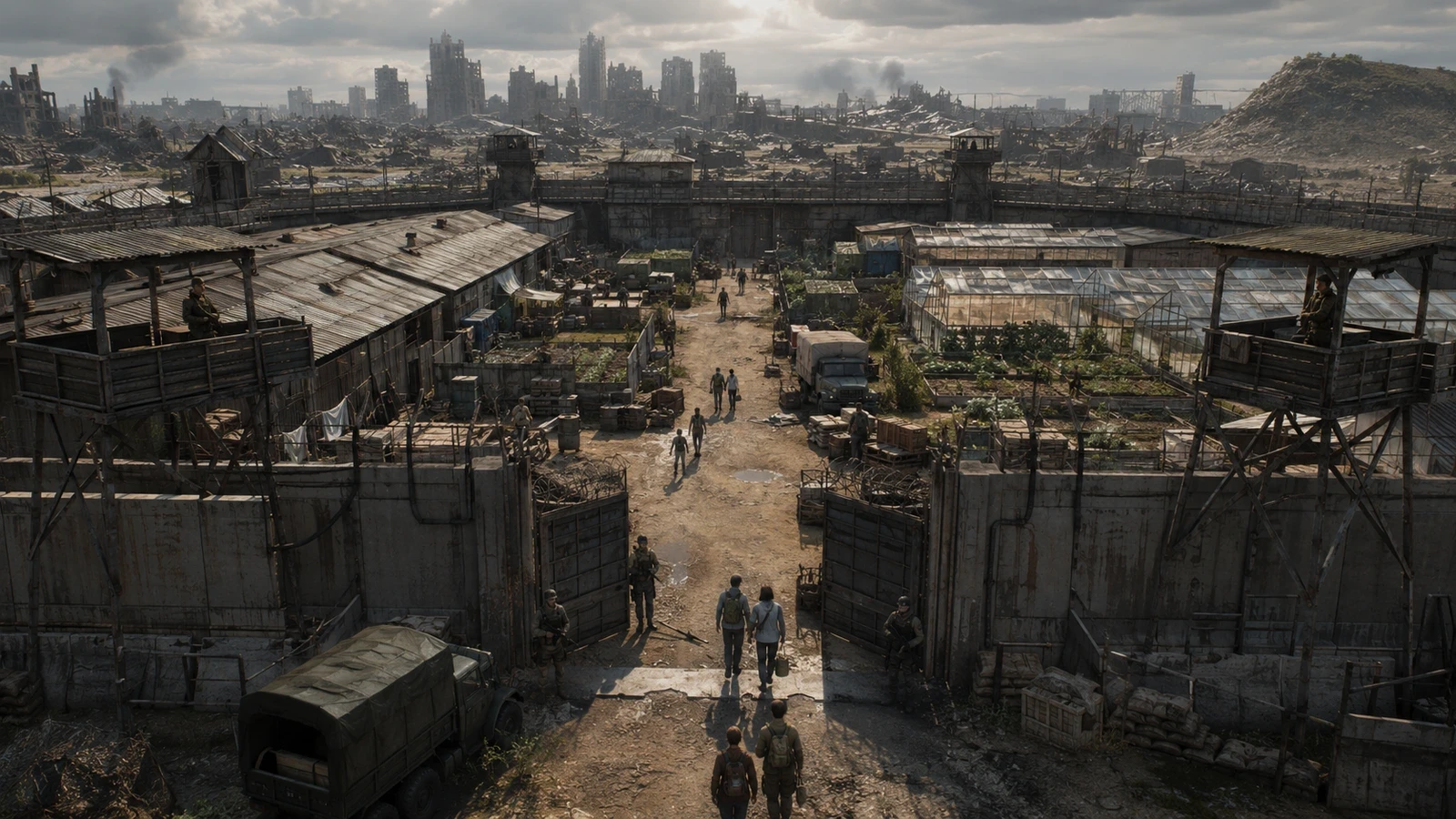
**The Extinction Cycle does not really have one ending. It has two victories separated by eight years, and the second victory changes the meaning of the first. Extinction War closes the original seven-book saga by proving that humanity can survive both the Variants and the people willing to weaponize the outbreak. Dark Age then asks whether that survival can become a civilization. Extinction Darkness answers by forcing the rebuilt Allied States to defend not only human life, but the idea that human beings should remain free to choose what kind of society they become.**
Choose Your Spoiler Tier
Tier 0: Safe overview
The original series ends with humanity surviving the first extinction war, but the world is devastated and the victory is incomplete. Eight years later, Dark Age reveals that civilization has rebuilt around fortified outposts and restored institutions. The sequel conflict tests whether the survivors can defend that rebuilt world against a more intelligent and organized enemy. The final book closes the New Gods war while leaving humanity with a political future to rebuild.
No named deaths are revealed in this tier.
Tier 1: After Extinction War
You can safely read through the section titled How the Original War Ends if you have finished Extinction War. That section discusses the defeat of the Resistance of Tyranny, the first-war political settlement, Team Ghost's transition, and the family future that leads toward Dark Age.
Tier 2: After Extinction Ashes
You can read through the discussion of the eight-year gap, the Allied States, the New Gods threat, and the escalation through the first three Dark Age books. Stop before Full Spoilers: The Extinction Darkness Endgame.
Tier 3: Full series
Everything after the full-spoiler heading reveals the deaths, political succession, final New Gods battle, webbing-network endgame, and principal character outcomes from Extinction Darkness.
Why the Ending Needs Two Books to Explain
Calling Extinction War "the ending" is understandable because it is the seventh book and the Season 1 finale.
It is also incomplete.
The later Dark Age front matter explicitly reframes the franchise as two seasons. The original seven-book saga becomes Season 1. The four Dark Age novels become Season 2. That means Extinction War is not overwritten by the sequel. It becomes history inside the sequel.
The ending therefore has to be read in two stages.
Stage one: Can humanity survive the immediate Great War of Extinction?
Stage two: Can the survivors rebuild a country strong enough to survive what comes after victory?
The answer to the first is yes, barely.
The answer to the second is also yes, but the cost is political as well as military.
How the Original War Ends
By Extinction War, the first biological war has already changed shape.
The Variants remain lethal, but the most immediate strategic threat is human.
The Resistance of Tyranny, led by Andrew Wood, turns the Hemorrhage Virus into a political weapon. ROT attacks safe-zone populations, seizes or contests military assets, broadcasts propaganda, and attempts to replace Ringgold's surviving government with a coercive rival order.
This matters because it changes the series' definition of extinction.
The first books ask whether the species will be physically destroyed.
Extinction War asks whether the people who survive will destroy the possibility of legitimate civilization themselves.
Reed Beckham at the end of the first war
Reed enters the book already transformed by survival.
He has lost a hand, depends on a prosthetic leg, and carries damage from the dirty-bomb endgame that helped break the juvenile Variant threat. He is no longer the apparently indestructible Master Sergeant who flew toward Building 8 with a complete six-man team.
He is physically evidence of the price of victory.
That is important because Extinction War never lets the first series end as a triumphalist military fantasy. Beckham's survival is costly. Team Ghost has lost people. The government has lost leaders. The country has lost cities. The remaining military can still fight, but it cannot recreate the United States that existed before the outbreak simply by winning one more battle.
The Resistance of Tyranny loses the information war
One of the most important elements of the finale is that Ringgold cannot simply kill Andrew Wood and declare herself legitimate.
ROT has built an ideology around the claim that Ringgold is a tyrant.
That means evidence matters.
The Greenbrier crisis, the naval conflict, recordings and proof of ROT's actions become part of the victory because people in the surviving territories have to understand what happened.
This is a major thematic change from the first outbreak.
At Building 8, information is tactical.
By Extinction War, information is constitutional.
A government that wins with force but cannot establish legitimacy has not rebuilt a country.
Andrew Wood and ROT fall
Wood's movement ultimately collapses.
Rachel Davis, already infected and transformed by the conflict, becomes part of the final reckoning and kills Wood. The outcome ends the central ROT command structure and destroys the man who tried to convert private grievance into a replacement state.
The first-season ending therefore defeats two forms of enemy.
The Variant threat is pushed back enough for reconstruction to become possible.
The human faction attempting to exploit the catastrophe for political power is also broken.
Neither victory means every Variant is dead or every extremist is gone.
It means there is enough surviving order to try again.
The European front proves there is no neat global cure
At the same time, Fitz and the rebuilt Team Ghost are operating in Europe and related theaters.
The significance is larger than the specific missions.
Regional forms such as Reavers, Wormers and armored mutations demonstrate that the first war has not produced one universal biological endpoint.
Humanity can win locally while remaining uncertain globally.
That lesson feeds directly into Dark Age.
The survivors will eventually mistake reduced contact for extinction.
The European story already warns them not to.
Reed and Kate's family becomes the emotional ending of Season 1
The birth of Javier Riley Beckham provides the strongest symbolic bridge out of the first war.
The name carries Alex Riley forward.
The child represents a generation born after catastrophe.
Reed and Kate's future is therefore not only romantic resolution. It is evidence that survival is beginning to become continuity.
That is what the next season will attack.
What Actually Survives Into Dark Age
The eight-year jump is the most important structural decision in the franchise.
If Dark Age had begun six months later, the sequel would simply be another stage of the same war.
Instead, it begins after people have had time to believe the war is history.
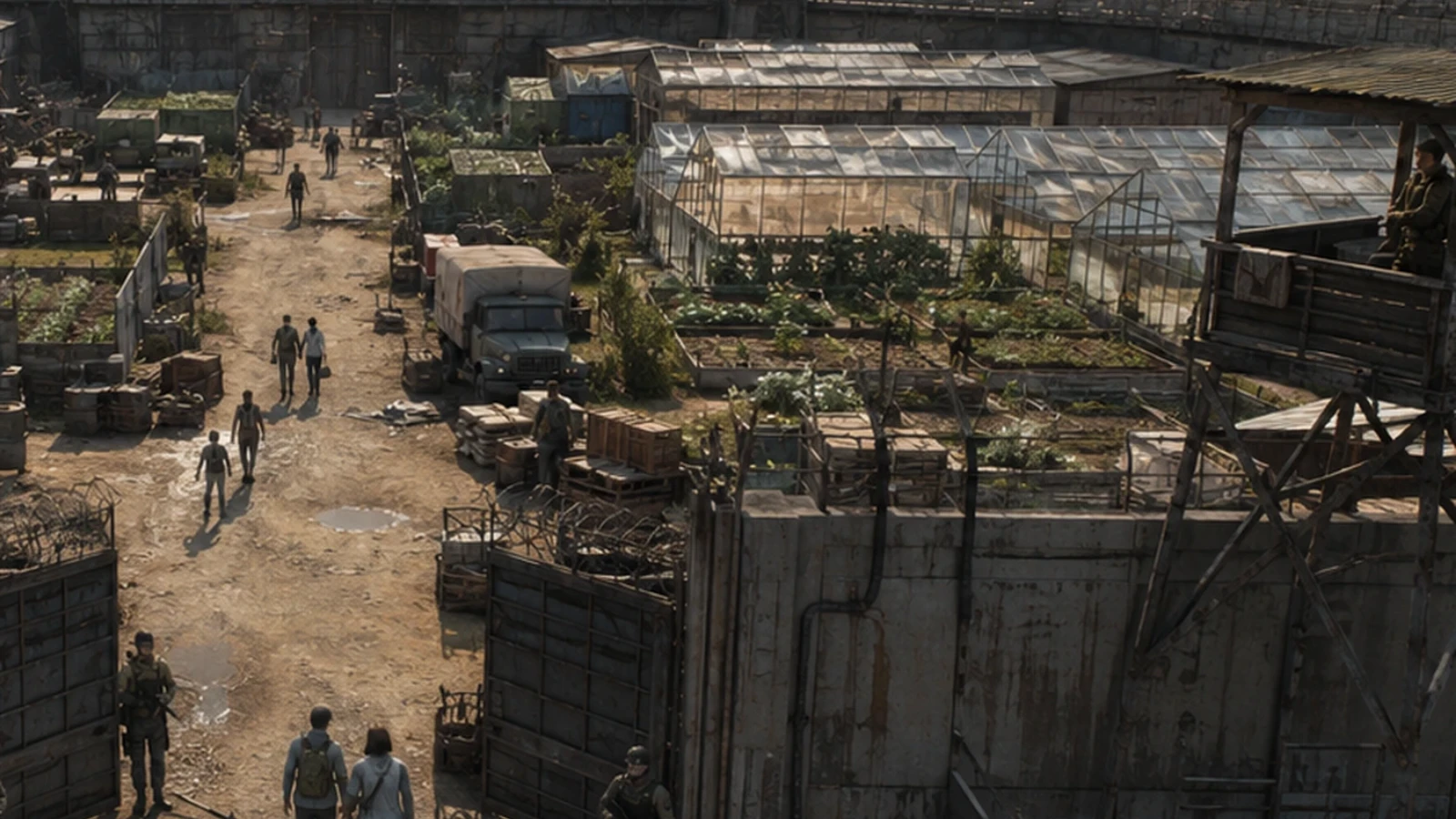
The Allied States now consists of roughly one hundred outposts, concentrated mainly in the Midwest and East Coast. Basic infrastructure has returned. Agriculture, manufacturing and the energy grid function again. Political offices matter. Elections matter. Rail movement and food production matter.
This is not a refugee camp.
It is a country trying to become ordinary.
Team Ghost survives as an institution
Reed Beckham does not return to normal field command.
Joe Fitzpatrick's Team Ghost continues operating.
For eight years, Ghost has hunted surviving Variants and rescued human prisoners from frontier and lawless zones.
That continuity is one of the most important things humanity carries from the first war.
The unit has memory.
It knows the enemy changes.
It knows missing intelligence is dangerous.
It knows supposedly secure places can fail.
The tragedy is that the wider society no longer lives with that same level of vigilance.
Reed and Kate survive long enough to have a life
Reed and Kate are married.
They live near Outpost Portland on Peaks Island with their son.
Parker Horn and his daughters remain close.
This domestic structure is what gives Dark Age its power.
When danger returns, the characters are no longer fighting only because there is nothing else left.
They have homes to lose.
They have a generation that grew up after the first war.
They know what peace feels like.
Ringgold survives into government rather than emergency command
Jan Ringgold is still one of the central national figures.
Her achievement between the seasons is not simply staying alive.
It is helping turn surviving command into a functioning state.
The Allied States is imperfect and politically divided, but the existence of political opposition is itself evidence of recovery.
People can argue about policy because survival is no longer the only subject.
What Dark Age Changes
The original Variants were terrifying because they were predators.
The Dark Age enemy becomes terrifying because it develops systems.
The surviving threat includes Alphas, masterminds, Scions, Thralls, Chimeras, collaborators and the New Gods hierarchy. The webbing network becomes biological infrastructure. Tunnels become movement and communication corridors. Human intelligence and Variant capabilities increasingly overlap.
The enemy is no longer simply hiding.
It is organizing.
That makes the sequel conflict political from the beginning.
Azrael's vision is not to kill every human as quickly as possible.
The New Gods seek power, bodies, territory, obedience and transformation.
Their promise is a rival future.
That is what makes them more than upgraded Variants.
The Dark Age War Is a War Over the Meaning of Survival
The first extinction war asks:
Can human beings remain alive?
The New Gods war asks:
If human beings remain alive by submitting to transformation and authoritarian rule, did humanity actually survive?
That is why the final confrontation requires Ringgold, Beckham, Kate, Fitz and Cornelius rather than one hero.
No single skill is enough.
Beckham understands war.
Kate understands the biological network.
Fitz carries the operational tradition of Team Ghost.
Ringgold represents political legitimacy.
Cornelius represents people who opposed Ringgold but still choose humanity over Azrael.
The ending works because those roles converge.
Full Spoilers: The Extinction Darkness Endgame
Reveal the full-spoiler ending timeline
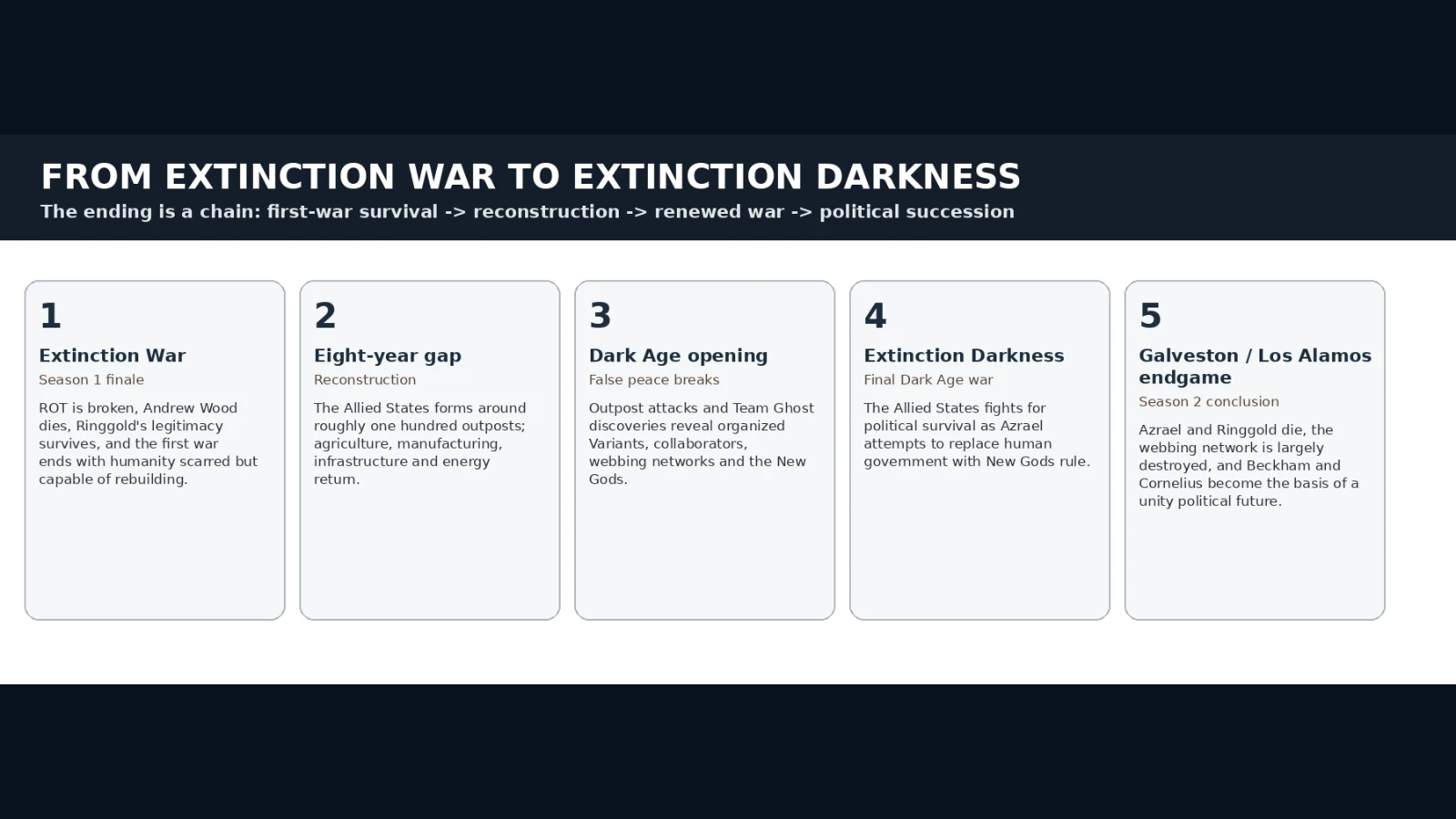
From this point forward, the article reveals the final major deaths and political outcome.
The assault on national continuity
By Extinction Darkness, the New Gods attack the rebuilt state at its strategic centers.
Puerto Rico and the First Fleet become part of the crisis. Captured assets, seaborne threats, Scions, collaborators and other forces expand the war beyond mainland outposts.
The target is not only military capability.
It is national confidence.
Azrael understands that a country can be defeated psychologically and politically before every soldier is dead.
Dan Lemke is executed
Vice President Dan Lemke becomes one of the finale's most important political casualties.
Azrael captures and publicly executes him.
The point is theater.
The New Gods want Ringgold and the country to see that the old state cannot protect its leaders.
Azrael's offer is not mercy. It is submission reframed as survival.
Lemke refuses to give him that victory.
His death creates a succession wound just as the Allied States is preparing for a final defense.
Galveston becomes the moral center of the ending
The Battle of Galveston pulls together groups that had spent the rebuilt era disagreeing with one another.
Ringgold.
Mark Cornelius.
Reed Beckham.
Parker Horn.
Kate.
Fitz and Team Ghost.
Marines.
Iron Hogs.
Private forces.
Civilians.
The coalition matters more than any one battlefield maneuver.
The Allied States does not survive because political disagreement disappears.
It survives because disagreement stops being more important than the shared line Azrael is trying to erase.
Azrael dies
Azrael reaches the old guard directly.
He threatens Beckham and the people around him, trying to turn the final battle into a demonstration of New Gods superiority.
Ringgold kills him.
That act resolves the personal confrontation, but its meaning is political.
The president of the Allied States rejects the proposition that submission, selected transformation and biological hierarchy are legitimate forms of peace.
The Prophet's death breaks the central ideological figure of the New Gods.
Jan Ringgold dies
Ringgold does not survive the victory.
Her death is one of the franchise's clearest statements about leadership.
She began as part of the emergency government.
She lived long enough to help create the Allied States.
She dies defending a country that is now larger than her own office.
The result is deliberately painful.
Humanity wins the final battle and immediately loses the person who symbolized much of its political continuity.
The webbing network is broken
The military victory at Galveston is only half the endgame.
Kate, Sammy and the surviving scientific team attack the biological command infrastructure behind the enemy.
By the epilogue, Sammy reports that more than ninety percent of the webbing network is dead due to anthrax and that no signals have been detected since Los Alamos.
This detail is essential to understanding the ending.
Killing Azrael alone would not be enough.
The New Gods had developed an infrastructure.
The infrastructure had to die too.
That makes the final victory a combined-arms success in the broadest sense:
soldiers, scientists, engineers, political leaders and local defenders all solve different parts of the same war.
Principal Character Outcomes
Reed Beckham
Reed survives.
That matters because his final role is not another assault.
He becomes the figure around whom national unity may be built.
After Ringgold and Lemke are gone, the Allied States needs legitimacy again. Beckham has military credibility, personal sacrifice, family ties to the first war, and public recognition that extends beyond one political faction.
The final political move is his proposal to run with Mark Cornelius as vice president.
That is a remarkable ending for a character introduced as a Delta Force team leader.
His last major mission is institutional rather than tactical.
Kate Lovato Beckham
Kate survives and remains central to the science of victory.
Her long arc began with a countermeasure that saved humanity while creating consequences she would carry for years.
The ending does not give her a perfect cure.
It gives her something more consistent with the series.
Enough understanding to break the current enemy system.
She remains with Reed and their family, but she also remains a scientist whose work will matter to whatever comes next.
Joe Fitzpatrick
Fitz survives the reviewed finale material and continues to represent Team Ghost as an institution larger than Beckham.
That is one of the quiet achievements of the entire saga.
The original six-man unit is gone.
Team Ghost is not.
Parker Horn
Horn survives the reviewed endgame and remains part of the family and old-guard defense structure.
His survival carries the long memory of Fort Bragg, Sheila, his daughters and Team Ghost into whatever rebuilt future follows.
Mark Cornelius
Cornelius survives and becomes part of the political solution.
He does not need to become Ringgold.
The importance of the unity-ticket idea is precisely that the ending does not erase political difference.
It tries to transform rivalry into coalition.
Sammy Tibalt
Sammy survives and helps deliver the scientific confirmation that the webbing network has largely collapsed.
That makes the next generation part of the victory rather than merely the population the old heroes are protecting.
What the Ending Means for Humanity
The ending is hopeful.
It is not clean.
That distinction fits the entire series.
Humanity does not win by exterminating every threat
The series never convincingly promises that every Variant, collaborator or future danger is gone.
It establishes something more realistic for its fictional world:
the enemy no longer possesses the organized system required to force humanity into extinction or New Gods rule.
That is enough for history to continue.
Institutions matter as much as heroes
The first book can feel like a Team Ghost story.
The final book cannot be solved by Team Ghost alone.
A rebuilt country requires science, government, agriculture, logistics, engineering, local defense, military command and public trust.
The ending therefore expands the definition of heroism.
Political unity does not require political sameness
Cornelius does not stop having a different political history from Ringgold and Beckham.
The point is that the final war changes the scale of disagreement.
The proposed Beckham-Cornelius ticket represents a civilization mature enough to distinguish political opposition from existential enemies.
The next generation is the real measure of victory
Javier, the Horn daughters, Sammy and younger survivors embody the thing the old guard never had during the first outbreak:
a future that can be imagined in years rather than hours.
That is the strongest meaning of the ending.
Humanity's victory is not that the last monster dies.
It is that people can again make plans long enough for politics, family, education, work and disagreement to matter.
Is Extinction Darkness the Final Ending?
It is the conclusion of the four-book Dark Age arc and the ending covered by this guide.
The safest interpretation is not "nothing dangerous can ever happen again."
The franchise's own structure argues against that kind of certainty.
The first war seemed decisive.
Then history continued.
The Dark Age ending is therefore best understood as the destruction of the New Gods' immediate system and the opening of a new political era.
It closes a war.
It does not close human history.
Final Answer
So what happens at the end of the Extinction Cycle through Extinction Darkness?
Humanity survives twice.
The first time, it survives the Variants and the human faction that tries to restart the outbreak.
The second time, it survives an organized post-human order that offers submission as the price of continued existence.
Reed Beckham survives long enough to move from operator to national political figure.
Kate survives long enough to turn years of scientific guilt and learning into part of the final victory.
Fitz keeps Team Ghost alive beyond its founder.
Cornelius survives as a rival who becomes a partner.
Ringgold dies after killing Azrael and defending the legitimacy of the country she helped rebuild.
Lemke dies refusing to make surrender look reasonable.
The New Gods lose their Prophet.
The webbing network is largely destroyed.
And the Allied States emerges from victory needing a new government rather than another dictator.
That is the final achievement of the saga.
The human race does not merely remain alive.
It remains human enough to argue about what should come next.
FAQ
Does Extinction War end the Extinction Cycle?
It ends the original seven-book Season 1. Dark Age is Season 2 and takes place eight years later.
What happens after Extinction War?
Survivors build the Allied States around roughly one hundred outposts. Infrastructure, agriculture, manufacturing and energy return, while Fitz's Team Ghost continues frontier missions.
Who is the main villain of Extinction Darkness?
The central New Gods leader is Azrael, also known as the Prophet.
Does Reed Beckham die?
No. Reed survives the reviewed ending and is positioned for political leadership after the final war.
Does Jan Ringgold die?
Yes. Ringgold dies during the Galveston endgame after killing Azrael.
What happens to the New Gods network?
The leadership is broken and the webbing communication infrastructure is largely destroyed. The epilogue reports more than ninety percent of the network dead and no signals detected since Los Alamos.
What is Reed's future after the ending?
The ending points toward a Beckham-Cornelius unity ticket, with Cornelius proposed as vice president.
Is humanity safe forever?
The ending defeats the immediate New Gods system. It does not establish that every future Variant or human threat has vanished.