
Reader Guides and Reading Order
Best Extinction Cycle Books Ranked: Every Main Series and Dark Age Novel From Good to Essential
Every main Extinction Cycle and Dark Age novel ranked, with spoiler-light reasons, best entry points, strongest Team Ghost books and where Red Line fits.
·
Category: Reader Guides and Reading Order
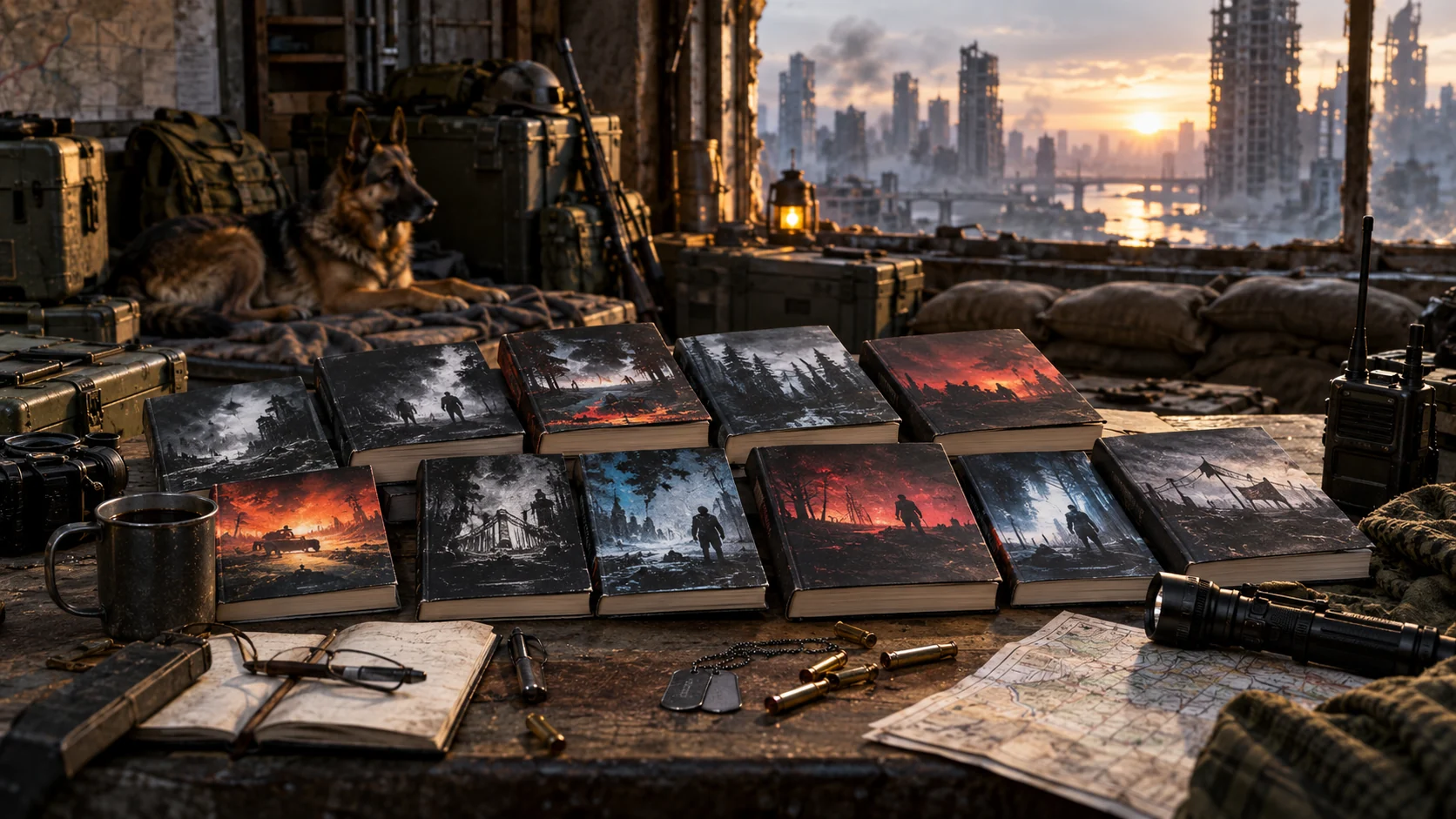
The main saga moves from outbreak discovery to evolution, global war, reconstruction and the Dark Age conflict.
Ranking the Extinction Cycle is harder than it looks because the books are doing different jobs.
Extinction Horizon has the advantage of discovery. Everything is new: Building 8, Reed Beckham, Kate Lovato, Team Ghost and the first terrifying realization that the infected are not conventional zombies.
Extinction Age is a pressure-cooker war novel in which the Variants are clearly learning.
Extinction Evolution leans into adaptation and the biological arms race.
Extinction War has to close the original seven-book story while escalating human political conflict.
Then Dark Age jumps eight years forward and asks a completely different question: what happens after humanity thinks it has won?
So this is not a ranking of "good books versus bad books." The floor is high. It is a ranking of which installments deliver the strongest mix of character, military action, horror, science, mythology and series importance.
The list covers the seven original main novels, the official prequel Extinction Red Line and all four Dark Age novels. Extinction Lost is discussed separately because it is a shorter Team Ghost story rather than a full-length main novel.
How the ranking works
Each book is scored conceptually on six factors:
- Story momentum
- Team Ghost material
- Variant horror
- Science and lore
- Character development
- Importance to the larger saga
A book can rank lower and still be essential to read in order.
This is a recommendation ranking, not a suggestion to skip continuity.
Quick ranking
| Rank | Book | Best feature | Best for |
|---|---|---|---|
| 12 | Extinction Ashes | Dark Age middle-war escalation | Readers invested in the New Gods campaign |
| 11 | Extinction Edge | Expands the outbreak and Kate's countermeasure problem | Readers who want the science-war connection |
| 10 | Extinction Aftermath | Globalizes the conflict and shows a world trying to recover | Readers who like broader military scope |
| 9 | Extinction Inferno | Raises the scale of the Dark Age invasion | Readers who want outpost warfare |
| 8 | Extinction Red Line | VX-99 origin and Trevor Brett | Lore-focused readers |
| 7 | Extinction Evolution | Variant adaptation becomes the central enemy | Creature and evolution fans |
| 6 | Extinction Shadow | Excellent return to the universe eight years later | Readers who love mystery and reconstruction |
| 5 | Extinction End | Emotional stakes and escalating Variant forms | Character-driven action readers |
| 4 | Extinction Darkness | Strong Dark Age payoff and franchise-level conclusion | Readers who want the Allied States endgame |
| 3 | Extinction Age | New York, Team Ghost attrition and peak survival pressure | Military-horror fans |
| 2 | Extinction War | Original-series finale and huge consequences | Readers invested in Reed, Kate and Ringgold |
| 1 | Extinction Horizon | Best combination of discovery, horror, military realism and franchise identity | Everyone |
12. Extinction Ashes
Why it ranks here: It is important connective tissue in the Dark Age war, but it has the difficult job of moving pieces toward the final confrontation after Extinction Shadow and Extinction Inferno have already established the new status quo and threat.
That does not make Extinction Ashes weak.
It makes it the installment most dependent on momentum from the books around it.
By this point, the New Gods are no longer a mystery. The Allied States understands that the threat is organized and that Scions, Thralls and human collaborators can operate together. The story therefore shifts away from discovery and toward escalation.
For readers who love campaign fiction, that is a strength. The book feels like a nation trying to survive the middle phase of a second extinction war.
Where it loses a little ground is novelty. The first Dark Age book has the thrill of returning to a rebuilt world. The last has the emotional and strategic payoff. Ashes carries the burden of making the bridge between them work.
Best element: The sense that the Allied States' reconstruction can still be burned down faster than it was built.
Read if you love: Large-scale campaign pressure, multiple fronts and the New Gods mythology.
11. Extinction Edge
Extinction Edge is the book where the first outbreak stops feeling like a shocking anomaly and becomes a sustained war.
Meg Pratt's New York storyline is especially important because it gives the series a civilian-responder perspective. She is not Delta Force and she is not a scientist. She is a firefighter trying to protect people in a city that has become a hunting ground.
Kate's scientific burden also grows. Her work on VariantX9H9 is treated as a possible salvation and a moral catastrophe at the same time.
That duality becomes one of the franchise's strongest recurring ideas.
The reason Edge sits outside the top ten is mostly structural. It expands the world effectively, but it lives between the unforgettable discovery of Horizon and the sharper Team Ghost pressure of Age.
It is the book that proves the series has enough depth to continue, even if later installments make bigger impressions.
Best element: The collision of scientific hope and ethical dread.
Read if you love: Kate Lovato, Meg Pratt and the early realization that the Variants are changing.
10. Extinction Aftermath
The title is slightly deceptive because there is very little peace in Extinction Aftermath.
Humanity has survived enough of the first catastrophe to begin thinking internationally, but the war has entered another phase. Europe is devastated. Juvenile Variants remain a major threat. Military operations have to move across countries and coalitions.
The book is valuable because it expands the scope beyond a primarily American survival story.
Rome, European forces and the global consequences of the outbreak make the extinction event feel appropriately planetary.
It also prepares the reader for Extinction Lost and Extinction War by showing Team Ghost functioning in an international theater.
Why not rank it higher?
The broader geography can make it feel slightly less intimate than books centered tightly on Reed, Kate and Ghost in one desperate location.
If your favorite part of Extinction Cycle is military worldbuilding, you may rank this far higher.
Best element: The global scale of post-outbreak warfare.
Read if you love: European campaigns, coalition military action and the later stages of Variant evolution.
9. Extinction Inferno
The second Dark Age novel benefits from a terrifying premise: the new enemy is no longer hypothetical.
Extinction Shadow reintroduces the world and lets the reader discover that something has been hiding beneath the Allied States' apparent recovery.
Inferno turns that mystery into war.
Outposts and infrastructure that took years to rebuild can be destroyed quickly. The New Gods demonstrate that they understand human systems and can attack more intelligently than old Variant hordes.
The book's greatest strength is scale.
The Allied States feels like a real country precisely because there is now something large enough to threaten it.
The ranking reflects personal preference rather than quality. I slightly prefer Shadow because discovery is so effective in this universe, and Darkness because the payoff is stronger.
But Inferno may be the Dark Age book that most feels like a traditional military-apocalypse sequel.
Best element: Seeing postwar security assumptions collapse.
Read if you love: Outpost defense, national-level stakes and organized enemy forces.
8. Extinction Red Line
Extinction Red Line, written by Nicholas Sansbury Smith and Tom Abrahams, is the official prequel and one of the most useful lore books in the franchise.
Its subject is Lieutenant Trevor Brett and the early VX-99 program.
The original series gives readers enough history to understand that the catastrophe did not begin in 2015. Red Line turns that history into a story.
Operation Burn Bright in Vietnam shows Marines receiving an experimental drug they do not fully understand. Brett's transformation becomes the horrifying prototype for the later Variant catastrophe.
The book works because it changes the emotional meaning of VX-99.
A classified program can sound abstract in exposition.
Watching the human subject experience it makes the program personal.
It ranks below the top seven because the main appeal is origin lore rather than the Reed-Kate-Team Ghost narrative engine.
For mythology-focused readers, that may be exactly why it belongs near the top.
Best element: The origin of the Red Line and the super-soldier project.
Read if you love: Government secrets, Vietnam-era military history and VX-99 lore.
7. Extinction Evolution
The title tells you what the book is really about.
The enemy is no longer simply infected humanity.
It is adaptation.
Marine Staff Sergeant Jose Garcia and the Variant Hunters encounter evidence that the monsters are changing. Missions in locations such as Key West make clear that the human side cannot depend on a fixed bestiary.
That is the installment where the franchise fully commits to its most distinctive idea: every successful countermeasure creates pressure for the next threat.
The series could have remained a fast-zombie military thriller.
Evolution helps make it an evolutionary arms-race story.
The book also works well as a bridge into the heavier juvenile and global-war material that follows.
Best element: The feeling that the enemy biology is becoming a strategic actor.
Read if you love: Variant taxonomy, field science and reconnaissance missions.
6. Extinction Shadow
Returning to a beloved apocalypse eight years later is risky.
If the world is too similar, the time jump feels pointless.
If it is too different, readers lose the characters and systems they cared about.
Extinction Shadow gets the balance right.
The Allied States is recognizable as the result of everything the original series fought to save. Reed and Kate are married. Their son is growing up. Horn and his daughters are part of the family. Fitz leads Team Ghost. Agriculture, electricity and manufacturing have returned.
Then settlements start disappearing.
That mystery is excellent because the characters think they understand Variants better than the reader does.
For once, experience is a liability.
Ghost investigates evidence that does not fit the old rules: vanished populations, strange biological webbing and enemies sophisticated enough to fool or defeat experienced units.
Shadow proves the sequel series has a reason to exist.
Best element: The contrast between hard-earned normality and the discovery of a hidden second extinction threat.
Read if you love: Reconstruction, older versions of the original heroes and investigative military horror.
5. Extinction End
Extinction End is the book where the emotional and biological stakes become almost unbearable.
Kate is carried through ruined New York as a Variant prisoner. Meg is still fighting. Horn's daughters are in danger. The Bone Collector and other advanced Variant threats make the enemy feel increasingly mythic without losing the science-military foundation.
The book is also where the title of the series starts to feel literal rather than promotional.
Humanity is running out of solutions.
The characters have already survived too much, which makes every new loss feel unfair in exactly the right way.
What keeps it outside the top four is that the series later gives War the job of completing the original arc. End feels like a climax, but it is not actually the end.
That tension is part of its appeal.
Best element: The Bone Collector era and the feeling that survival has become personal mythology.
Read if you love: High emotional stakes, powerful named Variants and Reed-Kate-Horn family material.
4. Extinction Darkness
The final Dark Age book has to conclude two things at once.
It must resolve the war with Azrael and the New Gods.
It must also answer whether the Allied States has a future beyond permanent military crisis.
The book succeeds because the ending is not simply a kill count.
After enormous loss, the final symbolic moment is the christening of a repaired Allied States Navy vessel as the USS Jan Ringgold.
Reed speaks about hope and the responsibility to carry forward what Ringgold represented.
The ship is patched and imperfect.
So is the country.
That image gives the franchise one of its best endings because it measures victory through institutional capacity.
A navy exists. A government exists. Families exist. People are repairing cities and thinking about generations.
Azrael's ideology loses not merely because he dies or his forces are defeated, but because ordinary humanity continues building.
Best element: The closing statement about reconstruction and human identity.
Read if you love: Payoff, Allied States politics and the final Reed-Kate-Fitz-Horn era.
3. Extinction Age
If someone asked for the purest Team Ghost book after Horizon, I would probably hand them Extinction Age.
New York is a perfect Variant environment.
The tunnels, rooftops, streets and abandoned infrastructure give the creatures every opportunity to demonstrate why they are not normal zombies.
Reed Beckham is injured and running on almost nothing. Ghost loses Jinx after a desperate pursuit. The Variants show pack behavior and tactical caution. The team has to escape underground while the city above is being bombed.
This is the franchise's military-horror formula operating at peak efficiency.
The book also deepens the political distrust around Plum Island and Colonel Wood while Kate's scientific work becomes more consequential.
Age ranks third because it has almost everything that makes Extinction Cycle distinctive without yet carrying the burden of wrapping up the entire saga.
Best element: New York, especially the tunnels and the Jinx sequence.
Read if you love: Team Ghost under pressure, limited ammunition and Variants behaving like predators rather than hordes.
2. Extinction War
Extinction War earns its ranking by delivering consequences.
Reed Beckham enters the finale physically devastated. He has lost part of an arm and leg. Friends are dead. Kate's fate is uncertain. Human enemies have learned to use the Hemorrhage Virus as a weapon. Chicago becomes another nightmare landscape.
The Resistance of Tyranny is important because it proves the central danger was never only the Variants.
Humans can take the biological catastrophe and deliberately restart it for political advantage.
That makes War the logical ending of the original series.
The first book asks what happens when a secret weapon escapes.
The seventh asks what happens when people understand the weapon and choose to use it anyway.
The book also earns enormous retrospective importance because Dark Age begins eight years later and shows what Reed, Kate, Ringgold, Horn and Fitz managed to build after surviving it.
Best element: The convergence of biological war, civil conflict and Reed's accumulated physical and emotional damage.
Read if you love: Finales, political conflict and large-scale payoff.
1. Extinction Horizon
The first book remains the best.
That is not because the later books fail to expand the universe.
It is because Extinction Horizon contains the perfect concentration of what made the series distinctive in the first place.
Team Ghost is introduced as an elite unit expecting a classified mission, not the end of civilization.
Building 8 on San Nicolas Island is frightening before a single Variant appears because Reed knows he is entering a Level 4 biological environment without enough information.
The mission objective is bureaucratically simple: retrieve Dr. Medford's research.
The consequences are impossible.
Panda, Tenor and Edwards die. Reed's trust in command begins to fracture. Kate Lovato and Michael Allen confront the biological truth. Chicago starts collapsing. The reader learns the rules at almost the same pace as the characters.
That discovery can never be repeated.
Later books have bigger monsters, bigger battles and more complicated politics.
Horizon has uncertainty.
Every closed door can contain something the characters do not yet have a name for.
The book also establishes the franchise's best long-term conflict: soldiers need scientists, scientists need soldiers, and both need information that their own government is not always willing to provide.
Everything afterward grows from that.
Best element: Building 8 and the discovery of the Variant threat.
Read if you love: Military suspense, biological horror and origin stories.
Where does Extinction Lost rank?
Extinction Lost is difficult to place beside full novels because it is a shorter Team Ghost story.
As a mission story, it is excellent.
Fitz leads an exhausted Ghost team to Greenland only hours after returning from France. Their target is an old Nazi facility repurposed as a government lab, where an anti-Variant weapon appears to have produced unexpected consequences.
The snowy isolation, secret base and worn-down team create one of the franchise's most atmospheric operations.
If it were a full-length novel, I would probably place it around the middle of the ranking.
As a novella, it is best treated as a bonus mission that enriches the period between larger European operations and Extinction War.
Best book for Team Ghost fans
Extinction Age.
Horizon introduces Ghost, but Age tests the team in the environment where its identity becomes most visible. Loyalty, ammunition discipline, urban tactics and loss all collide in New York.
Best book for Kate Lovato fans
Extinction Edge or Extinction End.
Edge puts her scientific work at the center of the countermeasure problem.
End gives her some of the most intense personal stakes.
Best book for Variant lore
Extinction Evolution.
The title is not subtle, and that is a compliment. The book makes changing Variant biology the strategic center of the story.
Dark Age readers should pair it with Extinction Shadow to see how that concept evolves from natural selection pressure into deliberate engineering.
Best book for Reed Beckham
Extinction War.
Reed's physical condition, grief and command experience all converge there. He is no longer the operator who entered Building 8. Every prior mission is visible in the way he thinks and fights.
Best Dark Age book
Extinction Darkness by a narrow margin over Extinction Shadow.
Shadow is the better mystery.
Darkness is the better payoff.
The final USS Jan Ringgold scene is one of the strongest pieces of franchise closure because it defines survival as rebuilding capacity rather than simply killing the last enemy.
Best entry point for a new reader
Start with Extinction Horizon.
Do not start with Dark Age just because the opening recap makes it possible.
The recap gives facts.
It cannot reproduce the emotional meaning of Team Ghost's losses, Kate's guilt, Reed's injuries or Ringgold's political evolution.
Similarly, Extinction Red Line is a prequel but works better after readers already understand what VX-99 becomes.
Chronological order is not automatically the best dramatic order.
Recommended reading order
For most readers:
- Extinction Horizon
- Extinction Edge
- Extinction Age
- Extinction Evolution
- Extinction End
- Extinction Aftermath
- Extinction Lost
- Extinction War
- Extinction Red Line either here or after the first few main books
- Extinction Shadow
- Extinction Inferno
- Extinction Ashes
- Extinction Darkness
Readers who prefer strict official chronology can place Extinction Red Line before Horizon, but first-time readers lose some mystery by learning too much about VX-99 in advance.
How the series changes across eras
Books 1 to 3: discovery and collapse
The world is ending faster than the characters can understand it.
Books 4 to 5: evolution
The enemy becomes a changing biological system.
Books 6 to 7: global war and political consequence
Humanity learns to fight back while human factions create new dangers.
Dark Age: reconstruction and replacement
The question changes from "Can humanity survive?" to "What kind of humanity will survive?"
That progression is why the full series rewards reading in order even when individual rankings vary.
Frequently asked questions
What is the best Extinction Cycle book?
Extinction Horizon is the strongest overall because it combines the Building 8 mystery, Team Ghost's introduction, biological horror, Kate's science storyline and the beginning of global collapse.
Is Extinction War the last book?
It is the seventh and final book of the original main series. The story later continues eight years afterward in the four-book Extinction Cycle: Dark Age series.
What are the Dark Age books in order?
Extinction Shadow, Extinction Inferno, Extinction Ashes and Extinction Darkness.
Should I read Extinction Red Line first?
You can, because it is the official prequel, but many readers will get more suspense by starting with Extinction Horizon and reading Red Line later as origin lore.
Where does Extinction Lost fit?
Extinction Lost is a Team Ghost short story set late in the original-series era, after European operations and before Extinction War.
Which book has the most Team Ghost action?
Extinction Age is one of the strongest choices for sustained Team Ghost military-horror action, especially the New York sequences.
Is Dark Age worth reading?
Yes if you want to know what Reed, Kate, Horn, Fitz, Ringgold and the surviving world become after the original war. It is less about repeating the first outbreak and more about testing the civilization built afterward.
Final ranking verdict
The best Extinction Cycle book is still Extinction Horizon because it contains something no sequel can recreate: the moment the rules disappear.
Team Ghost thinks it is entering a classified biological facility.
Kate thinks she is studying an outbreak.
The government thinks the crisis can be contained.
Everybody is wrong.
That uncertainty is the engine of the franchise.
Extinction Age perfects the Team Ghost survival formula.
Extinction War delivers the original payoff.
Extinction Darkness gives the larger saga its most satisfying statement about what victory means.
But Horizon is where readers first realize that the Variants are not zombies, the government does not know as much as it claims, and elite soldiers can be just as frightened as everyone else.
Every great Extinction Cycle book expands that idea.
The first one owns it.
Canon and source notes
This ranking covers the seven original Nicholas Sansbury Smith main novels, the official Extinction Red Line prequel by Smith and Tom Abrahams, and the four Extinction Cycle: Dark Age novels by Smith and Anthony J. Melchiorri. Extinction Lost is discussed separately because of its shorter format. Expanded-universe series such as Extinction Survival, Extinction NZ, The Redemption Trilogy and Missions from the Extinction Cycle deserve their own dedicated ranking rather than being mixed into a main-series list.
Recommended next pages
- series reading order
- character reed beckham
- character kate lovato
- Extinction Cycle Ending Explained: What Happens to Reed Beckham, Kate Lovato, Team Ghost and Humanity?
- Every Major Extinction Cycle Character Death Ranked by Impact
- What Happens After Extinction War? The Allied States and Dark Age Explained
- Team Ghost's Greatest Missions Ranked: From Building 8 to the Dark Age War
- Browse all Extinction Cycle editorials
Sources and editorial scope
- Canon treatment
- Independent fan analysis grounded in the supplied Extinction Cycle source audit and clearly separated from compared franchises or real-world science.
- Spoiler scope
- Light to moderate spoilers; major endings avoided until clearly marked