
Staged fate and spoiler guide
Extinction Cycle Major Deaths and Fates
Use staged spoiler tiers to understand major Extinction Cycle deaths, transformations, permanent injuries, unresolved evidence, and lasting consequences.
·
Category: Characters and Relationships
Character fate in Extinction Cycle is rarely captured by a simple dead-or-alive label. Reed Beckham survives the first war with permanent physical consequences. Alex Riley survives catastrophic injury before dying in a later defense. Nick survives an apparent end at Mount Katahdin only to be transformed into Abaddon. Jan Ringgold’s death changes both government and the meaning of the final victory. The important question is not merely whether a character reaches the end, but what form of life, identity, duty, or memory continues afterward.
The guide begins without naming outcomes, then crosses an explicit full-spoiler boundary. That separation makes it possible to choose how much to learn rather than encountering a wall of revealed names and causes.
Choose a spoiler level
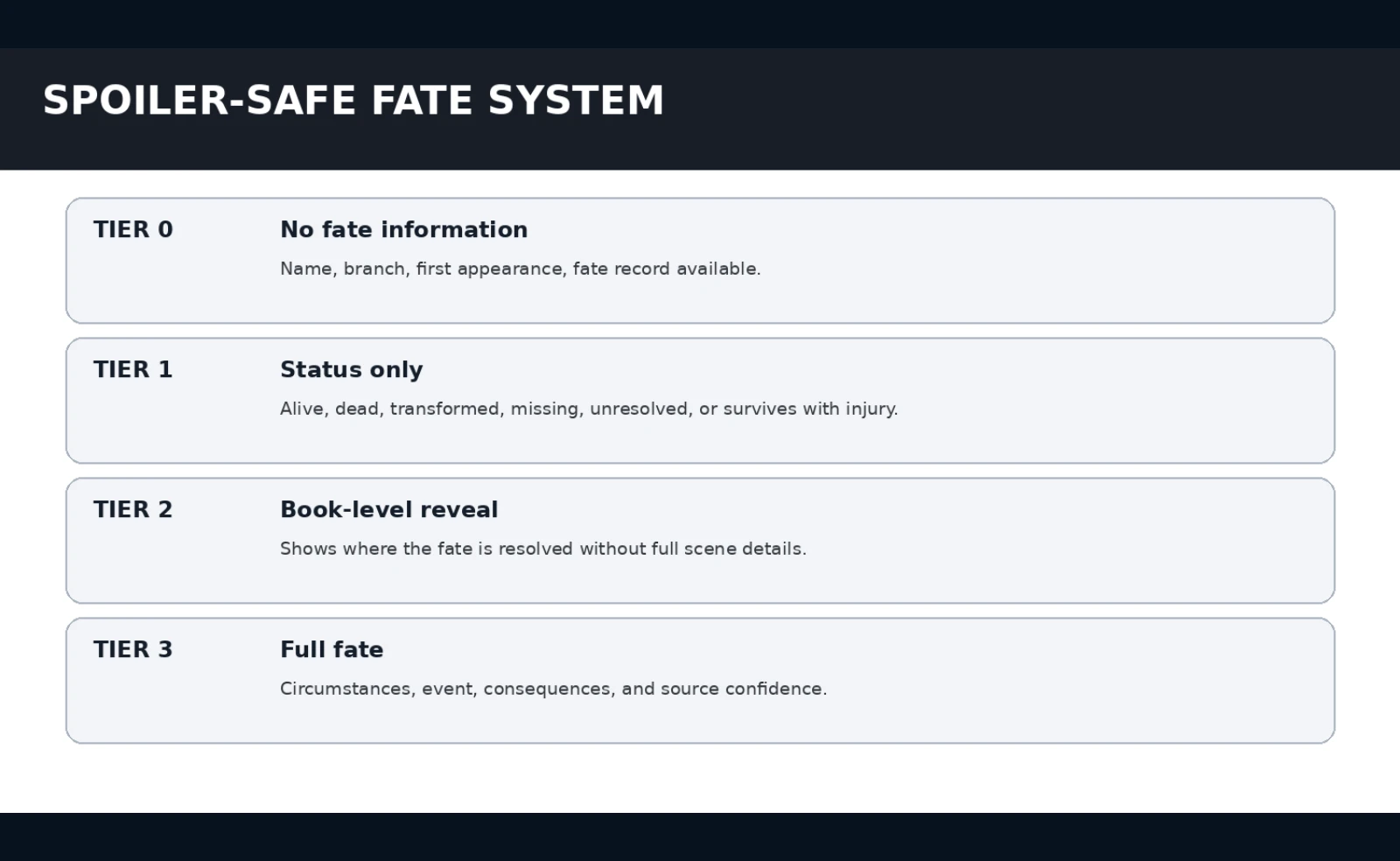
Tier 0 — No fate information. Use the character directory or spoiler-safe beginner guide for identities, affiliations, and early-series roles without checking final outcomes.
Tier 1 — Status only. Learn whether a fate is resolved, unresolved, transformed, or permanently changed without seeing the event, cause, or book.
Tier 2 — Book-level boundary. Learn the latest book required to understand the outcome, but not the scene or responsible character.
Tier 3 — Full fate. Learn the outcome, cause, context, consequences, and related identities.
The tiers solve different problems. A new reader may only want reassurance that a character remains important. Someone midway through the saga may want to know whether an apparent death is settled. A completionist may need the exact event because transformations, aliases, and inherited legacies affect continuity.
Full-spoiler boundary: Everything after “Major fate reference” reveals deaths, transformations, permanent injuries, relationships, and late Dark Age outcomes across the original series and sequel quartet.
Why “alive” and “dead” are incomplete
A binary label hides the distinctions that give the saga much of its emotional force. Someone can survive while losing the body, role, family, or authority that defined the earlier story. A person can die while continuing to shape later names, institutions, and political choices. Infection can end a human identity without immediately ending biological life. An apparent death can remain unresolved until a later work identifies what happened.
Seven categories keep those outcomes separate:
- Confirmed death: the narrative directly establishes death or later canon unequivocally confirms it.
- Transformation or infection: the person continues in an altered biological identity.
- Survives with permanent consequences: the person lives, but injury or transformation permanently changes the arc.
- Alive at the latest verified point: survival is shown at the end of the most recently published story.
- Missing: the person disappears without a conclusive later record.
- Unresolved: evidence supports several outcomes and none is confirmed.
- Ambiguous identity: two names or similarly named people cannot safely be merged without stronger evidence.
Those labels are not rankings. Confirmed death is not automatically more important than survival, and uncertainty is not a failure of explanation. It is a record of what the story has and has not established.
Major fate reference
| Character | Status | Book-level boundary | Why the fate matters |
|---|---|---|---|
| Reed Beckham | Survives with permanent consequences | Extinction War and Dark Age | Physical loss changes the form of his service without ending it. |
| Kate Lovato Beckham | Alive at latest verified point | Dark Age | Her science, family, and responsibility connect both wars. |
| Alex “Kid” Riley | Confirmed death | Extinction Evolution | His death and memory remain part of Team Ghost and Javier’s name. |
| Jinx | Confirmed death | Extinction Age | The New York escape makes the cost of recovery personal to Chow and the surviving force. |
| Hugh Stevenson | Confirmed death | Extinction War | Survival in Greenland is not his final outcome; the European campaign kills him later. |
| Blake Tanaka | Confirmed death | Extinction War | His final scene defines the successor Ghost roster as a family with its own losses. |
| Will Lincoln | Confirmed death | Extinction Shadow | His loss proves that eight years of experience cannot make the new team immune to surprise. |
| Jan Ringgold | Confirmed death | Extinction Darkness | Her final stand creates a leadership vacuum and a lasting civic legacy. |
| Nick / Abaddon | Transformation | Extinction Ashes and Extinction Darkness | The New Gods remake a human collaborator into the system he helped sustain. |
Reed Beckham: survival after the battlefield self ends
Reed Beckham survives Operation Extinction, but “alive” conceals the scale of the ending. The final campaign costs him a hand, part of a leg, and much of the vision in one eye. Those injuries end the illusion that the original Team Ghost commander can simply return to the same body and role after victory.
Eight years later, Reed is married to Kate, raising Javier near Outpost Portland, and living with prosthetics and impaired vision. His domestic life is not an intermission from heroism. It is evidence that the person he fought to preserve still exists after the soldier has been physically remade by war.
Dark Age pulls him back into service, but the arc does not erase the injuries to restore a younger action lead. He contributes experience, relationships, credibility, and judgment. After Jan Ringgold’s death, his responsibility expands toward public leadership. The fate category is therefore “survives with permanent consequences,” not merely “alive.” Survival changes what service means.
Kate Lovato Beckham: continuity through science and family
Kate Lovato survives both the opening catastrophe and the later New Gods war. Her outcome matters because she carries several forms of continuity at once. She remains the scientist trying to understand consequences created by older military decisions, Reed’s partner, Javier’s mother, and a person whose choices continue to matter after the emergency phase.
The eight-year gap confirms a life built beyond immediate response. Kate teaches, works in a laboratory, and lives with Reed and Javier. That stability makes the renewed crisis more consequential: there is now a family and a functioning social world to lose.
Her survival is not proof that her choices were costless or always correct. It allows the moral problem of science under uncertainty to continue. A death label would end responsibility; Kate’s continued life requires her to live with action, unintended consequence, love, and renewed investigation.
Alex Riley: death after catastrophic survival
Alex Riley survives Building 8 and a rooftop fall that shatters both legs. The injury removes him from the field role he expected, but not from Team Ghost’s family or from meaningful service. He trains Meg Pratt, adapts to life in casts and a wheelchair, and continues defending the people around him.
During the fall of Plum Island, Riley fights the Bone Collector from his wheelchair while Kate, Meg, Tasha, and Jenny are taken. The Alpha kills him. His death belongs to Extinction Evolution, not Extinction End, and it occurs during the collapse of a refuge that had seemed safer than the front.
Riley’s fate continues after death. The joker-bandana tradition links him to later Team Ghost memory, Meg carries the effects of their bond and training, and Javier Riley Beckham’s name places Riley inside Reed and Kate’s family future. He is dead, but the narrative does not treat death as disappearance.
Jinx: a recovered body and a lasting wound
Jinx dies during the New York tunnel escape connected to the opening of Extinction Age. The surviving group recovers the body rather than leaving it beneath the city. That act matters because Team Ghost and its allies repeatedly define themselves through refusal to reduce people to assets, even when carrying the dead increases danger.
The loss is especially personal for Jay Chow. It also reduces an already small fighting force while civilians and wounded survivors still need protection. Jinx’s outcome is confirmed; it should not be diluted into “missing during New York” or lost inside a generic casualty count.
The proper context is recovery under pressure. The team cannot reverse the death, but it can refuse the enemy’s logic that bodies are material without identity. That same conflict returns on a larger scale whenever the Variants or New Gods transform, display, or repurpose human beings.
Hugh Stevenson: survival in Greenland is not the final fate
Hugh Stevenson disappears during the Greenland operation in Extinction Lost. His bandana remains as immediate evidence of absence, and the team later finds him captive in the clandestine laboratory. He survives the suspension injuries and evacuation. Stopping at that book would produce the status “rescued alive.”
The European campaign continues his arc. In Extinction War, a Reaver pins Stevenson and snaps his spine before support can save him. He dies after returning to service, which makes his earlier rescue meaningful without turning it into permanent protection.
This is why every status needs a book-level boundary. “Alive after Greenland” is true at the end of Lost and false as a final-series summary. A fate record without the last verified appearance can preserve an outdated answer while appearing precise.
Blake Tanaka: inheritance cannot prevent loss
Blake Tanaka brings family blades, individual style, and close-combat skill into Fitz’s successor Team Ghost. The novels still present him as a disciplined modern operator rather than a swordsman detached from the team’s tactical reality. His weapons carry ancestry and voluntary memory into a war that tries to reduce identity to altered biology.
Tanaka suffers catastrophic wounds during the European campaign in Extinction War and dies after Team Ghost helps achieve a major victory. Apollo licks his arm, Yas Dohi bows his head, Jeni Rico grieves, and Fitz holds his hand. The intimacy of the scene matters more than a battlefield statistic. It confirms that the rebuilt roster has become a family capable of suffering losses distinct from the original unit.
His death also prevents the Team Ghost name from becoming magical armor. Reputation, inherited practices, and extraordinary competence can improve survival, but none removes mortality. The institution continues because people carry the dead, not because its members stop dying.
Will Lincoln: the cost of recognizing the second war
Will Lincoln belongs to the Dark Age generation of Team Ghost. His death during Operation Shadow arrives while the Allied States is still deciding whether isolated incidents represent raiders, starving remnants, collaborators, or a renewed organized enemy.
That timing gives the loss strategic weight. The team has spent eight years beyond the walls, yet experience cannot supply information that does not exist. Lincoln’s death demonstrates that the return of war will again make people pay before institutions agree on the threat.
The later roster cannot replace such experience without cost. Every fallen operator removes not only a fighter, but years of knowledge about tracks, ruins, Variant forms, prisoners, and the unsettled frontier. His fate belongs in the mission history as well as the character record.
Jan Ringgold: death as political succession
Jan Ringgold begins as a civilian leader trying to preserve lawful authority through national collapse and becomes the central political figure of reconstruction. Her final fate occurs in the Galveston battle in Extinction Darkness. She refuses Azrael’s demand for submission, loses a hand, kills him, and dies resisting the order he represents.
The outcome is both personal and constitutional. The Allied States loses the leader whose legitimacy connects the first war to the rebuilt nation. Dan Lemke, Mark Cornelius, Reed Beckham, and the surviving institutions must answer what comes after her. Victory does not automatically settle succession, public trust, military power, or the direction of recovery.
Her legacy remains visible in the USS Jan Ringgold and in Reed’s decision to carry forward a hope-centered idea of leadership. The ship is not merely a memorial object. It binds her name to a nation that has been damaged, repaired, and required to keep moving.
Nick and Abaddon: transformation is the confirmed continuation
Nick is badly wounded during the collapse of Mount Katahdin in Extinction Ashes. Taken alone, the chaos, approaching Thralls, and bombing run can resemble an unresolved death. That scene is not the final evidence.
The creatures Nick served carry him away for transformation. In Extinction Darkness, his transformed identity appears as Abaddon. Abaddon is Nick after the New Gods remake him, not a separate unconnected person and not an unsupported theory. His correct status is transformation.
The outcome completes his moral arc. Nick helps the New Gods guard prisoners, operate experiments, and convert ideology into routine control. He imagines collaboration will protect his family and give him status inside the new order. Once his injured human body is no longer useful, the same system claims it. Service never gave him ownership of the future it promised.
This correction also shows why apparent-death scenes cannot be frozen into final summaries. The end of one chapter may preserve uncertainty; a later primary passage can resolve it. Both statements can be true when dated to their evidence, but only the later one belongs in a final fate field.
Transformation is not a synonym for death
The Hemorrhage Virus and its descendants make identity more complicated than ordinary casualty lists allow. Some infected people die. Some are transformed while traces of prior perception, memory, relationship, or purpose remain important to the narrative. The resulting being may not possess the same moral agency or human status, but the connection cannot be erased without losing the point of the scene.
Sheila Horn’s ending in “The Fall of Fort Bragg” is one example of transformation overtaking emotional categories. Nick becoming Abaddon is another, much later form: deliberate capture and remaking inside the New Gods’ system. These are not identical processes, yet both require a fate label that preserves continuity between the human and altered identity.
Transformation records should name the source identity, altered identity when known, responsible mechanism or group when established, and last verified appearance. They should also avoid claiming a complete biological explanation when the fiction provides only observed changes.
Unresolved fates need dates, not guesses
An unresolved record is useful only when it says what remains unresolved and where the evidence stops. “Missing” can mean absent from one mission, not absent forever. “Presumed dead” can reflect character belief rather than narrative confirmation. A person may survive a rescue and die in a later campaign, as Stevenson does.
The safe pattern is: last confirmed event, last confirmed book, competing possibilities, and the evidence required to settle them. This keeps uncertainty honest and makes later corrections possible. It also prevents a confident summary from outrunning the story.
Similar names create another risk. A familiar surname or rank is not enough to merge two people. Identity needs direct textual support, a shared role and chronology, or another reliable link. Preserving two records temporarily is better than inventing one continuous biography.
Death changes the living
The saga’s major losses continue through relationships and institutions. Riley’s name becomes part of Javier Riley Beckham. Sheila’s death shapes Parker Horn’s protection of Tasha and Jenny. Tanaka and Stevenson define the grief of Fitz’s roster. Lincoln’s absence changes the operational capacity of the later team. Ringgold’s death reshapes political succession and Reed’s public duty.
These consequences are why a deaths guide cannot become a scoreboard. Counting bodies strips away the relationship between loss and rebuilding. The series repeatedly asks whether people can preserve identity, trust, and lawful community after systems have treated human beings as experiments, weapons, casualties, or resources.
A complete fate therefore has three parts: what happened, how confidently it is known, and what the outcome changes afterward. The third part turns continuity into meaning.
Follow the least revealing path
For an early-series character, begin with the character directory and avoid individual profiles marked full spoilers. For mission losses, use the Team Ghost mission timeline only after completing the relevant era. For the transition between the first war and sequel, use the Dark Age eight-year gap. For final outcomes, individual character profiles provide the deepest context.
The complete timeline is most useful after the main books because chronology itself can reveal survival, family relationships, political succession, and the appearance of transformed identities. A date or later-era appearance may spoil as much as an explicit death sentence.
Controlled disclosure does not make every discovery harmless. It gives a person a clear boundary before the names, causes, and consequences appear. That boundary is the difference between useful reference and accidental revelation.
FAQ
Does this reveal who dies?
Yes. The opening spoiler-level explanation is safe, but everything after “Major fate reference” contains full outcomes across the original series and Dark Age.
Are transformations treated as deaths?
No. Transformation has its own category because biological continuation and identity continuity can remain important even when human life has ended or radically changed.
Why include survivors?
Survival can involve permanent injury, changed identity, new family relationships, or political responsibility. Those outcomes are major fates even without death.
Is Nick’s fate unresolved?
No. Extinction Ashes shows him badly wounded and taken, while Extinction Darkness confirms the transformed identity Abaddon.
Does “alive after a rescue” mean alive at the end?
Not necessarily. Hugh Stevenson survives Greenland and later dies in the European campaign. Every status needs a last verified book or event.
Canon boundary
The outcomes above follow the reviewed character corrections, mission chronology, first-war continuity, and Dark Age records. Apparent deaths remain separate from confirmed deaths, transformations retain identity links, and uncertain identities are not merged without direct support.
Recommended next pages
Sources and editorial scope
- Canon treatment
- Every named outcome follows the latest reviewed primary or source-backed character record. Confirmed death, apparent death, transformation, permanent injury, missing status, and unresolved evidence remain distinct.
- Spoiler scope
- A safe tier explanation precedes an explicit full-spoiler boundary. The complete guide reveals outcomes across the original Extinction Cycle and Dark Age.