
Team Ghost operational chronology
Team Ghost Mission Timeline Explained
Follow Team Ghost from Building 8 and Operation Liberty through Europe, Greenland, Operation Shadow, and the Dark Age, with objectives, losses, and outcomes.
·
Category: Chronology and Continuity
From Building 8 to the Dark Age, Team Ghost changes from Reed Beckham's six-man Delta Force team into a standing institution for the missions nobody else can explain or survive. Its major operations reveal how objectives, casualties, intelligence failures, and hard-won lessons reshape the unit from one crisis to the next.
Spoiler warning: Major spoilers follow for the original Extinction Cycle, Extinction Lost, Extinction Aftermath, Extinction War, and Extinction Cycle: Dark Age.
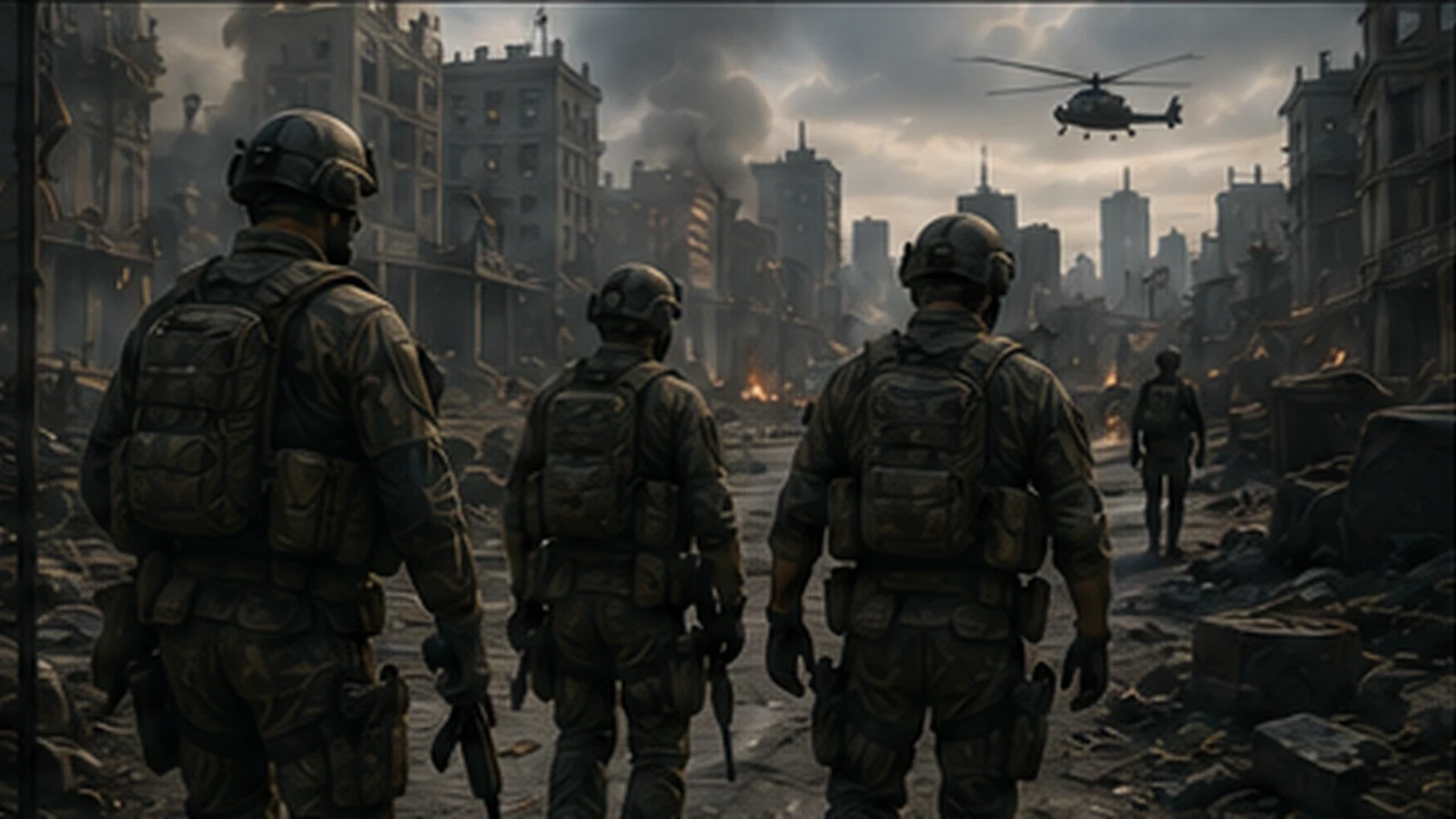
Team Ghost's history is easy to reduce to a highlight reel: Building 8, New York, Operation Extinction, Europe, Greenland, and the Dark Age. That shorthand misses what actually makes the unit important.
Ghost does not simply survive a sequence of difficult missions. It evolves because of them.
The unit that enters Building 8 in April 2015 is a compact Delta Force element led by Master Sergeant Reed Beckham. Its operators are trained for reconnaissance, direct action, sensitive-site exploitation, and missions where speed and discretion matter more than numbers. They are not a public symbol, a rescue service, or a permanent anti-Variant institution. They are soldiers sent to recover a classified sample from a site they have not been told the truth about.
By the Dark Age, almost everything has changed.
Beckham is no longer the normal field commander. Joe Fitzpatrick leads a roster assembled from different military backgrounds. Team Ghost hunts surviving Variants beyond the walls of the Allied States, rescues prisoners, investigates vanished outposts, studies evidence that may change scientific understanding, conducts HALO insertions into enemy territory, fights beside allied units, and confronts adversaries that combine Variant biology with human intelligence and military weapons.
The name stays the same.
The mission does not.
That evolution is the real Team Ghost timeline.
What Counts as a Major Team Ghost Mission
Team Ghost's history turns on major missions and operational arcs, not every patrol, guard shift, convoy movement, or battle in which a Ghost operator appears.
That distinction matters because the books do not give every sequence an official operation name. Operation Liberty, Operation Condor, Operation Extinction, Operation Beachhead, and Operation Shadow are formal named operations. Other entries, such as the Building 8 deployment, Plum Island security arc, New York tunnel escape, Greenland mission, and Turkey River investigation, are labeled descriptively so the timeline can organize events without inventing codenames.
The casualty record follows the same rule. A death or wound belongs to an operation when the books clearly establish the connection. Long campaigns with overlapping engagements cannot support a falsely exact assignment of every loss to one mission.
One other boundary is important: Operation Burn Bright is background to Team Ghost, not a Team Ghost mission. The 1968 VX-99 disaster involving Lieutenant Trevor Brett is essential to understanding the outbreak, but Team Ghost's operational history begins in 2015 with the Building 8 deployment.
Team Ghost Mission Timeline at a Glance
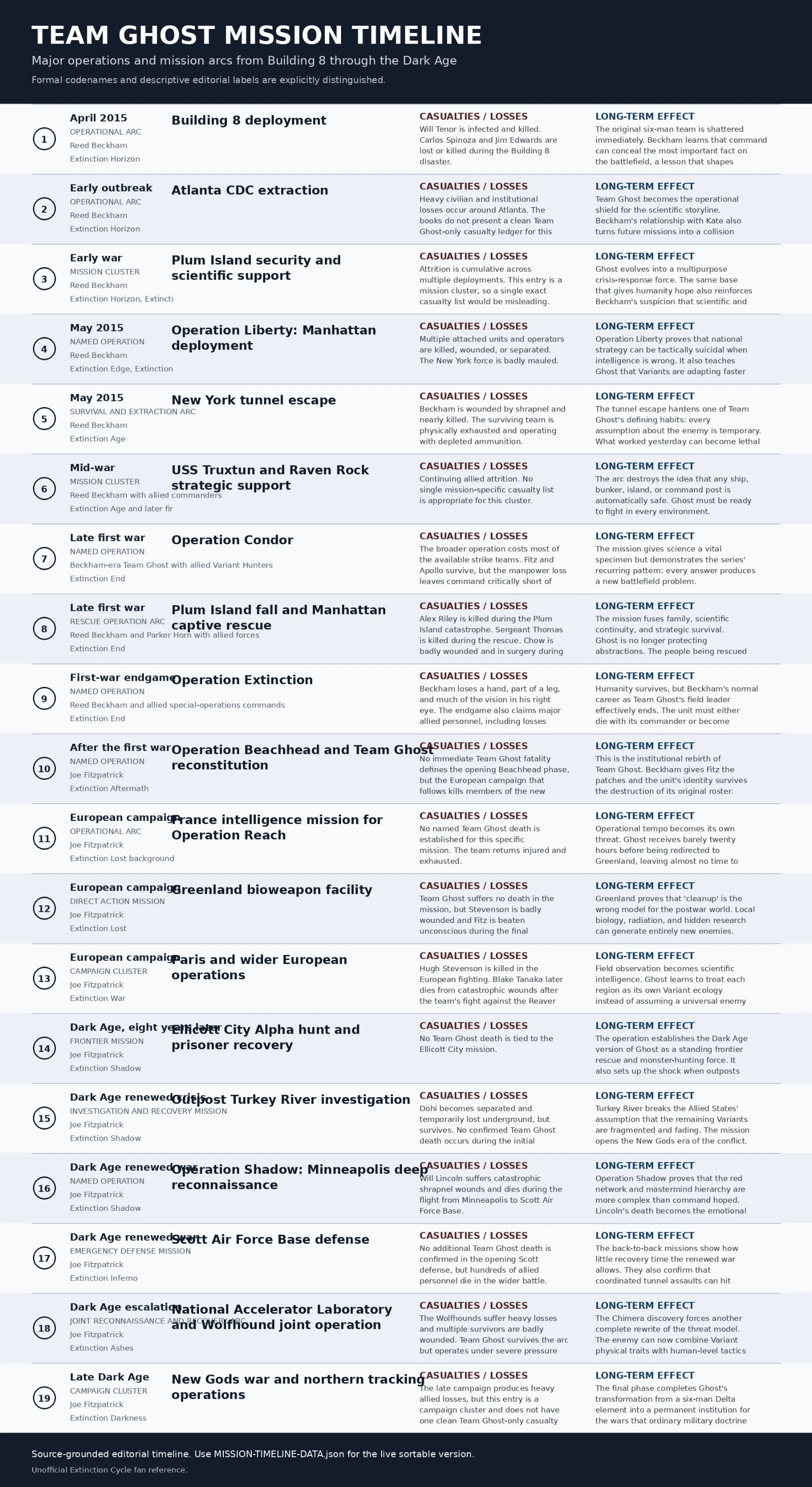
| # | Era | Mission | Leader | Primary source |
|---|---|---|---|---|
| 1 | April 2015 | Building 8 deployment | Reed Beckham | Extinction Horizon |
| 2 | Early outbreak | Atlanta CDC extraction | Reed Beckham | Extinction Horizon |
| 3 | Early war | Plum Island security and scientific support | Reed Beckham | Extinction Horizon, Extinction Edge, Extinction Age |
| 4 | May 2015 | Operation Liberty: Manhattan deployment | Reed Beckham | Extinction Edge, Extinction Age |
| 5 | May 2015 | New York tunnel escape | Reed Beckham | Extinction Age |
| 6 | Mid-war | USS Truxtun and Raven Rock strategic support | Reed Beckham with allied commanders | Extinction Age and later first-war arc |
| 7 | Late first war | Operation Condor | Beckham-era Team Ghost with allied Variant Hunters | Extinction End |
| 8 | Late first war | Plum Island fall and Manhattan captive rescue | Reed Beckham and Parker Horn with allied forces | Extinction End |
| 9 | First-war endgame | Operation Extinction | Reed Beckham and allied special-operations commands | Extinction End |
| 10 | After the first war | Operation Beachhead and Team Ghost reconstitution | Joe Fitzpatrick | Extinction Aftermath |
| 11 | European campaign | France intelligence mission for Operation Reach | Joe Fitzpatrick | Extinction Lost background |
| 12 | European campaign | Greenland bioweapon facility | Joe Fitzpatrick | Extinction Lost |
| 13 | European campaign | Paris and wider European operations | Joe Fitzpatrick | Extinction War |
| 14 | Dark Age, eight years later | Ellicott City Alpha hunt and prisoner recovery | Joe Fitzpatrick | Extinction Shadow |
| 15 | Dark Age renewed crisis | Outpost Turkey River investigation | Joe Fitzpatrick | Extinction Shadow |
| 16 | Dark Age renewed war | Operation Shadow: Minneapolis deep reconnaissance | Joe Fitzpatrick | Extinction Shadow |
| 17 | Dark Age renewed war | Scott Air Force Base defense | Joe Fitzpatrick | Extinction Inferno |
| 18 | Dark Age escalation | National Accelerator Laboratory and Wolfhound joint operation | Joe Fitzpatrick | Extinction Ashes |
| 19 | Late Dark Age | New Gods war and northern tracking operations | Joe Fitzpatrick | Extinction Darkness |
The broad pattern is visible even in the short version. Beckham's Team Ghost spends the first war moving from classified containment to national survival. Fitz's Team Ghost inherits a different problem: how to keep an elite unit relevant after the first war appears to be over, then how to respond when the enemy proves it has continued evolving.
Phase One: The Unit Is Born Inside a Lie
Team Ghost enters the Extinction Cycle with an enormous professional advantage and one fatal disadvantage.
The advantage is training. Beckham, Horn, Riley, Tenor, Spinoza, and Edwards are not learning how to operate under fire. They already understand small-unit movement, communications, weapons, and responsibility.
The disadvantage is information.
Building 8 teaches them that elite training cannot compensate for a deliberately incomplete threat picture. Command knows the facility is tied to VX-99. Command knows the 1968 experiment produced something monstrous. Yet Ghost is still sent into the site with information divided between agencies and personnel.
That becomes the first recurring rule of the unit's history: intelligence failure is often more dangerous than lack of firepower.
1. Building 8 deployment
Era: April 2015 Timeline status: Operational arc Primary source: Extinction Horizon Leader: Reed Beckham Major participants: Reed Beckham, Parker Horn, Alex Riley, Will Tenor, Carlos Spinoza, Jim Edwards; Dr. Pat Ellis; attached Army medical personnel
Objective: Escort the medical team into the classified Building 8 facility on San Nicolas Island, protect them, and recover the sample tied to Dr. Medford's VX-99 work.
Outcome: The team discovers that the incident is not a conventional containment problem. Building 8 becomes the point where Team Ghost first confronts the Variant threat and the hidden history of VX-99.
Casualties and losses: Will Tenor is infected and killed. Carlos Spinoza and Jim Edwards are lost or killed during the Building 8 disaster.
Effect on later events: The original six-man team is shattered immediately. Beckham learns that command can conceal the most important fact on the battlefield, a lesson that shapes his judgment for the rest of the war.
The important point in this entry is not merely whether Ghost completes the immediate assignment. Team Ghost's history is cumulative. Each deployment changes the assumptions carried into the next one. In some cases that change is tactical, such as learning how Variants use tunnels, walls, water, webbing, or coordinated command structures. In others it is institutional, such as the transfer of leadership from Beckham to Fitz or the realization that scientific personnel are as strategically important as ammunition. That continuity is what turns a list of battles into a genuine mission history.
2. Atlanta CDC extraction
Era: Early outbreak Timeline status: Operational arc Primary source: Extinction Horizon Leader: Reed Beckham Major participants: Beckham and surviving Team Ghost operators; Dr. Kate Lovato and surviving CDC personnel
Objective: Reach the collapsing CDC environment and extract Kate Lovato and other personnel whose knowledge is critical to understanding the Hemorrhage Virus.
Outcome: Kate survives and becomes central to the scientific response. Ghost's mission identity expands from classified recovery to protecting the people who may be able to stop the outbreak.
Casualties and losses: Heavy civilian and institutional losses occur around Atlanta. The books do not present a clean Team Ghost-only casualty ledger for this extraction.
Effect on later events: Team Ghost becomes the operational shield for the scientific storyline. Beckham's relationship with Kate also turns future missions into a collision between duty, science, and personal stakes.
The important point in this entry is not merely whether Ghost completes the immediate assignment. Team Ghost's history is cumulative. Each deployment changes the assumptions carried into the next one. In some cases that change is tactical, such as learning how Variants use tunnels, walls, water, webbing, or coordinated command structures. In others it is institutional, such as the transfer of leadership from Beckham to Fitz or the realization that scientific personnel are as strategically important as ammunition. That continuity is what turns a list of battles into a genuine mission history.
3. Plum Island security and scientific support
Era: Early war Timeline status: Mission cluster Primary source: Extinction Horizon, Extinction Edge, Extinction Age Leader: Reed Beckham Major participants: Beckham, Horn, surviving Ghost personnel and attached operators; Kate Lovato; Lieutenant Colonel Jensen; military and scientific personnel
Objective: Protect scientists, specimens, command personnel, and the research infrastructure that develops humanity's countermeasures.
Outcome: Plum Island becomes a research stronghold, command node, refuge, and staging base rather than merely a laboratory.
Casualties and losses: Attrition is cumulative across multiple deployments. This entry is a mission cluster, so a single exact casualty list would be misleading.
Effect on later events: Ghost evolves into a multipurpose crisis-response force. The same base that gives humanity hope also reinforces Beckham's suspicion that scientific and military institutions remain dangerously compartmentalized.
The important point in this entry is not merely whether Ghost completes the immediate assignment. Team Ghost's history is cumulative. Each deployment changes the assumptions carried into the next one. In some cases that change is tactical, such as learning how Variants use tunnels, walls, water, webbing, or coordinated command structures. In others it is institutional, such as the transfer of leadership from Beckham to Fitz or the realization that scientific personnel are as strategically important as ammunition. That continuity is what turns a list of battles into a genuine mission history.
Phase Two: Team Ghost Becomes a National Crisis-Response Force
The next stage is where Team Ghost stops behaving like a single special-operations team with one objective at a time.
Plum Island gives the survivors a base. Operation Liberty then demonstrates that even a national military plan can fail if it misunderstands the enemy. The Manhattan tunnel sequence strips the war down to its essentials: no clean command picture, almost no ammunition, no safe route, and predators that can move in spaces human planners treat as barriers.
From there, Team Ghost is repeatedly assigned to protect the surviving architecture of the country. Ships, bunkers, scientists, presidents, specimens, and command nodes all become mission objectives.
This is also the point where Beckham's distrust of command becomes more sophisticated. He does not simply reject orders. He asks what assumptions produced them, what intelligence may be missing, and who pays the price if headquarters is wrong.
4. Operation Liberty: Manhattan deployment
Era: May 2015 Timeline status: Named operation Primary source: Extinction Edge, Extinction Age Leader: Reed Beckham Major participants: Beckham-led Ghost element, attached soldiers and mechanized forces, surviving command personnel including Lieutenant Colonel Jensen
Objective: Support the nationwide attempt to retake major cities, destroy concentrated Variant populations, and rescue survivors.
Outcome: The plan fails catastrophically in major cities. Ground forces are used to draw Variants into kill zones while air strikes and firebombing devastate urban terrain. Ghost is driven underground in Manhattan.
Casualties and losses: Multiple attached units and operators are killed, wounded, or separated. The New York force is badly mauled.
Effect on later events: Operation Liberty proves that national strategy can be tactically suicidal when intelligence is wrong. It also teaches Ghost that Variants are adapting faster than conventional doctrine.
The important point in this entry is not merely whether Ghost completes the immediate assignment. Team Ghost's history is cumulative. Each deployment changes the assumptions carried into the next one. In some cases that change is tactical, such as learning how Variants use tunnels, walls, water, webbing, or coordinated command structures. In others it is institutional, such as the transfer of leadership from Beckham to Fitz or the realization that scientific personnel are as strategically important as ammunition. That continuity is what turns a list of battles into a genuine mission history.
5. New York tunnel escape
Era: May 2015 Timeline status: Survival and extraction arc Primary source: Extinction Age Leader: Reed Beckham Major participants: Reed Beckham, Chow, Timbo, Lieutenant Colonel Jensen, Jinx, Ryan, Valdez, and other survivors of the Manhattan operation
Objective: Survive the collapse of Operation Liberty, escape the Manhattan tunnels, and keep the remaining force together with minimal ammunition and no reliable map.
Outcome: Ghost survives by improvising, using smoke, grenades, movement, and constant reassessment while Variants stalk walls and ceilings.
Casualties and losses: Beckham is wounded by shrapnel and nearly killed. The surviving team is physically exhausted and operating with depleted ammunition.
Effect on later events: The tunnel escape hardens one of Team Ghost's defining habits: every assumption about the enemy is temporary. What worked yesterday can become lethal today.
The important point in this entry is not merely whether Ghost completes the immediate assignment. Team Ghost's history is cumulative. Each deployment changes the assumptions carried into the next one. In some cases that change is tactical, such as learning how Variants use tunnels, walls, water, webbing, or coordinated command structures. In others it is institutional, such as the transfer of leadership from Beckham to Fitz or the realization that scientific personnel are as strategically important as ammunition. That continuity is what turns a list of battles into a genuine mission history.
6. USS Truxtun and Raven Rock strategic support
Era: Mid-war Timeline status: Mission cluster Primary source: Extinction Age and later first-war arc Leader: Reed Beckham with allied commanders Major participants: Beckham-era Ghost, surviving military command, scientific personnel, naval and bunker security forces
Objective: Protect strategic personnel and assets while supporting the surviving military-scientific command network across ships, bunkers, and hardened facilities.
Outcome: Ghost operates as a mobile crisis-response element rather than a single-purpose raid team. Supposedly secure platforms repeatedly prove vulnerable.
Casualties and losses: Continuing allied attrition. No single mission-specific casualty list is appropriate for this cluster.
Effect on later events: The arc destroys the idea that any ship, bunker, island, or command post is automatically safe. Ghost must be ready to fight in every environment.
The important point in this entry is not merely whether Ghost completes the immediate assignment. Team Ghost's history is cumulative. Each deployment changes the assumptions carried into the next one. In some cases that change is tactical, such as learning how Variants use tunnels, walls, water, webbing, or coordinated command structures. In others it is institutional, such as the transfer of leadership from Beckham to Fitz or the realization that scientific personnel are as strategically important as ammunition. That continuity is what turns a list of battles into a genuine mission history.
Phase Three: Science and Combat Become the Same Mission
The late first war makes it impossible to separate the military and scientific sides of the story.
Operation Condor is the clearest example. Capturing a juvenile is not an ordinary high-value-target operation. The target is a living biological problem whose body may contain the information needed to save what remains of humanity. A tactical success therefore becomes a scientific asset.
Then Plum Island falls.
The sequence is devastating because the supposed sanctuary contains the researchers, families, specimens, and command infrastructure that the surviving government has concentrated in one place. When human collaborators help Variants penetrate it, Team Ghost's next mission is simultaneously a hostage rescue, scientific recovery, family rescue, and strategic emergency.
Operation Extinction then pushes the logic to its limit. Team Ghost and other special-operations elements are asked to deliver radiological dispersal devices into the enemy's major lairs. This is not victory in the conventional sense. It is a controlled act of devastation intended to break an opponent that has survived every previous answer.
The cost is written directly onto Beckham's body.
7. Operation Condor
Era: Late first war Timeline status: Named operation Primary source: Extinction End Leader: Beckham-era Team Ghost with allied Variant Hunters Major participants: Team Ghost, Variant Hunters, Joe Fitzpatrick, Apollo, and multiple strike teams
Objective: Capture a live juvenile Variant specimen so scientists can study the new generation of the enemy.
Outcome: Condor succeeds where other strike teams fail. A live juvenile is captured.
Casualties and losses: The broader operation costs most of the available strike teams. Fitz and Apollo survive, but the manpower loss leaves command critically short of forces for the crisis that follows.
Effect on later events: The mission gives science a vital specimen but demonstrates the series' recurring pattern: every answer produces a new battlefield problem.
The important point in this entry is not merely whether Ghost completes the immediate assignment. Team Ghost's history is cumulative. Each deployment changes the assumptions carried into the next one. In some cases that change is tactical, such as learning how Variants use tunnels, walls, water, webbing, or coordinated command structures. In others it is institutional, such as the transfer of leadership from Beckham to Fitz or the realization that scientific personnel are as strategically important as ammunition. That continuity is what turns a list of battles into a genuine mission history.
8. Plum Island fall and Manhattan captive rescue
Era: Late first war Timeline status: Rescue operation arc Primary source: Extinction End Leader: Reed Beckham and Parker Horn with allied forces Major participants: Beckham, Horn, Fitz, Apollo, Garcia, Tank, Thomas, surviving Ghost and Variant Hunter personnel; captives include Kate Lovato, Meg Pratt, Tasha Horn, Jenny Horn, and others
Objective: Recover the civilians and scientific personnel abducted after the Variant attack on Plum Island.
Outcome: The rescue force reaches New York and extracts the captives. The operation succeeds, but Plum Island's role as an unquestioned sanctuary is finished.
Casualties and losses: Alex Riley is killed during the Plum Island catastrophe. Sergeant Thomas is killed during the rescue. Chow is badly wounded and in surgery during the operation.
Effect on later events: The mission fuses family, scientific continuity, and strategic survival. Ghost is no longer protecting abstractions. The people being rescued are central to the future of the war.
The important point in this entry is not merely whether Ghost completes the immediate assignment. Team Ghost's history is cumulative. Each deployment changes the assumptions carried into the next one. In some cases that change is tactical, such as learning how Variants use tunnels, walls, water, webbing, or coordinated command structures. In others it is institutional, such as the transfer of leadership from Beckham to Fitz or the realization that scientific personnel are as strategically important as ammunition. That continuity is what turns a list of battles into a genuine mission history.
9. Operation Extinction
Era: First-war endgame Timeline status: Named operation Primary source: Extinction End Leader: Reed Beckham and allied special-operations commands Major participants: Beckham-led strike element, surviving Ghost and Variant Hunter personnel, multiple special-operations teams and supporting forces
Objective: Infiltrate major Variant lairs and deploy radiological dispersal devices against juvenile populations after earlier biological solutions prove incomplete.
Outcome: The final-stage attacks break the first Variant war and destroy or cripple major juvenile concentrations.
Casualties and losses: Beckham loses a hand, part of a leg, and much of the vision in his right eye. The endgame also claims major allied personnel, including losses remembered later by Beckham such as Jose Garcia and Lieutenant Colonel Jensen.
Effect on later events: Humanity survives, but Beckham's normal career as Team Ghost's field leader effectively ends. The unit must either die with its commander or become something larger than him.
The important point in this entry is not merely whether Ghost completes the immediate assignment. Team Ghost's history is cumulative. Each deployment changes the assumptions carried into the next one. In some cases that change is tactical, such as learning how Variants use tunnels, walls, water, webbing, or coordinated command structures. In others it is institutional, such as the transfer of leadership from Beckham to Fitz or the realization that scientific personnel are as strategically important as ammunition. That continuity is what turns a list of battles into a genuine mission history.
Phase Four: Beckham Hands Team Ghost to Fitz
A weaker military series could have ended Team Ghost when Reed Beckham could no longer operate as he had before.
Extinction Aftermath does something more interesting.
It transfers the unit.
Joe Fitzpatrick is not a copy of Beckham. He is a different operator with different scars, a different temperament, prosthetic legs from an earlier war, and his own history of loss. Beckham's decision to hand him the Team Ghost patches is therefore more than a personnel change. It establishes that Ghost is now an institution with a doctrine and memory that can survive its founding commander.
The new roster reflects the post-collapse military itself. Jeni Rico, Blake Tanaka, Yas Dohi, Hugh Stevenson, Fitz, and Apollo bring different backgrounds and styles into one unit. The military no longer has the luxury of maintaining perfectly conventional organizational boundaries. It needs the best available people to operate together.
Operation Beachhead tests that idea immediately.
10. Operation Beachhead and Team Ghost reconstitution
Era: After the first war Timeline status: Named operation Primary source: Extinction Aftermath Leader: Joe Fitzpatrick Major participants: Joe Fitzpatrick, Jeni Rico, Blake Tanaka, Yas Dohi, Hugh Stevenson, Apollo, 24th MEU and supporting U.S. forces
Objective: Land in France, establish a forward operating base, and open a route toward European Unified Forces positions around Paris.
Outcome: A new Team Ghost is formally assembled under Fitz. The EUF cannot support the landing as expected, forcing the American force to begin the campaign with less help and less intelligence than planned.
Casualties and losses: No immediate Team Ghost fatality defines the opening Beachhead phase, but the European campaign that follows kills members of the new roster.
Effect on later events: This is the institutional rebirth of Team Ghost. Beckham gives Fitz the patches and the unit's identity survives the destruction of its original roster.
The important point in this entry is not merely whether Ghost completes the immediate assignment. Team Ghost's history is cumulative. Each deployment changes the assumptions carried into the next one. In some cases that change is tactical, such as learning how Variants use tunnels, walls, water, webbing, or coordinated command structures. In others it is institutional, such as the transfer of leadership from Beckham to Fitz or the realization that scientific personnel are as strategically important as ammunition. That continuity is what turns a list of battles into a genuine mission history.
11. France intelligence mission for Operation Reach
Era: European campaign Timeline status: Operational arc Primary source: Extinction Lost background Leader: Joe Fitzpatrick Major participants: Fitz, Rico, Tanaka, Dohi, Stevenson, Apollo and supporting European-war personnel
Objective: Gather intelligence in France required for the next phase of the European campaign, Operation Reach.
Outcome: Ghost returns battered with intelligence judged important enough to move the next campaign forward.
Casualties and losses: No named Team Ghost death is established for this specific mission. The team returns injured and exhausted.
Effect on later events: Operational tempo becomes its own threat. Ghost receives barely twenty hours before being redirected to Greenland, leaving almost no time to recover or fully process what it learned.
The important point in this entry is not merely whether Ghost completes the immediate assignment. Team Ghost's history is cumulative. Each deployment changes the assumptions carried into the next one. In some cases that change is tactical, such as learning how Variants use tunnels, walls, water, webbing, or coordinated command structures. In others it is institutional, such as the transfer of leadership from Beckham to Fitz or the realization that scientific personnel are as strategically important as ammunition. That continuity is what turns a list of battles into a genuine mission history.
12. Greenland bioweapon facility
Era: European campaign Timeline status: Direct action mission Primary source: Extinction Lost Leader: Joe Fitzpatrick Major participants: Fitz, Rico, Tanaka, Dohi, Stevenson, Apollo; attached Marine and aviation elements
Objective: Locate and infiltrate a former Nazi facility repurposed for secret bioweapon research, destroy the weapon project, and demolish the site.
Outcome: Ghost discovers hybridized local monsters, rescues Stevenson and surviving personnel, kills the facility's dominant hybrid, and destroys the installation with explosives.
Casualties and losses: Team Ghost suffers no death in the mission, but Stevenson is badly wounded and Fitz is beaten unconscious during the final confrontation. Other attached personnel are killed.
Effect on later events: Greenland proves that 'cleanup' is the wrong model for the postwar world. Local biology, radiation, and hidden research can generate entirely new enemies.
The important point in this entry is not merely whether Ghost completes the immediate assignment. Team Ghost's history is cumulative. Each deployment changes the assumptions carried into the next one. In some cases that change is tactical, such as learning how Variants use tunnels, walls, water, webbing, or coordinated command structures. In others it is institutional, such as the transfer of leadership from Beckham to Fitz or the realization that scientific personnel are as strategically important as ammunition. That continuity is what turns a list of battles into a genuine mission history.
13. Paris and wider European operations
Era: European campaign Timeline status: Campaign cluster Primary source: Extinction War Leader: Joe Fitzpatrick Major participants: Fitz, Rico, Dohi, Tanaka, Stevenson, Apollo, European Unified Forces, U.S. expeditionary forces and local allies
Objective: Support European defenses, reach threatened population centers, gather intelligence, and fight regional Variant forms that do not match American experience.
Outcome: Ghost helps push the European campaign forward while documenting Reavers, Wormers, beetle-armored forms and other regional mutations.
Casualties and losses: Hugh Stevenson is killed in the European fighting. Blake Tanaka later dies from catastrophic wounds after the team's fight against the Reaver Queen and her forces.
Effect on later events: Field observation becomes scientific intelligence. Ghost learns to treat each region as its own Variant ecology instead of assuming a universal enemy template.
The important point in this entry is not merely whether Ghost completes the immediate assignment. Team Ghost's history is cumulative. Each deployment changes the assumptions carried into the next one. In some cases that change is tactical, such as learning how Variants use tunnels, walls, water, webbing, or coordinated command structures. In others it is institutional, such as the transfer of leadership from Beckham to Fitz or the realization that scientific personnel are as strategically important as ammunition. That continuity is what turns a list of battles into a genuine mission history.
Phase Five: Eight Years of Frontier War Change the Meaning of "Mission"
By the opening of the Dark Age, Team Ghost has been doing something almost unimaginable during the chaos of 2015: routine institutional work.
For eight years, Fitz's team has entered frontier and lawless zones, killed surviving Variants, and searched for abducted humans. The missions are still dangerous, but they take place inside a larger system. The Allied States has outposts, government, agriculture, transportation, military command, and a population that increasingly believes the worst is over.
That apparent success creates the next intelligence failure.
The survivors assume the remaining Variants are fragmented remnants.
Team Ghost discovers otherwise.
Ellicott City looks like the kind of assignment the unit has handled many times. Turkey River does not. A defended agricultural outpost with hundreds of residents should not disappear. Once Ghost finds tunnels, unusual webbing, and evidence of organized behavior, the mission changes from recovery to strategic warning.
From that point forward, the Dark Age operations repeat the oldest lesson in Team Ghost history: the enemy has changed while human institutions were busy believing their own reports.
14. Ellicott City Alpha hunt and prisoner recovery
Era: Dark Age, eight years later Timeline status: Frontier mission Primary source: Extinction Shadow Leader: Joe Fitzpatrick Major participants: Fitz, Jeni Rico, Yas Dohi, Justin Mendez, Bobby Ace, Will Lincoln
Objective: Hunt an Alpha Variant and locate three people abducted from Outpost Patapsco Valley.
Outcome: Team Ghost tracks down and kills the Alpha and saves a prisoner. The mission initially looks like another successful frontier hunt.
Casualties and losses: No Team Ghost death is tied to the Ellicott City mission.
Effect on later events: The operation establishes the Dark Age version of Ghost as a standing frontier rescue and monster-hunting force. It also sets up the shock when outposts begin disappearing in ways ordinary Alpha hunts cannot explain.
The important point in this entry is not merely whether Ghost completes the immediate assignment. Team Ghost's history is cumulative. Each deployment changes the assumptions carried into the next one. In some cases that change is tactical, such as learning how Variants use tunnels, walls, water, webbing, or coordinated command structures. In others it is institutional, such as the transfer of leadership from Beckham to Fitz or the realization that scientific personnel are as strategically important as ammunition. That continuity is what turns a list of battles into a genuine mission history.
15. Outpost Turkey River investigation
Era: Dark Age renewed crisis Timeline status: Investigation and recovery mission Primary source: Extinction Shadow Leader: Joe Fitzpatrick Major participants: Fitz, Rico, Dohi, Mendez, Ace, Lincoln; survivor Cedric Long
Objective: Determine how a heavily defended agricultural outpost was penetrated and what happened to nearly three hundred residents.
Outcome: Ghost finds Cedric Long, uncovers tunnels and abnormal red webbing, recovers biological and material samples, and confirms that the attack is part of something more organized than a random Variant incursion.
Casualties and losses: Dohi becomes separated and temporarily lost underground, but survives. No confirmed Team Ghost death occurs during the initial Turkey River investigation.
Effect on later events: Turkey River breaks the Allied States' assumption that the remaining Variants are fragmented and fading. The mission opens the New Gods era of the conflict.
The important point in this entry is not merely whether Ghost completes the immediate assignment. Team Ghost's history is cumulative. Each deployment changes the assumptions carried into the next one. In some cases that change is tactical, such as learning how Variants use tunnels, walls, water, webbing, or coordinated command structures. In others it is institutional, such as the transfer of leadership from Beckham to Fitz or the realization that scientific personnel are as strategically important as ammunition. That continuity is what turns a list of battles into a genuine mission history.
16. Operation Shadow: Minneapolis deep reconnaissance
Era: Dark Age renewed war Timeline status: Named operation Primary source: Extinction Shadow Leader: Joe Fitzpatrick Major participants: Fitz, Rico, Dohi, Mendez, Ace, Will Lincoln
Objective: HALO into Minneapolis, investigate the University of Minnesota and downtown, identify the Variant communication system, and kill the controlling mastermind.
Outcome: Team Ghost penetrates the city, splits into teams, reaches the mastermind, and destroys it. The expected collapse of the enemy network does not happen cleanly.
Casualties and losses: Will Lincoln suffers catastrophic shrapnel wounds and dies during the flight from Minneapolis to Scott Air Force Base.
Effect on later events: Operation Shadow proves that the red network and mastermind hierarchy are more complex than command hoped. Lincoln's death becomes the emotional bridge into the next mission.
The important point in this entry is not merely whether Ghost completes the immediate assignment. Team Ghost's history is cumulative. Each deployment changes the assumptions carried into the next one. In some cases that change is tactical, such as learning how Variants use tunnels, walls, water, webbing, or coordinated command structures. In others it is institutional, such as the transfer of leadership from Beckham to Fitz or the realization that scientific personnel are as strategically important as ammunition. That continuity is what turns a list of battles into a genuine mission history.
17. Scott Air Force Base defense
Era: Dark Age renewed war Timeline status: Emergency defense mission Primary source: Extinction Inferno Leader: Joe Fitzpatrick Major participants: Fitz, Rico, Dohi, Mendez, Ace; Scott AFB defenders and evacuation personnel
Objective: Protect evacuation routes and the command building, destroy tunnel breaches, and prevent Variants from overrunning the base immediately after Operation Shadow.
Outcome: Ghost joins the defense only hours after leaving Minneapolis, kills Alphas, helps collapse tunnel access, and keeps critical personnel moving while the base fights for survival.
Casualties and losses: No additional Team Ghost death is confirmed in the opening Scott defense, but hundreds of allied personnel die in the wider battle. Lincoln's body is still aboard the team's aircraft when the mission begins.
Effect on later events: The back-to-back missions show how little recovery time the renewed war allows. They also confirm that coordinated tunnel assaults can hit hardened military infrastructure.
The important point in this entry is not merely whether Ghost completes the immediate assignment. Team Ghost's history is cumulative. Each deployment changes the assumptions carried into the next one. In some cases that change is tactical, such as learning how Variants use tunnels, walls, water, webbing, or coordinated command structures. In others it is institutional, such as the transfer of leadership from Beckham to Fitz or the realization that scientific personnel are as strategically important as ammunition. That continuity is what turns a list of battles into a genuine mission history.
18. National Accelerator Laboratory and Wolfhound joint operation
Era: Dark Age escalation Timeline status: Joint reconnaissance and recovery arc Primary source: Extinction Ashes Leader: Joe Fitzpatrick Major participants: Fitz, Rico, Dohi, Mendez, Ace; Lieutenant Singh and the Wolfhounds
Objective: Infiltrate the National Accelerator Laboratories in California, recover SDS equipment and Project Rolling Stone intelligence, and determine what threats remain in the devastated West.
Outcome: The mission expands into rescue, combat, and a freighter investigation. Ghost encounters Chimeras, intelligent Variant-human hybrids capable of using weapons and communicating.
Casualties and losses: The Wolfhounds suffer heavy losses and multiple survivors are badly wounded. Team Ghost survives the arc but operates under severe pressure and injury.
Effect on later events: The Chimera discovery forces another complete rewrite of the threat model. The enemy can now combine Variant physical traits with human-level tactics and weapons.
The important point in this entry is not merely whether Ghost completes the immediate assignment. Team Ghost's history is cumulative. Each deployment changes the assumptions carried into the next one. In some cases that change is tactical, such as learning how Variants use tunnels, walls, water, webbing, or coordinated command structures. In others it is institutional, such as the transfer of leadership from Beckham to Fitz or the realization that scientific personnel are as strategically important as ammunition. That continuity is what turns a list of battles into a genuine mission history.
19. New Gods war and northern tracking operations
Era: Late Dark Age Timeline status: Campaign cluster Primary source: Extinction Darkness Leader: Joe Fitzpatrick Major participants: Fitz, Dohi, Ace and rotating Ghost personnel; Canadian Team Spearhead and other Allied forces in representative operations
Objective: Track regional super-Variants, investigate abnormal behavior tied to the New Gods, support surviving Allied positions, and continue the intelligence war against Chimeras, Scions, Thralls, and their human collaborators.
Outcome: Ghost remains active across national and international theaters, including tracking giant 'bear' Variants near Banff while the Allied States fights a wider New Gods offensive.
Casualties and losses: The late campaign produces heavy allied losses, but this entry is a campaign cluster and does not have one clean Team Ghost-only casualty list.
Effect on later events: The final phase completes Ghost's transformation from a six-man Delta element into a permanent institution for the wars that ordinary military doctrine cannot explain.
The important point in this entry is not merely whether Ghost completes the immediate assignment. Team Ghost's history is cumulative. Each deployment changes the assumptions carried into the next one. In some cases that change is tactical, such as learning how Variants use tunnels, walls, water, webbing, or coordinated command structures. In others it is institutional, such as the transfer of leadership from Beckham to Fitz or the realization that scientific personnel are as strategically important as ammunition. That continuity is what turns a list of battles into a genuine mission history.
The Leadership Transition: Reed Beckham to Joe Fitzpatrick
The mission timeline is also a leadership timeline.
Reed Beckham's era
Beckham builds Team Ghost around trust under uncertainty. His defining leadership problem is that higher command repeatedly lacks, withholds, or misunderstands essential information. He learns to question assumptions without allowing skepticism to paralyze action.
His missions are dominated by collapse:
- secure the site
- extract the scientist
- hold the island
- survive the city
- protect the command network
- capture the specimen
- rescue the prisoners
- deploy the weapon
His version of Ghost is always fighting while the world is getting smaller.
Joe Fitzpatrick's era
Fitz inherits a world that is trying to expand again.
His missions begin with Operation Beachhead, where Team Ghost is rebuilt for an international theater. They later become frontier missions inside a recovering country. That means Fitz has to preserve Ghost's aggression without letting the team become a relic of the first war.
His challenges include:
- integrating operators from different branches
- working with foreign forces
- interpreting regional Variant evolution
- conducting rescue missions beyond formal borders
- gathering scientific evidence in the field
- investigating threats the rebuilt government does not understand
- maintaining cohesion after years of casualties
- fighting enemies that increasingly use command, networks, and weapons
Beckham teaches Ghost how to survive catastrophe.
Fitz teaches it how to remain useful after catastrophe, and then how to fight when catastrophe returns.
Casualties: Why Team Ghost Never Has a Stable Roster
The roster changes are not cosmetic. They are the mechanism by which the series shows the cost of continuity.
The Building 8 mission destroys the original six-man structure almost immediately. Will Tenor, Carlos Spinoza, and Jim Edwards are removed from the team during the foundational disaster. Alex Riley survives long enough to become one of Ghost's emotional anchors, then dies during the endgame around the fall of Plum Island. Other attached operators and allies die across the first war.
Operation Extinction leaves Beckham alive but permanently transformed by injury.
The rebuilt team under Fitz pays its own price. Hugh Stevenson dies in Europe. Blake Tanaka survives multiple seemingly impossible fights before dying from wounds sustained during the Reaver campaign. Eight years later, Will Lincoln joins a Ghost that already carries generations of dead operators in its memory, then dies after Operation Shadow in Minneapolis.
The important continuity point is not the raw number.
It is that Team Ghost keeps replacing people without pretending they are interchangeable.
Fitz remembers Stevenson and Tanaka.
The Dark Age roster knows the names that came before it.
Beckham remains part of the unit's institutional identity even after he is no longer its normal field leader.
That memory matters because Ghost's greatest operational advantage is not superior ammunition. It is accumulated experience.
How Team Ghost's Mission Types Change Over Time
1. Sensitive-site recovery
Building 8 begins as a classic classified recovery problem: enter a restricted site, protect specialists, retrieve a target.
That mission type never fully disappears. It evolves into scientific recovery operations, specimen missions, and intelligence exploitation.
2. Rescue and extraction
Atlanta, New York, the captive rescue, frontier prisoner recovery, and later outpost missions all reinforce the same ethic: getting people out is often as strategically important as killing the enemy.
3. Direct action
Operation Liberty, Operation Extinction, European combat, and Dark Age raids put Ghost into overt warfighting.
The difference is that the targets become less predictable over time.
4. Scientific support
Condor is the clearest case, but nearly every later mission produces scientific evidence. Samples, Variant bodies, webbing, tunnel data, Chimera equipment, and observations about behavior all feed the research effort.
5. Reconnaissance under uncertainty
France, Greenland, Turkey River, Minneapolis, California, and Banff demonstrate a later Ghost specialty: going where the intelligence picture has failed.
The unit is increasingly deployed because command does not know what is happening.
6. Institutional crisis response
By the Dark Age, Team Ghost functions almost like a national emergency instrument. When outposts vanish, an Alpha abducts civilians, or a new enemy appears, Ghost is one of the units the government sends to find the truth.
That is a much broader purpose than the one Beckham's six men carried into Building 8.
The Intelligence Pattern That Connects Every Mission
Look across the timeline and a striking pattern emerges.
The most dangerous variable is often not the Variant directly in front of the team.
It is the thing Team Ghost does not know yet.
At Building 8, the missing information is VX-99 history.
During Operation Liberty, it is Variant intelligence and urban adaptation.
In the tunnels, it is enemy movement and terrain.
During Condor, it is juvenile biology.
In Greenland, it is a secret second bioweapon project.
In Europe, it is regional mutation.
At Turkey River, it is the existence of an underground communication and transport system.
During Operation Shadow, it is the hierarchy behind the webbing network.
In California, it is the existence of Chimeras.
The tactical lesson is obvious: Ghost cannot simply become better at killing the last version of the enemy.
It has to become better at learning.
That is why Dohi's tracking matters.
It is why Kate's science matters.
It is why recovered samples matter.
It is why Fitz's willingness to change plans matters.
And it is why Beckham's anger at concealed intelligence is not merely personal. In the Extinction Cycle, bad information repeatedly kills at strategic scale.
What Makes a Team Ghost Mission Different?
Not every battle in the series is a Team Ghost mission.
A useful way to identify the missions that define the unit is to look for five characteristics.
First, the objective matters beyond the immediate firefight. Ghost is sent after a scientist, specimen, command node, kidnapped civilians, hidden facility, mastermind, or intelligence source whose survival or destruction changes later events.
Second, the intelligence is incomplete. If command already understood the problem perfectly, it could often send a larger conventional force.
Third, the team is expected to improvise. Plans collapse. Extraction routes disappear. Targets behave differently. Friendly forces do not arrive.
Fourth, the mission generates new information. Team Ghost does not merely close problems. It discovers the next one.
Fifth, the consequences follow the team home. Casualties alter the roster. Evidence changes science. Failures reshape strategy. Personal losses change leaders.
That is why the mission chronology is one of the best ways to understand Team Ghost as a whole.
Final Takeaway
Team Ghost begins the Extinction Cycle as six Delta Force operators flying toward a laboratory that officially should not exist.
It survives by becoming something else.
The Building 8 team is built for classified direct action.
The New York team becomes a desperate survival unit.
The Plum Island team becomes the shield around the scientific response.
The Operation Extinction team becomes part of humanity's last strategic gamble.
The Beachhead team becomes a multinational expeditionary force.
The Dark Age team becomes an institutional frontier service, rescue force, intelligence collector, and anti-Variant special operations unit.
Then the New Gods force it to evolve again.
That is the real meaning of the Team Ghost timeline.
The unit's continuity is not defined by a fixed roster, a particular weapon, or even one commander.
It is defined by a method.
Enter the place where the intelligence has failed.
Find out what is really there.
Protect the people who matter.
Bring back the information.
Adapt before the enemy does.
And when the team loses someone, carry what that person taught into the next mission.
Team Ghost's history is therefore not a sequence of isolated adventures. It is a chain of cause and effect running from the first lies surrounding VX-99 to the evolved threats of the Dark Age.
Every mission changes the next one.
Every loss changes the team.
And every time humanity believes the war has finally become understandable, Team Ghost is sent out to discover how wrong that belief is.
FAQ
What was Team Ghost's first mission in the Extinction Cycle?
The first Team Ghost mission in the main story is the Building 8 deployment in Extinction Horizon. Reed Beckham's six-man Delta Force team escorts medical personnel into the classified San Nicolas Island facility to recover a sample tied to VX-99 research.
Was Operation Burn Bright a Team Ghost mission?
No. Operation Burn Bright is 1968 backstory involving Lieutenant Trevor Brett and the original VX-99 experiment. It explains the history that eventually produces the Extinction Cycle, but Team Ghost itself enters the story in 2015.
What was Team Ghost's most important mission?
There is no single objective answer. Building 8 defines the unit's war, Operation Condor provides critical scientific material, and Operation Extinction helps break the first Variant war. For the unit's institutional history, Operation Beachhead may be equally important because it establishes Joe Fitzpatrick's successor Team Ghost.
When does Joe Fitzpatrick take over Team Ghost?
Fitz becomes the leader of the reconstituted Team Ghost after the first American war, with Extinction Aftermath showing the new roster preparing for Operation Beachhead in Europe.
Who dies on Team Ghost in Europe?
Hugh Stevenson and Blake Tanaka are two of the major Team Ghost deaths during the European campaign depicted around Extinction War.
What is Operation Shadow?
Operation Shadow is a Dark Age mission in Minneapolis. Fitz leads Team Ghost on a HALO insertion to investigate Variant activity, penetrate the enemy network, and destroy a mastermind. Specialist Will Lincoln is mortally wounded during the operation and dies during extraction.
Why is Turkey River important to Team Ghost?
The Turkey River investigation exposes evidence that the postwar Variant threat is organized and technologically or biologically coordinated in ways the Allied States did not expect. The tunnels and red webbing recovered there become crucial clues to the renewed Dark Age conflict.
Is every Team Ghost deployment included here?
No. The chronology includes the major operations and operational arcs that materially change Team Ghost, the war, or later events. Routine patrols and smaller engagements are omitted.
Sources and Canon Scope
This timeline is based primarily on the main Extinction Cycle novels, Extinction Lost, Extinction Aftermath, Extinction War, and the Dark Age quartet. It distinguishes formal named operations from descriptive mission arcs.
Descriptive labels such as "Plum Island security and scientific support" are not official operation names. Only a codename explicitly established by a primary text is treated as a named operation.
Primary works used
- Extinction Horizon
- Extinction Edge
- Extinction Age
- Extinction Evolution
- Extinction End
- Extinction Aftermath
- Extinction Lost
- Extinction War
- Extinction Shadow
- Extinction Inferno
- Extinction Ashes
- Extinction Darkness
Editorial Disclosure
This is an independent fan reference and critical analysis. It is not an official publication of Nicholas Sansbury Smith, Great Wave Ink, Orbit, or other rights holders. Generated images supplied with this package are unofficial editorial illustrations and should be identified as such.
Recommended next pages
Sources and editorial scope
- Canon treatment
- Source-grounded chronology that distinguishes official named operations from descriptive mission arcs and avoids inventing codenames, exact casualty assignments, or unsupported dates.
- Spoiler scope
- Full mission, casualty, leadership, and outcome spoilers for the original Extinction Cycle, Extinction Lost, Extinction Aftermath, Extinction War, and Dark Age.