
Locations
Key West
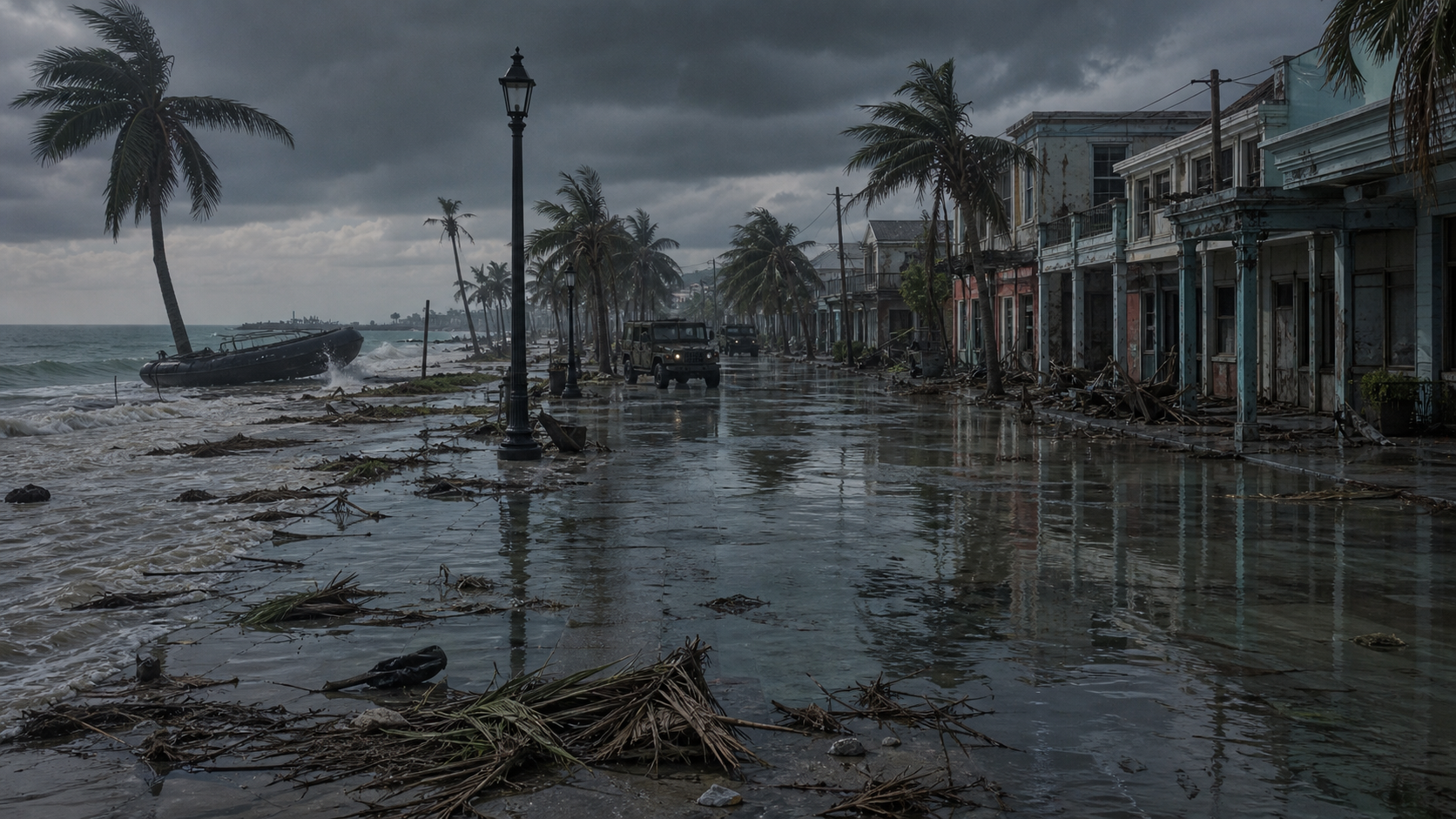
Key West is a coastal reconnaissance location in Nicholas Sansbury Smith's Extinction Evolution and the site of the first major field proof that Variants have adapted to aquatic terrain and deliberate ambush. Marine Staff Sergeant Jose Garcia leads the six-man Variant Hunters ashore at Smathers Beach to observe changes in the surviving enemy population. The team discovers child-sized Variant bodies with functional gill-like tissue, obtains a sample, and advances into the city. An injured woman then draws the Marines toward a prepared kill zone near the Sheraton.
Quick Facts
- Role
- Locations
- Aliases
- key-west, Florida Keys, Smathers Beach
Overview
Garcia identifies the trap only after the team has committed to the rescue. Adult Variants pour from hotel rooms, sewers, and streets while aquatic forms move under the surf and flank the retreat. Daniels, Morgan, and the unnamed woman are killed before three Black Hawks suppress the beach and extract Garcia, Tank, Thomas, and Stevo. The mission changes the scientific and tactical understanding of the war. Water can no longer be treated as a barrier, apparent victims and corpses can be placed as bait, and regional adaptation must be investigated before assumptions become casualties.
Location information
- Field: Location; Detail: Key West, Florida Keys, Florida
- Field: Principal landing area; Detail: Smathers Beach
- Field: Nearby landmark; Detail: Sheraton hotel overlooking the beach and highway
- Field: Operation type; Detail: Night maritime infiltration, reconnaissance, documentation, tissue recovery, and emergency extraction
- Field: Launch platform; Detail: George Washington Carrier Strike Group
- Field: Ground force; Detail: Six-man Marine Force Recon team known as the Variant Hunters
- Field: Team leader; Detail: Staff Sergeant Jose Garcia
- Field: Team members; Detail: Rick Thomas, Jimmy Daniels, Steve "Stevo" Holmes, Jeff Morgan, and Ryan "Tank" Talon
- Field: Mission objective; Detail: Locate and observe Variants, document adaptation, and return evidence to the scientific command network
- Field: Principal discoveries; Detail: Gill-like anatomy, submerged approach capability, coordinated bait placement, urban ambush, and multi-directional attack
- Field: Human bait; Detail: Unnamed injured woman found in the street
- Field: Team losses; Detail: Jimmy Daniels and Jeff Morgan killed
- Field: Surviving team; Detail: Garcia, Thomas, Stevo, and Tank
- Field: Extraction; Detail: Three Black Hawks using rockets and M240 fire
- Field: Primary work; Detail: Extinction Evolution, prologue and immediate follow-up chapters
Strategic background
More than a month after the Hemorrhage Virus outbreak, the George Washington Carrier Strike Group is the last intact American strike group described in the operation. It combines ships, aircraft, Marines, command personnel, and access to the surviving scientific network. Its mobility makes it one of the few platforms able to send small teams toward coastal cities without depending on functioning roads or local bases.
VariantX9H9 has killed most infected people, but the surviving minority retains the cellular and anatomical changes initiated by VX-99. Command receives reports that those survivors are no longer uniform. Climate, terrain, inherited differences, and continuing biological change may be producing distinct regional forms. The Variant Hunters exist to turn rumors into evidence.
Garcia dislikes the observational emphasis. His wife Ashley and daughter Leslie are dead, and he has no desire to treat the creatures that destroyed his family as an academic subject. He trusts ammunition more readily than laboratory interpretation. The Key West mission punishes that division between science and combat. The team is sent to learn because killing an enemy without understanding its new capabilities may place the force exactly where it can be surrounded.
Maritime approach
The six Marines leave the strike group in a Zodiac. Garcia knows the Variants can swim, which already makes the dark water psychologically and tactically dangerous. The team slows offshore, prepares its equipment, and completes the final distance by swimming with only their heads above the surface.
The approach is designed to reduce sound and visual signature. It also places every Marine inside the environment the enemy has adapted to exploit. At this stage, Garcia knows swimming Variants exist but does not know they may possess gills or approach unseen beneath the surface. The water is treated as a risky insertion route, not yet as an enemy avenue equivalent to a road or tunnel.
After reaching Smathers Beach, the Marines change equipment, reassemble their weapons posture, and establish security. Daniels sees two small bodies caught in the surf. The objects appear at first to be dead boys. They are the first part of the trap and the first scientific discovery.
Child-sized bodies in the surf
The two bodies wear clothing and have the size of children, but closer examination reveals Variant anatomy: swollen lips, altered eyes, visible vascular changes, and gill-like structures under the ear. Water remains in the fleshy tissue. Garcia and Morgan photograph the feature and cut a sample rather than attempting to transport the corpses.
The discovery demonstrates environmental adaptation at a level the team can physically document. The gills are not a vague report or a shape glimpsed from an aircraft. The Marines can see and touch the structures, preserve tissue, and return an account to Pat Ellis, Kate Lovato, and the wider scientific response.
The bodies also violate familiar Variant feeding behavior. Garcia notes that the creatures usually consume prey or carry it to a lair.
Later evidence confirms that the placement was deliberate. The bodies are not simply casualties washed ashore. They help focus the Marines on the beach while the enemy observes their reactions. Whether the dead forms were infected children or offspring is not established by the scene itself. Their role as child-shaped bait and their aquatic anatomy are clear.
Advance toward the hotel district
The Variant Hunters move from Smathers Beach toward the highway and the Sheraton. Urban debris creates multiple lines of concealment: abandoned cars, hotel balconies, open rooms, drainage systems, streets, and the dark water behind them. The team remains quiet and dispersed, but every surface route can be observed from above while sewers and surf provide covered approaches.
Garcia's uneasy sense of observation returns. The city feels empty, yet its emptiness is active rather than neutral. The Variants do not rush the first sound or expose themselves as an uncontrolled horde. They wait while the Marines enter the intended space.
A woman's cries break the silence. She drags herself across the pavement with badly damaged feet and asks for help. Her injuries make escape without assistance impossible. Her presence creates the exact decision an intelligent predator would want from a human rescue force: either abandon an apparently living civilian or concentrate several operators around her.
Rescue decision
Garcia orders Daniels to recover the woman, with Morgan and Stevo assisting. Tank and Thomas hold security while the unit prepares to withdraw. The decision reflects Marine and human duty. A reconnaissance team does not stop recognizing a survivor as a person simply because the mission objective concerns samples.
The woman resists or struggles as the Marines lift her, increasing noise and delay. Garcia searches the Sheraton and sees a lean figure standing in a third-floor doorway. It disappears. He realizes the woman is bait and orders the team to move.
The recognition comes moments too late to restore initiative. The rescue element is carrying a wounded person, the team is spread between street and beach, and the enemy already occupies covered positions. The mission has shifted from reconnaissance to breakout.
Ambush from the Sheraton and sewers
Initial Variants attack from the hotel area. Garcia and the Marines kill the advance elements, but the first attackers are only the front of a much larger force. Creatures pour from open windows, descend the outside of the Sheraton, emerge from sewers, and fill the street.
The pattern demonstrates coordination. The hotel population has remained concealed until the team commits to the bait. Sewer movement allows the enemy to enter streets beyond a simple building perimeter. The attack is not a single frontal charge. It is a release from several prepared spaces intended to force the Marines toward the water.
Tank contacts command under the Victor Hotel call sign and requests immediate extraction. Surveillance confirms the team's position, and three Black Hawks are sent toward the insertion point. The Marines use controlled fire and grenades to create movement time, but the horde grows from dozens to hundreds.
The team reaches the beach and discovers that the apparent escape route is another boundary of the trap. They cannot safely swim to the Zodiac because Variants are faster in the water and now possess aquatic adaptations. The shoreline becomes a fixed defensive line rather than an exit.
Aquatic flank and casualties
While the Marines face the street horde, Variants swim beneath the waves and approach from behind. The enemy uses darkness and water to bypass the team's weapons. Garcia hears an incomplete warning over the radio but remains focused on the visible threat.
Daniels and the woman are dragged into the water before Garcia understands the flank. Morgan is then killed, part of his face torn away by talons. The deaths reduce the six-man team to four in seconds and prove that the gills are not an isolated anatomical curiosity. Aquatic movement has direct tactical effect.
The woman remains unnamed in the source. That absence reinforces the moral cruelty of the bait. She is a person whose injuries and fear are used to manipulate rescuers, yet neither the Marines nor the record receives enough time to recover her identity. The Variants exploit more than sound. They exploit the human belief that an unknown wounded person is still worth saving.
Air extraction
Three Black Hawks arrive with door-mounted weapons and rockets. Their fire cuts across the surf and beach, killing exposed Variants and breaking the pressure around Garcia, Tank, Thomas, and Stevo. The helicopters must engage close to the surviving Marines, turning the extraction zone into a field of blast, sand, water, and bodies.
The aircraft save the remaining team, but the mission is not a clean success. It returns the biological sample and firsthand evidence at the cost of two Marines and the civilian. Garcia leaves Key West convinced that his own failure to respect the science contributed to the deaths. If he had treated adaptation as an operational fact rather than an unwanted research concern, he might have watched the water more carefully and recognized the arrangement earlier.
His conclusion is not the only possible allocation of responsibility. Command sent six people into a city based on incomplete intelligence, and no existing doctrine fully accounted for aquatic flanking or bait tactics. Garcia nevertheless carries the leader's burden. The event becomes part of the grief that hardens his later approach in Atlanta.
Scientific impact
The sample and report reach Ellis and Kate. Ellis tells Kate that the Key West forms possessed gills and that the Marines believed the Variants set a trap with an injured woman. Kate initially resists the intelligence implication because deliberate bait requires cognition beyond the behavior documented in early infected populations.
Key West joins evidence from other climates. Cold-region Variants display fur, desert forms show heat-related physical changes, and additional populations demonstrate camouflage or altered anatomy. Kate and Ellis distinguish physical metamorphosis from learned or evolved behavior, but both recognize the same strategic conclusion: there may be thousands of locally adapted forms that surviving institutions have not yet seen.
The mission also supports Ellis's staged theory. Physical changes such as altered mouths, talons, smell, and gills form one level. Traps represent a higher behavioral level. Later communication and leadership represent another. Key West therefore sits between anatomical discovery and the emergence of creatures such as the White King.
Tactical consequences
After Key West, coastal and island planning must account for several new risks:
The lesson is not to stop rescuing civilians. The woman is genuinely injured and afraid. The lesson is that the enemy can understand rescue behavior and arrange the battlefield around it. Marines must protect compassion with better observation rather than abandon compassion altogether.
- submerged Variants can approach a beach without appearing on a street-level search;
- water does not provide a dependable barrier for ships, islands, or shoreline settlements;
- apparent corpses may have been positioned to control attention;
- a distress call may be genuine and still form part of an enemy plan;
- hotels, sewers, streets, and surf can be used as one connected ambush system;
- rescue formations require rear and water security even when the visible horde is inland;
- tissue collection is useful only if the team survives long enough to deliver both sample and context.
Relationship to juvenile and Variant evolution
Key West is frequently connected to juvenile Variants because of the bodies' size and its position in the broader reproductive arc. The scene itself does not state that the two aquatic bodies were born from adult Variants. Later in Extinction Evolution, Garcia documents offspring in Atlanta and explicitly distinguishes them from human children transformed by infection.
The strongest formulation is therefore that Key West reveals child-sized aquatic Variants, while Atlanta supplies direct evidence of Variant-born juveniles. Both discoveries support the wider conclusion that the enemy population is diversifying. The two scenes are distinct evidence and cannot be treated as one biological claim without qualification.
Key West also anticipates Rome and the European campaign, where winged, swimming, armored, and specialized forms invalidate assumptions developed against early American Variants. Regional adaptation means every theater requires local intelligence.
Human and narrative significance
The location changes Garcia. Before landing, he dismisses scientific curiosity and thinks in terms of extermination. After losing Daniels and Morgan, he recognizes that observation is part of protecting his Marines. The lesson does not make him less aggressive. It makes aggression answer to evidence.
The mission also defines the Variant Hunters. Team Ghost often enters a known strategic crisis to recover people, destroy a target, or gather a specimen. Garcia's Marines are tasked with discovering what command does not yet know. Their casualties become the cost of converting biological change into doctrine.
Key West further changes the genre of the enemy. The Variants no longer behave only as infected humans driven by hunger. They manipulate terrain, wait, conceal numbers, and weaponize an injured captive. The city becomes the point where the war fully recognizes a predator capable of studying the people sent to study it.
Status after the mission
The operation does not reclaim Key West or establish a permanent human position. Its outcome is intelligence and extraction. The strike group retains the surviving Marines, the scientific team receives evidence, and the island remains hostile territory.
That distinction matters. A successful reconnaissance can produce decisive knowledge without controlling the ground. Key West is a tactical withdrawal and a strategic warning. The dead remain on the island, but what happened to them changes subsequent decisions aboard Plum Island and the George Washington.
Important connections
- Jose Garcia: Team leader whose assumptions and grief are transformed by the ambush.
- Jimmy Daniels: Marine assigned to carry the woman; killed in the aquatic flank.
- Jeff Morgan: Point man and sample assistant; killed during the beach attack.
- Rick Thomas: Security element and surviving Variant Hunter.
- Ryan "Tank" Talon: Radio operator who requests the Black Hawk extraction.
- Steve "Stevo" Holmes: SAW gunner and survivor whose later fate deepens Garcia's losses.
- Kate Lovato and Pat Ellis: Scientists who interpret the sample and trap report within the larger evolution model.
- George Washington Carrier Strike Group: Launch, command, and recovery platform.
- Variant evolution: Larger biological framework connecting gills, climate adaptation, reproduction, intelligence, and communication.
Chronology and consequences
- Extinction Evolution, prologue - Zodiac approach, Smathers Beach landing, aquatic-body discovery, street bait, Sheraton ambush, deaths of Daniels and Morgan, and Black Hawk extraction.
- Extinction Evolution, early chapters - Ellis briefs Kate on the gills and trap, the finding is compared with adaptations elsewhere, and Garcia carries the loss into the Atlanta mission.
- Later main-series evolution material - Key West becomes an early reference point for juveniles, regional forms, Kryptonite planning, and the need for field biology.
Continue Exploring
Connected Universe
Books and Stories
Locations, Events, and Lore
Groups and Factions
Sources
- Extinction Evolution: the Variant Hunters reconnaissance mission at Smathers Beach, aquatic adaptation evidence, ambush, casualties, and extraction.
- Extinction Evolution, Extinction Evolution - Prologue
- Extinction Evolution, Extinction Evolution - Chapter 1