
Event Arcs
Key West Evolution Recon
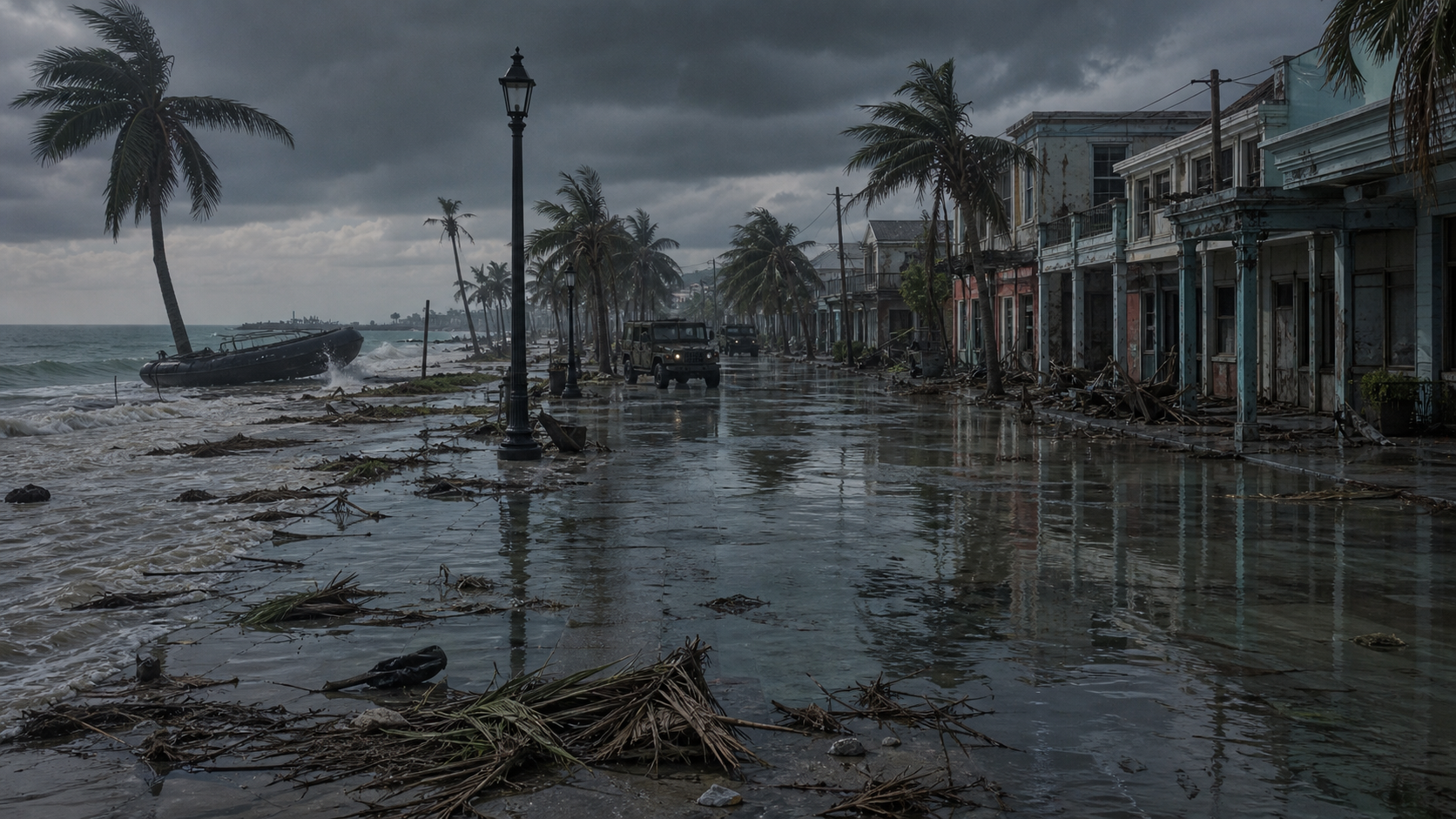
The Key West evolution reconnaissance mission is an early Variant Hunters operation in Extinction Evolution. Roughly a month after the Hemorrhage Virus outbreak, Marine Staff Sergeant Jose Garcia leads a six-man Force Recon team from the USS George Washington Carrier Strike Group to Smathers Beach in Key West, Florida. Their orders are to locate and observe Variants, document suspected adaptation, and return biological evidence rather than conduct a general extermination mission.
Quick Facts
- Role
- Event Arcs
Overview
The team discovers two small bodies in the surf that initially appear to be dead children. Both are Variants, and one has functional-looking gill structures beneath its ear. The Marines photograph the anatomy and collect a tissue sample. As they begin to withdraw, a wounded young woman calls for help from the road. The apparent rescue target is bait. Variants concealed in the Sheraton, surrounding streets, sewers, and water allow the Marines to commit to the casualty before attacking from multiple directions.
Daniels and Morgan are killed during the ambush, and the woman is lost with them. Garcia, Rick Thomas, Steve "Stevo" Holmes, and Ryan "Tank" Talon survive after three Black Hawks provide close fire support and extraction. The mission proves three facts that change later doctrine: coastal Variants can adapt for aquatic movement, organized enemies can stage human bait, and compassion itself can be incorporated into an ambush. Garcia's later conclusion is personal as well as scientific. His contempt for the observation mission contributed to assumptions that cost members of his team their lives.
Mission information
- Field: Type; Detail: Amphibious special reconnaissance and biological-intelligence mission
- Field: Date; Detail: Early outbreak, approximately one month after initial spread
- Field: Location; Detail: Smathers Beach, Nathan Lester Highway, and Sheraton area, Key West, Florida
- Field: Launch platform; Detail: USS George Washington Carrier Strike Group
- Field: Supporting naval asset; Detail: USS Emory S. Land operating in the regional sea space
- Field: Unit; Detail: Marine Force Recon team codenamed the Variant Hunters
- Field: Team leader; Detail: Staff Sergeant Jose Garcia
- Field: Roster; Detail: Rick Thomas; Jimmy Daniels; Steve "Stevo" Holmes; Jeff Morgan; Ryan "Tank" Talon
- Field: Primary objective; Detail: Locate, observe, photograph, and sample evidence of Variant adaptation
- Field: Principal discoveries; Detail: Gill-like anatomy; aquatic flanking; patient concealment; use of a wounded human as bait
- Field: Friendly losses; Detail: Jimmy Daniels and Jeff Morgan killed; civilian bait victim lost
- Field: Surviving team members; Detail: Garcia, Thomas, Holmes, and Talon
- Field: Primary work; Detail: Extinction Evolution, prologue
Operational background
The George Washington Carrier Strike Group is one of the last intact American military formations. Its ships provide aviation, sensors, medical spaces, command staff, weapons, and a mobile refuge beyond the reach of most land-based hordes. Garcia's team operates from this network and views it as home after losing family and ordinary life.
Recent intelligence suggests that the infected are changing at an alarming rate. The Variant Hunters are assigned to confirm and document those changes in the field. The mission is not designed around a body count. Samples, images, and observed behavior are the objective because scientists cannot update countermeasures or commanders cannot update doctrine without evidence.
Garcia resists that emphasis internally. His wife Ashley and infant daughter Leslie are dead, and he has spent twenty years in the Marine Corps. He sees his suppressed M4 as a more immediate answer than laboratory interpretation. The initials of his wife and daughter are engraved on ammunition, turning every engagement into a private act of vengeance.
That attitude does not make him undisciplined. It does create a blind spot. He knows the Variants can swim but has not fully considered what deliberate aquatic adaptation means for a team using the shore as its extraction boundary.
Variant Hunters roster and roles
Garcia commands five Marines selected for complementary tasks.
Sergeant Rick Thomas carries a suppressed M4 and provides experienced security. Corporal Jimmy Daniels, also armed with a suppressed M4, operates beside Thomas and later carries the wounded woman during the attempted withdrawal. Corporal Steve Holmes carries a suppressed M249 squad automatic weapon, giving the team sustained fire for a break-contact drill. Lance Corporal Jeff Morgan carries a suppressed MK11 and serves as point man because of his speed and agility. Corporal Ryan Talon, known as Tank, is the team's radio operator and helps run the Zodiac's motor. His size and steadiness contrast with Morgan's lighter reconnaissance role.
The six men call themselves the Variant Hunters. A scientist's joking label, the Monster Squad, irritates Garcia because it makes the work sound like entertainment. To the Marines, the enemy killed their families and destroyed their country. Reconnaissance is not sport.
The roster matters during the ambush because survival depends on role discipline. Morgan and Daniels approach evidence or casualties. Holmes supplies automatic fire. Thomas covers sectors and uses grenades. Tank maintains communications with command. Garcia decides when the mission has produced enough evidence and when rescue obligations override withdrawal.
Maritime insertion
The team travels by Zodiac over the Florida Keys, leaving the carrier group behind. About five hundred feet from shore, the Marines prepare for a quiet water insertion. They protect night-vision equipment, don fins and masks, enter individually, and swim in pairs toward Smathers Beach using a modified sidestroke.
The approach is tactically discreet but psychologically difficult. Dark water removes visibility while the team already knows Variants can swim. Garcia's childhood unease around murky water returns, but training controls it. At the surf line, the Marines change from swim to combat equipment while paired teammates maintain security.
The beach appears abandoned. The pink Sheraton rises beyond the road. Derelict vehicles, scattered tourist equipment, trash, and empty structures create a landscape that offers many concealed approaches. A drone can be heard overhead, giving the team remote observation and a connection to command, but it cannot see every interior, sewer, or body beneath the water.
Discovery of the gilled bodies
Daniels identifies two small corpses caught in seaweed and surf. Under night vision, Garcia initially believes they are boys about eight or nine years old. Their placement is suspicious because Variants rarely leave useful meat in the open, and the bodies lack the expected feeding wounds.
Closer examination shows that they are infected. One has yellow slit-like eyes, swollen lips, prominent veins, and a structure beneath the ear resembling fleshy gills. Water emerges when Garcia separates the tissue. Morgan photographs the feature and takes a sample for the scientific team.
This is the mission's first success and first warning. The evidence confirms that infection does not produce a fixed body plan. A coastal environment can select or activate traits that support survival in water. The bodies' childlike size also complicates identification. Silhouette alone can trigger a rescue or protective response before a soldier recognizes an infected form.
Garcia decides the team needs additional documentation to satisfy command. That judgment is reasonable within the assigned mission, but his unease increases as they move from the open beach toward the highway. The calm feels observed rather than empty.
The apparent survivor
Garcia smells the characteristic sour, rotting-fruit odor and halts the advance. His instincts tell him the team is compromised even though he cannot see a target. He orders a retreat. Before the Marines can return to the beach, a woman calls for help.
The voice transforms the problem. Leaving an uninfected survivor behind violates the purpose for which the military continues to exist. Moving toward her risks the entire team. Garcia divides the force: Daniels, Morgan, and Holmes recover the woman; Tank and Thomas hold security; Garcia controls the withdrawal.
The woman is young, with braided blonde hair and feet mutilated badly enough to leave a blood trail. Her condition explains why she cannot move but raises a question Garcia recognizes too late: how has she remained alive and exposed in territory occupied by Variants?
As the Marines lift her, Garcia scans the Sheraton and sees a lean figure watching from a third-floor doorway. It disappears when observed. The behavior reveals patience and placement rather than an immediate feeding charge. Garcia identifies the scene as a trap and orders the team to move.
The woman's later warning that the Variants will not let them leave suggests she understands her role. The record does not establish whether she was coerced into calling, positioned while injured, conditioned through terror, or simply used after capture. Her lack of freedom is clear even though the method is not.
Ambush from hotel, streets, sewers, and sea
The first Variants appear from the Sheraton area and move with enough speed to overtake the team. Holmes and Morgan provide covering fire while Daniels carries the woman. The initial attackers are only the forward element. Hundreds pour from hotel windows, descend walls, emerge from sewer openings, and use vehicles and buildings to approach.
Tank contacts command under the Victor Hotel call sign and requests immediate extraction. Remote observation confirms the team's location, and three Black Hawks are redirected to Smathers Beach. Thomas uses grenades to break the pursuing mass while Garcia, Tank, and the others fire from the shoreline.
The sea appears to be the final defensive edge, but the gill evidence has already invalidated that assumption. Variants move beneath the surface, outside the Marines' focus, and emerge behind the perimeter. The attack is a deliberate envelopment. The hotel and streets push the team toward water while aquatic forms close the route that looks safest.
Daniels and the woman are dragged into the water before Garcia can respond. Morgan is struck by talons and lost with severe facial injury. Their deaths occur not because the team lacks firepower, but because its attention and geometry were manipulated.
The Black Hawks arrive with rockets and door-mounted M240 fire. Their attack kills Variants in the water and on the beach, creating enough space for Garcia, Thomas, Holmes, and Tank to survive. Smathers Beach becomes a cratered, blood-filled extraction zone rather than the quiet insertion point the team entered.
Casualties and immediate outcome
Jimmy Daniels and Jeff Morgan are the two confirmed Marine losses associated with the Key West ambush. The wounded woman is also lost and is not recovered alive. Garcia, Thomas, Holmes, and Talon leave with images, a biological sample, direct observation of the trap, and knowledge purchased through those deaths.
The mission is tactically mixed. It completes the reconnaissance objective by obtaining evidence no laboratory could have produced in isolation. It fails to extract the civilian and loses one-third of the team. The outcome is therefore neither a simple success nor a failed patrol.
Garcia's immediate assessment is unsparing. He recognizes that he treated science as secondary even though the team's purpose was to learn how the enemy had changed. Had he integrated the gill discovery into the extraction plan at once, the shoreline might not have been treated as a secure boundary. That does not make him solely responsible for a sophisticated enemy ambush, but it changes how he approaches later evidence.
Scientific findings
The tissue and photographs become part of the broader Variant-evolution record. Kate Lovato and Pat Ellis later brief Ringgold that field teams have found gills, fur in cold climates, fatty humps, camouflage, and other environmental traits. They argue that VX-99 nanostructures activate genetic possibilities according to geography, climate, and host conditions and that the infected continue adapting after initial transformation.
Key West therefore supports two different conclusions. The first is biological: bodies can develop structures suited to water. The second is behavioral: Variants can observe human rescue behavior, preserve a captive, place forces in several concealment zones, and time an attack.
The mission does not establish whether one Alpha issued every instruction, whether the trap emerged from pack learning, or whether human collaborators helped arrange the woman. It establishes coordinated effect. Doctrine must respond to what the enemy can do even when command mechanism remains uncertain.
Doctrinal consequences
After Key West, coastlines cannot be treated as natural anti-Variant barriers. Shore parties require underwater security, observation of surf and drainage systems, extraction plans that do not funnel personnel toward one predictable point, and rapid review of local biological evidence.
Rescue targets also require threat assessment without abandoning the duty to save people. It is that recovery teams need overwatch, distance, alternate routes, and an assumption that an enemy capable of taking prisoners may weaponize the rescuers' ethics.
The operation further validates small reconnaissance teams. A large landing force might have produced more firepower but also more casualties and a louder approach. Six Marines gather decisive evidence. Their losses show the limits of small teams, not the uselessness of the mission type.
Finally, the drone and helicopter response illustrate combined arms. Remote command identifies the team, but overhead surveillance misses concealed water and interior threats. Aircraft save the survivors once the trap closes, but they cannot restore the Marines already pulled beneath the surf. Technology extends perception and firepower without removing the need for ground judgment.
Effect on the Variant Hunters
Daniels and Morgan become part of the team's memorial identity. Garcia uses tattoos and names to carry the dead into later missions. Thomas, Holmes, and Talon survive Key West but continue into operations where the unit is divided, wounded, captured, and reduced again.
The loss hardens the brotherhood without making the Marines indifferent. Their willingness to attempt the woman's rescue is exactly what the enemy exploits, yet it is also the reason they remain different from the creatures and collaborators they fight.
Key West changes Garcia's relationship with science. He does not become a laboratory specialist, and grief does not disappear. He accepts that samples and observation can save Marines if commanders translate them into doctrine quickly enough. Field biology becomes part of combat competence.
The mission also prepares the team for Atlanta and Operation Condor. Later encounters with juvenile Variants, Alpha control, human prisoners, and collaborators no longer appear as unrelated anomalies. They belong to an evolutionary pattern first made undeniable on the beach.
Narrative significance
Key West is one of the series' clearest reversals of the hunter-prey relationship. The Marines arrive under the name Variant Hunters. By the end, they have been studied, baited, channeled, flanked, and nearly annihilated. The name remains valid only if hunting includes learning from the animal that escaped or turned the trap around.
The scene also shows why evolution pages must separate anatomy from ideology. Gills are a physical adaptation. Bait use is behavior. Neither alone proves the later New Gods religious hierarchy or webbing network. Key West is important precisely because it records an early stage in which biological and tactical complexity are visible before a centralized doctrine is known.
The civilian bait creates the mission's moral wound. The series instead presents a harder problem: if soldiers stop responding to cries for help, the enemy has already changed the society they are trying to preserve. Future doctrine has to protect compassion rather than eliminate it.
Connections
- Jose Garcia: Commander whose grief, skepticism toward science, and later self-critique frame the mission.
- Rick Thomas: Security and grenadier role; one of four Marines extracted alive.
- Jimmy Daniels: Recovery-team member killed during the aquatic flank.
- Steve Holmes: Automatic rifleman whose covering fire helps the team break contact and who survives extraction.
- Jeff Morgan: Point man and sample photographer killed during the final attack.
- Ryan "Tank" Talon: Radio operator whose extraction call connects the trapped team to carrier aviation.
- George Washington Carrier Strike Group: Mobile command and aviation network supporting the reconnaissance.
- Variant evolution: Biological category confirmed by gills and later incorporated into Kate and Ellis's scientific model.
- Operation Condor: Later reconnaissance and capture effort shaped by the need for live evidence about offspring and advanced forms.
Chronology and consequences
- Extinction Evolution, prologue - Complete Key West insertion, discovery, trap, casualties, and extraction.
- Extinction Evolution, later chapters - Scientific interpretation of gills and continuation of the Variant Hunters' reconnaissance arc.
- Extinction End - Later combined operations show the consequences of the Variant Hunters' accumulated field intelligence.
- Missions from the Extinction Cycle - Expands Garcia's team culture, casualties, and naval environment.
Continue Exploring
Connected Universe
Books and Stories
Locations, Events, and Lore
Sources
- Extinction Evolution, Extinction Evolution - Chapter 10
- Extinction Evolution, Extinction Evolution - Chapter 11
- Extinction Evolution, Extinction Evolution - Chapter 12
- Extinction Evolution, Extinction Evolution - Chapter 13
- Extinction Evolution, Extinction Evolution - Chapter 14
- Extinction Evolution, Extinction Evolution - Chapter 15
- Extinction Evolution, Extinction Evolution - Chapter 16