
Variant Bestiary
Juvenile Variants
Juvenile Variants, also called Variant offspring, are members of the new generation born after the VX-99 and Hemorrhage Virus catastrophe in the Extinction Cycle. Unlike infected children, they are not human children transformed by exposure. They are born to adult Variants after the initial outbreak and develop within a reproductive cycle whose speed, protective behavior, and physical specialization demonstrate that the altered population can sustain itself without new human hosts.
Quick Facts
- Role
- Variant Bestiary
- Aliases
- juvenile-variants, Juveniles, bestiary/juvenile-variants, bestiary-juvenile-variants
Overview
The first confirmed field observation occurs at Turner Field in Atlanta during Extinction Evolution. Sergeant Jose Garcia and the Variant Hunters record small, scaly creatures circling a captive human while an adult appears to teach them how to hunt. A later encounter inside the lair of the White King confirms that adults shelter the offspring underground and that an Alpha can direct them as part of a larger social group. The discovery leads the surviving government to launch Operation Condor, a multi-city effort to capture a live juvenile so Dr. Kate Lovato and Dr. Pat Ellis can determine whether Kryptonite will work on the next generation.
Juvenile Variants change the strategic meaning of the war. Earlier plans assume that humanity can win by killing the remaining infected population faster than it can adapt. Reproduction removes that limit. Even if no newly infected humans survive, protected offspring can mature, inherit or develop environmental traits, and become a permanent successor population. Later juvenile forms associated with aquatic, armored, and aerial Variant populations show that "juvenile" describes a life stage rather than one uniform body type.
Classification
- Field: Type; Detail: Reproductively born Variant life stage
- Field: Common terms; Detail: Juvenile Variant, Variant offspring, offspring, armored juvenile
- Field: Distinction; Detail: Born to Variants rather than transformed from an infected human child
- Field: First confirmed observation; Detail: Turner Field, Atlanta
- Field: Principal early observer; Detail: Sergeant Jose Garcia and the Variant Hunters
- Field: Known early traits; Detail: Scaly skin, developing armor, curved or cone-shaped head, long armored limbs, rapid movement, claws, hissing and squawking vocalizations
- Field: Social position; Detail: Protected by adult Variants and responsive to Alpha direction
- Field: Estimated gestation; Detail: Weeks rather than months, according to Kate and Ellis's early analysis
- Field: Major capture program; Detail: Operation Condor
- Field: Scientific objective; Detail: Determine development, armor strength, growth rate, and susceptibility to Kryptonite
- Field: Major associated Alphas; Detail: The White King and the Bone Collector
- Field: Principal works; Detail: Extinction Evolution, followed by Extinction End, Extinction Aftermath, and Extinction War continuity
Origin and reproductive change
The original Variants are human beings changed by two linked agents. The Hemorrhage Virus damages the body and brain, while the VX-99 nanostructures activate genetic changes intended by the old military program to enhance human performance. In the outbreak population, the interaction produces predatory anatomy, extreme aggression, altered senses, and rapid environmental adaptation.
Reproduction is a later consequence of that transformation rather than an additional deployment. By the time Kate and Ellis discuss the phenomenon with President Jan Ringgold, field reports indicate that Variants are breeding and that pregnancy progresses over weeks rather than the ordinary human term. Adult females seen near juveniles still show physical evidence of recent birth. The short interval gives every surviving lair the potential to replace combat losses quickly.
The process also changes the biological question facing the scientists. The original infected retain human origin even when their bodies become almost unrecognizable. The offspring begin life within the altered reproductive system. Their scaly skin and developing armor are therefore not injuries acquired during infection. They are features of a body built under Variant biology from birth.
No complete reproductive physiology is established. The record does not give a universal litter size, maturation age, fertility rate, or proof that every Variant form can reproduce with every other form. The observable facts are narrower: pregnancy occurs, gestation is unusually short, multiple juveniles can occupy one lair, and adults defend them with coordinated violence.
Physical characteristics
The earliest juveniles are small enough to be mistaken at a distance for children or compact armored shapes. Close observation reveals scaly skin that appears to harden into protective plating. Their heads are curved or cone-shaped, their limbs are long and armored, and they move quickly on all fours. They hiss, squawk, circle prey, and use claws and jaws at close range.
The armor creates an immediate capture problem. Tranquilizer darts can fail to penetrate cleanly or can strike at ineffective angles. Rifle fire can kill juveniles, but Operation Condor requires a living specimen. Soldiers must separate an offspring from adults, expose a vulnerable point, deliver a sedative dose, and transport the body before the lair closes around them.
Adult populations show environmental changes such as gills, fur, fatty tissue, camouflage, wings, and other region-specific traits. Later continuity associates young forms with similarly specialized populations, including armored herds in Europe and threats capable of pursuing survivors through water or from the air. The stable category is developmental origin, not a single appearance.
The child-sized bodies found during the Key West reconnaissance are particularly easy to confuse with confirmed offspring. Those corpses possess gill-like structures and show that smaller aquatic forms exist. The Key West team, however, does not establish their parentage. Turner Field supplies the explicit observation that the smaller creatures are born from Variants. The two discoveries belong to the same pattern of biological diversification but are not interchangeable evidence.
Discovery at Turner Field
Garcia's team enters Atlanta to study reported breeding behavior. From a concealed observation point at Turner Field, the Marines record hundreds of Variants moving through the stadium and a human survivor crawling toward the pitcher's mound. Several smaller creatures circle the captive while an adult manages the encounter.
The behavior is more important than size. Garcia concludes that the juveniles are not infected children. They are offspring, and the adult appears to be teaching them how to hunt. The scene combines reproduction with learned behavior. A new generation is not merely born with weapons; it can receive instruction from older creatures.
The observation also changes the meaning of captivity. Earlier lairs show living humans stored in organic webbing. Turner Field shows a captive used as a training resource. Variant social behavior now includes the preservation of prey, protection of young, and controlled exposure of those young to hunting.
Garcia returns with video rather than a specimen. That evidence is enough to convince military leadership that the threat requires an organized scientific response. It is also incomplete. The recording cannot measure armor resistance, blood chemistry, development, or drug susceptibility. Those unknowns become the rationale for Operation Condor.
The White King's lair
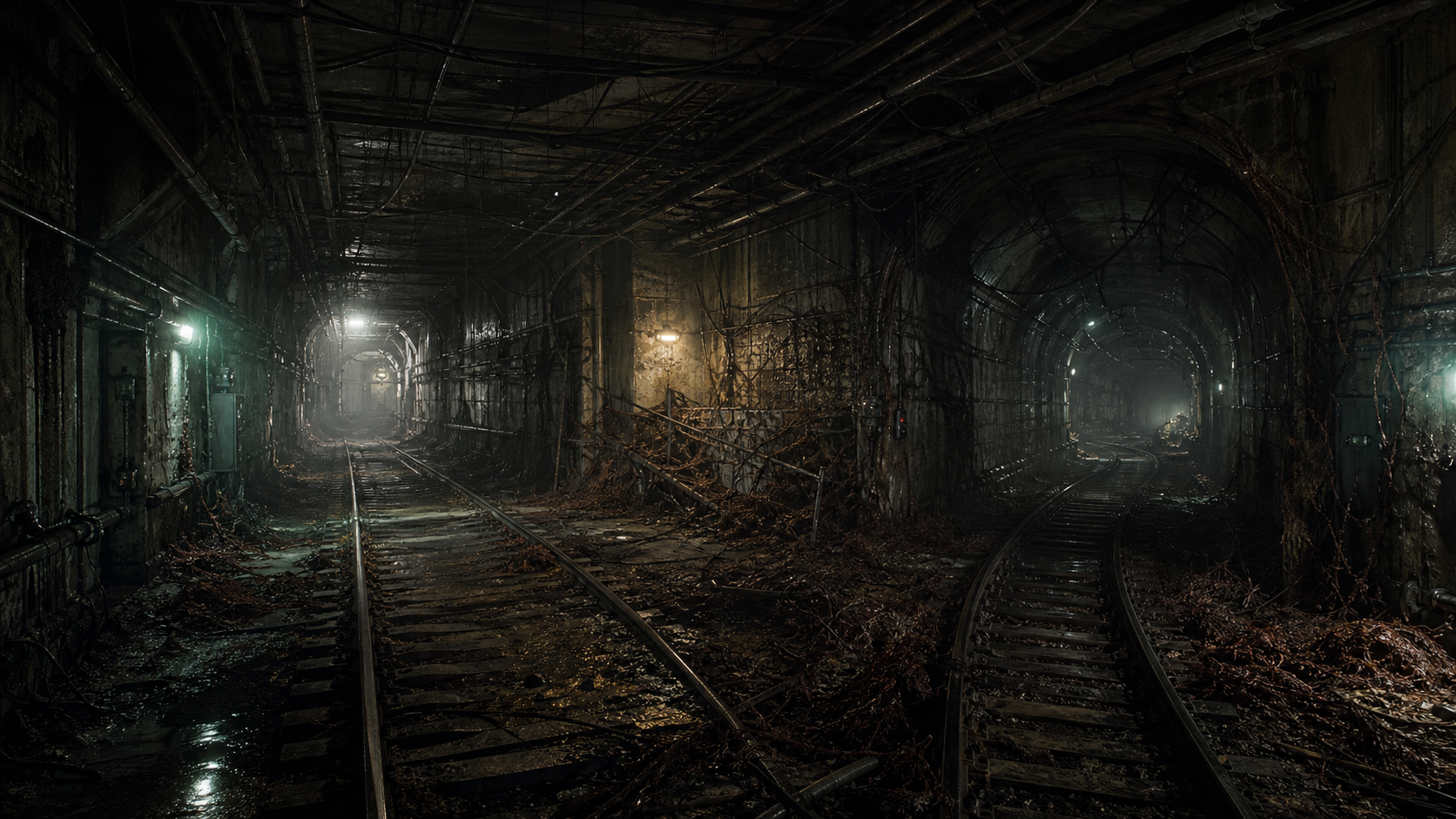
After leaving Turner Field, Garcia and Corporal Steve "Stevo" Holmes take refuge in a sewer and are captured by human collaborators. They are brought into a lair ruled by an Alpha known as the White King. Juveniles gather around the raised area from which the Alpha controls the larger population.
The White King uses basic language and commands. It injures Stevo, uses him as leverage, and demands that Garcia lead collaborators to other survivors. The Alpha's relationship to the juveniles is both protective and instrumental. It feeds them and directs surrounding adults, while the lair's human captives and collaborators help sustain the system.
During the later military assault, soldiers observe the White King coordinating the offspring and other Variants. When the Alpha is killed or incapacitated, the juveniles temporarily lose coordinated purpose and begin feeding rather than continuing an organized defense. The contrast indicates command dependency in that particular lair. It does not prove that all juveniles everywhere require an Alpha to act, but it shows that leadership can convert a dangerous group into a tactically organized one.
The White King also links reproduction to the emergence of higher cognition. Ellis theorizes that some altered brains recover enough function for basic speech and command. A reproductive lair led by such an Alpha is more than a nest. It is an early enemy society with leaders, protected young, human labor, stored food, and territorial goals.
Operation Condor
Vice President George Johnson, naval leadership, Team Ghost, and the Variant Hunters respond by developing Operation Condor. Thirty-four strike teams are assigned to coastal cities, with Garcia's intelligence used to brief personnel on lair behavior. The operation seeks a live juvenile rather than a body because the scientists must observe physiology and test Kryptonite directly.
The mission design confronts a severe contradiction. Juveniles rarely leave the underground spaces where adults protect them. A team capable of reaching one must penetrate the densest part of a lair. Heavy weapons increase the chance of survival but can destroy the target. Tranquilizers preserve it but may not penetrate armor quickly enough to stop an attack.
Atlanta becomes the principal documented battlefield. Strike teams insert around Turner Field and advance toward the White King's position. Adult Variants form defenses around the offspring, and the Alpha redirects attacks against the humans. Multiple teams suffer catastrophic losses. At least one juvenile is tranquilized during the fighting, but the wider extraction breaks down amid the Alpha attack and the collapse of the force.
The failure demonstrates why assigning many teams does not guarantee a specimen. The government can multiply insertions but cannot remove the biological and terrain disadvantages. Each lair contains unknown numbers, hidden approaches, captives, and leadership behavior that aerial planning cannot fully model.
New York capture
Operation Condor continues after Atlanta. Fitz and military working dog Apollo become separated during a New York operation involving the Bone Collector, another Alpha, and human collaborators. Reed Beckham, Parker Horn, Jay Chow, Garcia, Thomas, and Tank enter the city both to find their missing allies and to finish the juvenile-capture objective.
Inside the New York lair, the team finds adults clustered around six armored juveniles. Many of the defending Variants appear to be females that recently gave birth. The adults create a perimeter and attempt to move the offspring away when the soldiers advance. The scene provides the clearest evidence of communal defense: protection of the young overrides simple feeding and continues under overwhelming fire.
The humans split between searching for Fitz and Apollo, pursuing escaping offspring, and surviving the adult counterattack. Chow is pulled beneath a mass of Variants and suffers extensive lacerations before his teammates reach him. Garcia's group successfully tranquilizes one juvenile. The injury forces Beckham to accept extraction before the larger search is complete, because delaying risks both Chow's life and the specimen.
The capture is therefore a limited victory rather than a clean conclusion. A living juvenile reaches the surviving research system, but the team pays in blood and leaves Fitz and Apollo to find their own route. The episode continues the series' repeated equation between scientific evidence and field sacrifice. A laboratory answer depends on somebody reaching into the center of a lair and returning with what the scientists cannot safely obtain themselves.
Relationship to Kryptonite
Kryptonite is designed around an antibody targeting the altered Superman protein and a chemotherapy payload intended to destroy Variant cells. Its early development uses adult Variant material and an extraordinary human test by Ellis. Juvenile biology creates uncertainty because armor, growth, metabolism, and inherited changes may alter delivery or response.
The captured specimen allows Kate and the surviving scientific network to test the next generation rather than assuming adult results apply. The urgency is strategic. A countermeasure that kills existing adults but spares offspring could produce a temporary surface victory followed by a new population raised entirely in hidden lairs.
Operation Condor is consequently part of Kryptonite deployment, but it is not the same operation. Condor obtains evidence. Kryptonite development and production create the weapon. Later delivery campaigns attempt to expose dispersed Variant populations. Separating those stages preserves the cause-and-effect chain from discovery to capture, testing, manufacture, and field use.
Later evolution and regional forms
Later entries expand juvenile danger beyond the first Atlanta and New York specimens. Post-Plum Island operations encounter offspring within mature packs and specialized regional ecologies. European campaigns include armored juveniles moving with larger Variant populations, while aquatic and aerial forms show that reproduction continues alongside environmental adaptation.
These appearances do not establish that every specialized juvenile inherits a finished adult form unchanged. They show that the new generation participates in the same evolutionary system. A coastal lair can produce young suited to a marine environment; an enclosed city can protect armored offspring; an Alpha can organize the defense or movement of both adults and young.
The fall of Plum Island and Operation Extinction raise the stakes further. Once the principal laboratory is attacked and the surviving government must act with reduced infrastructure, there is less opportunity for controlled study. Field teams increasingly encounter juveniles as combatants rather than specimens. Biological knowledge remains essential, but the war narrows the time available to obtain it.
Behavior and social organization
Observed juvenile behavior includes circling captives, feeding, following adult movement, responding to Alpha commands, retreating under protection, and attacking when cornered. Some actions may be instinctive, while Turner Field suggests active teaching. The record does not establish a spoken juvenile language or independent political structure.
Adult behavior around them is more revealing. Females defend offspring in groups. Alphas keep them near central lair positions. Collaborators help maintain the surrounding human and material system. Captives are preserved long enough to serve as food, leverage, labor, or hunting instruction.
This network explains why juveniles are rarely observed during ordinary surface patrols. Adults do not expose the most important part of their population without reason. Human intelligence based on streets and rooftops will undercount them in the same way Operation Liberty undercounts the Variants concealed below New York.
Countermeasures
No single countermeasure solves the juvenile threat. Field forces use rifles, automatic weapons, grenades, aircraft, explosives, traps, light, sedatives, and biological agents according to mission objectives. Armor makes shot placement important, while speed and group defense reduce the time available for careful fire.
Kryptonite offers population-level reach if it can affect young bodies. Conventional weapons remain necessary for immediate defense and for forms not reached by an aerosol or other deployment. Repellents and specialized biological work later supplement rather than replace weapons, because distribution, mutation, shelter, and environmental form can all reduce a universal response.
Capture remains uniquely dangerous. A dead juvenile can reveal anatomy, but only a living subject can establish behavior, metabolism, and real-time response to a candidate treatment. Operation Condor's losses show that future research must balance the value of one specimen against the survival of a population already short of trained personnel.
Narrative significance
Juvenile Variants transform the franchise from an outbreak story into an evolutionary conflict. The enemy is no longer only humanity's infected remainder. It has children of its own, protects them, teaches them, and organizes territory around their survival.
That fact complicates the language of extinction. Humans see the juveniles as proof that the threat will become permanent. The Variants' behavior shows a competing drive to preserve their species. The White King's demand and protection of offspring do not excuse torture or predation, but they prevent the creatures from being understood as directionless disease alone.
The juveniles also expose the moral limits of scientific necessity. Capturing one can save human settlements, yet every mission enters a space where adults defend their young. The soldiers must suppress the resemblance to family while confronting bodies and behavior that are deliberately coded as a new family system. The discomfort is part of the story's purpose.
Important connections
- Jose Garcia: Records the Turner Field offspring and survives the White King's lair to brief Operation Condor.
- The White King: Alpha that protects, feeds, and commands juveniles in Atlanta.
- The Bone Collector: New York Alpha connected to another lair, collaborators, and the later capture effort.
- Kate Lovato and Pat Ellis: Scientists who interpret reproduction, gestation, adaptation, and Kryptonite susceptibility.
- Operation Condor: Multi-city program created to recover a live juvenile.
- Kryptonite: Targeted countermeasure whose usefulness must be tested against the next generation.
- Team Ghost and the Variant Hunters: Joint field force that obtains the New York specimen.
- Human collaborators: People who help Alpha-led lairs manage captives, movement, and old-world equipment.
- Key West forms: Child-sized aquatic bodies that demonstrate specialization but are not explicitly confirmed as offspring.
- Plum Island: Principal research center whose survival determines whether field evidence can become a deployable countermeasure.
Chronology and consequences
- Extinction Evolution - Breeding analysis, Turner Field discovery, White King lair, Operation Condor, Atlanta losses, and New York capture.
- Extinction End - Juveniles within the final phases of the first extinction war and the assault on human scientific capacity.
- Extinction Aftermath - European and postwar encounters with specialized Variant populations and their young.
- Extinction War - Continued conflict with evolved forms during the struggle over the surviving safe-zone order.
- Dark Age sequence - Later biological hierarchies develop beyond the early juvenile and Alpha model.
Continue Exploring
Connected Universe
Locations, Events, and Lore
Characters
Groups and Factions
Sources
- Extinction Evolution and later first-war continuity: Variant reproduction, Turner Field, the White King, Operation Condor, the New York capture, Kryptonite uncertainty, and regional evolution.
- Extinction Aftermath, Extinction Aftermath - Prologue
- Extinction Aftermath, Extinction Aftermath - Chapter 1