
Locations
USS George Washington
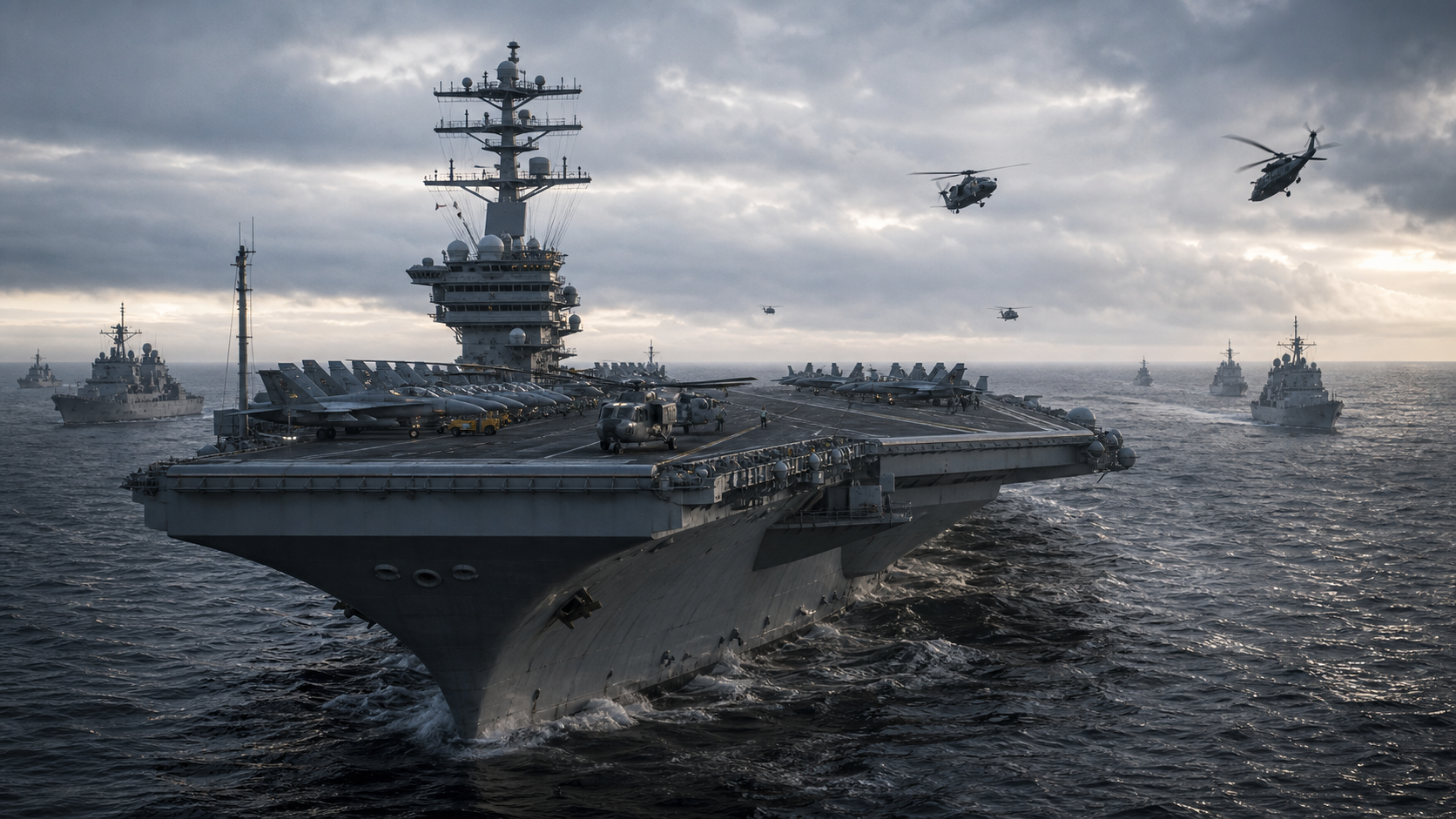
The USS George Washington is the floating command center of the first war’s later phase. As land bases fall and command chains fracture, the carrier strike group becomes one of the last intact instruments of American military power. It houses naval command, supports the Variant Hunters, coordinates Operation Extinction, and later becomes a prize in the ROT crisis.
Quick Facts
- Role
- Locations
- Aliases
- uss-george-washington, GW, George Washington Carrier Strike Group, USS George Washington Carrier Strike Group
Place in the story
The carrier sits at the meeting point of science, military command, and naval survival. It is both fortress and symbol. When the land is overrun, the sea gives the survivors distance, mobility, and a platform from which to coordinate missions. But the ship also becomes vulnerable to mutiny, infiltration, and political terror.
Chronological story arc
After the outbreak destroys much of the conventional military, the George Washington Carrier Strike Group becomes central to the counteroffensive. Garcia’s Variant Hunters deploy from it, Davis rises as one of its defining officers, and Johnson and Ringgold use naval command to direct operations. During the ROT crisis, Andrew Wood’s forces seize naval assets and the ship becomes part of a struggle over whether the surviving United States will remain a lawful government or fracture under terror.
Book-by-book role
In Extinction Evolution, the carrier is home base for Garcia and the Variant Hunters. In Extinction End, it supports the rescue and Operation Extinction endgame. In Extinction War, the ship becomes central to the ROT crisis, Davis’s command arc, and the fight over naval legitimacy.
People, groups, and lore connected to this location
Rachel Davis: Naval officer. Her command identity is inseparable from the ship and its crew
Jose Garcia: Marine team leader. The Variant Hunters deploy from the strike group
George Johnson: Wartime commander. He uses naval assets to coordinate the surviving war effort
Andrew Wood: Human antagonist. His ROT campaign targets naval legitimacy and firepower
Variant Hunters: Marine unit. Their missions rely on carrier support and intelligence
Resistance Of Tyranny: Enemy faction. The ROT crisis weaponizes the ship’s symbolic and military value
Why this location matters
The George Washington matters because the war cannot be won from bunkers alone. The carrier preserves mobility, command, aviation, and naval continuity after the country loses much of its land-based structure. Its later compromise shows that hardware is only as secure as the people controlling it.
George Washington CIC
George Washington CIC is a micro-location page for the exact kind of place superfans remember after the larger location summary is not enough.
George Washington CIC is a sublocation or scene-focused setting. It connects to the broader location page and from the missions, characters, and lore that depend on it.
Defines a precise physical place inside a larger setting.
Connects memorable scenes to characters and consequences.
Helps readers move from broad geography to exact scene memory.
George Washington CIC matters because the Extinction Cycle's geography is emotional. Fans remember rooms, graves, tunnels, rooftops, labs, and bridges because those places change what characters carry afterward.
George Washington Infirmary
George Washington Infirmary is a micro-location page for the exact kind of place superfans remember after the larger location summary is not enough.
George Washington Infirmary is a sublocation or scene-focused setting. It connects to the broader location page and from the missions, characters, and lore that depend on it.
George Washington Infirmary matters because the Extinction Cycle's geography is emotional. Fans remember rooms, graves, tunnels, rooftops, labs, and bridges because those places change what characters carry afterward.
USS Abraham Lincoln
USS Abraham Lincoln is a named U.S. Navy vessel tied to the final main-series war. Even where its screen time is limited, the ship matters because named naval assets help readers understand the scale of surviving military operations and losses.
By Extinction War, humanity is operating with depleted resources, damaged command structures, and fragile pockets of power. Any named carrier or major vessel carries strategic weight.
whether it appears directly or as part of broader fleet/intelligence reporting
how it relates to final-war operations
whether it is active, lost, damaged, or historical by the time it is mentioned
connection to George Washington and other surviving ships
USS Truxtun
USS Truxtun is a U.S. Navy vessel associated with the main-series military response, especially the Extinction Age period. Its importance is partly operational and partly structural. The Extinction Cycle uses naval assets as floating fragments of government, military command, medical research, and civilization. Each named ship helps readers follow how the surviving military preserves power after land-based systems collapse.
The Truxtun belongs in the same wiki ecosystem as USS George Washington, USS Zumwalt, USS Freedom, USS Emory S. Land, and USS Forest Sherman.
what strike group or command structure it supports
what missions it participates in or enables
whether it survives, is damaged, or is lost
how it relates to Plum Island, naval escort, or wider fleet operations
USS Forest Sherman
USS Forest Sherman is the destroyer that supports the Extinction Lost Greenland mission. It matters because it shows Fitz-era Team Ghost operating in the European theater with naval backing after the original main-war endgame.
The ship is rerouted from the main European front for the Greenland operation.
The ship's story runs through the mission support crew, including aviation personnel such as Hector Webb and the pilots connected to Team Ghost's insertion and extraction.
The Forest Sherman provides a tarmac/deck environment, helicopter support, and destroyer-based launch point for a black-ops mission into a frozen enemy site.
Its core appearance is Extinction Lost, a Team Ghost short story set before Extinction War.
The Greenland mission is the defining event, with Fitz, Rico, Dohi, Tanaka, Stevenson, Apollo, Tito, Webb, and other crew tied to the ship's operations.
The mission includes serious injury and deaths among Team Ghost and enemy forces. The ship itself functions as staging and extraction platform.
USS Forest Sherman helps bridge Aftermath, Lost, and War, proving Team Ghost remains active outside the United States.
USS Emory S. Land
USS Emory S. Land is a supporting naval asset that helps make the George Washington strike group feel like a real fleet rather than a single carrier. Its mention during the Key West reconnaissance grounds the Variant Hunters in a wider maritime operation.
The submarine tender operates somewhere near the Florida Keys during Garcia's Key West mission, part of the surviving naval structure around the GW strike group.
No major command figure is centered on the ship; its role is a supporting naval asset in Garcia's wider maritime operation.
As a submarine tender, it belongs to the logistics and support side of the fleet, extending the operational reality behind frontline missions.
Its relevant appearance is in Extinction Evolution during the Key West reconnaissance setup.
Key West reconnaissance and wider GW naval operations are its primary connections.
The ship's narrative role is support and logistics rather than a major individual-loss thread.
The ship connects naval assets, Garcia, the Variant Hunters, and the George Washington strike group without becoming a major narrative hub on its own.
George Washington Carrier Strike Group
The George Washington Carrier Strike Group is the last major intact U.S. naval platform and one of the most important institutions in the original series. It becomes command center, refuge, laboratory support hub, airbase, and political symbol.
As mainland command collapses, the strike group becomes home to surviving command, aircraft, Marines, scientists, and political leaders.
Key leaders include Captain Humphrey, Rachel Davis, Vice President George Johnson, President Jan Ringgold, and naval officers who keep the group functioning under impossible conditions.
The group includes the carrier, cruisers, destroyers, submarine tender, support ships, aircraft, CIC, medical spaces, and later bioreactor-linked scientific capacity.
From Evolution through End, the strike group supports reconnaissance, Kryptonite, and Operation Extinction. In War, ROT seizure turns the group into a hostage crisis and proof that surviving institutions can be captured.
Key West reconnaissance, Operation Condor monitoring, Kryptonite relocation, Operation Extinction, and the ROT crisis are the main mission links.
The group loses personnel, security, and trust during ROT infiltration. Its transformation is from last bastion to contested symbol and back toward hard-won continuity.
The strike group connects the military, science, and government layers more than almost any other location or unit.
USS George Washington and Zumwalt Crisis
The George Washington and Zumwalt crisis connects Rachel Davis, Andrew Wood, ROT, naval power, biological terrorism, and the fight over whether military assets serve survival or domination.
The USS George Washington and Zumwalt crisis belongs to the human-antagonist side of the series. Andrew Wood and ROT show that even after monsters nearly end humanity, ships, missiles, chain of command, and propaganda can still become tools of tyranny.
Rachel Davis is central because her command arc turns the crisis into a test of naval courage and moral authority. The ships are not just hardware; they are symbols of whether surviving military power will defend civilians or become a private empire.
Andrew Wood weaponizes fear, military assets, and biological threat.
Davis provides the clearest naval-command counterpoint.
The crisis is not only a ship-seizure story. It is tied to biological terrorism and the fear that safe-zone populations can be broken from within. Wood's strategy uses the memory of the original outbreak against the people who survived it.
It is the proof that the old weapons of extinction can be reused by human enemies.
Links Andrew Wood to the broader human-antagonist chain after Zach Wood.
Needs strong cross-links to Rachel Davis and ROT.
USS Zumwalt
The USS Zumwalt is part of the naval crisis that defines Extinction War. While the George Washington carries the weight of command symbolism, Zumwalt represents the surviving fleet’s advanced destructive power. In the ROT conflict, any ship that can launch, strike, or project force becomes more than a platform. It becomes a political weapon.
Zumwalt belongs to the sea-war portion of the final main-series conflict. It links Rachel Davis, the Navy survivors, Andrew Wood’s ROT forces, and the larger question of whether the remaining military can hold together after the biological war seems to have been won.
Instead, ROT turns naval assets into instruments of coercion. The Zumwalt crisis expands the conflict beyond safe zones and outposts by reminding readers that whoever controls ships and missiles can threaten the entire survivor government.
In Extinction War, Zumwalt is tied to the naval side of the ROT crisis and helps make that arc larger than a ground rebellion.
Rachel Davis: Naval survivor. Her arc shows how shipboard command becomes personal and political
Andrew Wood: ROT leader. He understands naval power as leverage against the government
Navy Survivors: Group. Zumwalt belongs to the fleet remnants that shape late main-series survival
Resistance Of Tyranny: Enemy faction. ROT turns fleet power into terror leverage
Uss George Washington: Related location. The ships together define the naval crisis
Zumwalt matters because the Extinction Cycle does not end with the monsters. Human factions inherit the weapons that survived, and those weapons can decide whether reconstruction becomes law or tyranny.
Naval Assets of the George Washington Strike Group
The George Washington strike group is the floating heart of the surviving U.S. war effort. Its naval assets preserve command, logistics, science, airpower, and political continuity after land-based institutions collapse.
The strike group includes the USS George Washington and supporting cruisers, destroyers, a submarine tender, cargo ship, survey ship, aircraft, boats, and later allied naval assets.
The group becomes central after the mainland command structure collapses and the military consolidates around ships that can still move, communicate, and fight.
Naval assets provide flight decks, CIC spaces, medical care, weapons storage, missile launch capacity, bioreactor relocation, and a protected platform for leaders such as Ringgold, Johnson, Davis, and Humphrey.
Ships can become prisons, targets, or bargaining chips. ROT proves this by seizing the George Washington, turning naval survival into a legitimacy crisis.
Key West reconnaissance launches from the strike group, Kryptonite assets are guarded and moved through it, and the ROT crisis turns the carrier into a political and military battlefield.
The strike group is where science, command, and legitimacy converge. Without naval assets, there is no organized national response after the land collapses.
Naval Assets of the George Washington Strike Group belongs in the science and equipment layer because the Extinction Cycle treats tools as choices, not props. Every countermeasure depends on the people who create it, authorize it, carry it, and survive its consequences.
Continue Exploring
Connected Universe
Books and Stories
Characters
Groups and Factions
Sources
- Extinction Evolution, Extinction Evolution - Prologue
- Extinction Evolution, Extinction Evolution - Chapter 1
- Extinction End, Extinction End - Chapter 1
- Extinction End, Extinction End - Chapter 2
- Extinction Aftermath, Extinction Aftermath - Prologue
- Extinction Aftermath, Extinction Aftermath - Chapter 1
- Extinction War, Extinction War - Prologue
- Extinction War, Extinction War - Chapter 1