
Dark Age Politics and Allied States Governance
Freedom Party Platform
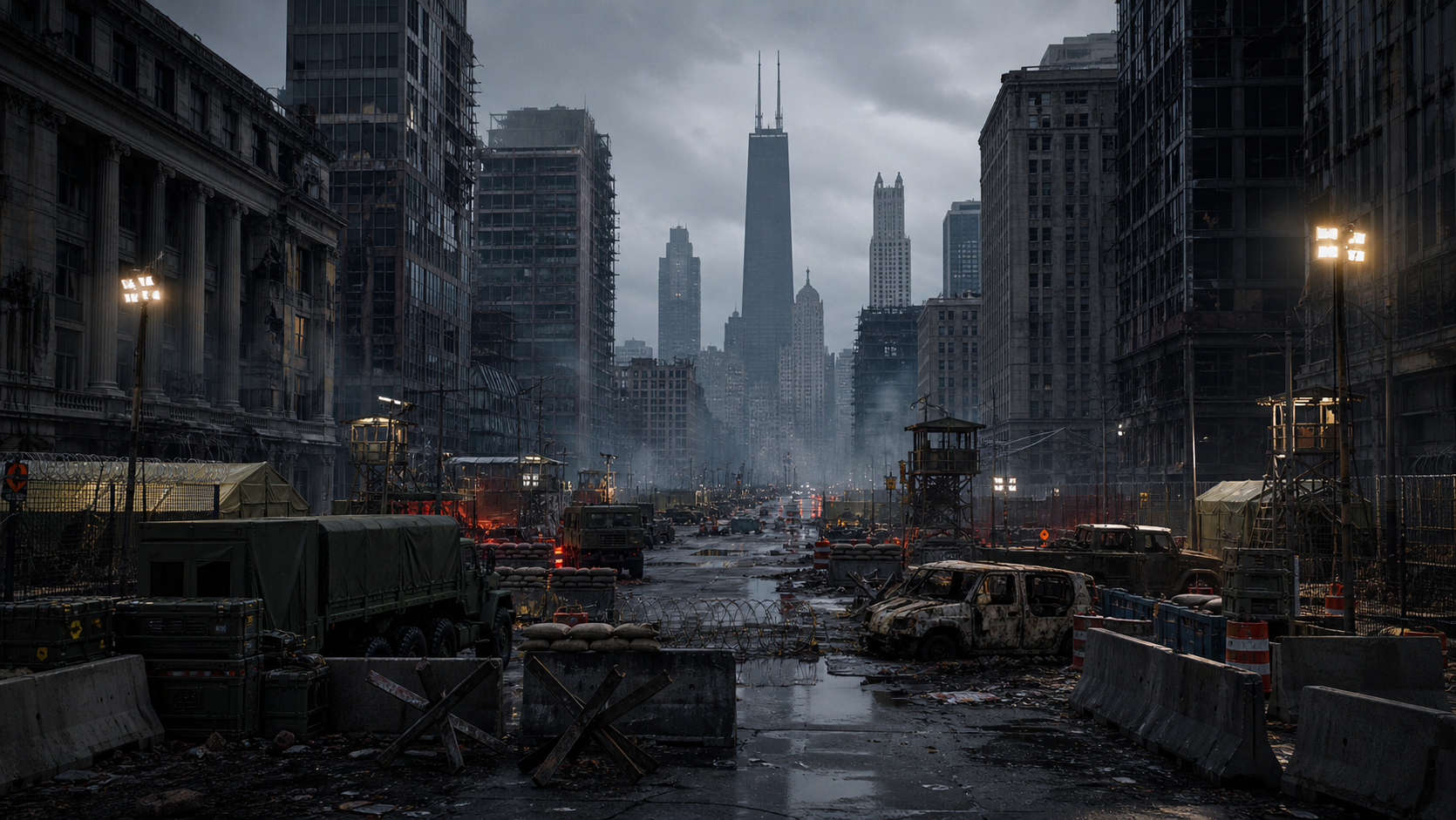
The Freedom Party platform is the hardline security and reclamation program advanced by retired General Mark Cornelius during the Allied States election in Extinction Cycle: Dark Age. Its principal proposals include compulsory service for men and women between eighteen and thirty, a larger national fighting force, aggressive clearance or destruction of frontier cities, and stronger action against Variants, collaborators, raiders, and independent groups occupying territory outside the outpost system. Cornelius presents the program as the necessary end of a defensive era in which humanity has survived behind walls but failed to reclaim its country.
Quick Facts
- Role
- Dark Age Politics and Allied States Governance
- Aliases
- freedom-party-platform, dark-age-politics, politics/freedom-party-platform, politics-freedom-party-platform
Overview
The platform competes with the New America Coalition's program of gradual reconstruction, targeted missions, and continuity under President Jan Ringgold and Vice President Dan Lemke. Its popularity is rooted in genuine insecurity. Outposts have been attacked, travel beyond defended corridors remains dangerous, and the belief that Variants are disappearing proves false. The political danger lies in converting that fear into mass coercion, treating the postwar generation as replacement manpower, and assuming ruined cities can be cleared without reliable intelligence about captives and independent survivors. The New Gods crisis validates the platform's warning that an organized enemy remains on the frontier but does not establish that every Freedom Party remedy is sound.
Platform information
- Field: Political organization; Detail: Freedom Party
- Field: Principal leader; Detail: Retired General Mark Cornelius
- Field: Political era; Detail: Allied States election during the Dark Age period, approximately eight years after the first extinction war
- Field: Main opponent; Detail: New America Coalition, represented by President Jan Ringgold and candidate Dan Lemke
- Field: Security premise; Detail: Outpost defense and targeted missions have not eliminated Variants or restored lost territory
- Field: Core personnel proposal; Detail: Conscription of men and women from eighteen through thirty
- Field: Territorial proposal; Detail: More aggressive reclamation, clearance, or destruction of frontier cities and hostile zones
- Field: Strategic tendency; Detail: Larger military mobilization, heavier strikes, and decisive offensive action
- Field: Social constituency; Detail: Voters frightened by attacks, frontier insecurity, and the slow pace of reclamation
- Field: Principal critics; Detail: Ringgold, Lemke, Reed Beckham, Kate Lovato Beckham, and supporters of limited targeted force
- Field: Crisis test; Detail: Rise of Azrael and the New Gods, attacks on outposts, and the Battle of Galveston
- Field: Final political status; Detail: Original election disrupted by war; Cornelius survives and becomes a possible unity partner for Reed Beckham
Political background
The Allied States has survived long enough for political disagreement to return. Ringgold's administration rebuilds roads, food systems, communications, military units, outposts, and civil institutions after the Extinction War. That success creates expectations the emergency government could once defer. Citizens no longer ask only whether a wall can hold tonight. They ask why cities remain abandoned, why travel requires armed escorts, why attacks continue, and whether the country will ever extend beyond defended islands of population.
The New America Coalition argues that recovery must protect the population that remains. It favors measured expansion, intelligence, specialist teams, and a balance between military command and civilian authority. Team Ghost can strike a defined target without drafting an entire generation, while engineers and local governments rebuild territory that can actually be held.
The Freedom Party argues that this method confuses survival with victory. Every city left to Variants or raiders can become a base against an outpost. Every year behind walls allows hostile groups to reproduce, organize, and exploit unmonitored infrastructure. Cornelius's military career gives the argument credibility. He is not an outside commentator demanding risks he cannot understand; he has command experience and a material power base at Outpost Galveston.
Rise of the party
The platform gains support before the full New Gods network is visible. Reed and Kate discuss the election on Peaks Island and note that Cornelius is leading Lemke in polling. The result is not presented as irrational mass panic. Communities closest to attacks have direct reasons to distrust claims that the remaining Variants are scattered and dying.
Outpost politics magnifies local experience. A settlement that loses guards, farmers, or children to a breach may judge national policy by that event rather than by overall reconstruction statistics. The Freedom Party gives those voters a direct explanation: the government has ceded too much territory and asks walls to solve a problem that requires an offensive.
Cornelius also commands relationships with contractors, private soldiers, vehicles, aircraft, petroleum interests, and personnel associated with Galveston's regional defense. His campaign therefore carries an implicit implementation capacity. He is not only promising a larger force; he already has access to organized armed power outside the central government.
Conscription
The most controversial plank would compel men and women between eighteen and thirty to serve. The proposal is usually discussed as military conscription, although the available record does not provide a complete statute defining service categories, terms, exemptions, or appeals.
Supporters see a manpower crisis. The first war killed much of the professional military, and a small group of veterans cannot defend every outpost, patrol every road, and clear every city. Universal service could spread risk beyond the same aging operators and give young citizens the training required when walls fail.
Opponents see a second claim on a generation already shaped by catastrophe. Tasha and Jenny Horn survived Fort Bragg as children and grew up around soldiers. Timothy Temper, Bo, and their peers inherit trauma and reconstruction work rather than ordinary childhood. Kate understands the proposed age band through those names. The draft would not mobilize an abstract population; it would take the children the first war was supposedly fought to protect.
The policy also raises implementation questions the platform summary does not answer. A larger army needs instructors, ammunition, medicine, transport, food, officers, and screening against collaborators. Drafting thousands of people without those systems can create casualties rather than capability.
Frontier-city reclamation
Cornelius proposes stronger action against abandoned cities and lawless territory. The objective is to deny enemies permanent sanctuaries, recover infrastructure, and demonstrate that the Allied States intends to become a territorial nation rather than a collection of fortified enclaves.
The policy can include clearing operations, forced removal of groups outside national control, conventional bombing, and discussion of heavier strikes such as low-yield nuclear weapons. The indexed material does not provide a city list, strike order, evacuation protocol, or final authorization.
Ruined cities are not empty. New York contains captives in Variant lairs. Other frontier zones contain independent families, scavengers, collaborators, prisoners, usable archives, power systems, and hidden biological infrastructure. A city can be hostile terrain without every living person inside being an enemy. Forced reclamation therefore requires reconnaissance, negotiation, quarantine, and post-clearance governance as well as firepower.
Centralized military capacity
The Freedom Party favors greater readiness and the ability to act decisively across regions. Cornelius's supporters regard fragmented outpost commands and slow national approval as vulnerabilities. A concentrated force could respond to simultaneous attacks and hold territory after elite teams depart.
Critics fear that the same concentration can subordinate elected government to military necessity. The first war includes repeated examples of officers who use secrecy, emergency, and superior information to escape accountability. A platform led by a respected general must still explain how civilian oversight survives permanent mobilization.
Arguments supporting the platform
The strongest argument is factual: the enemy is not gone. Variants survive outside defended territory, outposts are attacked, human collaborators operate in the open spaces, and the New Gods eventually reveal a coordinated biological and ideological network. A purely defensive policy gives such enemies time and terrain.
The second argument concerns fairness to existing soldiers. Team Ghost and other specialist units cannot be sent indefinitely to every crisis. Their members age, accumulate injuries, and have families. A society that depends on a few volunteers while most citizens receive protection may be neither sustainable nor equitable.
The third argument is political confidence. Visible reclamation can convince isolated communities that the national government is expanding rather than retreating. Reopened routes, cleared towns, and secured resources can improve food production and trade. Cornelius offers action to voters who experience patience as abandonment.
Arguments opposing the platform
Operation Liberty is the clearest military warning. Command commits armor, troops, bombing, and helicopters to New York without understanding the surviving enemy's use of darkness and tunnels. Numerical superiority becomes a target concentration, and firepower cannot distinguish lairs, captives, and underground movement.
The history of VX-99 and VariantX9H9 is the scientific warning. Emergency solutions can save humanity while creating new problems. A mass reclamation plan undertaken without current biological intelligence may select for stronger forms, disperse enemy populations, or destroy evidence needed to understand them.
ROT provides the political warning. Andrew Wood uses grievance, propaganda, and the Hemorrhage Virus to attack the government's legitimacy. Coercive mobilization, forced removal, and indiscriminate strikes could create new recruits for extremist groups even when the original operation succeeds.
The population itself is a limiting resource. Every conscript taken from a farm, clinic, machine shop, school, or construction crew weakens reconstruction. The Allied States cannot defend a civilization by converting all of its builders into infantry.
The New America Coalition alternative
Ringgold and Lemke do not advocate passivity. Outposts maintain guards, mines, sensors, dogs, patrols, and emergency procedures. Team Ghost and other units conduct lethal operations against specific threats. The difference is the threshold for mass force and the degree of certainty required before entering a population center.
Targeted missions reduce civilian mobilization and can gather intelligence before a larger commitment. Their weakness is scale. A successful raid may kill a leader without holding the territory, and specialist losses are difficult to replace. The Coalition's method works only if intelligence networks detect threats before those threats reach the walls.
Lemke faces a difficult campaign because continuity is hardest to defend after an attack. He must ask voters to trust a system whose successes are gradual and whose failures are immediate. Cornelius can point to every ruined city as evidence that the government has accepted incompleteness.
New Gods crisis
Azrael and the New Gods alter the debate by revealing that frontier danger is organized. Webbing networks, Scions, Chimeras, masterminds, Thralls, and human collaborators operate within a system capable of attacking outposts and challenging the Allied States. Cornelius's warning about concealed enemies is vindicated.
The crisis does not prove that mass conscription or city bombing would have found the network. The enemy uses underground routes, biological signals, infiltration, and prisoners. Defeating it requires Kate and other scientists, intelligence from survivors, and small teams able to reach network nodes. A larger army is useful for defense and holding ground but cannot replace specialized knowledge.
Galveston forces political opponents into the same battlefield. Cornelius's private and regional forces become necessary to the common defense, while national personnel bring capabilities his base cannot supply alone. The cooperation proves that legitimate opposition can survive an emergency without becoming treason.
Election disruption and later alignment
The original contest between Cornelius and Lemke does not reach a normal political resolution. Ringgold dies, Lemke is executed during the crisis, and the Galveston endgame destroys the succession path around which the election was organized. The Freedom Party platform enters a different world from the one in which it was proposed.
Reed Beckham later considers or enters a political alignment with Cornelius as a unity response. Reed has firsthand knowledge of both hidden enemies and failed mass operations. Cornelius has demonstrated that his armed organization can serve the wider state. Their cooperation suggests a synthesis of security and legitimacy rather than a retrospective declaration that one campaign was wholly correct.
The surviving account does not confirm that the original conscription proposal is enacted exactly as introduced. It also does not establish that every frontier-strike proposal becomes law. The platform's legacy is the set of questions the next government must answer under changed conditions.
Political and thematic significance
The Freedom Party turns survival into a debate about citizenship. During the outbreak, leaders decide who receives evacuation or a weapon. In Dark Age, the state must decide who owes service, who controls force, which settlements belong to the nation, and what obligations extend to people living outside its walls.
The party is effective as a political force because its fear is not fabricated. Its danger is the leap from a correct diagnosis of insecurity to remedies that may reproduce the command failures of the first war. The story does not require Cornelius to be a villain for Ringgold's objections to matter, or Ringgold to be naive for Cornelius's warning to be accurate.
The unresolved tension is the platform's lasting importance. Freedom without defense can be destroyed. Defense without limits can destroy the freedom it claims to preserve.
Important connections
- Mark Cornelius: Retired general, Freedom Party leader, and Galveston power center.
- Dan Lemke: New America Coalition candidate representing continuity with Ringgold's administration.
- Jan Ringgold: President whose targeted-force and civic-reconstruction model opposes mass coercion.
- Reed Beckham: Veteran skeptic of overconfident operations who later becomes a possible unity partner for Cornelius.
- Kate Lovato Beckham: Scientist and parent who frames conscription through its cost to the postwar generation.
- Tasha, Jenny, Timothy, and Bo: Named members of the generation affected by the proposed age range.
- Operation Liberty: Historical warning against city reclamation without adequate intelligence.
- ROT: Historical warning about grievance, militarization, and attacks on legitimacy.
- New Gods: Organized threat that validates frontier fear while demonstrating the need for specialized science and intelligence.
Chronology and consequences
- Original Extinction Cycle and Extinction War - Establish Operation Liberty, command failure, ROT, Ringgold's leadership, and the historical arguments used in Dark Age politics.
- Extinction Shadow - Introduces the mature Allied States, election context, party competition, outpost insecurity, and Freedom Party rise.
- Extinction Inferno, Extinction Ashes, and Extinction Darkness - Escalate the New Gods crisis, Galveston conflict, deaths of Ringgold and Lemke, and post-crisis political realignment.
Continue Exploring
Connected Universe
Books and Stories
Sources
- Dark Age Introduction: Allied States, election, Lemke, Cornelius, outposts, surviving Variants.
- Dark Age Chapter 2: Reed and Kate discuss Freedom Party polling, conscription, frontier cities, and fear in attacked outposts.
- Extinction War: ROT as the prior human extremist cautionary example.
- Extinction War, Extinction War - Prologue
- Extinction War, Extinction War - Chapter 1