
Dark Age Politics and Allied States Governance
Conscription Policy
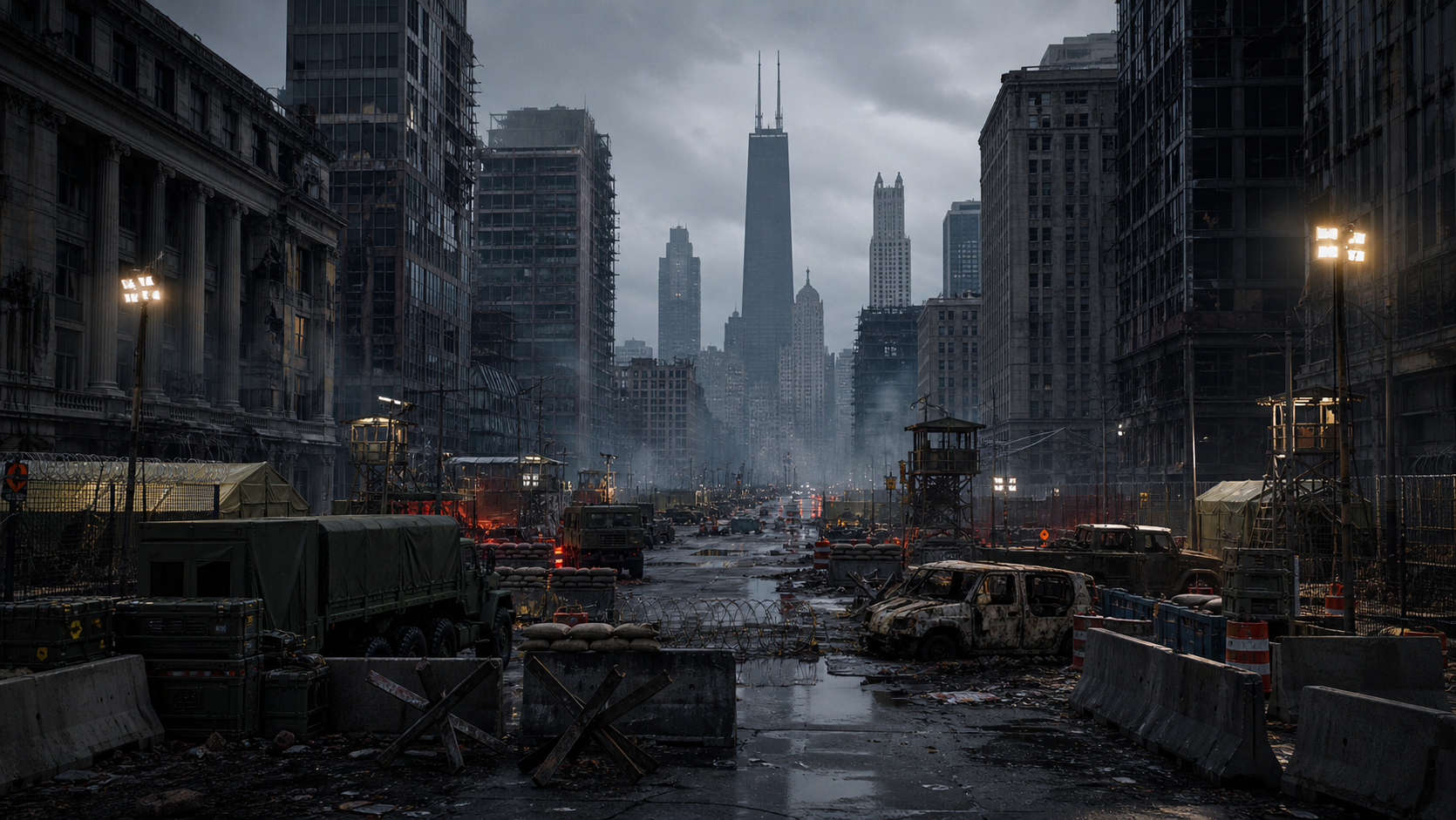
The conscription policy is a Freedom Party proposal to compel military service from men and women between the ages of eighteen and thirty during the Dark Age era of the Extinction Cycle. General Mark Cornelius and his party present mass mobilization as the force required to reclaim frontier cities, destroy remaining Variant populations, suppress collaborators and raiders, and end the Allied States' dependence on fortified outposts. President Jan Ringgold, Vice President Dan Lemke, and the New America Coalition oppose or resist that scale of compulsory service, favoring defended settlements and targeted operations by units such as Team Ghost.
Quick Facts
- Role
- Dark Age Politics and Allied States Governance
- Aliases
- conscription-policy, dark-age-politics, politics/conscription-policy, politics-conscription-policy
Overview
The proposal is politically powerful because the threat beyond the walls is real. Abandoned cities contain Variants, captives, weapons, resources, and later the hidden infrastructure of the New Gods. It is morally dangerous because the eligible population is the first generation to reach adulthood after surviving the original extinction war as children. Tasha and Jenny Horn are approaching the relevant age. Timothy Temper and Bo belong to the same postwar cohort. The policy would turn people protected by the first generation's sacrifices into the manpower pool for another national campaign.
The available continuity documents the age range, inclusion of both men and women, political sponsors, strategic purpose, and opposition. It does not establish that a complete conscription statute passes or takes effect. No canonical draft lottery, exemption code, service term, enforcement agency, or vote count is supplied.
Policy information
- Field: Policy type; Detail: Proposed compulsory national military service
- Field: Proposed eligible population; Detail: Men and women from age eighteen through thirty
- Field: Principal sponsor; Detail: General Mark Cornelius and the Freedom Party
- Field: Principal opponents; Detail: President Jan Ringgold, Vice President Dan Lemke, New America Coalition, and affected families
- Field: Strategic purpose; Detail: Frontier-city reclamation, expanded defense, elimination of Variants, raiders, collaborators, and other lawless-zone threats
- Field: Alternative security model; Detail: Fortified outposts, professional forces, local guards, and targeted Team Ghost operations
- Field: Political era; Detail: Allied States election period, approximately eight years after the first war
- Field: Principal affected cohort; Detail: Children who survived the Great War of Extinction and reached adulthood during reconstruction
- Field: Known personal stakes; Detail: Tasha Horn; Jenny Horn; Timothy Temper; Bo; other postwar young adults
- Field: Later complication; Detail: Coordinated New Gods attacks prove the frontier contains an organized enemy
- Field: Legal status; Detail: Proposal and campaign platform; final enactment is not established in the available record
Postwar setting
The Allied States is not a restored preoutbreak country with a normal population pyramid and a large reserve of trained personnel. It is a network of roughly one hundred fortified outposts, farms, manufacturing sites, energy projects, rail links, ships, and government centers built from a tiny surviving population. Every healthy adult may already be a farmer, mechanic, parent, medic, teacher, guard, scientist, rail worker, or technician.
Ringgold's reconstruction policy accepts limited territorial control. The Midwest and East Coast contain much of the recovered population and production, while large western regions and ruined cities remain outside routine government reach. Outposts protect concentrated communities with walls, towers, patrols, dogs, sensors, weapons, and local forces. Team Ghost penetrates frontier territory when intelligence identifies a specific threat or captive group.
This system preserves people but does not eliminate danger. Raiders can strike farms. Independent survivors may be trapped beyond the network. Variants and collaborators use abandoned infrastructure. Political supporters of Cornelius regard the frontier as both a security failure and a symbol of unfinished national recovery. The old map has not been reclaimed, and the outpost system can look defensive to the point of surrender.
Freedom Party objectives
The Freedom Party's proposal is intended to solve a manpower problem. Targeted units can destroy a nest, rescue prisoners, or investigate a silent outpost, but they cannot simultaneously occupy cities, secure roads, guard rail lines, clear buildings, protect engineers, and hold recovered territory. A national reclamation program requires far more personnel than Team Ghost or the existing professional military can supply.
Conscription would create a large force without waiting for voluntary recruitment. Its supporters can make several plausible arguments:
The proposal also serves an electoral purpose. It transforms fear into a concrete program and distinguishes Cornelius from Lemke's continuity platform. The Freedom Party can portray caution as stagnation, while its opponents portray compulsory service as a return to the mass-sacrifice logic that nearly finished humanity.
- Frontier threats are allowed to grow when the government responds only after an attack.
- Former cities contain infrastructure, transport hubs, hospitals, ports, industrial equipment, and symbolic national territory.
- A wider service obligation distributes defense beyond the same aging veterans and elite teams.
- Young adults raised behind outpost walls may need training before an emergency reaches their homes.
- A visible reclamation campaign could reassure exposed communities that the government intends to expand security rather than abandon them indefinitely.
Eligible population and the next generation
The age band from eighteen through thirty is broad in ordinary politics but narrow in a near-extinction society. Its lower end captures people whose earliest memories may be Fort Bragg, Plum Island, safe-zone flight, captivity, hunger, or the loss of their parents. Its upper end includes adults who were young during the first war and may already have essential occupations or children.
Including men and women reflects the demographic reality and the Allied States' military culture. Women serve as operators, pilots, scientists, officers, medics, guards, and political leaders throughout the series. A male-only policy would exclude needed capability and place an even more disproportionate burden on a small population. At the same time, drafting both sexes increases the risk of removing multiple caregivers and skilled workers from the same household or settlement.
The policy becomes personal when Reed explains it to Kate on Peaks Island. Kate immediately thinks of Tasha and Jenny, who are close to eligibility, and of Timothy, Bo, and the other children raised within the extended survivor network. These are not anonymous future recruits. The audience has watched adults sacrifice themselves to keep them alive.
Javier Riley Beckham belongs to the next generation but is younger than the named draft-age group during the opening Dark Age period. His existence still matters politically. A policy adopted for one cohort can become permanent, shaping the life expected of every child who follows.
Proposed military function
The current record does not supply a full force design, but the proposal's strategic purpose implies several categories of work. Reclaiming a city requires reconnaissance, route clearance, perimeter defense, casualty evacuation, engineering, decontamination, logistics, communications, prisoner handling, and a garrison able to remain after the assault. Simply issuing rifles to young adults would not accomplish those tasks.
Training is therefore the first practical constraint. Veterans such as Cornelius, Beckham, Horn, Fitz, and Ringgold know that courage cannot substitute for small-unit discipline, biological protection, night operations, and intelligence. Operation Liberty demonstrated the cost of committing a large formation on false assumptions about Variant numbers and behavior. A conscript army trained too quickly could reproduce the scale of that disaster.
Equipment is the second constraint. Every recruit requires weapons, ammunition, clothing, medical support, food, transport, communications, and shelter. Vehicles and aircraft need fuel and parts. Expanding personnel faster than the industrial system expands may create units that exist on paper but cannot move or survive.
Command is the third constraint. The Allied States has experienced officers but not enough to lead an instant mass army without stripping outpost defenses and technical units. Veterans also carry injuries and trauma from the first war. Building junior leadership would take time and would expose the policy to political appointments, uneven standards, and local resistance.
Finally, holding territory is different from clearing it. A campaign that enters a city, kills visible enemies, and withdraws can leave tunnels, laboratories, prisoners, and webbing intact. Successful reclamation needs civilians and institutions prepared to inhabit what the army takes.
Civil, economic, and demographic effects
Every conscript is removed from another role. Agricultural outposts depend on seasonal labor. Power systems and rail networks require scarce technicians. Schools, clinics, laboratories, workshops, fisheries, and ships may have only one or two people qualified for critical tasks. A blanket age rule could reduce the very production that supports the army.
Family effects are equally severe. The postwar society contains orphans, blended households, informal guardians, and adults responsible for children who are not biologically their own. Prewar categories such as dependent, spouse, or sole caregiver may not fit these families. The record does not state what exemptions the Freedom Party would recognize.
Demography gives every death wider consequence. A lost recruit is also a possible parent, specialist, caregiver, and bearer of knowledge. This does not mean young adults can never be asked to fight. Outposts will fall if nobody defends them. It means the threshold for mass casualty must reflect a population that cannot replace a division within a generation.
Compulsion can also affect legitimacy. The Allied States presents itself as a lawful alternative to raiders, collaborators, and Azrael's hierarchy. If citizens believe the government protects favored communities while sending frontier youth into unwinnable campaigns, the draft may strengthen separatism rather than national unity. If exemptions appear arbitrary, outposts may resist registration or conceal eligible residents.
Ringgold and Lemke's alternative
Ringgold's position is not pacifism or abandonment of the frontier. Outposts are armed. Patrols and professional units engage threats. Team Ghost spends years entering enemy territory, killing Variants, and rescuing prisoners. Scientists and military commands develop countermeasures when ordinary weapons are insufficient.
The alternative is selective force tied to verified objectives. A small, experienced team can move quietly, distinguish prisoners from collaborators, collect biological evidence, and withdraw without requiring a city-wide occupation. The model preserves the wider population and avoids exposing untrained recruits to enemy terrain.
Its weakness is scale. Team Ghost cannot protect every outpost. Repeated missions exhaust the same operators and make the state dependent on irreplaceable individuals. Targeted action also assumes intelligence can find a threat before it grows into a strategic system. The New Gods exploit precisely the spaces left outside persistent observation.
Lemke's political role is to continue Ringgold's measured reconstruction rather than promise permanent inaction. His campaign has to explain how restraint will become security, not merely why Cornelius's plan is dangerous. That burden helps make conscription a competitive issue rather than an obviously rejected extreme.
Operation Liberty as precedent
The first war provides the principal warning against mass reclamation without adequate intelligence. Operation Liberty commits major forces to New York under assumptions that air and drone observation have revealed the enemy's true numbers. Variants use buildings, subways, tunnels, and dormancy to conceal themselves. The operation inflicts catastrophic losses and leaves surviving teams focused on escape rather than occupation.
The lesson is not that cities can never be entered. It is that manpower cannot compensate for a false model of the enemy. More troops create more people to supply, coordinate, evacuate, and potentially lose. A Dark Age army would also face evolved forms, collaborators, prisoners, and webbing networks unavailable to the original planners.
Cornelius can answer that permanent avoidance has its own cost. The New Gods use abandoned territory to develop hidden command, laboratories, aircraft, ships, and human control systems. Operation Liberty therefore supports neither automatic invasion nor permanent withdrawal. It supports reconnaissance, scientific integration, civilian accounting, and a realistic plan for the day after combat.
Effect of the New Gods war
The rise of Azrael validates the Freedom Party's claim that frontier danger is organized and growing. Outposts are not being attacked by the last starving remnants of a dying species. Scions, Chimeras, Thralls, masterminds, collaborators, and living webbing form a command system capable of attacking the Allied States at multiple points.
That revelation does not automatically validate the original draft design. The New Gods are defeated through a combination of veteran operators, naval and ground forces, intelligence, scientific study, an anthrax-based attack on the biological network, local defense, and political refusal to surrender. Specialized knowledge remains as important as numbers.
The war also disrupts the institutions that might implement conscription. Lemke is captured and executed. Ringgold dies at Galveston. Outposts and fleets suffer losses. Reed and Cornelius move toward cooperation because neither the old administration nor the Freedom Party can govern alone after the crisis.
Their coalition suggests that postwar policy may combine stronger defense with Ringgold's commitment to freedom and restraint. It does not establish that the original eighteen-to-thirty proposal is enacted unchanged. A program designed before the New Gods are understood may be strategically obsolete after the war exposes the real enemy structure.
Policy design questions left unresolved
The continuity leaves several implementation issues open:
These are not minor administrative gaps. In a fragile state, the procedure by which people are selected may determine whether the policy is seen as shared defense or coercive rule.
- Whether service would be military only or include medical, engineering, agriculture, logistics, science, and civil defense.
- Whether selection would use a lottery, universal registration, local quotas, or occupational assignment.
- How caregivers, pregnant people, injured survivors, essential workers, and existing outpost guards would be treated.
- Whether service would be national, regional, or attached to a person's home outpost.
- How long a term would last and what rights a conscript would retain.
- Which civilian authority could review assignments, punishment, or claims of exemption.
- Whether frontier campaigns would require a separate political authorization after mobilization.
- How the state would prevent a large conscript army from becoming an independent political base for its commanding general.
Relationship and connection map
- Mark Cornelius and the Freedom Party: Sponsors of compulsory service and aggressive frontier reclamation.
- Jan Ringgold: Defender of measured reconstruction, civilian legitimacy, and protection of the postwar generation.
- Dan Lemke and New America: Political continuity faction opposing or resisting the Freedom Party's mass-mobilization program.
- Reed Beckham: Veteran who understands military necessity and the human cost of committing young people under uncertain command.
- Kate Lovato: Scientist, mother, and caregiver who sees named children rather than an abstract manpower pool.
- Tasha and Jenny Horn: Survivors approaching the policy's lower age boundary and the clearest family stakes.
- Timothy Temper and Bo: Members of the postwar cohort whose lives could be redirected by compulsory service.
- Team Ghost: Targeted-force alternative and evidence of both the strengths and limits of relying on elite volunteers.
- New Gods: Proof that frontier danger was underestimated, but also proof that science and intelligence cannot be replaced by mass infantry.
Status and legacy
Conscription remains one of the clearest tests of what the Allied States means by freedom. A state that refuses every compulsory burden may fail to defend its citizens. A state that treats its young adults as expendable material may survive physically while abandoning the political values it claims to protect.
The proposal's lasting significance lies in the questions it forces Reed, Kate, Ringgold, Cornelius, and the surviving society to confront. Who owes service to a society that saved them? What does that society owe in return? Can an election authorize extinction-level risk for a generation too young to remember choosing the government? Does the discovery of a real enemy excuse an earlier policy designed without adequate knowledge of that enemy?
The known post-Galveston settlement points toward coalition and revision, not a simple verdict. Cornelius's security concerns cannot be dismissed, and Ringgold's refusal to sacrifice freedom cannot be discarded. Any later policy worthy of both inheritances would need narrower objectives, competent training, scientific intelligence, civilian control, and explicit protection for the population whose future it is meant to secure.
Chronology and consequences
- Extinction War - Provides the immediate political and military background for the reconstructed state.
- Extinction Shadow - Introduces the election-period proposal and Reed and Kate's personal discussion of the eighteen-to-thirty age range.
- Extinction Inferno - Escalating outpost attacks make the security side of the argument harder to dismiss.
- Extinction Ashes - Scientific understanding and political collapse complicate any simple mass-mobilization solution.
- Extinction Darkness - Galveston, Ringgold's death, and Reed-Cornelius cooperation transform the policy context.
Continue Exploring
Connected Universe
Books and Stories
Groups and Factions
Sources
- Dark Age Chapter 2: Reed and Kate discuss conscription of ages eighteen to thirty and the children who would be affected.
- Dark Age Introduction: Allied States outposts and Lemke/Cornelius election.
- Phase 3 fate registers and families pages: next-generation stakes.
- Extinction War, Extinction War - Prologue
- Extinction War, Extinction War - Chapter 1