
Dark Age Politics and Allied States Governance
Frontier Cities Debate
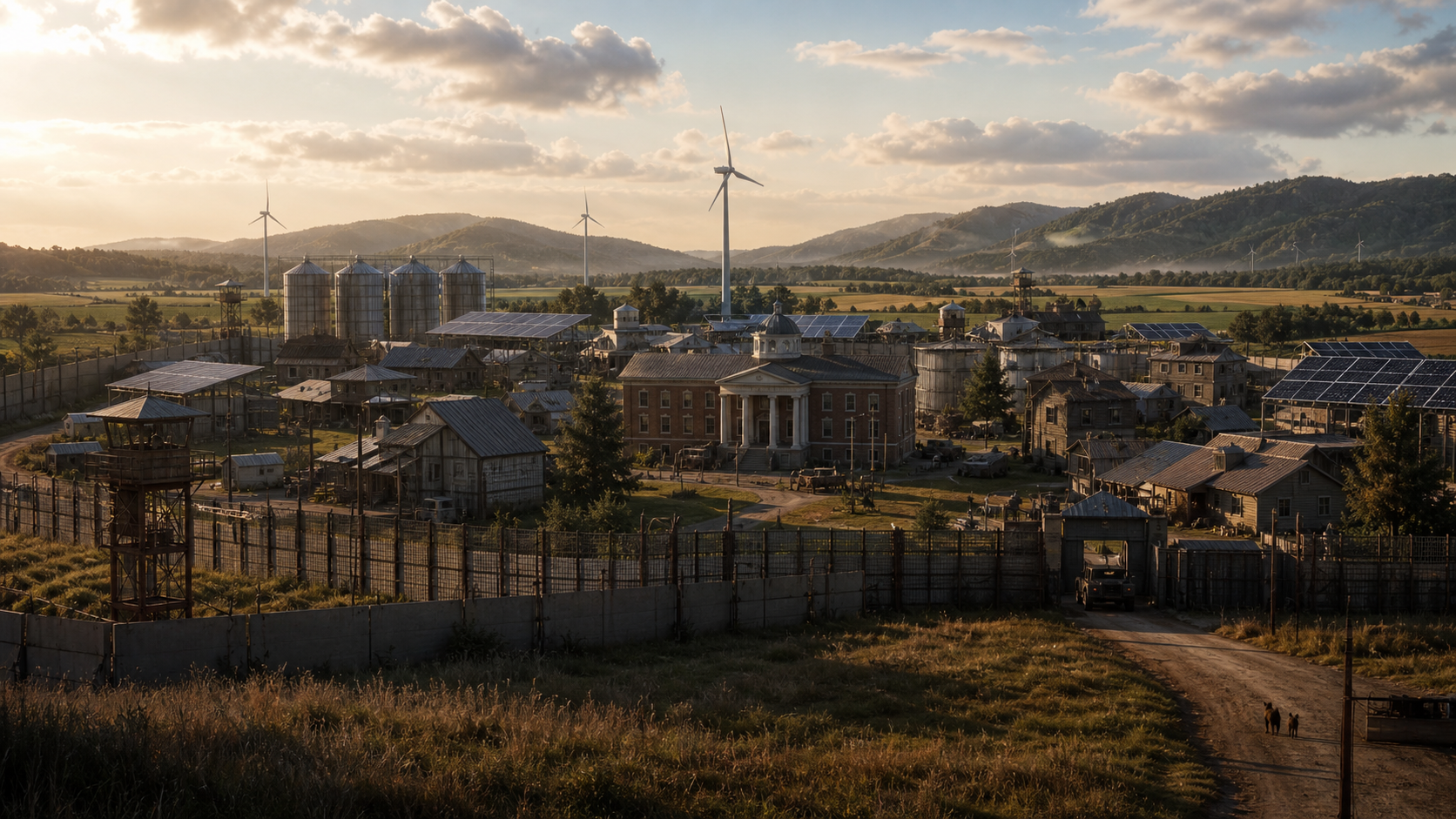
It becomes a major political dividing line in the Dark Age era, when approximately one hundred outposts in the Midwest and East support a fragile national recovery while much of the former West Coast and numerous cities remain outside routine government authority.
Quick Facts
- Role
- Dark Age Politics and Allied States Governance
- Aliases
- frontier-cities-debate, dark-age-politics, politics/frontier-cities-debate, politics-frontier-cities-debate
Overview
The argument places security against demographic and moral restraint. The Freedom Party, associated with retired General Mark Cornelius, contends that abandoned cities allow Variants, collaborators, raiders, and later the New Gods to organize in the shadows. Its platform favors aggressive reclamation or destruction and would compel independent survivors to leave threatened zones. Jan Ringgold, Dan Lemke, Kate Lovato, and the New America Coalition favor consolidation, intelligence, negotiated relationships, and targeted operations by forces such as Team Ghost. They do not deny that the frontier is dangerous. They argue that a government with a severely reduced population can destroy itself by trying to occupy every old boundary.
Neither position is wholly vindicated or disproved. Operation Liberty shows the cost of entering a city with insufficient understanding of an evolved enemy. The New Gods later prove that neglected territory can conceal an organized threat capable of attacking outposts and national command. Independent homesteaders and small communities prove, in turn, that frontier space is not empty land available for indiscriminate bombing. By the Battle of Galveston, former rivals must cooperate, leaving the rebuilt government with a harder question than either campaign slogan acknowledged: how to confront real danger without repeating the mass sacrifice of the first war.
Debate information
- Field: Issue; Detail: Status of ruined cities and uncontrolled territory after the extinction war
- Field: Era; Detail: Allied States reconstruction and Dark Age election period
- Field: Geographic scope; Detail: Frontier cities, abandoned urban centers, lawless zones, rural settlements, and former military sites
- Field: Government context; Detail: Approximately one hundred outposts concentrated mainly in the Midwest and East; much of the West Coast outside routine control
- Field: Aggressive position; Detail: Retake cities, destroy unrecoverable strongholds, remove or relocate independent survivors, and expand national military reach
- Field: Principal aggressive faction; Detail: Freedom Party under Mark Cornelius
- Field: Measured position; Detail: Consolidate outposts, gather intelligence, negotiate where possible, and use targeted teams against confirmed threats
- Field: Principal measured faction; Detail: New America Coalition and Ringgold administration
- Field: Key figures; Detail: Jan Ringgold; Dan Lemke; Mark Cornelius; Kate Lovato; Reed Beckham; Parker Horn; Team Ghost
- Field: Principal historical precedent; Detail: Operation Liberty in New York City
- Field: Later threat affecting the debate; Detail: New Gods network under Azrael
- Field: Core ethical question; Detail: Whether territorial reclamation can justify civilian displacement, conscription, bombing, and large military losses
- Field: Final status; Detail: Unresolved as a simple doctrine; transformed by the New Gods war, Ringgold and Lemke's losses, and cooperation at Galveston
Reconstruction by concentration
The Allied States emerges after the original extinction war with only a fraction of the former population, industrial base, and functioning infrastructure. It cannot restore the old national map by declaration. Survivors are concentrated in defended outposts and larger territories where food, medicine, power, communications, and armed protection can be organized.
This system produces genuine recovery. Children grow up inside communities rather than temporary camps. Elections and political parties return. Farms, workshops, clinics, schools, and local governments make survival less dependent on continuous military deployment. The existence of roughly one hundred outposts demonstrates that national coordination has moved beyond a single refuge.
Concentration also leaves vast spaces outside everyday authority. Roads deteriorate, bridges fail, buildings become unstable, and communications disappear. The government may possess a legal claim to former territory without having the people or equipment to patrol it. That difference between map and control creates the frontier-cities question.
Meaning of a frontier city
A frontier city is not simply an old city that has not been rebuilt. It is an urban area whose inhabitants, hazards, and political status are uncertain. It may contain Variants, nests, webbing networks, collaborators, captives, scavengers, raiders, or independent communities. Several groups can occupy different parts of the same metropolitan region without knowing the full extent of one another.
The term therefore combines geography with a problem of knowledge. A quiet skyline can indicate emptiness, successful concealment, or an enemy waiting for movement. A radio transmission can come from genuine survivors, bait, or someone forced to speak. Government planners cannot calculate risk from population records created before the outbreak.
The frontier also includes spaces between cities. Rural compounds, ruined suburbs, tunnels, industrial sites, and former military installations can shelter people or threats. Policy aimed only at municipal centers may push danger outward without creating lasting control.
Freedom Party position
The Freedom Party treats abandoned territory as a continuing strategic defeat. From this perspective, leaving cities alone gives the enemy depth. Variants can reproduce or reorganize beyond observation. Human collaborators can trade, imprison others, and guide hostile forces. Raiders can strike roads and settlements before retreating into terrain the government refuses to enter.
Cornelius's supporters argue that the Allied States cannot remain a permanent archipelago of walls. If it never expands, each outpost becomes an isolated target, and the idea of a national recovery loses meaning. Reclamation would restore transportation nodes, salvage industrial resources, and deny hostile groups the symbolic power of occupying old American centers.
The platform includes a coercive edge. Cities judged unrecoverable may be destroyed rather than held, and people living independently in targeted areas may be forced out. That policy assumes the government has both the right to define danger and the capacity to relocate people safely. It also connects with proposals for wider conscription, because large clearing and occupation campaigns require far more personnel than a small professional force.
The argument draws strength from real failures. Attacks on outposts, human collaboration, and the eventual New Gods campaign all demonstrate that hidden territory is not automatically dormant. Cornelius is wrong only if his warning is reduced to paranoia. The more difficult criticism is that a correct warning does not make every proposed remedy workable or just.
New America Coalition position
Ringgold's administration and the New America Coalition place population preservation before territorial symbolism. Every trained soldier, medic, engineer, farmer, and parent is difficult to replace. Losing thousands in a campaign for ruins can damage the surviving society more than leaving those ruins unoccupied.
Their alternative is strategic consolidation. The government strengthens existing outposts, protects supply routes, develops intelligence, and sends elite teams against specific dangers. Team Ghost represents this model. A small experienced unit can verify a threat, recover a person or specimen, destroy a defined target, and return without requiring permanent occupation of an entire city.
This policy is not pacifism. Ringgold authorizes dangerous missions and uses force against confirmed threats. The distinction lies in objective and scale. A targeted operation asks what must be accomplished now. A reclamation campaign can begin with an abstract desire to restore the map and discover its true cost only after troops are committed.
The measured position has vulnerabilities. It depends on intelligence from areas where communications are poor. It can appear passive to communities already suffering attacks. Concentration may protect the center while abandoning people who chose or were forced to remain outside. A government that waits for proof may learn about an organized enemy only after the enemy chooses to reveal itself.
Operation Liberty as precedent
Operation Liberty is the principal historical warning in the debate. The campaign attempts to retake major cities after early military victories create confidence that the Variant threat can be cleared on a large scale. New York demonstrates that the enemy has changed. Variants use tunnels, buildings, vertical terrain, coordination, and human collaborators in ways that undermine a conventional occupation plan.
The operation shows the difference between striking a target and controlling a city. Aircraft and heavy weapons can kill visible enemies, but they cannot search every underground space or identify every person moving between civilian and hostile roles. Soldiers entering the ruins inherit a battlefield prepared by creatures that already live there.
Operation Liberty also consumes scarce people. In the old United States, a failed urban operation could be reinforced from a population of hundreds of millions. After extinction, each casualty removes a significant share of surviving experience and family continuity. The political value of reclaiming a famous city must therefore be compared with the communities weakened to supply the force.
For Ringgold's side, Liberty proves that ambition without intelligence is not recovery. For the Freedom Party, it proves that the problem was execution and delay rather than the goal itself. This difference keeps the precedent contested. Both sides remember the same disaster but draw opposing policy lessons from it.
Cities are not empty
Independent survivors make the debate ethically complex. Some people outside the outposts are raiders or collaborators. Others are homesteaders, family groups, refugees, or communities that survived without national aid. They may distrust centralized authority because they remember Building 8 secrecy, failed evacuations, military coercion, or simple abandonment.
A bombing policy cannot reliably distinguish these groups from the air. Destroying a suspected Variant stronghold may also destroy captives and hidden civilians. Forced relocation can deprive a community of crops, wells, livestock, shelter, and local knowledge that cannot be reproduced inside an outpost.
The government also faces a legitimacy problem. If people survived independently for years, national officials cannot assume that the return of a flag automatically cancels their autonomy. Protection may justify quarantine or evacuation during an immediate threat, but permanent incorporation requires a political relationship, not only armed capacity.
At the same time, independence does not make a settlement immune to consequences beyond its borders. A community may unknowingly shelter infection, trade with collaborators, or occupy a route essential to multiple outposts. The frontier debate is difficult because rights and risks cross the same boundaries.
Demography
Population is the Allied States' most limited resource. The old cities were built for millions, but the surviving nation does not have enough people to repair, supply, govern, and defend them all. A city can be captured in a military sense while remaining impossible to inhabit safely.
Young adults are especially contested. The Freedom Party's conscription position would expand the force needed for reclamation. Opponents fear that the same generation expected to rebuild families, farms, institutions, and technical professions would be sent into ruins created by older leaders. Kate's attention to children and adolescents gives this concern a personal center.
Logistics
Clearing is only the first stage of occupation. A reclaimed city requires clean water, food, medical care, decontamination, structural assessment, power, communications, and a route that can be defended in every season. Salvaged resources may justify some missions, but those resources must be recovered without spending more fuel, equipment, and lives than they return.
Outposts already compete for maintenance and supplies. Expansion can lengthen routes faster than production grows. A policy that looks bold on a map may create dozens of weak positions dependent on convoys the government cannot protect.
Intelligence
The frontier's most dangerous quality is uncertainty. New Gods webbing networks and human collaborators reveal how an enemy can exploit gaps in surveillance. Targeted reconnaissance can reduce that uncertainty, but reconnaissance teams also have limited reach and can miss a distributed threat.
The debate therefore concerns timing as much as force. Acting too early repeats Operation Liberty. Acting too late allows hostile organization. Neither slogan removes the need for continuous observation, local relationships, and commanders willing to revise assumptions.
Holding territory
Military control is not the same as political restoration. Troops can occupy an intersection while neighborhoods remain unsafe. A government can appoint an administrator without earning cooperation. If residents see reclamation as invasion, every supply movement becomes harder and human intelligence disappears.
A durable policy needs stages: survey, contact with survivors, containment of confirmed biological threats, recovery of essential assets, negotiated administration, and only then larger settlement. The story does not present this sequence as a formally enacted doctrine, but the failures and successes within the continuity support the distinction.
Kate and Reed at Peaks Island
Kate Lovato Beckham and Reed Beckham give the debate a private form during their conversation at Peaks Island. Kate thinks about the generation growing up after the first outbreak. Political expansion is not abstract to her because the people drafted, displaced, or exposed will include children who survived only because adults promised them a different future.
Reed approaches the silence beyond the outposts as a soldier. He knows quiet can mean planning. His experience with Alphas, collaborators, underground lairs, and failed urban operations prevents him from assuming that abandoned territory is harmless simply because no army is visible.
Their perspectives are not opposites. Kate does not deny danger, and Reed does not endorse indiscriminate destruction. Together they define the actual dilemma. Protecting the next generation requires restraint, but it also requires attention to threats forming beyond the walls.
The New Gods later validate Reed's warning without invalidating Kate's moral concern. Azrael's network uses hidden spaces and human subordination to build power. Yet the losses of the ensuing war show why throwing young survivors into every ruin would not have been a simple preventative solution.
The New Gods and partial vindication
The New Gods transform the frontier debate from election policy into immediate war. They are not isolated remnants waiting to be cleared. Their hierarchy, webbing communication, human captives, and coordinated attacks demonstrate an organized system capable of operating across the gaps between outposts.
Their rise supports the Freedom Party claim that abandoned territory can conceal strategic danger. It also supports the Coalition claim that the enemy must be understood before a large campaign begins. The New Gods are not merely more Variants occupying old nests. A plan designed for the first war may fail against their biology, command structure, and political use of human prisoners.
Cornelius's military strength becomes necessary during the final crisis, while Reed and other figures associated with Ringgold's order contribute experience and legitimacy. Cooperation at Galveston shows that the surviving sides need both readiness to fight and a political purpose worth defending.
Relationship to the conscription debate
The frontier-cities and conscription debates overlap but are not identical. Frontier policy defines where and why the government might fight. Conscription defines who can be compelled to fight and under what authority.
An aggressive city program makes mass recruitment more likely because clearing, garrisoning, and supplying multiple urban areas exceeds the capacity of small elite teams. Resistance to conscription therefore often includes resistance to territorial overreach. Conversely, a person may support a defensive draft while opposing indiscriminate city bombing, or favor reclamation while preferring volunteers.
Keeping the issues distinct clarifies the political conflict. The ethical judgment does not rest on whether force is ever justified. It rests on objective, evidence, proportionality, civilian status, and the legitimacy of the government ordering sacrifice.
Relationship to the Freedom Party platform
Frontier reclamation is one component of the Freedom Party's broader program. The party also campaigns on security, national strength, and dissatisfaction with Ringgold's administration. The city issue allows it to present visible ruins as evidence of governmental weakness.
That symbolism is powerful. A voter does not need access to classified intelligence to see that famous cities remain abandoned. The Freedom Party can promise to reverse humiliation, while the Coalition must explain why restraint is not surrender.
The platform's danger lies in treating all frontier space as one category. A Variant stronghold, a captive camp, a farming settlement, and an empty industrial district require different responses. Political language rewards a simple answer where field reality demands discrimination.
Galveston and the post-crisis synthesis
The losses leading to Galveston destroy the idea that the debate can end with one faction defeating the other at the ballot box. Ringgold dies, Lemke is lost, and the Allied States faces an enemy capable of reaching supposed fallback positions. Cornelius and Reed must cooperate in defense of a surviving political community.
The resulting lesson is not automatic adoption of either earlier platform. The New Gods prove that hidden threats cannot be ignored. The cost of the war proves that population cannot be spent as if the old nation's reserves still exist. Galveston also reinforces the importance of coalition: military strength without broad legitimacy risks becoming another coercive faction, while legitimacy without defensive capacity cannot protect citizens.
After the crisis, frontier policy remains a continuing function of government. Intelligence, diplomacy with independent survivors, selective recovery, secure outposts, and force against confirmed enemies all have roles. The exact balance must be argued repeatedly because conditions differ by place.
Political and ethical significance
The debate asks what it means to inherit a country after its population and infrastructure have collapsed. The Allied States possesses memories, institutions, and claims associated with the former United States, but it cannot treat empty land as more valuable than living citizens. Rebuilding the nation may require accepting that some old boundaries will remain aspirational for generations.
It also tests the meaning of freedom. Independent survivors may view forced removal as tyranny. Outpost residents may view the government's refusal to clear nearby threats as abandonment. Soldiers may view conscription as necessary collective defense or as the transfer of political ambition onto young bodies.
The series refuses to solve these questions through proof that one speaker was entirely right. Cornelius identifies a real danger. Ringgold and Kate identify a real limit. Reed's unease is justified, but Operation Liberty remains a warning. The frontier-cities debate matters because responsible government must act while all of those truths remain present.
Important connections
- Allied States: Rebuilt national system whose limited population and outpost network create the policy problem.
- Jan Ringgold: President associated with consolidation, restraint, and targeted security operations.
- Dan Lemke: Coalition leader and successor figure involved in preserving the postwar political order.
- Mark Cornelius: Freedom Party leader and principal advocate of aggressive reclamation and national military strength.
- New America Coalition: Political faction favoring measured expansion and preservation of existing communities.
- Freedom Party: Political faction advocating stronger coercive and territorial action.
- Kate Lovato Beckham: Voice for the demographic and moral interests of the next generation.
- Reed Beckham: Veteran whose suspicion of quiet frontier territory anticipates the New Gods threat.
- Team Ghost: Targeted-response model used against confirmed threats without general city occupation.
- Operation Liberty: Failed or costly city-reclamation precedent that structures later caution.
- Frontier and lawless zones: Geographic and social spaces at the center of the dispute.
- Independent survivors: People whose presence prevents the frontier from being treated as empty enemy territory.
- New Gods: Organized enemy whose rise proves the danger of unobserved spaces.
- Battle of Galveston: Crisis that forces rival political and military figures into cooperation.
Chronology and consequences
- Extinction Edge and Extinction End - Establish Operation Liberty, urban enemy adaptation, and the original cost of large city campaigns.
- Extinction Aftermath and Extinction War - Establish postwar reconstruction, safe territories, human political conflict, and the conditions inherited by the Allied States.
- Extinction Shadow - Introduces the mature Allied States, election environment, competing parties, and frontier-security argument.
- Extinction Inferno - Shows outpost pressure and the growing evidence that danger beyond the walls is coordinated.
- Extinction Ashes - Develops the New Gods structure and converts political warning into national emergency.
- Extinction Darkness - Brings rival forces together through the command crisis and Battle of Galveston.
Continue Exploring
Connected Universe
Books and Stories
Groups and Factions
Locations, Events, and Lore
Sources
- Dark Age Introduction: one hundred outposts, abandoned West Coast, remaining Variants and collaborators.
- Dark Age Chapter 2: Freedom Party proposal to retake or bomb frontier cities and force out independent survivors.
- Operation Liberty pages: prior warning about city-retaking overconfidence.
- Extinction War, Extinction War - Prologue
- Extinction War, Extinction War - Chapter 1