
Fact Versus Fiction
Could the Extinction Cycle Actually Happen? The Real Science Behind VX-99, Epigenetics and the Hemorrhage Virus
What is real and fictional about VX-99, epigenetics, viral outbreaks and rapid human transformation in Extinction Cycle? A science-based breakdown.
·
Category: Fact Versus Fiction
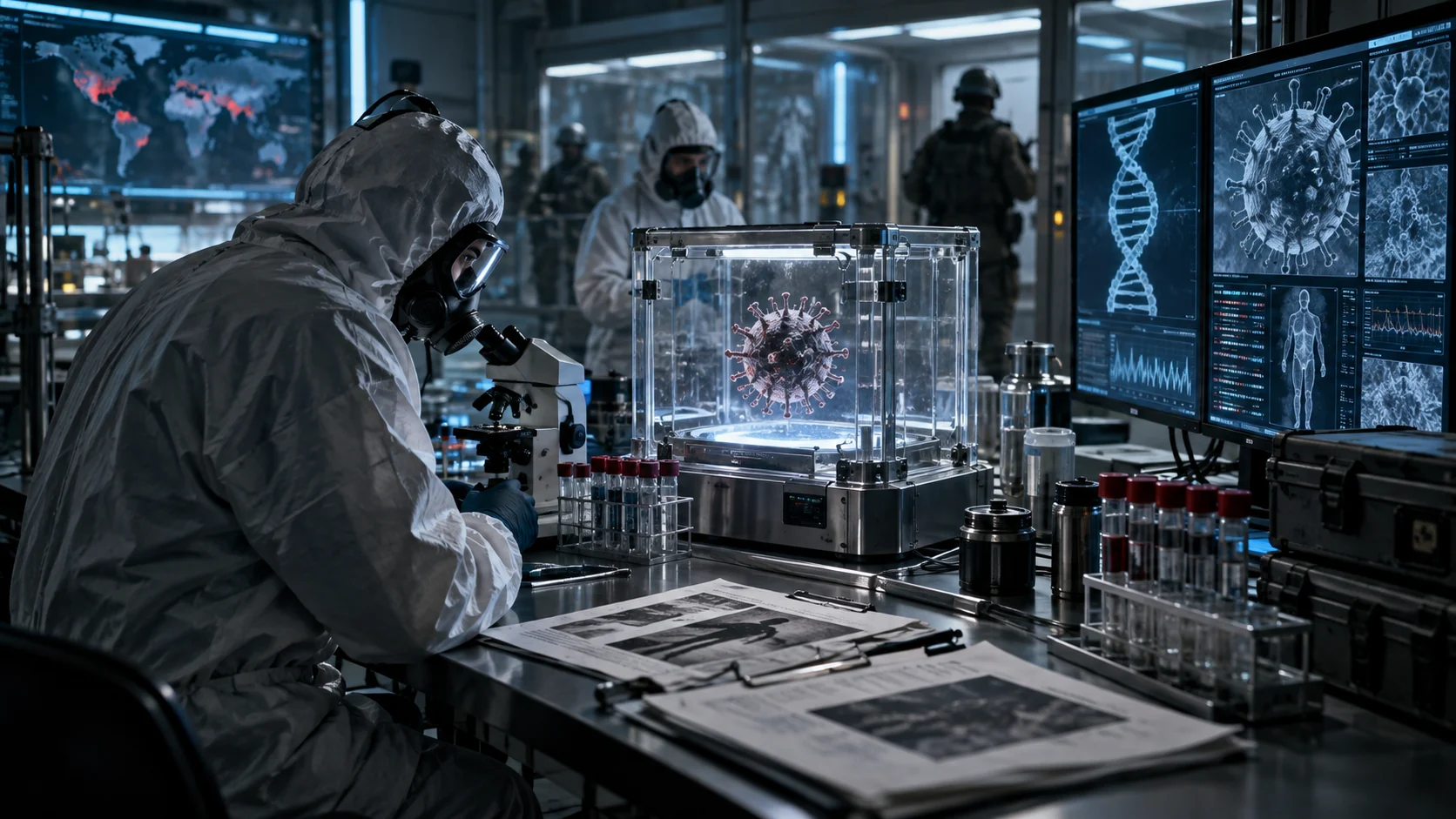
The franchise borrows real scientific vocabulary while using fictional mechanisms to create its Variant biology.
Nicholas Sansbury Smith built the Extinction Cycle around a particularly effective kind of fear: the monsters are fictional, but some of the vocabulary is real.
VX-99 is fictional. The Hemorrhage Virus is fictional. Variants are fictional. Human beings cannot be transformed in hours into wall-climbing predators by "reactivating dormant animal genes" in the way the novels dramatize.
But epigenetics is real. Gene expression is real. Viruses can alter cells. Pathogens can spread internationally before governments fully understand them. Laboratories do work with dangerous organisms under strict containment. Military and public health planners really do worry about emerging pathogens, accidental releases, deliberate misuse and the difficulty of responding to fast-moving outbreaks.
That mixture of real science and fictional extrapolation is what makes Extinction Cycle feel more plausible than supernatural zombie stories.
The right question is therefore not "Could VX-99 literally exist?"
It is: Which parts of Extinction Cycle are grounded in real biology, which parts are speculative, and which parts are impossible or wildly exaggerated?
This article separates the science from the fiction without turning the discussion into a blueprint for creating harmful biological agents. The focus is on concepts, plausibility and public-health reality.
The quick answer
No, the Extinction Cycle as depicted could not happen with current biology.
A pathogen cannot realistically rewrite an adult human body in hours into a stronger, faster, armored, reproductively altered predator while preserving enough function for coordinated movement. Epigenetic changes do not work like hidden switches that unlock a complete ancestral animal body plan. Human DNA does not contain a dormant wolf, ape or reptile waiting to be turned on.
However, several underlying ideas are scientifically meaningful:
- genes can be regulated differently without changing the DNA sequence
- infections can alter gene expression and immune behavior
- environmental exposures can produce epigenetic changes
- pathogens can spread globally through travel networks
- some neurological infections can alter behavior
- disease can create extreme social disruption long before most people become infected
- laboratory accidents and deliberate misuse are legitimate biosecurity concerns
- evolution and selection can change pathogen populations over time
The novels compress, combine and amplify these real concepts into science-fiction horror.
What VX-99 is in Extinction Cycle
Within the franchise, VX-99 is associated with a U.S. military program originally intended to create a strategic biological capability and enhance soldiers. The program's history reaches back to experiments during the Vietnam era, including Lieutenant Trevor Brett and his men.
By the time of Extinction Horizon, the consequences of that research have become catastrophic. The Hemorrhage Virus spreads beyond containment, and infected humans become Variants.
The fictional explanation repeatedly invokes epigenetic changes and the activation of proteins encoded by genes that supposedly separate modern humans from more animalistic ancestors.
That wording sounds scientific because it combines real concepts:
- genes encode proteins
- gene expression can be turned up or down
- epigenetic mechanisms regulate gene activity
- evolution leaves traces in genomes
But the way those concepts are assembled is fictional.
What epigenetics actually means
The U.S. Centers for Disease Control and Prevention defines epigenetics as changes that affect how genes work without changing the underlying DNA sequence. These changes can influence whether genes are more or less active.
One familiar mechanism is DNA methylation. Chemical tags can influence gene activity, affecting how cells read genetic instructions. Other mechanisms include changes to proteins associated with DNA and regulatory RNA molecules.
The important point is that epigenetics changes gene regulation, not species identity.
A skin cell and a neuron contain essentially the same DNA, but they use different sets of genes. That is one reason they look and behave differently. Development depends on carefully coordinated patterns of gene activation and repression.
This is real and extraordinary.
It is also very different from the fictional idea that a chemical could suddenly switch on an entire prehistoric predator program inside an adult human.
Why "turning on animal genes" is misleading
Humans are animals. We already share enormous amounts of genetic machinery with other species because all life is related through evolution.
The genes involved in muscles, metabolism, sensory systems, immune function and development do not sit in neat categories labeled "human" and "wild animal."
Evolution usually modifies existing biological systems through many genetic changes over long periods. A trait like stronger jaws, different limb proportions, night-adapted vision or claw-like structures would depend on development, anatomy, hormones, bone growth, tissue organization and many interacting genes.
An adult body cannot simply express a few old genes and remodel itself instantly into a new species.
The limitation is not only genetic information. It is construction.
Bodies are built through developmental processes. Bone shape, muscle attachment, nervous-system wiring and organ architecture are established over years. Changing the instructions does not instantly rebuild the finished structure.
A useful analogy is software and hardware.
Epigenetics can change which software processes are running in a cell. It cannot instantly turn a laptop into a helicopter because the hardware is different.
Could gene expression make a human stronger or more aggressive?
Gene expression can influence muscle growth, hormone signaling, metabolism and neurological function. Drugs and diseases can also alter behavior and physical performance.
But there are hard biological constraints.
A person cannot suddenly double muscle mass without raw material, energy and time. Bone density cannot instantly increase enough to support a radically larger frame. Tendons and cardiovascular capacity have to adapt. More muscle creates greater oxygen and nutrient demand.
This is where Extinction Cycle actually contains one scientifically useful consequence: metabolic cost.
Variants need enormous amounts of protein. Later stories emphasize starvation as a real weakness. That follows a legitimate biological principle. Extraordinary physical output requires energy.
The novels exaggerate the transformation but remember that enhanced physiology must be fueled.
That is better science than simply giving monsters unlimited strength with no metabolic penalty.
What about behavior-changing infections?
This is one of the more plausible foundations of infection horror.
Real pathogens can affect the brain. Rabies is the obvious example because it can cause neurological symptoms, agitation and abnormal behavior. Other infections can produce confusion, delirium, seizures or psychiatric symptoms through direct neurological effects or immune responses.
Parasites can also alter animal behavior, sometimes in ways that benefit transmission.
That does not mean a pathogen could produce the precise organized predatory behavior of an Extinction Cycle Variant.
Complex behavior depends on multiple brain systems. Destroying inhibition can increase agitation, but producing improved tracking, coordinated pack tactics and enhanced combat ability would require preserving and reorganizing sophisticated neural function.
In fiction, the Hemorrhage Virus does both: it strips away much of ordinary human behavior while enhancing predatory function.
In reality, severe brain infection is more likely to impair coordination, cognition and survival than to create a superior hunter.
Could an outbreak spread as fast as Extinction Cycle?
The speed is dramatized, but rapid international spread is not an absurd premise.
Modern transportation allows infected people to cross continents before symptoms are recognized. The COVID-19 pandemic demonstrated how quickly a respiratory pathogen can establish international transmission. Influenza planning has long accounted for similar risks.
However, the faster and more visibly catastrophic a disease is, the easier it can become to identify affected people.
A person who remains mobile and infectious while appearing healthy can spread disease efficiently. A person who transforms rapidly into an obviously violent medical emergency is much easier to notice, even if they are dangerous locally.
Extinction Cycle gets around this partly through the chaos of the initial event, incomplete intelligence and the speed of transformation.
The social collapse may actually be more plausible than the biology.
Airports close. Hospitals overload. Police and military units receive contradictory information. Rumors move faster than official guidance. People flee cities. Transportation corridors jam. Critical workers stop showing up.
A modern civilization does not need 90 percent of its population to become infected before essential systems start failing.
The most realistic part: system failure
The series' strongest science is arguably not molecular biology. It is disaster systems thinking.
Civilization is interconnected.
Hospitals depend on electricity, supply chains, staff, oxygen, pharmaceuticals and transportation. Water systems depend on power and trained operators. Food distribution depends on trucking, refrigeration, fuel and functioning roads. Military units depend on communications, maintenance, ammunition and command.
When multiple systems fail simultaneously, the damage compounds.
This is why a fictional disease with impossible monster biology can still create a believable apocalypse.
The details of the pathogen are less important than what it does to infrastructure.
A disease that causes panic, absenteeism, violence and transportation shutdown can create secondary deaths from causes unrelated to infection.
That systems-level cascading failure is very real.
Could a laboratory accident start a global outbreak?
Laboratories that work with dangerous pathogens use multiple layers of containment, training and oversight precisely because accidents are possible.
The probability of any specific fictional scenario is difficult to quantify, and modern biosafety systems are designed to make severe releases extremely unlikely.
But "unlikely" is not the same as "physically impossible."
Biosecurity experts study laboratory-acquired infections, containment failures and human error. Governments also plan for deliberate biological attacks.
Where Extinction Cycle becomes less realistic is the combination of secrecy, scale and transformation. The fictional program produces an agent with almost perfectly catastrophic properties and then loses control in a way that allows explosive spread.
That is narrative concentration. Real disasters usually involve messier chains of failure.
Still, Building 8 works as a believable symbol of a broader truth: high-consequence research creates responsibilities that extend beyond the laboratory walls.
Could a military really study biological enhancement?
Militaries have historically researched ways to improve soldier performance, including endurance, alertness, protection from chemical and biological threats, wound care and human-machine integration.
That is not the same as secretly turning soldiers into monsters.
The fictional VX-99 program combines two different areas of concern:
- biological weapons
- human performance enhancement
Both are real policy topics, but the specific Extinction Cycle approach is invented.
The frightening plausibility comes from motive rather than mechanism. Governments have incentives to seek technologies that reduce casualties, improve combat performance or create strategic advantage.
Fiction asks what happens when that incentive overwhelms restraint.
Are genetically engineered pathogens possible?
Modern biotechnology can alter microorganisms in laboratories. Scientists routinely modify organisms for legitimate research, medicine and industrial purposes.
That statement should not be confused with the claim that scientists can design a pathogen with arbitrary capabilities.
Biological systems are complicated. A change that increases one trait can weaken another. Virulence, transmission, stability, immune evasion and host range involve tradeoffs. Engineering a reliable organism is far harder than writing down a desired list of features.
This is another place where Extinction Cycle exaggerates for effect.
VX-99 and its descendants behave as if researchers can intentionally push human biology toward a chosen endpoint. Real genetic engineering is not remotely that predictable at the whole-organism level.
The safe scientific takeaway is that biotechnology is powerful enough to require governance, not that fictional super-pathogens are around the corner.
Does evolution really happen during outbreaks?
Yes.
Pathogens evolve as they reproduce. Mutations occur, and selection can favor variants that transmit more effectively under particular conditions. This process is observable in real viruses and bacteria.
But the timescale and type of change in Extinction Cycle are heavily fictionalized.
A pathogen can evolve quickly because it reproduces quickly. A human host cannot evolve a new body plan over days. The host's cells can change, immune responses can change and disease progression can alter tissues, but that is not equivalent to generations of organism-level evolution.
When the books describe Variants "evolving," several processes are blended together:
- disease progression inside an individual
- epigenetic changes
- mutation of the infectious agent
- selection among infected hosts
- reproduction of new Variant generations
As fiction, this creates a coherent escalating threat.
As biology, those mechanisms would need to be separated.
Could armored juvenile Variants evolve?
Not on the timeline shown.
Natural selection can produce armor-like structures across many generations if traits are heritable and provide reproductive advantage. That is how evolution produces shells, scales and thickened bone in real species.
The Extinction Cycle timeline is much too short for ordinary human evolution to create radically armored descendants.
A fictional engineered developmental program could theoretically accelerate tissue changes, but the energy, growth and anatomical problems remain enormous.
Juvenile Variants therefore sit firmly in speculative science fiction.
The scientifically interesting idea is not that such creatures could appear in months. It is that an evolving threat can invalidate yesterday's countermeasure.
That principle is real.
Could humans develop a counter-bioweapon as quickly as Kate does?
Real biomedical development is slower, more regulated and more uncertain than emergency fiction usually depicts.
Identifying a pathogen, understanding its mechanism, designing a countermeasure, testing safety, manufacturing doses and distributing them are separate challenges.
During a true existential emergency, governments could compress timelines and accept greater risk. The COVID-19 pandemic showed how quickly vaccines can be developed when prior scientific platforms, massive funding and global trial infrastructure are available.
But a countermeasure that selectively kills transformed Variants while sparing ordinary humans would be extraordinarily difficult.
Kate's achievements are therefore heroic science fiction rather than a realistic development schedule.
What is realistic is the structure of the problem:
- researchers need live or preserved samples
- field teams need to retrieve specimens
- scientists need to understand changing biology
- manufacturing becomes as important as discovery
- political leaders have to decide when evidence is sufficient for deployment
Those are genuine public-health and military logistics questions.
The biggest scientific problem with Variants: energy
Suppose for a moment that a human could transform into a Variant.
Where does the mass come from?
Growing claws, thicker muscle, denser bones and altered organs requires material. Protein must come from food or the body's existing tissues. Rapid remodeling would generate enormous heat and waste. The cardiovascular system would need to supply oxygen. The liver and kidneys would have to manage metabolic byproducts.
Extinction Cycle partially acknowledges this through extreme hunger and protein demand.
But the transformation still happens far too quickly for realistic physiology.
If anything, a real organism undergoing such uncontrolled growth would be more likely to experience organ failure than superhuman performance.
The second biggest problem: the brain
Variants gain useful predatory abilities at exactly the time ordinary human cognition is being stripped away.
That is narratively effective but neurologically difficult.
Better smell requires sensory processing. Echolocation requires specialized brain interpretation. Pack coordination requires social signaling. Accurate climbing requires motor planning. Tool use requires still more cortical function.
Dark Age Scions push this even farther because they combine enhanced bodies with speech, weapons use and organized military behavior.
At that point the science is explicitly closer to engineered transhumanism than infection.
No current biotechnology can redesign an adult human nervous system that way.
What science makes Dark Age more interesting?
Dark Age changes the question from accidental infection to deliberate enhancement.
Azrael uses genetic engineering and surgical intervention to create Scions. These beings preserve strategic intelligence while gaining Variant-like physical features.
That is even less plausible with current science than the original outbreak, but conceptually it reflects a real debate: if biotechnology becomes increasingly powerful, who decides which human modifications are acceptable?
The threat is not only technical capability.
It is ideology.
Azrael believes he is improving humanity. That belief is more realistic than his methods.
History is full of people who justified coercion, medical abuse and violence by claiming to improve society or create a superior population.
Dark Age turns that ethical danger into literal monsters.
Could a real "zombie virus" exist?
A pathogen could theoretically cause some behaviors associated with zombie fiction:
- confusion
- aggression
- impaired judgment
- altered movement
- reduced fear response
- fever and bleeding
But the complete package seen in Extinction Cycle is not realistic.
A real neurological infection severe enough to destroy normal cognition would usually make a person worse at coordinated hunting, not better.
The most plausible "zombie-like" emergency would therefore look less cinematic: sick, confused, aggressive or delirious people creating dangerous situations while medical systems become overwhelmed.
That could be terrible without producing a single superhuman monster.
Why the fiction still works
Scientific fiction does not have to be literally possible to be effective.
It has to preserve enough causal logic that readers can follow the escalation.
Extinction Cycle does this well in four ways.
1. The monsters have costs
Variants need food. They can starve. Their senses can be disrupted. They can be killed.
2. Countermeasures create new pressures
Human weapons change the environment in which the creatures survive, creating an evolutionary arms-race feeling.
3. Science requires samples and information
Kate cannot solve problems by intuition alone. Teams retrieve specimens and intelligence.
4. Institutions fail before biology becomes impossible
Government secrecy, military desperation and infrastructure collapse create believable consequences even when the Variant transformation itself is fantastical.
That combination is why the series feels grounded.
A plausibility scorecard
| Extinction Cycle concept | Real science basis | Plausibility |
|---|---|---|
| Epigenetic regulation | Strong real basis | Real |
| Gene expression changing cell behavior | Strong real basis | Real |
| Virus altering behavior | Real in limited ways | Plausible in principle |
| Rapid global spread through travel | Strong real basis | Plausible |
| Laboratory accident | Real risk category | Plausible but uncommon |
| Military biological research | Historically real category | Real in broad terms |
| Pathogen evolution | Strong real basis | Real |
| Human turning into a Variant in hours | No realistic mechanism | Essentially impossible |
| Instant massive muscle and bone remodeling | Violates physiological constraints | Essentially impossible |
| Adult human developing new predator anatomy | No realistic mechanism | Essentially impossible |
| Alphas gaining coordinated pack command through infection | Highly speculative | Very unlikely |
| Armored juvenile Variant generation on series timeline | Requires impossible developmental speed | Essentially impossible |
| Scion-level adult genetic redesign | Beyond current capabilities | Science fiction |
Frequently asked questions
Is VX-99 real?
No. VX-99 is a fictional element of the Extinction Cycle universe.
Is epigenetics real?
Yes. Epigenetics is a real field studying mechanisms that influence gene activity without changing the underlying DNA sequence. The fictional use of epigenetics in Extinction Cycle is heavily exaggerated.
Can dormant genes turn humans into animals?
No. Human genomes do not contain a complete dormant predator body plan that can be switched on. Evolution modifies many interacting developmental systems across generations.
Can viruses change behavior?
Yes, some infections can affect the nervous system and alter behavior, but there is no known pathogen that reliably turns humans into coordinated superhuman predators.
Could a genetically engineered pandemic happen?
Biosecurity experts take deliberate misuse and laboratory accidents seriously. That does not mean a fictional pathogen like the Hemorrhage Virus is technically feasible. Modern biosafety and security systems are designed to reduce these risks.
Could infected people become stronger because they feel less pain?
Reduced pain or inhibition could make a person behave more recklessly, but it would not eliminate the physical limits of muscle, bone, blood flow and injury. Ignoring damage is not the same as being immune to it.
Final verdict
The Extinction Cycle could not happen the way the books depict it.
That is not a criticism. It is the point where science ends and science fiction begins.
Epigenetics is real, but it cannot unlock a hidden monster. Pathogens evolve, but adult human bodies do not evolve in days. Infections can affect behavior, but severe neurological disease does not normally create elite predatory intelligence. Genetic engineering is powerful, but it cannot currently redesign a living adult human into a Scion.
What could happen is the part surrounding the monsters.
A new pathogen could spread internationally. Officials could make mistakes. Laboratories could face containment failures. Hospitals could be overwhelmed. Supply chains could break. Rumors could undermine trust. Governments could struggle to balance transparency, security and panic. Scientists could be pressured to move faster than normal standards allow.
That is why Extinction Cycle works.
The fictional biology provides the nightmare image. The realistic systems around it make the nightmare feel close enough to imagine.
Real-world science references
- CDC, Epigenetics, Health, and Disease: https://www.cdc.gov/genomics-and-health/epigenetics/index.html
- CDC, Genetics Basics: https://www.cdc.gov/genomics-and-health/about/index.html
- National Institute of Environmental Health Sciences, Epigenetics: https://www.niehs.nih.gov/health/topics/science/epigenetics
- NCBI Bookshelf, gene expression and gain-of-function concepts: https://www.ncbi.nlm.nih.gov/books/NBK26818/
Canon and source notes
Franchise discussion is based on Extinction Red Line, Extinction Horizon, the original Extinction Cycle sequence, relevant side stories and the four-book Extinction Cycle: Dark Age continuation. Real-world science is clearly separated from fictional mechanisms throughout this article.
Recommended next pages
- building 8 to vx 99 cause and effect
- lore plum island specimen mission
- lore variant evolution new gods
- Every Extinction Cycle Variant Ranked From Least to Most Dangerous
- The Last of Us vs. Extinction Cycle: Which Infection Would Be Harder to Survive?
- 28 Years Later vs. Extinction Cycle: Rage Virus vs. Hemorrhage Virus
- Browse all Extinction Cycle editorials
Sources and editorial scope
- Canon treatment
- Independent fan analysis grounded in the supplied Extinction Cycle source audit and clearly separated from compared franchises or real-world science.
- Spoiler scope
- Moderate franchise spoilers