
Fact Versus Fiction
The Last of Us vs. Extinction Cycle: Which Infection Would Be Harder to Survive?
Cordyceps versus the Hemorrhage Virus: compare The Last of Us infected and Extinction Cycle Variants, survival odds and long-term danger.
·
Category: Fact Versus Fiction
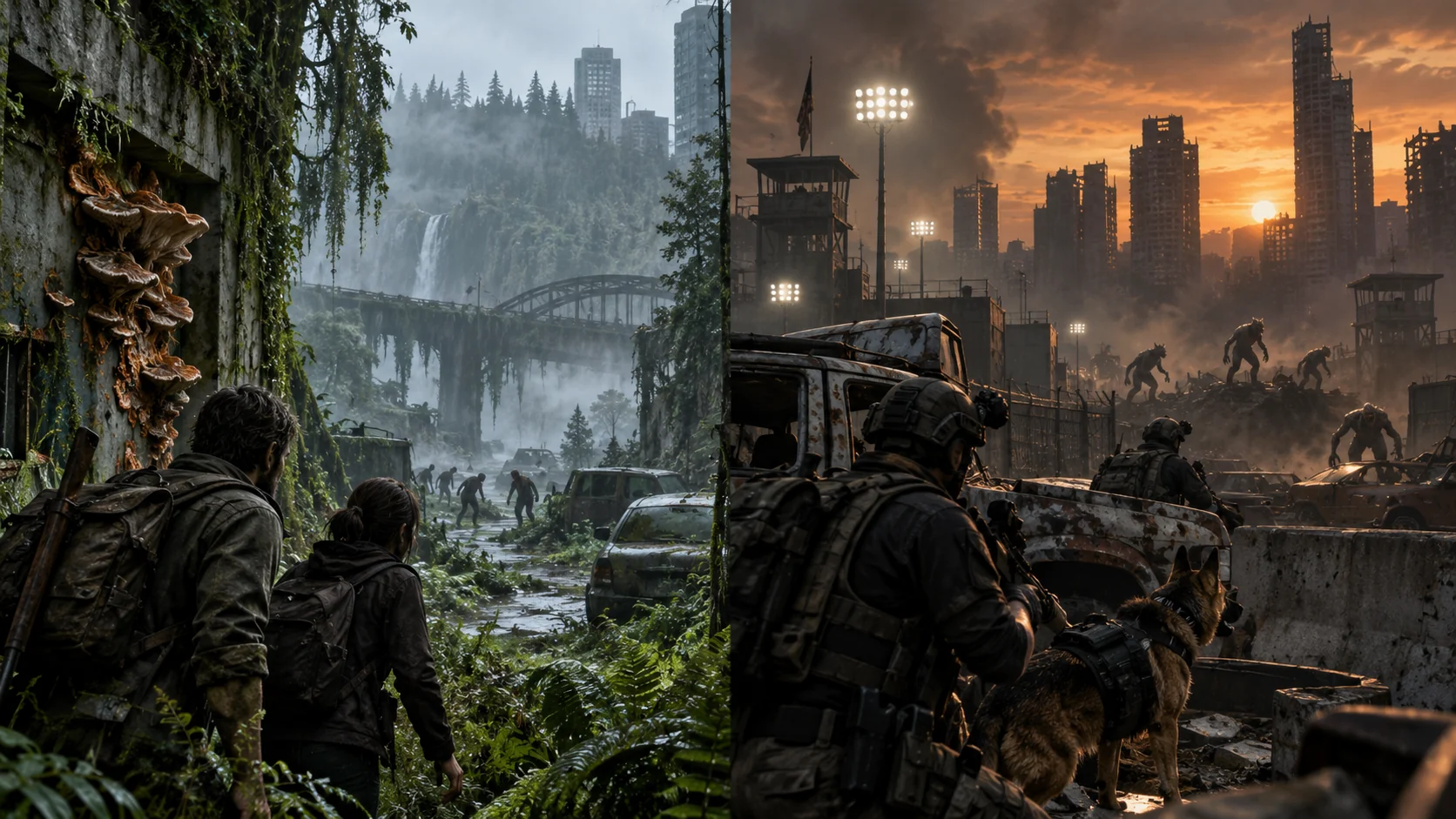
Both worlds punish slow threat recognition, but Extinction Cycle eventually adds organized, armed infected forces.
Two of the most frightening modern apocalypse worlds begin with the same basic nightmare: humanity loses control of biology.
In The Last of Us, a fungal infection transforms people over time into increasingly inhuman forms. In Nicholas Sansbury Smith's Extinction Cycle, a military bioweapon and the Hemorrhage Virus create Variants that are fast, predatory and capable of evolving into increasingly specialized threats.
The similarities are obvious enough that fans naturally ask the crossover question: which world would actually be harder to survive?
The answer depends on when you arrive, where you are, and what kind of survivor you are.
If the question is about the first chaotic days of collapse, Extinction Cycle may be worse because its Variants can attack with shocking speed before society understands what is happening. If the question is about surviving decades after the initial outbreak, The Last of Us becomes brutally difficult because infection is embedded in the environment itself and dangerous infected forms persist for years. If the question is which enemy becomes the greater military threat, Extinction Cycle eventually wins because its later Variants and Dark Age engineered forms can organize, use weapons and wage strategic war.
This comparison uses the game continuity of The Last of Us as the clearest baseline for infection mechanics. The television adaptation changes some transmission details, so those differences should not be treated as identical rules.
Quick verdict
| Category | The Last of Us | Extinction Cycle | Advantage |
|---|---|---|---|
| Initial outbreak speed | Fast societal collapse | Extremely fast global military-biological crisis | Extinction Cycle |
| Baseline infected speed | Runners are fast | Standard Variants are extremely fast and agile | Extinction Cycle |
| Environmental infection | Spores and contaminated spaces matter in game continuity | Primarily infected hosts and biological exposure | The Last of Us |
| Climbing and mobility | Varies by infected stage | Variants routinely exploit walls, roofs and tunnels | Extinction Cycle |
| Heavy infected durability | Bloaters and other advanced forms are heavily protected | Juveniles and engineered forms become highly armored | Tie |
| Intelligence | Mostly limited, though stalking behavior can be sophisticated | Alphas, named Variants, Scions and New Gods can plan and command | Extinction Cycle |
| Long-term persistence | Excellent, with fungal growth and dormant infected | Strong, but food scarcity can weaken old Variants | The Last of Us |
| Military organization | Infected do not build armies in a human strategic sense | Dark Age enemies can use weapons, collaborators and logistics | Extinction Cycle |
| Rural survival potential | Better than dense urban zones but never safe | Potentially better if isolated from Variant populations | Slight edge to Extinction Cycle survivors |
| Worst-case enemy | Massive armored infected and infected ecosystems | New Gods, Scions, Chimeras and organized Variant forces | Extinction Cycle |
Overall verdict: An ordinary civilian would probably have a better chance of building a long-term isolated life in the Extinction Cycle world after the first war than in The Last of Us, but the actual combat threat posed by Extinction Cycle's advanced Variants is more dangerous. If you are caught during the initial collapse, Extinction Cycle is the worse place to be.
The infections begin differently
The first major difference is origin.
The Extinction Cycle catastrophe is rooted in military science. VX-99 originates in a government program connected to the search for a biological weapon and super-soldier capability. The disaster is therefore tied to secrecy, command decisions and laboratories from the beginning. Building 8 is not simply where a random disease happens to appear. It is part of a system designed to manipulate biology for strategic purposes.
That matters because the outbreak is surrounded by classified information. Reed Beckham and Team Ghost enter the crisis without being told the full truth. Scientists like Kate Lovato have to solve a problem while pieces of its history remain concealed. Military leaders make decisions with incomplete or deliberately restricted intelligence.
In The Last of Us, the central horror is fungal adaptation. PlayStation's official franchise material describes the infected as humans afflicted by Cordyceps infection who develop through stages. Earlier forms remain more humanoid. Later stages become increasingly transformed. In the game continuity, bites, scratches and airborne spores can transmit infection.
This creates a very different emotional texture.
Extinction Cycle says: humans deliberately opened a biological door they could not close.
The Last of Us says: nature adapted, and the human species discovered it was not as secure in its ecological niche as it believed.
For survival, however, origin matters less than transmission and speed.
Which infection spreads faster?
During the opening phase, the Hemorrhage Virus has the more terrifying operational tempo.
Extinction Cycle depicts cities and military positions collapsing rapidly. Air travel and dense population centers accelerate the disaster. People who believe they are dealing with a conventional outbreak are suddenly facing transformed humans capable of rapid violence.
The crucial problem is that Variants are not merely sick people. They become mobile predators.
That means every infected person can create immediate physical chaos. Police, hospitals, airports, roads and military response points become attack zones before command systems have time to adapt.
The Last of Us also produces devastating global collapse, but the infection's later survival challenge is more environmental. Once fungal contamination takes hold, abandoned buildings and underground spaces can remain dangerous independent of any visible active horde.
So the two franchises dominate different phases.
Extinction Cycle is worse during explosive collapse. The Last of Us is worse when trying to reclaim contaminated space years later.
Runner versus standard Variant
A Runner is one of the closest Last of Us comparisons to an early Extinction Cycle Variant because both are fast, aggressive and still recognizably derived from the human body.
But the standard Variant has the tactical edge.
Variants do not merely sprint. They climb, leap, move across structures and exploit vertical terrain in ways that repeatedly surprise trained soldiers. New York becomes especially dangerous because buildings, rooftops, sewers and tunnels all become connected hunting terrain.
A survivor can no longer think of a locked door as a boundary.
That is a major problem for anyone trained on conventional zombie logic.
Runners are dangerous because they close distance quickly and attack aggressively. Variants add another layer: they can turn architecture itself into a hunting surface.
In a straight encounter with no weapons, neither is something a rational survivor should fight. But if forced to choose which one to evade in a city, the Runner is the better option.
Clicker versus Alpha Variant
This is where the comparison becomes more interesting.
Clickers are terrifying because the fungus has transformed the head and sensory system. Their vision is lost, but they can detect targets through echolocation. The result is an enemy that can be difficult to approach quietly and extraordinarily dangerous at close range.
Extinction Cycle Alphas also benefit from enhanced sensory systems, and the series shows that echolocation-like capabilities can shape how they hunt and coordinate.
The difference is command intelligence.
A Clicker is a highly dangerous biological predator.
An Alpha can become the organizing center of other Variants.
That changes how a survivor has to think. Killing a Clicker removes one major threat. Killing an Alpha may disrupt an entire pack. Leaving an Alpha alive may allow other creatures to hunt more effectively.
This is one of the recurring advantages the Extinction Cycle enemy gains over The Last of Us infected: hierarchy.
Bloater versus juvenile Variant
This is the heavyweight fight fans would want to see and sane survivors would run away from.
PlayStation describes the Bloater as a later infection stage with massive size, increased strength and fungal armor. Its hearing remains important while other senses have deteriorated. The fungus covering the body functions as protection, and the creature can use biological material offensively.
Extinction Cycle juveniles are likewise frightening because their bodies become heavily armored and exceptionally difficult to kill. Military units have to rethink weapons and tactics because ordinary assumptions about small arms become unreliable.
The similarities are strong:
- both represent late biological development rather than freshly infected humans
- both are larger and more resistant to damage
- both punish survivors who depend on a single firearm
- both require either heavy firepower, environmental advantage or avoidance
A Bloater may have the advantage in biological armor density. A juvenile Variant may have the advantage in mobility and the broader Variant ecosystem's ability to coordinate around it.
For a lone survivor, the practical answer is a tie because either encounter can be fatal before the comparison matters.
The Last of Us has the more dangerous environment
This is the category where Cordyceps clearly wins.
In the game continuity, the environment itself can become infectious. Spores make enclosed areas dangerous even when no infected creature is directly attacking. Gas masks and filtration become survival equipment, and a damaged mask can turn exploration into a death sentence.
That changes the psychology of scavenging.
In Extinction Cycle, a silent building might genuinely be empty.
In The Last of Us, a silent building can still be biologically hostile.
That is a profound long-term disadvantage for survivors trying to reclaim cities. Every basement, subway, hospital and sealed room can contain infection risk that is not obvious from outside.
It also makes industrial recovery harder. Rebuilding civilization requires entering old infrastructure. Power plants, warehouses, tunnels, laboratories and transit systems cannot simply be cleared of enemies. They may need environmental decontamination.
The Extinction Cycle world is more militarily dangerous. The Last of Us world is more ecologically contaminated.
Extinction Cycle has the smarter enemy
This is the decisive category.
The infected in The Last of Us can display stalking behavior and different hunting patterns depending on stage, but they do not create a strategic society designed to defeat uninfected humans.
Extinction Cycle moves steadily in that direction.
Standard Variants learn. Packs test defenses. Alphas command. Named creatures retain fragments of memory and purpose. Dark Age then introduces intentionally engineered soldiers such as Scions and Chimeras that can communicate, use firearms and follow organized command.
Azrael takes this to its logical conclusion.
He is not simply a powerful infected creature. He understands science, military logistics, government, prisoners, propaganda and technology. His forces can include human collaborators, trainable Thralls and engineered soldiers.
At that point the threat is no longer "infected people."
It is a rival civilization.
No equivalent infected political structure exists in The Last of Us.
Human factions are often the most sophisticated threat there. In Extinction Cycle, the boundary between human faction and infected faction eventually collapses.
Which world gives the military a better chance?
At first glance, Extinction Cycle should favor the military because its major protagonists include elite operators, carrier groups, Marines and organized government remnants.
The problem is that Variants are uniquely well suited to break conventional assumptions.
Military bases depend on perimeters. Variants climb.
Infantry depends on fields of fire. Variants move fast and attack from multiple elevations.
Command depends on intelligence. The government initially withholds critical information from its own operators.
Heavy weapons can destroy monsters, but ammunition and logistics are finite.
The Last of Us world also crushes conventional military structures, but quarantine zones and authoritarian remnants demonstrate that organized forces can maintain territory for long periods.
The better comparison is not which military is stronger. It is which infection makes conventional military doctrine obsolete faster.
That answer is Extinction Cycle.
Team Ghost survives because it continuously modifies tactics rather than assuming the enemy will behave like a human force.
Which world is better for a rural survivor?
This category is surprisingly close.
A remote farm or mountain settlement offers advantages in both settings: fewer people, fewer initial infected, better control of approaches and access to local food production.
Extinction Cycle may offer the better long-term rural opportunity because Variants have a severe metabolic problem. They need food. As human populations disappear, some old Variants weaken and starve.
That gives geography real value. A sufficiently isolated community may avoid major concentrations of infected and eventually face a declining local population.
Cordyceps is less forgiving. Fungal infection can persist in structures, and infected may remain dormant for long periods. The environment can preserve danger without a constant human food supply.
A remote island is therefore arguably more valuable in The Last of Us because physical separation limits infection routes. A remote inland farm may be more reliably safe in later-stage Extinction Cycle territory if surrounding Variant populations have collapsed.
Would Joel survive in Extinction Cycle?
Joel's core skills transfer well.
He understands scarcity, stealth, ambushes, improvised weapons, reading hostile people and moving through ruined urban spaces. He is extremely good at deciding when a confrontation is unwinnable.
Those are valuable traits.
The problem is speed.
Extinction Cycle punishes the kind of close-range improvisation that works against many human enemies in The Last of Us. A Variant can close the gap extraordinarily fast. Climbing ability also reduces the safety of elevated or improvised positions.
Joel would adapt, but he would need to become more ammunition-conscious in a different way: not merely conserving bullets, but maintaining enough stopping power to prevent a Variant from reaching grappling distance.
His biggest advantage would be caution. He rarely assumes a building is safe simply because it looks quiet.
His biggest disadvantage would be unfamiliarity with coordinated packs and Alphas.
He probably survives longer than most civilians, but the learning curve would be brutal.
Would Reed Beckham survive in The Last of Us?
Reed has an excellent chance, particularly if inserted with Team Ghost rather than alone.
His advantages are tactical discipline, reconnaissance habits, weapons proficiency and willingness to treat unfamiliar biology as an intelligence problem. Team Ghost is comfortable operating inside tunnels, contaminated areas and ruined cities.
The biggest adaptation would be environmental infection.
In the Extinction Cycle, the primary danger usually has a body. In the game version of The Last of Us, spores can make the air itself a threat.
That means Reed's CBRN experience becomes extremely valuable. A disciplined military team with intact respirators, replacement filters and contamination procedures could outperform many ordinary survivors.
Where Reed would struggle is logistics. Elite training does not create ammunition, filters or antibiotics. The Last of Us is a world where twenty years of collapse has reduced military technology to whatever can still be maintained.
Reed could survive. Keeping Team Ghost supplied would be the real war.
Which safe zone is easier to defend?
A well-designed Extinction Cycle outpost requires:
- tall reinforced walls
- overlapping fields of fire
- rooftop and tunnel security
- sensors for subterranean approaches
- rapid-reaction teams
- enough heavy weapons for armored forms
- biological screening
A Last of Us settlement requires many of the same physical defenses plus environmental controls:
- contamination detection
- mask and filter supplies
- quarantine procedures
- fungus inspection inside structures
- strict management of newly reclaimed buildings
The Last of Us settlement therefore has the harder sanitation burden.
The Extinction Cycle settlement has the harder assault-defense burden.
If the enemy attacks, the Extinction Cycle outpost is in more danger. If no enemy attacks, the Last of Us settlement still has to worry about the infection embedded in the environment.
The human threat changes the result
Both franchises understand that monsters do not eliminate human politics.
In The Last of Us, military authorities, rebels, hunters, militias, cults and other survivor factions often become more dangerous than the infected. Scarcity makes violence rational enough that every encounter with strangers carries risk.
Extinction Cycle includes the same dynamic through corrupt or secretive government figures, the Resistance of Tyranny, collaborators and later the New God movement.
The difference is that Extinction Cycle eventually merges human intelligence with Variant biology.
That is why Azrael is such a dangerous crossover problem. He occupies the space normally reserved for a human faction leader while possessing enhanced physiology and engineered soldiers.
A settlement prepared for monsters may underestimate his politics. A settlement prepared for raiders may underestimate his biology.
Could Cordyceps infect a Variant?
There is no canonical answer because the franchises operate under unrelated fictional rules.
Biologically, the safest crossover assumption would be that neither infection automatically works on the other host. Extinction Cycle Variants have radically altered physiology. Cordyceps in The Last of Us is adapted to its fictional human hosts. Cross-infection would require compatibility that neither series establishes.
The more interesting scenario is ecological competition.
Variants need protein and aggressively hunt living prey. Cordyceps infected remain potential physical targets. A region containing both populations could produce violent competition even if neither pathogen could colonize the other's host.
That would be terrible for everyone nearby.
The hardest scenario: entering a city alone
Imagine the same survivor has to cross ten miles of abandoned city in each universe.
In The Last of Us, the key questions are:
- Which buildings contain spores?
- Where are infected dormant?
- Can you move quietly enough to avoid Clickers?
- Do you have a functioning mask?
- Are human factions watching the route?
In Extinction Cycle, the questions are:
- Are Variants tracking your scent?
- Are they on the roofs or inside the tunnels?
- Is an Alpha coordinating the pack?
- How much ammunition do you have?
- Is the creature you see deliberately drawing your attention from another approach?
The first environment is a haunted biological minefield.
The second is a predator's hunting ground.
For one trip, I would rather cross the Last of Us city with a functioning mask than cross an active Extinction Cycle city during peak Variant occupation.
The hardest scenario: surviving ten years
Now reverse the verdict.
Over ten years, Extinction Cycle survivors can potentially benefit from the Variants' biological limits, military countermeasures and organized reconstruction. Dark Age shows a real national system returning, with agriculture, manufacturing, electricity, defended outposts and a military.
The Last of Us remains far more fragmented decades after outbreak.
That does not mean no functioning communities exist. It means the pathogen has become part of the world's ecology in a way the Extinction Cycle infection has not.
For long-term civilization, Extinction Cycle offers the clearer road back.
It is simply a much more dangerous road to survive long enough to reach.
Frequently asked questions
Are Extinction Cycle Variants faster than The Last of Us infected?
Standard Variants are generally depicted as exceptionally fast, agile and capable of climbing and leaping through complex terrain. Runners are fast, but Extinction Cycle gives its baseline infected a broader mobility advantage.
Is a Clicker more dangerous than a Variant?
At close range, a Clicker is extremely lethal, but a standard Variant has better mobility. An Alpha Variant is a greater overall tactical threat because it can coordinate other infected.
Would a Bloater beat a juvenile Variant?
There is no canonical crossover answer. Both are heavily armored, high-strength late-stage threats. A Bloater may have stronger fungal armor, while a juvenile Variant may have superior mobility.
Which infection is easier to contain?
After the initial catastrophe, the Extinction Cycle infection may be more containable because surviving Variants have biological resource needs and human countermeasures can reduce populations. Cordyceps is harder to remove from contaminated environments.
Which apocalypse is worse for civilians?
During the initial collapse, Extinction Cycle is probably worse because Variants move and kill so quickly. Over decades, The Last of Us may be harder because the environment remains persistently contaminated and society stays fragmented.
Which franchise has smarter infected?
Extinction Cycle by a wide margin. Alphas display command behavior, and Dark Age introduces engineered Scions and Chimeras capable of organized combat and weapons use.
Final verdict: which world would you choose?
If forced to choose one apocalypse and given no special equipment, I would choose the Extinction Cycle world after the Great War, not during the outbreak.
That timing qualifier is everything.
During the first weeks, Extinction Cycle is a nightmare of speed, secrecy and military collapse. Standard shelters fail because Variants climb. Cities become vertical hunting grounds. The enemy evolves while humans are still learning the rules.
But the saga eventually gives humanity something The Last of Us rarely offers at the same scale: reconstruction.
The Allied States exists. Outposts trade and cooperate. Agriculture and manufacturing return. The military can field organized units. Children can grow up inside communities that are more than temporary camps.
The Last of Us infected may be less strategically intelligent, but the fungal world is harder to clean. The danger can live in the walls and air long after the battle ends.
So the winner depends on what "harder to survive" means.
Harder first month: Extinction Cycle.
Harder infected enemy in a firefight: Extinction Cycle.
Harder environment to reclaim: The Last of Us.
Harder twenty-year civilization problem: The Last of Us.
Most dangerous final evolution: Extinction Cycle.
And if Azrael's New Gods are active, the choice becomes easy.
Give me the Clickers.
Sources and editorial notes
Extinction Cycle details are drawn from the original Nicholas Sansbury Smith novels, the Dark Age continuation and relevant republished side stories. The Last of Us infection stages are based primarily on PlayStation's official franchise reference material, which describes Runners, Stalkers, Clickers, Bloaters and game-continuity transmission through bites, scratches and spores.
External reference: https://www.playstation.com/en-us/the-last-of-us/
Recommended next pages
- lore variant evolution new gods
- building 8 to vx 99 cause and effect
- series reading order
- Every Extinction Cycle Variant Ranked From Least to Most Dangerous
- Could the Extinction Cycle Actually Happen? The Real Science Behind VX-99, Epigenetics and the Hemorrhage Virus
- Browse all Extinction Cycle editorials
Sources and editorial scope
- Canon treatment
- Independent fan analysis grounded in the supplied Extinction Cycle source audit and clearly separated from compared franchises or real-world science.
- Spoiler scope
- Spoilers for The Last of Us games and Extinction Cycle through Dark Age