
Fact Versus Fiction
28 Years Later vs. Extinction Cycle: Rage Virus vs. Hemorrhage Virus
Rage Virus versus Hemorrhage Virus: compare 28 Years Later's infected with Extinction Cycle Variants, Alphas, survival tactics, evolution and military response.
·
Category: Fact Versus Fiction
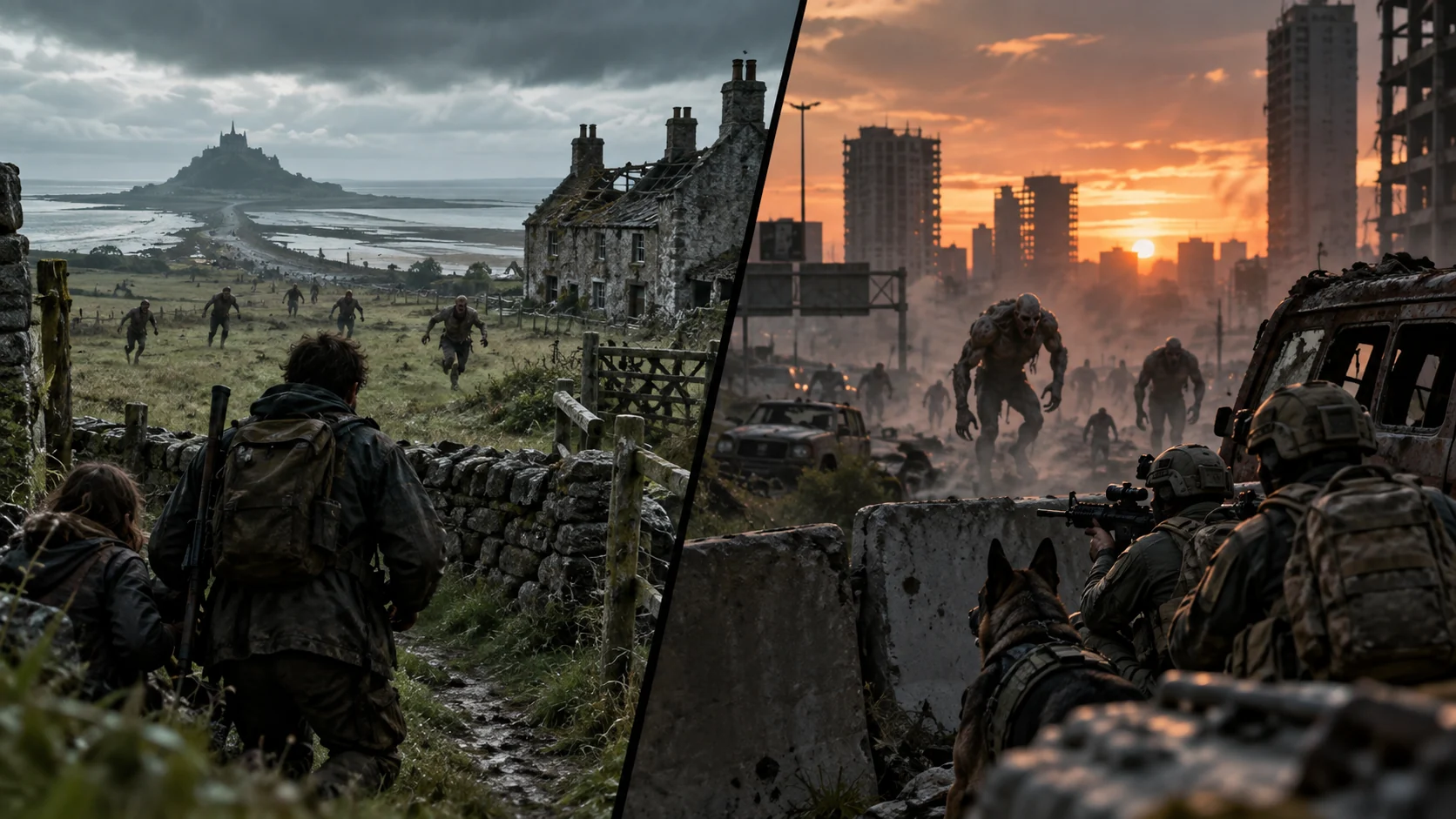
The Rage Virus and Hemorrhage Virus create similar fast-infected terror but diverge sharply in long-term evolution.
Few modern apocalypse stories changed the zombie conversation as dramatically as 28 Days Later. Its infected did not shuffle. They sprinted. They attacked with overwhelming rage. Civilization did not slowly lose a war of attrition. It fell apart before most people understood what was happening.
Nicholas Sansbury Smith's Extinction Cycle takes that same basic terror and escalates it in a different direction. Its Variants are fast from the beginning, but speed is only the first problem. They climb, hunt, organize, evolve and eventually become part of an engineered military system under the New Gods.
With 28 Years Later and 28 Years Later: The Bone Temple expanding the Rage Virus world into a decades-long post-collapse society, the comparison has become more interesting than ever.
Both franchises ask what happens after humanity survives the initial catastrophe. Both show that the infected are only one part of the danger. Both turn isolated communities into laboratories for new cultures. But they disagree about the long-term trajectory of infection.
The Rage Virus world becomes a story about what people become when civilization is gone for generations.
The Extinction Cycle becomes a story about what the infected themselves can become.
So which virus is worse? Which infected are harder to fight? Which world gives humanity the better long-term chance?
Quick verdict
| Category | 28 franchise | Extinction Cycle | More dangerous |
|---|---|---|---|
| Initial attack speed | Extremely fast | Extremely fast | Tie |
| Baseline infected aggression | Maximum rage | Maximum predatory aggression | Tie |
| Climbing and mobility | Fast human-level movement | Extreme climbing, leaping and vertical movement | Extinction Cycle |
| Intelligence | Limited in early infected, later world adds more complexity | Pack learning, Alphas, Scions and strategic commanders | Extinction Cycle |
| Transmission terror | Rapid bodily-fluid exposure | Highly contagious outbreak plus transformed predators | Close |
| Starvation vulnerability | Central to early Rage Virus logic | Variants also face extreme metabolic demands | Tie |
| Long-term mutation | 28 Years Later expands infected mutation and hierarchy | Core feature throughout the franchise | Extinction Cycle |
| Human social danger | Enormous | Enormous | Tie |
| Organized infected warfare | Limited | Major Dark Age threat | Extinction Cycle |
| Long-term state rebuilding | Britain remains deeply transformed and quarantined | Allied States rebuilds national institutions | Extinction Cycle gives survivors better odds |
Overall: The Rage Virus may be the cleaner nightmare because it strips away human restraint almost instantly. The Hemorrhage Virus is the more strategically dangerous threat because Extinction Cycle Variants do not remain one type of enemy.
The shared DNA of fast-infected horror
Neither franchise is primarily interested in the classic Romero problem of slow corpses accumulating into an unstoppable mass.
The horror is acceleration.
A normal person becomes a threat fast enough that social trust collapses. Roads become dangerous. Hospitals become traps. Police and soldiers are forced to make life-or-death decisions before they have reliable information.
That changes the opening hours of the apocalypse.
In a slow-zombie world, governments may have time to establish perimeters. In a fast-infected world, the perimeter can fail while the briefing is still being written.
This is where 28 Days Later and Extinction Horizon feel like cousins. Both make the audience understand that the old rulebook is useless.
The difference appears after that first shock.
Rage Virus: the horror of immediate behavioral collapse
Sony's official description of 28 Days Later emphasizes the central mechanism: infected hosts are driven into furious, murderous rage. The film's opening disaster begins with infected chimpanzees released from a laboratory, and the resulting epidemic nearly wipes out the population.
The important feature is not superhuman anatomy.
It is the destruction of inhibition.
The infected remain recognizably human in body but become terrifyingly efficient at violence because hesitation, empathy and social restraint disappear. Their speed is close enough to ordinary human sprinting to feel physically believable, which makes them more unsettling.
You do not need to imagine a creature growing claws.
You only need to imagine the person next to you becoming homicidal in seconds.
That simplicity is one of the Rage Virus franchise's greatest strengths.
Hemorrhage Virus: the horror of biological escalation
Extinction Cycle starts with a similar loss of humanity but quickly adds physical transformation.
Variants develop altered skin, sensory systems, climbing ability, tremendous speed and predatory behavior. As the series continues, the infected population develops pack behavior, Alphas, armored juveniles and specialized forms.
By Dark Age, human scientists have deliberately taken the same biological knowledge and created Scions and Chimeras capable of using weapons and functioning inside an organized military hierarchy.
This is the major difference.
Rage removes civilization from a human mind.
VX-99 and the Hemorrhage Virus eventually create a rival form of civilization.
Which infection is faster?
The Rage Virus is famous for extremely rapid conversion. That is part of what makes a single exposure terrifying. A bite or contaminated blood event can become an immediate emergency rather than a future medical concern.
Extinction Cycle also depicts rapid transformation, but its outbreak feels broader because infection combines with global transportation and military confusion.
In practical survival terms, both are catastrophic.
The difference is decision time.
A Rage exposure is so obviously dangerous that survivors learn to react almost instantly. The moral horror is that they may have to kill someone before there is time to process what happened.
The Hemorrhage Virus produces the same urgency but inside a more complicated scientific mystery. Early responders do not initially understand the Variants' capabilities, the origin of the pathogen or the government's classified history.
So Rage is faster at the interpersonal level.
Extinction Cycle is more confusing at the strategic level.
Which infected is harder to fight one-on-one?
A freshly infected Rage victim is horrifying but still built like a human being.
That matters.
A firearm, blunt trauma or physical barrier interacts with a Rage infected body using mostly familiar anatomy. The person may ignore fear and pain, but the skeleton, muscles and organs are still human.
A standard Extinction Cycle Variant is already more biologically extreme. It can climb aggressively, leap, move through urban structures and attack with altered anatomy.
In an open hallway with equal warning, I would rather face a Rage infected attacker.
That is not because it is safe. It is because the Variant has more movement options and less respect for architectural boundaries.
The city test
Imagine being trapped on the fifth floor of an apartment building.
Against Rage infected, locking stairwells, blocking doors and controlling the hallway can buy time. They are fast, but they still have to physically reach you through normal human paths unless they find another access point.
Against Variants, windows, walls, fire escapes, roofs and exterior surfaces are all potential routes.
That makes the Extinction Cycle city dramatically more dangerous.
Humans naturally think in two dimensions: doors and roads.
Variants hunt in three.
Starvation is the great equalizer
Both franchises understand that hyper-aggressive infected need energy.
This is one of the more grounded aspects of fast-infected fiction.
The original 28 mythology makes starvation part of the infected population's long-term decline. Extinction Cycle likewise shows Variants weakened by lack of protein. In Warrior's Fate, starving Variants can appear degraded and sluggish while still becoming explosive predators when food appears.
The shared principle is important:
A monster can violate human behavior without violating thermodynamics.
If it runs, fights and heals, it needs fuel.
This gives survivors a long-term strategy that classic undead stories often remove: wait.
But neither franchise lets that strategy remain simple forever.
28 Years Later changes the starvation assumption
The official Sony synopsis for 28 Years Later establishes that almost three decades have passed since the Rage Virus escaped a biological weapons laboratory. Britain remains under ruthless quarantine, yet infected still exist. Survivors have built isolated communities, including a settlement on an island connected to the mainland by a heavily defended causeway.
That alone changes the old question of whether the infected should simply starve out.
Something has allowed the ecosystem of infection to persist.
The 2025 film also emphasizes mutation, not only among infected but among survivors. The world has had time to create new social structures, myths and forms of adaptation.
The follow-up, 28 Years Later: The Bone Temple, continues immediately after the 2025 film and makes the human danger even more explicit. Sony describes a world where the infected are no longer the only threat and the inhumanity of survivors may be stranger and more terrifying.
That thematic move brings the franchise closer to Dark Age than it first appears.
The Bone Temple versus Dark Age
Both sequels ask the same post-apocalyptic question:
What happens when the generation that remembers the old world is no longer the only generation shaping the new one?
In Dark Age, the Allied States has rebuilt power, agriculture, manufacturing and defended outposts. A government exists. Elections exist. Military institutions exist.
But Azrael and the New Gods have built a competing ideology.
In The Bone Temple, human factions and belief systems become central. The Jimmies operate under Jimmy Crystal's violent ideology, while Dr. Kelson's relationship with the infected pushes scientific and moral questions into the foreground.
The key contrast is institutional direction.
Extinction Cycle asks whether civilization can be rebuilt.
28 Years Later asks what strange civilizations emerge when the old one never returns.
Alpha Variant versus Alpha infected
The word "alpha" exists in both kinds of fan discussion, but the meaning is not identical.
Extinction Cycle Alphas are important because they command. They organize packs, show greater intelligence and can shape Variant behavior.
The 28 Years Later era introduces more developed infected hierarchy and mutation, including exceptionally powerful infected forms. But the franchise still does not move as far into military command as Extinction Cycle.
An Extinction Cycle Alpha is dangerous not simply because it is bigger.
It can become a tactical node.
Kill the node, and the pack may lose coordination. Leave it alive, and the entire horde becomes more effective.
That makes the Alpha a military target rather than just a monster.
Which universe has the worse human beings?
This may be the closest category.
The 28 franchise has always understood that infected rage is only one kind of violence. The military refuge in 28 Days Later becomes terrifying because the surviving soldiers' plans for the women reveal how quickly protection can become coercion.
28 Weeks Later expands the danger of military containment and panic.
28 Years Later and The Bone Temple explore the cultures that develop after decades of isolation and trauma.
Extinction Cycle has its own human horrors: officials hiding the truth, commanders sacrificing troops, the Resistance of Tyranny, collaborators working with Variant forces and Azrael's followers.
The shared message is brutal:
The infection does not invent human cruelty.
It removes the institutions that normally limit it.
Which military survives longer?
The Extinction Cycle gives organized armed forces more narrative space and more technical capability.
Carrier groups, Delta Force units, Marines, scientists and government remnants continue to function even after enormous losses. That provides humanity with a platform for counterattack.
The 28 world is more fragmented, particularly inside quarantined Britain.
This is why the long-term outcome diverges.
Extinction Cycle survivors eventually rebuild a successor state.
The 28 world produces enclaves.
If I were a civilian choosing which surviving military system to depend on ten years after outbreak, I would choose the Allied States.
If I were a civilian standing in the first chaotic containment zone, I would distrust everyone equally.
Would an island solve both apocalypses?
Islands are valuable in both franchises because water creates a controllable barrier.
The island settlement in 28 Years Later uses a single heavily defended causeway, which turns geography into security. Every land approach can be monitored.
Extinction Cycle repeatedly uses islands and naval assets for similar reasons. Plum Island, carrier groups and other offshore positions gain enormous value because Variants cannot simply flood across a highway.
But islands create their own risks:
- limited food production
- dependence on boats
- medical isolation
- restricted evacuation routes
- vulnerability if infection gets inside
A perfect island is not one with the tallest walls. It is one with sustainable food, fresh water, redundant power, boats and enough space to quarantine newcomers.
Which infected can be reasoned with?
Early Rage infected cannot meaningfully negotiate.
Standard Variants cannot either.
The difference appears at the high end of Extinction Cycle evolution.
The Bone Collector shows memory and purpose. Dark Age Scions communicate. Azrael is fully strategic and ideological.
That seems like an advantage because communication creates possibilities.
In practice, it can be worse.
A creature that cannot reason cannot manipulate you.
Azrael can.
The return of language does not restore humanity. It restores politics.
Which threat is more frightening at night?
Rage infected are terrifying at night because visibility favors sudden speed.
Variants are worse.
Many Extinction Cycle forms possess enhanced low-light capability and other sensory adaptations. Darkness does not merely hide them from humans. It can become their preferred environment.
That reverses the natural assumption that both sides are equally impaired by low visibility.
A human without night vision is losing information.
The Variant may not be.
A survivor skill transfer test
Skills that work in both worlds
- staying quiet
- maintaining multiple escape routes
- avoiding dense population centers
- checking rooftops and windows
- controlling exposure to blood
- carrying first-aid supplies
- knowing when not to fight
- building small trusted groups
- securing food and water before weapons become the only concern
Skills more important in the 28 world
- instant response to exposure
- quarantine discipline
- emotional willingness to separate from newly infected people
- maintaining distance from blood spray
- choosing geographically isolated communities
Skills more important in Extinction Cycle
- vertical security
- night-vision capability
- ammunition depth
- heavy weapons for advanced forms
- anti-tunnel defenses
- understanding pack behavior
- intelligence gathering on Alpha leadership
Would Jim survive Extinction Cycle?
Jim's survival advantage is not military skill. It is adaptation.
He learns quickly, observes people, understands when rules have changed and becomes capable of extreme violence when necessary.
Those qualities transfer.
His problem would be the Variant's physical advantage. Running from Rage infected works because Jim is still operating inside the performance range of human bodies.
Running from a Variant is less reliable.
He would need firearms, a defensible group and better reconnaissance much earlier.
If he survived the first few encounters, he could adapt. The first encounter is the problem.
Would Reed Beckham survive the Rage Virus world?
Reed's odds are excellent if he understands transmission.
Team Ghost is trained to operate under uncertainty, move quietly and use disciplined fields of fire. Rage infected are physically more familiar than Variants, so many of Ghost's standard tactics become easier rather than harder.
The danger is exposure.
A soldier who treats an attacker like a Variant may engage too close and become contaminated by blood. The Rage Virus punishes physical contact more severely because transformation is so immediate.
Once Ghost understands that rule, it would likely perform extremely well.
Which infection wins in a crossover?
There is no scientific or canonical answer.
If both infected populations occupied the same city, the likely result would be violent ecological competition.
Rage infected would attack immediately. Variants would be physically better adapted for climbing, ambush and, at higher levels, coordination.
Standard Variants probably dominate individual fights.
Alphas make the result increasingly one-sided.
Dark Age Scions turn it into a massacre because they can use weapons and organized tactics.
The Rage Virus's best advantage is transmission. If Variant physiology remained susceptible to Rage infection, the outcome could change completely. Neither franchise gives us a basis to assume that.
Which apocalypse would be easier to rebuild after?
Extinction Cycle, based on what the stories actually show.
Eight years after Extinction War, survivors have formed the Allied States. Roughly one hundred outposts exist. Infrastructure, agriculture, manufacturing and the energy grid are returning.
Almost three decades into the Rage Virus timeline, Britain remains isolated and radically transformed.
That does not mean one pathogen is objectively more survivable. Geography, international containment and story focus differ.
But from the perspective of an individual choosing a future, the Allied States offers more institutional stability.
You can imagine your child becoming an engineer there.
In the 28 world, you first have to ask whether the causeway will still be open tomorrow.
Frequently asked questions
Is the Rage Virus the same type of infection as the Hemorrhage Virus?
No. They are unrelated fictional pathogens. Rage primarily causes extreme violent behavior, while Extinction Cycle's infection produces extensive physical transformation and later evolutionary forms.
Are Extinction Cycle Variants zombies?
The books deliberately distinguish Variants from traditional zombies. They are living transformed humans created through a fictional bioweapon and viral process, not reanimated corpses.
Are the 28 infected zombies?
The franchise is often grouped with zombie fiction, but its infected are living humans affected by the Rage Virus rather than undead corpses.
Which infected is faster?
Both are extremely fast. Extinction Cycle Variants have the broader mobility advantage because they frequently climb, leap and move across urban surfaces in ways that exceed ordinary human movement.
Which infection lasts longer?
The 28 franchise now establishes infected persistence across nearly three decades. Extinction Cycle Variants also persist for years, though many face starvation. Later engineered forms extend the threat beyond the original outbreak population.
Which series has smarter infected?
Extinction Cycle. Alphas organize packs, named Variants retain higher cognition, and Dark Age introduces engineered Scions and Chimeras capable of speech, weapons use and organized warfare.
Final verdict
The Rage Virus is the purer fast-infected nightmare.
It asks how quickly society collapses when a human body becomes a weapon and empathy disappears.
The Hemorrhage Virus is the broader evolutionary nightmare.
It asks what happens when the weapon does not stay the same.
If I had to survive the first 48 hours, I would rather face Variants only if I had military support. As an ordinary civilian, I would probably choose the Rage world because the enemy still moves within more familiar human anatomical limits.
If I had to survive the next twenty years, I would choose Extinction Cycle after the Great War because the Allied States proves large-scale reconstruction is possible.
If I had to fight the most advanced infected either franchise can produce, I would choose the Rage infected without hesitation.
A charging infected person is horrifying.
A genetically engineered predator with a rifle, a commander and a political ideology is worse.
That is the dividing line between the two franchises.
28 Years Later shows what remains after civilization is gone.
Extinction Cycle asks what might rise to replace us.
Sources and editorial notes
28 franchise background was checked against Sony Pictures' official pages for 28 Days Later, 28 Years Later and 28 Years Later: The Bone Temple. Extinction Cycle analysis is based on the original series, Dark Age continuation and relevant expanded-universe stories.
External references:
- https://www.sonypictures.com/movies/28dayslater
- https://www.sonypictures.com/movies/28yearslater
- https://www.sonypictures.com/movies/28yearslaterthebonetemple
- https://www.sonypictures.com/movies/28yearslaterthebonetemple/official-faqs
Recommended next pages
Sources and editorial scope
- Canon treatment
- Independent fan analysis grounded in the supplied Extinction Cycle source audit and clearly separated from compared franchises or real-world science.
- Spoiler scope
- Spoilers for the 28 franchise through The Bone Temple and Extinction Cycle through Dark Age