
Two doctrines for national collapse
The Division vs. Extinction Cycle: Which Response Could Save America?
Compare The Division and Extinction Cycle through sleeper agents, Team Ghost, urban operations, civilian protection, continuity, and national recovery.
·
Category: Analysis and Opinion
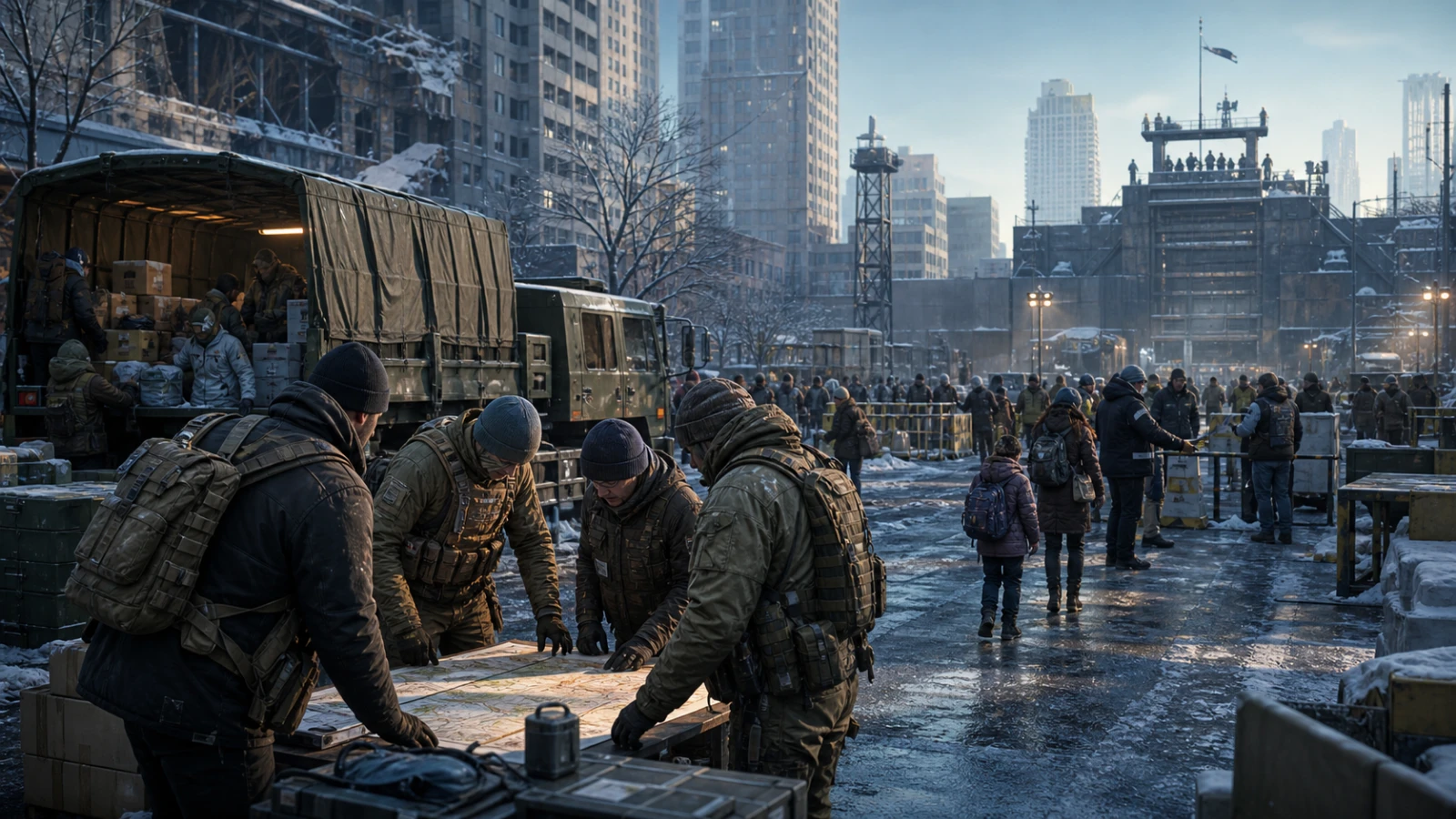
Thesis: Both worlds imagine a collapsing America under biological pressure, but one trusts sleeper tactical agents and fragmented federal recovery while the other relies on overt military struggle, outpost survival, and the brutal adaptation demanded by Variants.
Spoiler and Scope Note
This article is a speculative comparative analysis. It is not a claim of official crossover canon. The Extinction Cycle discussion is grounded in recurring canon themes, while the outside-franchise side is treated as a thematic comparison rather than a scene-by-scene recap.
Introduction: Two Tactical Fantasies of National Survival
The Division and Extinction Cycle are built from a similar anxiety: what happens when a biological catastrophe turns America into a map of broken infrastructure, frightened civilians, and contested authority? Yet they answer that question through different tactical fantasies. The Division imagines sleeper agents who can emerge from civilian cover and restore order once institutions buckle. Extinction Cycle imagines a world where the threat rapidly outgrows ordinary public-order assumptions, forcing survival into an overtly military, settlement-based, and reconstruction- conscious struggle.
That contrast makes this one of the most useful comparison topics in modern apocalypse fiction. Both properties are interested in collapse management, command continuity, urban operations, civilian protection, and the problem of rebuilding legitimacy after the state has failed. But they diverge over what kind of response can actually work. The Division trusts elite adaptability nested inside a government continuity design. Extinction Cycle trusts tactical leadership too, but it exposes how quickly even good operators run into the limits of force, secrecy, and logistics when the threat is biologically adaptive and civilization-scale.
This article asks which tactical response could save a collapsing America. The answer depends on what “save” means. Does it mean restoring order block by block in dense cities? Does it mean ensuring that some form of federal authority survives? Does it mean protecting civilians better than predators and opportunists can reach them? Or does it mean building durable settlements capable of carrying social life beyond the emergency phase? Both worlds can make credible claims, but they are trying to save slightly different versions of the country.
That is why this comparison is more than a power ranking. It is a test of doctrines: decentralized elite intervention versus grinding military survival, hidden continuity versus openly defended outposts, and state restoration versus civilization repair.
Collapse Conditions: Pandemic Breakdown vs. Variant War
The Division begins from a recognizable urban collapse logic. The pandemic scenario shatters trust, overwhelms institutions, and produces cascading failures in public safety, services, and governance. The tactical environment is shaped by looting, rogue factions, abandoned infrastructure, and the need to reassert control in fragmented urban space. Even when violence intensifies, the underlying premise remains that the country may still be stabilized if the right systems reactivate effectively enough.
Extinction Cycle begins from a harsher premise. The outbreak is not merely a public-health disaster that destabilizes order. It quickly becomes a species-level military emergency. Variants are not crowds to be contained but adaptive enemies that can shred the assumptions underlying routine emergency response. This changes the tone of collapse immediately. It is not just that America is falling apart. It is that many of the tools designed to keep a state intact are being stress-tested by a threat that does not behave like a normal insurgency, riot, or epidemic.
That difference matters for tactical doctrine. A Division-style response is well suited to reclaiming neighborhoods, securing distribution points, protecting critical infrastructure, and suppressing hostile factions in urban environments. Extinction Cycle’s response model is shaped by evacuation, fortified defense, mobile strike operations, scientific urgency, and the need to think beyond city limits toward survival corridors and long-range recovery nodes.
If collapse is measured by loss of social order, The Division offers a strong first answer. If collapse is measured by a biologically evolving predator war, Extinction Cycle offers the more realistic long-term adaptation. Saving America requires correctly identifying the nature of the thing that is actually ending it.
Command Continuity: Sleeper Agents vs. Team Ghost
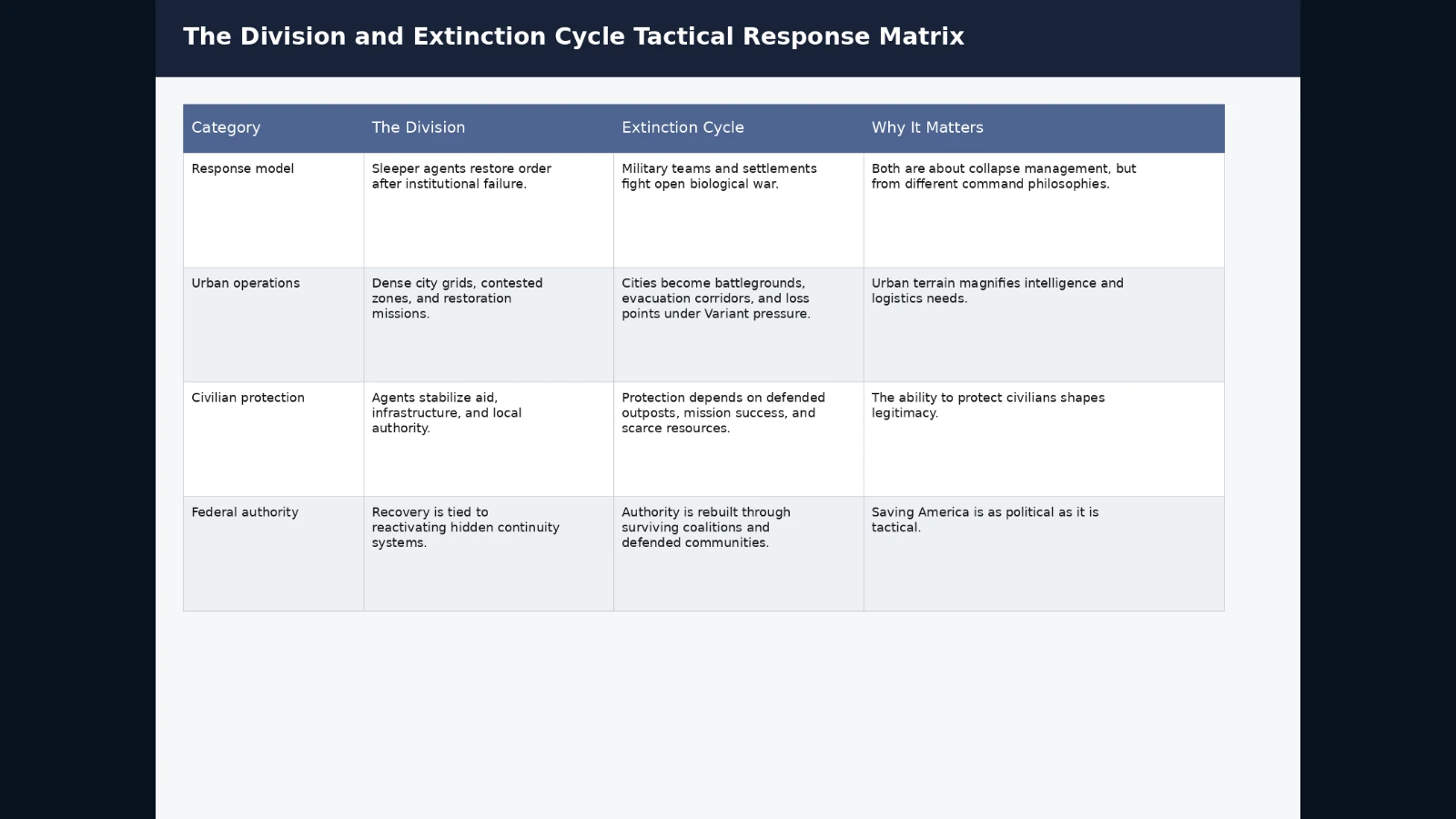
One of the most striking differences between the two worlds is how command continuity is imagined. The Division places extraordinary faith in a hidden reserve of trained operatives who can step forward when ordinary systems fail. This is elegant as a tactical concept because it allows continuity to survive invisibly until activated. The country appears broken, but a latent response architecture still exists. It is a fantasy of buried resilience.
Extinction Cycle relies less on hidden continuity and more on visible leadership under conditions of escalating chaos. Team Ghost is emblematic here. It is not a mystical reserve but a unit forced to adapt, improvise, and lead in real time. Its members are judged less by secret activation protocols than by whether their mission judgment, trust networks, and combat decisions can keep people alive. Continuity, in this world, is not quietly preserved. It is fought for mission by mission.
There are advantages to both models. The Division’s approach preserves flexibility and makes targeted intervention possible even after widespread breakdown. Extinction Cycle’s approach is more honest about the psychological and logistical burden carried by people trying to hold a collapsing world together without any guarantee that intact institutions still exist behind them. The tension is between elegant design and lived endurance.
If one asks which model better survives surprise, The Division has appeal. If one asks which model better survives prolonged adaptive war, Extinction Cycle looks stronger because it already assumes the hidden scaffolding may not save you. Leadership must become relational, tactical, and durable at once. It cannot wait to be activated by doctrine alone.
Urban Operations and the Problem of Terrain
The Division is, at heart, an urban operations setting. Dense blocks, narrow sight lines, vertical danger, bottlenecked aid routes, and contested districts define the tactical challenge. Agents succeed by reading the city as an operational puzzle. Infrastructure matters. So do supply nodes, communications systems, and civilian movement patterns. Urban order is not restored abstractly; it is rebuilt through control of terrain.
Extinction Cycle certainly uses urban environments, but it is not confined by them. Cities are significant as outbreak multipliers, battlegrounds, and symbols of civilizational loss, yet the series keeps expanding outward to bases, roads, islands, rural refuges, defended outposts, and reconstruction zones. Terrain therefore matters in a broader ecological sense. Urban operations are only one piece of a survival map that must remain dynamic as the threat evolves.
This gives each world a tactical edge in different dimensions. The Division is probably superior at imagining focused urban stabilization under fractured but still partly human opposition. Extinction Cycle is superior at imagining how cities fit into a wider survival ecosystem when the enemy is not simply another armed group but a biologically transformed force that turns static control into an illusion. An intersection can be secured, but can the route feeding it remain open? A district can be swept, but what happens when the wider environment collapses?
The best response to a collapsing America would need both mindsets. It would need The Division’s respect for urban complexity and Extinction Cycle’s insistence that the city is never the whole battlefield.
Civilian Protection and the Politics of Legitimacy
No tactical response can claim success if it fails to protect civilians, but protection means more than stopping immediate violence. It also means maintaining legitimacy. People obey, cooperate, and rebuild when they believe authority is working for their survival rather than merely using them as a backdrop for operations.
The Division foregrounds this elegantly. Its agents often act as connectors between security, aid, and local recovery. Civilian protection is not only about firefights. It includes stabilizing essential services, pushing back predatory factions, and creating the conditions under which a frightened population can begin trusting governance again. The tactical and political missions are tightly linked.
Extinction Cycle also cares about civilian protection, but the pressures are more severe. Outposts, settlements, and defended routes exist because the environment is so hostile that protection must be spatially concentrated. Team Ghost-style operations may save people indirectly by destroying threats, securing resources, or enabling escape, but the books never let readers forget that civilians pay for every failed mission. Legitimacy becomes fragile because survival choices are so constrained.
This produces an important distinction. The Division imagines a response that can still visibly serve the public inside a national frame. Extinction Cycle imagines a response that often has to choose which publics can be saved at all. That is morally brutal, but it also clarifies a hard truth: legitimacy in apocalyptic conditions is tied not to rhetoric but to demonstrated protection. Communities will accept hardship from leaders who keep them alive. They will not accept endless sacrifice without visible safety.
Rebuilding Federal Authority
A collapsing America is not saved merely because a few tactical victories are won. It is saved when some believable political architecture returns. The Division treats federal authority as battered but recoverable. Its continuity fantasy depends on the idea that lawful order, though weakened, can still be reactivated and re-legitimated through decisive intervention. Agents become the spear tip of national restoration.
Extinction Cycle takes a rougher road. The political world that survives is rebuilt through defended communities, alliances, and eventually broader reconstruction efforts. Authority emerges from endurance rather than simple continuity. In many ways this feels more historically plausible for a civilization-scale breakdown. People trust what they can see functioning: defended settlements, reliable leaders, resource distribution, and institutions rebuilt from surviving social cores. Large-scale legitimacy is assembled after the fact.
This does not mean one model is obviously better. The Division’s model has advantages in symbolic cohesion. It allows survivors to imagine that the republic never entirely disappeared. Extinction Cycle’s model has advantages in realism under extreme conditions. It does not assume that old authority can simply be switched back on. It must be earned again through performance and sacrifice.
The key question is what kind of collapse has occurred. If the federal center remains meaningfully recoverable, Division-style continuity could accelerate restoration. If the country has passed through a deeper biological and infrastructural devastation, Extinction Cycle’s bottom-up reconstruction is more credible. Saving America may therefore depend on knowing whether you are restoring a damaged state or rebuilding a broken civilization.
Which Tactical Response Adapts Better?
Adaptation is the decisive standard. A tactical response that looks elegant on paper but cannot adapt to a changing threat will fail, no matter how heroic its operators. The Division excels at flexible urban action, decentralized initiative, and the restoration of order under pressure. But its world generally assumes that the enemy remains within a recognizable spectrum of armed factions, lawless actors, and infrastructure breakdown. That is a huge challenge, but it is still a humanly legible challenge.
Extinction Cycle’s response model is forged under more radical pressure. Variants change the problem faster than doctrine would like. Scientific uncertainty collides with battlefield urgency. Safe spaces prove temporary. Reconstruction must begin before the war is truly emotionally over. This gives Extinction Cycle a harder adaptation burden and, arguably, a more robust long-term survival doctrine. It assumes nothing will stay simple for long.
That said, The Division may hold an advantage in civic integration. Its agents are conceptually designed to reconnect security and governance. Extinction Cycle’s military emphasis can stabilize space, but it can also struggle when asked to transition seamlessly into legitimate politics and civil reconstruction. Tactical response is not only about winning engagements. It is about what kind of public order can grow behind those engagements.
The strongest answer may therefore be hybrid. The country would want The Division’s urban civic- restoration instincts paired with Extinction Cycle’s ruthless awareness of biological escalation and adaptive danger.
Final Verdict: Which Response Saves America?
If the question is which tactical response could save a collapsing America, the answer depends on the phase of collapse. In the early to middle stages of urban breakdown, The Division offers the cleaner response model. Sleeper agents, decentralized initiative, infrastructure protection, and visible civilian support create a compelling framework for containing civic fragmentation. It is a strong doctrine for holding the center when the state is failing but not yet erased.
Extinction Cycle becomes more persuasive as collapse deepens. Once the threat is not merely social breakdown but adaptive biological war, tactical response must expand beyond city blocks and beyond the fantasy that restoring familiar order is enough. Team Ghost’s world understands evacuation, strategic mobility, defended outposts, and the ugly truth that long-term survival demands both force and reconstruction. Its operators are not just saving a government. They are fighting for the conditions under which a civilization can exist again.
So which response wins? For a pandemic that leaves America fractured but structurally recoverable, The Division probably provides the better immediate tactical answer. For an outbreak that evolves into a relentless survival war, Extinction Cycle is better built for the long haul. Saving America is not one mission. It is a sequence: stabilize, defend, adapt, rebuild. The best doctrine would borrow from both. But if forced to pick the more durable response to a true extinction-level biological collapse, Extinction Cycle holds the edge because it has already abandoned the illusion that restoring yesterday is enough.
FAQ
What is the biggest difference between the two response models?
The Division preserves a hidden federal continuity mechanism for restoring order. Extinction Cycle assumes a deeper biological war in which visible teams, outposts, evacuation, and bottom-up reconstruction become essential.
Which response is better?
The Division has the edge during recoverable urban breakdown. Extinction Cycle offers the more durable model once an adaptive threat overwhelms ordinary institutions and forces civilization-scale reconstruction.
Is this real emergency guidance?
No. It is a fictional comparison, not tactical, security, or emergency advice.
Source note
Ubisoft's official material describes the Strategic Homeland Division as a secret reserve of trained civilian agents activated after a viral pandemic. Extinction Cycle claims are checked against current Team Ghost, Allied States, outpost, mission, and reconstruction records.
Editorial note
This independent fan analysis uses original generic artwork and a submitted editorial comparison chart. It does not reproduce official franchise images, actor likenesses, logos, or claim a canon crossover.
Recommended next pages
Source and canon pack
- Canon treatment
- Official Ubisoft material establishes the Strategic Homeland Division premise. Team Ghost, Allied States, and outpost claims follow local records; the response verdict remains interpretive.
- Primary wiki source plan
- Team Ghost, Allied States, outpost, command, mission, civilian-protection, and reconstruction records provide the Extinction Cycle baseline.
- Spoiler scope
- Broad worldbuilding spoilers about Division agents, Team Ghost, outposts, and national recovery without recapping individual campaigns or late-book outcomes.
- Safety boundary
- Independent transformative fan criticism. No official Division imagery, agents, costumes, orange technology motifs, UI, screenshots, logos, real tactical or emergency instruction, or claim of canon crossover is published.
- Program article ID
- EC-36
- Scheduled publication
- 2026-08-26T18:27:00-04:00