
Outbreak strategy comparison
Extinction Cycle vs World War Z
Compare Extinction Cycle and Max Brooks’s World War Z by intelligence, doctrine, logistics, science, settlements, politics, and recovery strategy.
·
Category: Analysis and Opinion
A monster comparison is easy. Variants are faster. World War Z's undead are more numerous and harder to exhaust. The more interesting question is strategic: which fictional civilization learns how to fight its own outbreak better? To answer that, the comparison has to move beyond speed and teeth into intelligence, doctrine, logistics, fortification, science, political legitimacy and recovery.
This article compares the Max Brooks novel, not the 2013 film, unless specifically noted.
That distinction matters.
The novel is an oral history of a global war. Penguin Random House describes it as a record of the pandemic told through survivors across the world, and the book's reputation rests heavily on institutional failure, the Battle of Yonkers, the Redeker Plan, military adaptation, national retreat and the later counteroffensive.
The Extinction Cycle is organized differently.
It follows recurring characters closely enough that the reader experiences strategy through missions.
Building 8.
Operation Liberty.
Plum Island.
Operation Extinction.
Europe.
The ROT war.
Dark Age outposts.
The New Gods.
The scale becomes global, but the camera often stays near the people carrying out the plan.
That produces two very different models of apocalypse warfare.
First Principle: Doctrine Must Match the Enemy
The most useful military lesson in both fictional worlds is exactly the same:
the first doctrine fails because the enemy is misidentified.
In World War Z, the U.S. military arrives at Yonkers equipped for a recognizable modern war.
The zombies do not behave like a recognizable modern enemy.
They cannot be shocked.
They do not panic.
They do not retreat.
They do not care about losing the formation in front of them.
Technology designed to break human morale is therefore partly wasted.
In the Extinction Cycle, Operation Liberty fails for a parallel reason.
The military has firepower.
It does not have an accurate model of Variant intelligence, numbers, movement and adaptation.
The result in both stories is catastrophic.
The lesson is not "technology is bad."
The lesson is "firepower multiplied by the wrong assumption is still the wrong answer."
The Enemy Models Are Almost Opposites
World War Z zombies
Brooks's zombies are terrifying strategically because they are simple.
They are dead.
They do not need food, rest or morale in the human sense.
They can accumulate into enormous masses.
They keep coming.
But once the humans truly understand them, the tactical problem becomes stable.
The head is the decisive target.
The enemy does not suddenly produce a new biological caste that climbs walls, operates radios or constructs a communication network.
Extinction Cycle Variants
Variants are terrifying because the problem refuses to stay stable.
They are living transformed humans.
They move fast.
They climb.
They hunt.
They exploit terrain.
Later generations and forms change the battlefield.
The Dark Age eventually produces masterminds, Scions, Thralls, Chimeras and the New Gods hierarchy.
The enemy becomes biological, tactical and political at once.
This is the first reason the winning strategies cannot simply be swapped.
Who Does Intelligence Better?
World War Z: intelligence eventually becomes civilization-wide doctrine
The oral-history form allows Brooks to show dozens of mistakes and adaptations.
Countries respond differently.
The Redeker Plan formalizes the horrific reality that not everyone can be saved.
Israel's early recognition allows a different type of preparation.
The United States learns from Yonkers.
Over time, the world accumulates lessons until the zombie is no longer mysterious.
That is a strategic advantage.
The enemy does not evolve as quickly as the human doctrine.
Eventually, knowledge catches up.
Extinction Cycle: intelligence remains perishable
Team Ghost repeatedly learns something only for the enemy to change again.
At Building 8, the missing intelligence is the history of VX-99.
During Operation Liberty, the military underestimates the Variant population and behavior.
In the tunnels, the humans learn to treat walls and ceilings as threat space.
At Key West, old environmental assumptions fail.
Europe produces regional mutations.
Turkey River exposes organized infrastructure.
Minneapolis exposes a deeper command network.
California reveals Chimeras.
The Extinction Cycle never gives humanity the comfort of a final field manual.
That makes its intelligence culture more flexible but its strategic situation less stable.
Edge: World War Z, if the enemy remains the World War Z zombie
Once the zombie is understood, knowledge stays useful.
Against Variants, World War Z's standardized doctrine would become obsolete dangerously fast.
Military Doctrine: Simplicity vs Flexibility
The Battle of Yonkers is the classic example of doctrinal mismatch.
The later World War Z response succeeds by simplifying.
Use weapons and formations that efficiently destroy the actual target.
Maintain discipline.
Control ammunition.
Build the force around the biology of the dead rather than prestige technology.
The Extinction Cycle takes the opposite path because the target is more complicated.
Its response needs:
- special operations
- conventional units
- aircraft
- scientific teams
- live-specimen capture
- targeted countermeasures
- radiological options
- engineers
- network analysis
- fortified local security
This makes the EC model more adaptable and much harder to sustain.
Which is better?
For a predictable mass enemy, World War Z's mature doctrine is better.
For an evolving intelligent enemy, the Extinction Cycle's mixed science-and-special-operations doctrine is necessary.
The Redeker Plan vs the Allied States Outpost System
These two concepts look similar from far away.
Both concede territory.
Both concentrate survivors.
Both use defendable zones.
Both accept that resources are finite.
The moral logic is very different.
Redeker: triage at national scale
The Redeker Plan is built around the idea that the state cannot save everyone.
Resources and military strength must be concentrated in defensible areas.
Other populations are effectively abandoned, sometimes used as distractions that buy the protected zone time.
It is strategically ruthless.
Its horror comes from making the arithmetic explicit.
Allied States: reconstruction network
The Allied States outposts are a later-stage system.
By Dark Age, the immediate extinction event has passed.
The outposts are not simply redoubts waiting for the enemy to leave.
They are towns and production centers.
Turkey River grows food.
Portland anchors a regional safe zone.
Other outposts contribute location, transport, defense, science or governance.
The state becomes networked.
Which is stronger?
During uncontrolled collapse, the Redeker logic is more brutally optimized for preserving a core population.
During reconstruction, the Allied States model is more sustainable because it distributes economic function rather than concentrating everyone inside one fortress.
Logistics: World War Z's Greatest Strategic Strength
If this comparison has one clear winner by category, it is mass logistics.
World War Z eventually becomes a story of entire societies retooling for total war.
Population is moved.
Industry changes.
Weapons change.
Training changes.
National priorities change.
The enemy is cleared through years of systematic effort.
The scale matters.
Extinction Cycle humanity loses so much population and infrastructure that its later system is smaller.
The Allied States can rebuild rail, food production, manufacturing and energy, but every outpost remains precious.
One disappearing agricultural hub can become a national problem.
The WWZ model has more mass.
The EC model has less margin.
Science: Extinction Cycle's Greatest Strategic Strength
The categories reverse when science becomes the question.
World War Z can win without a cure because the zombie has a stable physical vulnerability.
The strategic problem is destroying enough zombies while preserving enough human systems.
In the Extinction Cycle, firepower alone cannot solve the biology.
Kate Lovato's work becomes central.
VariantX9H9 changes the outbreak.
Kryptonite targets Variant healing.
Live specimens matter.
The juvenile phase matters.
Dark Age science eventually helps attack the webbing network as biological infrastructure.
Science is not support.
It is a weapon system and intelligence service at once.
Edge: Extinction Cycle
Against Variants, there is no plausible path to victory without biological understanding.
Fortified Settlements
World War Z provides memorable examples of geographic defense.
Islands.
Castles.
Cold regions.
Mountain or national redoubts.
The mature strategy uses terrain to reduce the advantage of the dead.
The Extinction Cycle turns fortification into governance.
A Dark Age outpost is a defended town with a job inside the national network.
That creates a different type of resilience.
A fortress survives the siege.
A functioning outpost helps rebuild the country.
The weakness
Outposts become targets whose loss can cascade through food, transport and public confidence.
That is exactly what the New Gods exploit.
What Happens if the Strategies Are Swapped?
This is the most revealing thought experiment.
Put World War Z doctrine against Variants
The later WWZ firing-line discipline would initially be devastating against a straightforward Variant mass.
Then the Variants would adapt.
They would use speed, darkness, terrain, tunnels and flanking.
A static doctrine optimized for slow zombies would become a trap.
WWZ would need to evolve toward Team Ghost-style reconnaissance and intelligence very quickly.
Put Extinction Cycle doctrine against World War Z zombies
The EC response would be tactically effective and strategically expensive.
Special operators could kill zombies.
Scientists could study them.
Aircraft could destroy concentrations.
But much of the sophisticated biological countermeasure system would be unnecessary if the enemy remained physically predictable and could be killed by standardized head destruction.
The Extinction Cycle might win battles faster while wasting resources better spent on mass mobilization.
Which World Handles Political Failure Better?
Both worlds begin with failure.
World War Z spreads the blame across governments, markets, denial, propaganda and bad military assumptions.
The Extinction Cycle concentrates more of the early failure around secrecy, classified science and command decisions.
The later difference is reconstruction.
World War Z's oral history is already being told after a global victory.
The political systems that survive are varied and sometimes disturbing.
The Extinction Cycle keeps the political conflict inside the action.
ROT tries to replace Ringgold.
The Freedom Party challenges reconstruction policy.
The New Gods offer an authoritarian post-human order.
The final war is partly about who has legitimate authority.
That makes political legitimacy a more explicit combat objective in the Extinction Cycle.
Which Outbreak Strategy Could Actually Win Its Own War?
World War Z
Yes.
Its mature strategy is built for its actual enemy:
- simplify doctrine
- concentrate populations
- use defensible terrain
- rebuild mass production
- train for the undead rather than human war
- launch a systematic counteroffensive
- keep clearing until the zombie population is manageable
The moral cost is enormous.
The strategy works because the enemy stops changing while humanity keeps learning.
Extinction Cycle
Also yes, but less permanently.
Its strategy must remain adaptive:
- special operations gather intelligence
- scientists create and revise countermeasures
- fortified outposts preserve population and production
- political institutions maintain legitimacy
- conventional forces provide mass
- engineers and analysts target enemy infrastructure
- every victory is treated as temporary until evidence proves otherwise
The system is messier because the enemy is messier.
Which Strategy Is Better Overall?
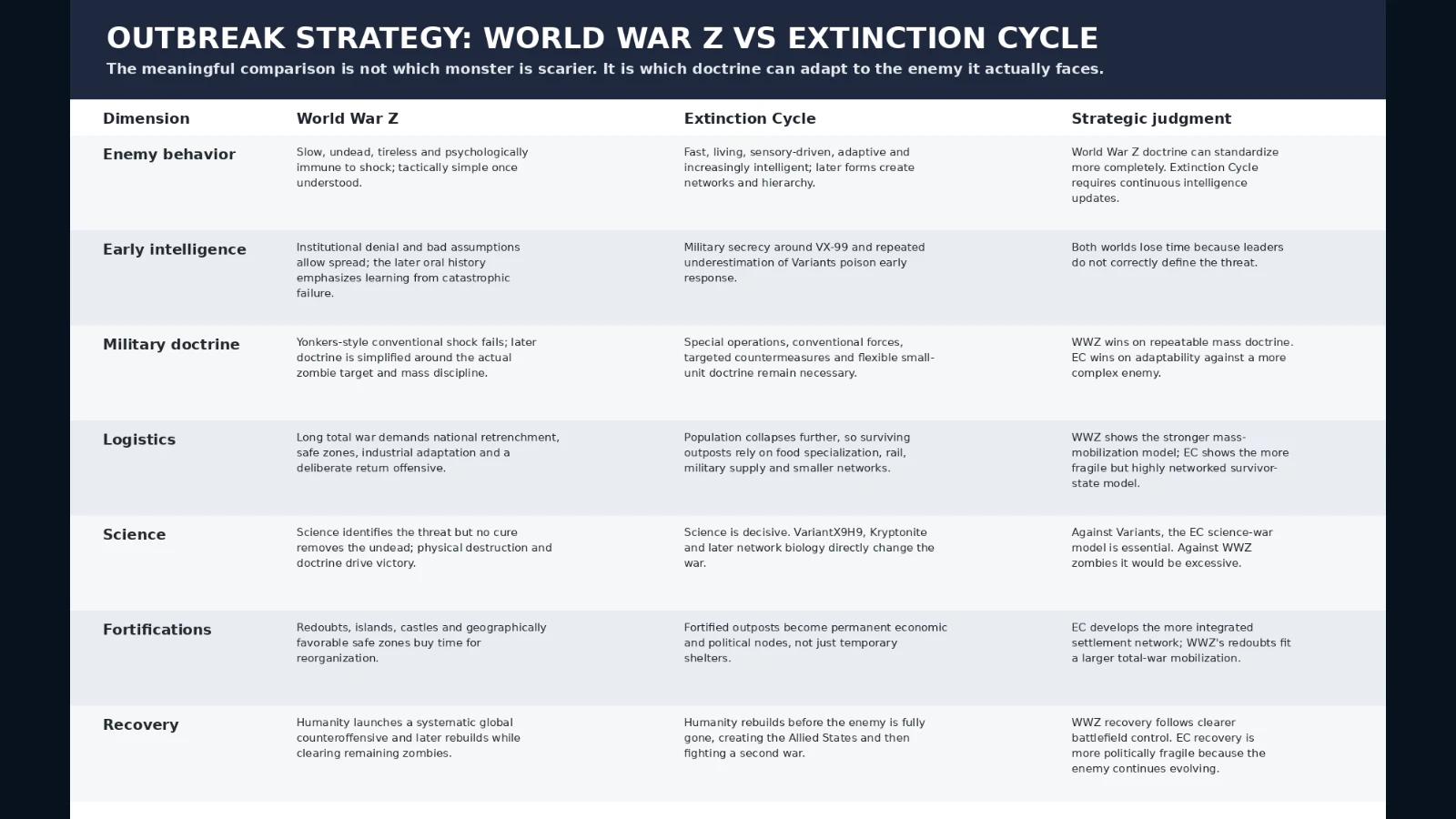
There is no useful answer without specifying the enemy.
Against World War Z zombies: the mature World War Z strategy is superior because it is cheaper, simpler and scalable.
Against Variants: the Extinction Cycle strategy is superior because WWZ doctrine assumes an enemy that is too predictable.
For long-term rebuilding: the ideal fictional system combines WWZ's mass logistics with the Allied States' networked outposts and the Extinction Cycle's science-intelligence integration.
That hybrid is the strongest strategy in the comparison.
Morale and Psychology: The Hidden Strategic Difference
The enemy's psychology determines what human psychology has to endure.
World War Z's undead have almost no psychology to exploit.
They do not fear.
They do not negotiate.
They do not care about casualties.
That makes human morale disproportionately important.
At Yonkers, the failure is not just physical.
The spectacle of advanced military power failing against an enemy that refuses to react as expected becomes a national psychological disaster.
The later doctrine restores confidence by making the battlefield legible again.
Soldiers understand the target.
The public understands that the dead can be destroyed.
The war becomes terrible but comprehensible.
The Extinction Cycle never receives that same psychological luxury.
Variants can ambush.
They can change.
Human collaborators can deceive.
New Gods can make political arguments.
The enemy therefore attacks morale through uncertainty as well as violence.
A soldier can know exactly how to kill one Variant and still be unprepared for the next form.
That is a much harder long-term psychological environment.
Ethics as Strategy
The Redeker Plan is often discussed as an ethical horror, but it is also a strategic doctrine.
Its central proposition is that the state must preserve enough people and resources to continue the war even if that means abandoning others.
The Extinction Cycle repeatedly arrives at similar moral mathematics through different mechanisms.
Commanders decide which cities receive countermeasures.
Scientists create weapons that will kill huge infected populations.
Outposts prioritize resources.
Military units are sent after specimens because the scientific value may exceed the lives risked capturing them.
The difference is visibility.
World War Z formalizes the sacrifice as policy.
The Extinction Cycle distributes it across operations.
That makes WWZ morally clearer and emotionally colder.
It also makes the strategy easier to audit.
Everyone knows what the doctrine is doing.
In the Extinction Cycle, responsibility can become blurred between scientist, general, politician and operator.
Urban Warfare
Cities are disastrous in both universes for opposite reasons.
World War Z city problem
Population density creates enormous zombie mass.
Once the dead fill the streets, conventional mobility collapses.
The enemy becomes a numbers problem.
Extinction Cycle city problem
Density matters, but architecture matters more.
Tunnels.
Roofs.
Walls.
Subways.
Basements.
Laboratories.
Variants use the vertical and hidden parts of cities.
That makes clearing operations intelligence-intensive.
A square-mile count of enemy bodies is not enough.
The human force needs to know where the enemy can move.
Ammunition Economics
World War Z eventually turns ammunition into an industrial arithmetic problem.
If every zombie requires a reliable disabling hit, the state must train soldiers, manufacture rounds and structure formations around a predictable consumption rate.
The Extinction Cycle has a more volatile problem.
Some targets can be killed conventionally.
Some require specialized weapons.
Some need to be captured.
Some environments make firing dangerous.
Some missions prioritize data over kills.
That means EC ammunition logistics are less standardized and harder to scale.
WWZ's mature doctrine wins here because predictability creates efficiency.
Scientific Risk
Science is powerful in the Extinction Cycle and dangerous for the same reason.
A scientific intervention can create selection pressure.
It can save millions and alter the enemy.
It can become a military weapon.
It can be deployed before complete certainty exists.
World War Z largely avoids that dilemma because the war is not won by biologically redesigning the enemy.
The absence of a cure forces humanity toward operational certainty:
kill the brain.
That is crude.
It is also strategically clean.
The EC world gets more options from science and more ways to make a catastrophic mistake.
Civil-Military Relations
The two books also differ in how much they trust military centrality.
World War Z eventually mobilizes whole societies.
The military is essential, but so are farmers, factory workers, administrators, refugees, planners and civilians whose labor supports total war.
The Extinction Cycle begins closer to elite-unit fiction.
It expands over time.
By Dark Age, that expansion is complete.
Team Ghost can kill a mastermind.
It cannot grow Turkey River's food.
Kate can interpret the network.
She cannot run every outpost.
Ringgold can coordinate national policy.
She cannot personally defend every wall.
That development moves the series closer to Brooks's systems view by the end.
What Each World Could Learn From the Other
World War Z should borrow
Extinction Cycle reconnaissance culture
Do not wait for a massive public defeat before allowing field observations to change doctrine.
Scientific integration
Even if a cure is impossible, better biological understanding can improve detection, decomposition estimates, environmental planning and operational safety.
Networked local resilience
A country of specialized outposts may adapt faster locally than a system concentrated in a few giant redoubts.
Extinction Cycle should borrow
Standardization
Once a tactic is proven against a known form, teach it widely and simplify it.
Industrial scale
Elite units cannot substitute for mass capacity.
Explicit strategic triage
Horrifying as it is, clear resource prioritization may be safer than pretending every objective can be achieved at once.
National training culture
If Variants remain a generational threat, civilian and local-defense education should become as normal as fire drills.
Which World Is More Likely to Make the Same Mistake Twice?
World War Z, once its doctrine matures, is less likely.
Its great strategic advantage is that the enemy does not innovate.
Lessons harden into doctrine.
The Extinction Cycle is forced to remain suspicious of doctrine itself.
That does not mean it is less competent.
It means its enemy can make competence expire.
This is one reason the Dark Age begins with complacency.
The Allied States correctly remembers that it won.
It incorrectly assumes that victory froze the enemy in place.
The Ultimate Cross-World Test
Imagine one hundred thousand enemies approaching a defended position.
If they are World War Z zombies
Choose the World War Z mature doctrine.
Create disciplined firing systems, simple target rules, deep logistics and relief rotations.
If they are adult Extinction Cycle Variants
Choose a mobile combined-arms defense with intelligence, terrain control, overlapping sensors and rapid response.
If the enemy includes New Gods and Chimeras
The WWZ model becomes dangerously incomplete.
Now the defenders need counterintelligence, science, political security and special operations.
The enemy can think.
At that point, the war is no longer pest control at military scale.
It is conflict between adaptive systems.
Final Verdict
World War Z is the better manual for winning a war against a stable enemy.
The Extinction Cycle is the better model for surviving a war in which the enemy changes.
Brooks's humanity wins when it stops fighting zombies like humans.
Smith's humanity wins when it stops assuming yesterday's Variant is tomorrow's Variant.
That difference explains everything.
Yonkers is a failure of doctrine.
Operation Liberty is a failure of intelligence.
The World War Z recovery becomes systematic because the zombie stays the same.
The Extinction Cycle recovery is interrupted because the enemy learns, mutates and eventually organizes.
So which outbreak strategy could actually win?
Both.
But only if each is used in the world that created it.
FAQ
Are World War Z zombies faster than Variants?
No. The novel's zombies are slow compared with Extinction Cycle Variants.
Which military adapts better?
World War Z ultimately produces a more standardized mass doctrine. The Extinction Cycle retains a more flexible mixed model because its enemy keeps changing.
Would the Redeker Plan work in Extinction Cycle?
It could preserve a core population during collapse, but fast intelligent Variants and infiltrating human collaborators would make static safe zones more vulnerable than they are against slow undead.
Would Team Ghost do well in World War Z?
Yes tactically, but elite teams alone cannot solve a zombie population measured in the hundreds of millions. The WWZ scale requires mass logistics and mass mobilization.
Which world rebuilds better?
World War Z demonstrates broader global recovery after a clearer military victory. The Extinction Cycle builds a sophisticated Allied States outpost network before the enemy has truly stopped evolving.
Source Scope
World War Z material refers primarily to Max Brooks's novel and publisher-supported descriptions, not the 2013 film.
Extinction Cycle material is grounded in the uploaded novels and the source-backed mission, outpost and Dark Age materials used elsewhere on the site.