
A chronology of failed certainty
The Enemy Never Stayed the Same: Every Time Humanity Misunderstood the Variants
Each apparent breakthrough became dangerous when commanders treated a changing enemy as if its latest form were final.
·
Category: Chronology and Continuity
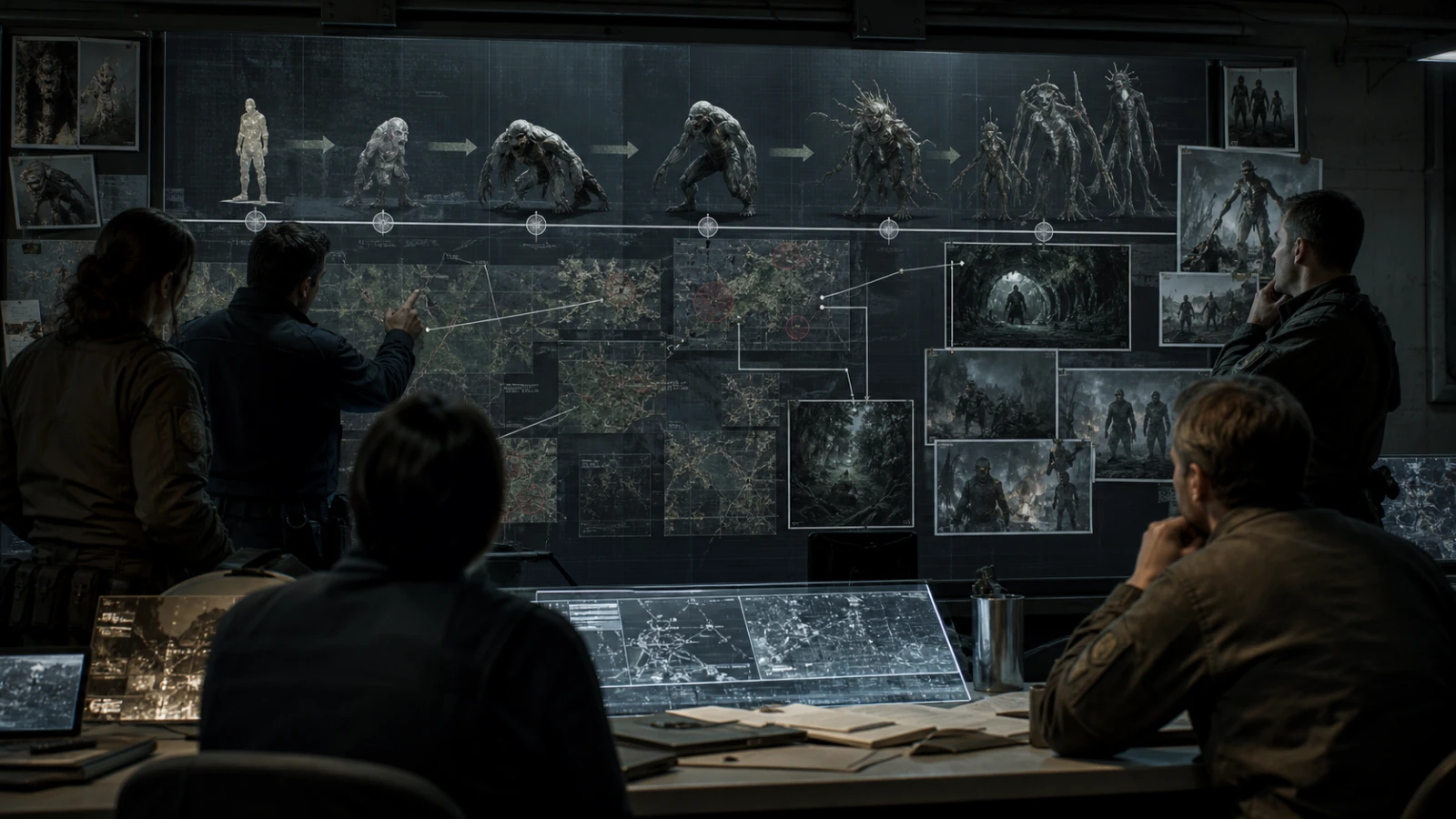
Introduction: The Real Villain Is Yesterday's Intelligence
The Extinction Cycle is often described through monsters, missions, and military survival, but one of its strongest recurring ideas is simpler: humanity keeps dying because it fights the enemy it remembers instead of the enemy that exists now.
The Variants are dangerous because they are fast, violent, and biologically altered. They are more dangerous because they change.
Every major stage of the franchise contains an intelligence failure. Sometimes the failure comes from secrecy. Sometimes it comes from reasonable assumptions that age badly. Sometimes it comes from institutional pride. Sometimes it comes from the most human mistake of all: success.
A victory teaches people a lesson. Then the enemy changes and the lesson becomes a trap.
This article traces that pattern chronologically. At each stage, it asks four questions:
What did the humans believe?
What evidence proved the belief incomplete?
Who adapted fastest?
What did the mistake cost?
The result is a different way to understand the Variant arc. Instead of a bestiary, it becomes a history of failed certainty.
Team Ghost's real advantage is not that it has the best weapons. It is that its best operators are unusually willing to discard their own assumptions when reality contradicts them.
That is the survival skill the larger institutions repeatedly struggle to learn.
Building 8: The Threat Is Misclassified Before the War Begins
Building 8 establishes the pattern before humanity even understands that it is in a war.
The original Team Ghost roster enters a classified facility with incomplete knowledge of the VX-99 history and the true nature of the biological danger.
This is not a simple operational accident. It is an information-architecture failure.
The people expected to survive the mission do not possess the full context needed to understand what is happening around them.
The first mistaken assumption is therefore institutional rather than tactical: classified science can be compartmentalized without compromising the people sent to contain its consequences.
Building 8 destroys that belief.
The original six-man team is shattered by a threat that does not behave like the problem described by the mission frame. Will Tenor, Carlos Spinoza, and Jim Edwards are lost during the foundational disaster.
The lesson for Beckham is permanent. Command may not know enough. Command may know more than it says. Either condition can kill.
This matters because every later Variant mistake inherits the original sin of incomplete truth.
Before humanity misunderstands the enemy's body, it misunderstands its own information system.
Early Outbreak: Conventional Containment Still Feels Possible
The next assumption is understandable.
Outbreaks are supposed to be contained.
Facilities can be isolated.
Cities can be cordoned.
Scientists can identify a mechanism.
The military can restore order.
That logic is built into modern emergency planning.
The Extinction Cycle deliberately destroys it.
The Hemorrhage Virus is fictional and radically more catastrophic than real outbreak threats. The infected do not remain patients who can be managed through ordinary clinical isolation. They become living predators.
That transformation moves the crisis from public health into armed survival.
The danger of the assumption is not that containment is foolish. It is that institutions remain emotionally attached to containment after the problem has crossed into a new category.
The humans need to stop asking only, 'How do we stop transmission?' and start asking, 'What kind of enemy population now exists because transmission happened?'
That is a different war.
The people who adapt fastest are those closest to field reality. Soldiers, survivors, and scientists working with direct specimens understand sooner than distant institutions that the infected cannot be treated as a temporary disturbance around an otherwise intact system.
The system itself is collapsing.
Operation Liberty: Firepower Is Not the Same as Understanding
Operation Liberty is one of the franchise's clearest demonstrations of institutional overconfidence.
The military has enormous destructive capacity.
That capacity creates a psychological temptation: if the threat can be concentrated, the threat can be killed.
The mistake is not using force. Force is necessary.
The mistake is assuming the enemy's behavior is understood well enough for the force plan to work as intended.
New York and other urban operations reveal how dangerous that confidence can be. Variants are not passive targets waiting inside a kill box. They use terrain, move aggressively, and exploit the three-dimensional structure of cities.
The result is a recurring Extinction Cycle principle: firepower multiplies good intelligence and multiplies bad intelligence too.
When the threat model is wrong, more force can mean more people committed to the wrong plan.
Team Ghost survives these situations partly because small units can update faster than national doctrine. Beckham can change a movement plan in seconds.
A national operation cannot always change that quickly.
Operation Liberty is therefore less a story about military weakness than institutional latency.
The enemy updates faster than the plan.
New York: Walls and Ceilings Become Enemy Terrain
The New York tunnel sequence changes the physical map of Variant warfare.
Humans are naturally biased toward horizontal threat.
Doors.
Hallways.
Streets.
Corners.
The Variants force Team Ghost to think vertically.
They move on walls and ceilings, use darkness, and transform enclosed infrastructure into predator habitat.
This is a profound intelligence correction.
A tunnel that looks like a chokepoint for humans may be a mobility corridor for Variants.
A ceiling that looks like empty architecture may be occupied threat space.
A defensive position is only defensive if the enemy shares your assumptions about movement.
The mistake costs ammunition, confidence, and lives across the broader campaign.
It also produces one of Team Ghost's most valuable cultural traits: check the space humans normally ignore.
That lesson sounds tactical, but it becomes philosophical.
The Variants are dangerous because they continually reveal human perceptual blind spots.
The war is partly about learning to see the world the way the enemy uses it.
Key West and Environmental Adaptation: Geography Stops Being a Guarantee
Extinction Evolution pushes the intelligence failure outward from buildings to geography.
Islands, water, coastlines, and distance are supposed to create natural barriers.
The Variant Hunters discover that environmental adaptation can undermine those assumptions.
Key West is important not simply because it introduces another frightening encounter. It breaks sanctuary logic.
If the enemy can exploit coastal or aquatic environments, islands and ships are no longer automatically safe because a map says water lies between them and danger.
This is the same pattern repeated at a larger scale.
Humans identify a barrier.
The enemy evolves around the barrier.
The strategic cost is enormous because geography shapes settlement planning.
A government may invest heavily in a location because its natural defenses appear strong.
If those natural defenses become permeable, the entire logic of the safe zone changes.
The lesson should have been obvious by then: no environmental advantage remains permanent against a biologically adaptive enemy.
Yet humans need stability.
They keep turning temporary advantages into permanent beliefs.
That psychological need is one of the Variants' greatest indirect weapons.
Juveniles and Alphas: The Enemy Develops Generations and Hierarchy
Later first-war material forces another revision.
The enemy is not simply a population of similar adult Variants.
Juveniles and Alphas reveal generational and hierarchical complexity.
That changes both science and tactics.
A juvenile is not merely a smaller version of the familiar enemy. It may represent the future of the enemy population.
An Alpha is not merely a stronger target. It may influence group behavior and organization.
Operation Condor reflects the scientific importance of this transition. Capturing a live juvenile becomes worth enormous risk because the old model is no longer enough.
This is a critical moment in the intelligence war.
Humans begin to understand that Variant biology has a future tense.
The enemy does not simply persist.
It reproduces, differentiates, and creates new strategic problems.
That realization should have permanently ended any belief in one final Variant manual.
It does not.
Human institutions still seek stable categories because stable categories make planning possible.
The enemy keeps converting those categories into history.
Europe: There Is No Universal Variant
The European campaign breaks another attractive assumption: Variants are globally standardized.
Regional forms such as Reavers, Wormers, and armored variants demonstrate that local conditions can produce threats that do not match American experience.
This makes international military cooperation harder.
A unit trained on one theater can arrive in another carrying dangerous confidence.
Weapons, movement, and expectations that worked in the United States may not transfer cleanly.
The broader implication is devastating for global recovery.
If Variant evolution is regional, then one country's scientific and tactical success cannot simply be copied everywhere.
Each theater becomes an intelligence problem.
Field observation becomes scientific data.
Local survivors may understand more about a threat than the arriving professional force.
This is another reason Team Ghost's adaptability matters.
The team can learn.
Institutions are slower.
Europe turns the Variant war into an ecology rather than a single enemy profile.
Dark Age: Victory Becomes the Most Dangerous Assumption
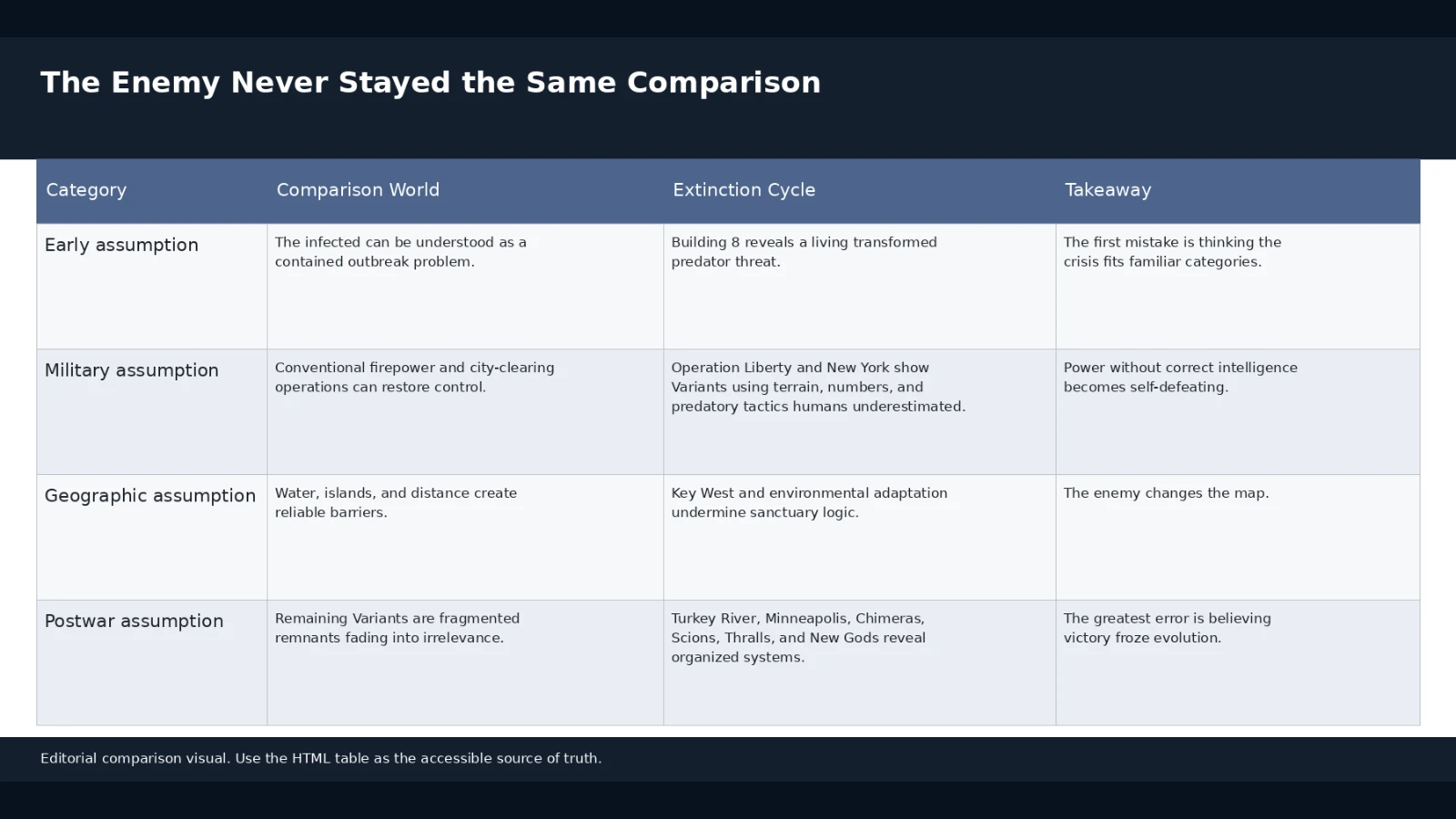
The eight-year gap creates the franchise's most psychologically realistic intelligence failure.
Humanity wins enough.
The Allied States forms.
Outposts stabilize.
Infrastructure returns.
Children grow up without seeing Variants directly.
Guards can spend years without close combat.
The remaining enemy begins to feel like a frontier problem rather than an extinction problem.
This is exactly what victory is supposed to achieve.
It is also the condition that allows strategic complacency to grow.
The public cannot remain at 2015 panic levels forever.
Veterans cannot keep every civilian psychologically mobilized.
Politicians have to govern a functioning country rather than an emergency camp.
The mistake is not rebuilding normality.
The mistake is assuming normality means the biological problem has stopped developing outside public attention.
Dark Age begins by attacking that belief.
Turkey River: The Outpost Model Meets an Enemy That Has Been Studying It
The Turkey River investigation is one of the most important Dark Age corrections.
A heavily defended agricultural outpost with hundreds of residents should not simply disappear.
Its wall, towers, sensors, mines, dogs, and routines embody everything the rebuilt society believes it has learned.
Team Ghost arrives to find that the model has failed.
Tunnels and red webbing reveal a threat capable of bypassing the visible logic of fortification.
The attack is not simply a stronger horde hitting a stronger wall.
It is an enemy using a different layer of the environment.
This is the New York lesson returning at settlement scale.
Humans built security in the spaces they could see.
The enemy developed below them.
Turkey River therefore marks the end of the assumption that the surviving Variants are fragmented remnants.
Something is organizing.
Something is communicating.
The problem is again larger than the defenders thought.
Minneapolis and Operation Shadow: Kill the Mastermind, Solve the Network?
Operation Shadow introduces another seductive assumption: if the enemy has a mastermind, kill the mastermind and the system collapses.
That idea is logical.
It is also incomplete.
Team Ghost penetrates Minneapolis, identifies the target, and destroys the mastermind.
The expected strategic collapse does not occur cleanly.
The mission succeeds tactically while revealing that the enemy network is more complex than the model predicted.
This is the Variant intelligence pattern in its purest form.
Humans discover hierarchy.
Humans build a hierarchy-based solution.
The enemy turns out to be more distributed.
Will Lincoln's death during extraction adds emotional cost to the lesson.
The mission is not a failure.
It is a victory that produces a new question.
The Extinction Cycle repeatedly uses this structure because it mirrors real learning under uncertainty.
An answer can be correct and still incomplete.
Chimeras, Scions, Thralls, and New Gods: The Enemy Becomes a Competing System
The later Dark Age forms complete the transition from outbreak to competing order.
Chimeras combine Variant physical capability with more recognizably human tactical intelligence and weapon use.
Scions and Thralls reveal structured roles.
The New Gods elevate the enemy from biological threat toward political and ideological organization.
At this point, the early label 'infected' has become strategically inadequate.
The enemy has institutions of its own.
This is the endpoint of the franchise's intelligence history.
Humans begin with a pathogen problem.
They end with a rival post-human system.
That does not mean the New Gods are morally equivalent to the Allied States or that coexistence is necessarily viable.
It means the analysis must move beyond disease response.
The final war is about power, territory, loyalty, communication, and competing visions of the future.
Every previous misunderstanding trained the humans for this moment, but only if they remember the lessons.
Why Team Ghost Learns Faster Than Institutions
Team Ghost's advantage is cultural.
The unit repeatedly enters places where the briefing is incomplete.
That experience produces skepticism without paralysis.
Good operators do not reject intelligence.
They treat it as provisional.
That distinction matters.
Institutions need stable doctrine to train thousands of people.
Teams need enough flexibility to survive when doctrine fails.
Beckham's era and Fitz's era both reinforce the same principle: observe, update, communicate, adapt.
The unit's real weapon is not a rifle.
It is the willingness to say, 'The thing we believed ten minutes ago is no longer good enough.'
That is cognitively difficult for organizations because admitting a model is wrong threatens authority.
For a field team, refusing to admit it threatens survival immediately.
The faster feedback loop makes Ghost better at living inside uncertainty.
Dark Age ultimately turns that team habit into a lesson for the entire country.
Final Verdict: The Enemy Never Stayed the Same Because Humanity Kept Wanting It To
The Variants are not dangerous only because they evolve.
They are dangerous because human institutions keep needing the enemy to stop evolving.
Stable enemies make budgets, doctrine, fortifications, politics, and public reassurance easier.
An adaptive enemy makes every success temporary.
Building 8 teaches that hidden science can make the first briefing wrong.
Operation Liberty teaches that firepower cannot repair a bad threat model.
New York teaches that the enemy uses terrain differently.
Key West teaches that geography can fail.
Juveniles and Alphas teach that the enemy has generations.
Europe teaches that it has regional ecologies.
Dark Age teaches that victory can hide continuing evolution.
Turkey River teaches that fortifications can be bypassed.
Minneapolis teaches that hierarchy can be distributed.
Chimeras, Scions, Thralls, and New Gods teach that the enemy can become a system.
The central lesson of the Extinction Cycle is therefore not simply 'adapt or die.'
It is more precise:
Never let yesterday's victory become tomorrow's intelligence.
FAQ
How is this different from the Variant evolution guide?
The evolution guide explains forms, fictional science, and taxonomy. This article follows the human intelligence failures chronologically: what people believed, what disproved it, who adapted, and what the mistake cost.
What is Team Ghost's real advantage against changing Variants?
Its best operators treat intelligence as provisional. They can discard a briefing or doctrine when direct evidence shows that the enemy, terrain, or hierarchy has changed.
Does this article contain spoilers?
Yes. It discusses major Variant developments and missions across the original series and Dark Age, including later enemy organization.
Canon source note
The chronology is checked against the site's source-indexed records for Building 8, Operation Liberty, New York, Key West, juvenile and Alpha Variants, European regional forms, Turkey River, Operation Shadow, Chimeras, Scions, Thralls, webbing, and the New Gods. It analyzes changing threat models rather than duplicating the existing bestiary or taxonomy.
Editorial note
This independent fan analysis uses original generic artwork and a submitted editorial summary chart. It does not reproduce official book art and avoids inventing unsupported biological mechanisms or creature lineages.
Recommended next pages
Source and canon pack
- Canon treatment
- The chronology follows current source-indexed mission, Variant, outpost, webbing, and New Gods records. It analyzes changing threat models without inventing biological mechanisms or creature lineages.
- Primary wiki source plan
- Building 8, Operation Liberty, New York, Key West, juvenile and Alpha Variant, European regional form, Turkey River, Operation Shadow, Chimera, webbing, Scion, Thrall, and New Gods records.
- Spoiler scope
- Full original-series and Dark Age Variant-development spoilers, including later forms, missions, hierarchy, and New Gods organization.
- Safety boundary
- Unofficial spoiler-heavy canon analysis. No official book artwork, named-character likenesses, invented biological mechanisms, real tactical or emergency instruction, advertising, or affiliation claims are published.
- Program article ID
- EC-43
- Scheduled publication
- 2026-08-26T18:54:00-04:00