
Locations
Rome
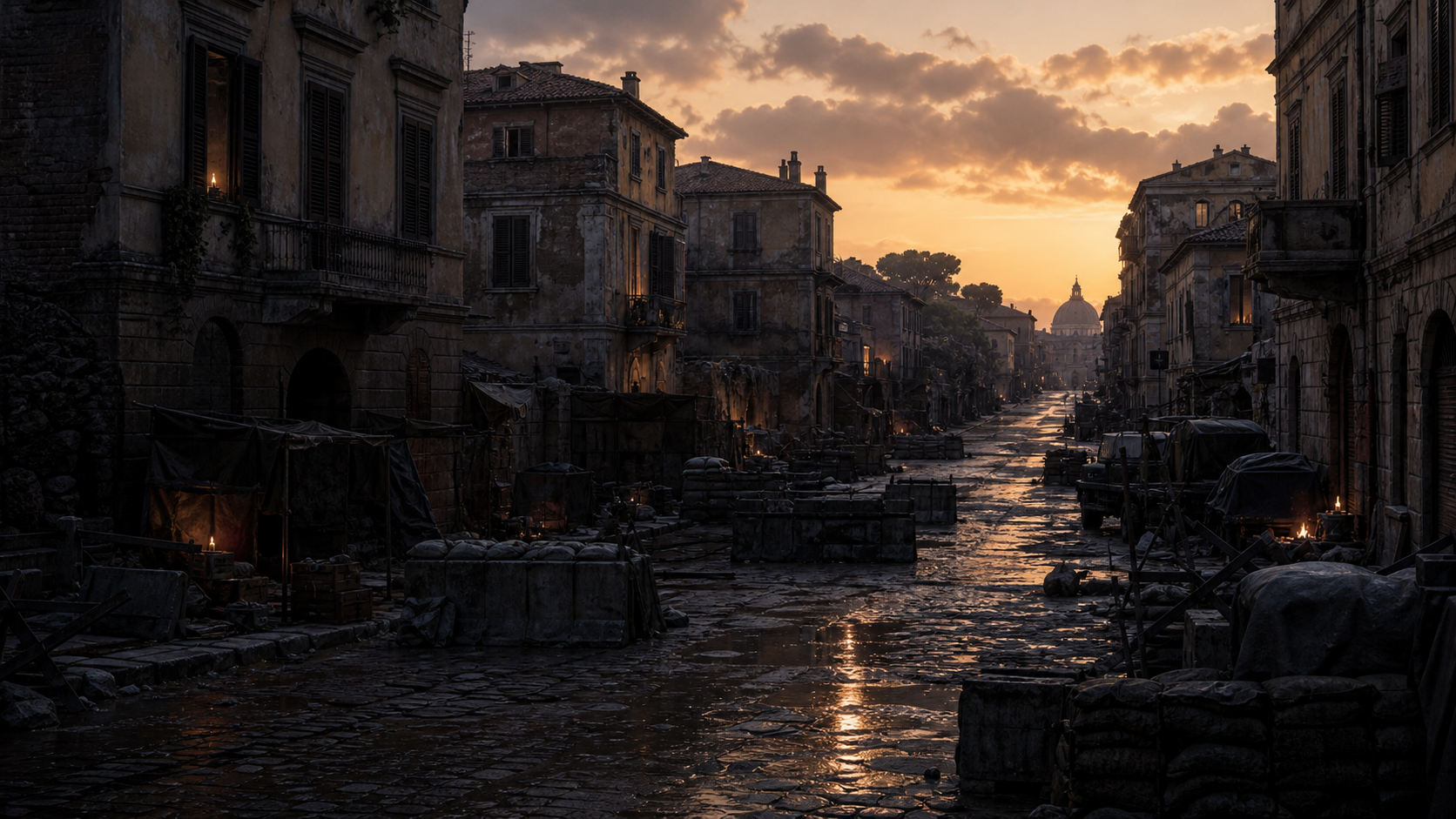
Rome is the principal Italian location and emotional center of the European campaign in the later original-series novels of Nicholas Sansbury Smith's Extinction Cycle. The city is introduced through Sergeant Piero Angaran and Lieutenant Antonio LoMaglio of the 4th Alpini Parachutist Regiment after an airborne effort to reclaim, inspect, or restore control over the capital is destroyed by juvenile Variants. Piero and Antonio survive the initial loss of their unit, but the city's streets, bridges, water, monuments, and catacombs have become a connected enemy habitat.
Quick Facts
- Role
- Locations
- Aliases
- rome, European Rome Arc, Rome Campaign
Overview
Antonio is killed during an attack involving specialized juvenile forms, leaving Piero alone with a mouse named Ringo. Piero survives through concealment, repellent, observation, and movement beneath the city, eventually transmitting evidence that European Variants have developed along paths not seen in the earliest American war. In Extinction War, he discovers a coordinated nest and a Queen-like command organism. Captured, mutilated, and webbed among the nest structures, Piero calls European fire onto the Vatican and Colosseum sectors despite knowing the bombardment will kill him. The strike destroys the enemy concentration and turns Rome from a failed reclamation mission into one soldier's final act of strategic denial.
Location information
- Field: Location; Detail: Rome, Italy
- Field: Narrative role; Detail: Principal European urban-survival and Variant-evolution location
- Field: Main viewpoint; Detail: Sergeant Piero Angaran
- Field: Key companion; Detail: Lieutenant Antonio LoMaglio
- Field: Military affiliation; Detail: 4th Alpini Parachutist Regiment and later European Unified Forces context
- Field: Animal companion; Detail: Ringo, a mouse found or kept by Piero during isolation
- Field: Important areas; Detail: Surface ruins, bridges and waterways, St. Peter's and Vatican area, catacombs, and Colosseum sector
- Field: Initial mission; Detail: Airborne insertion or reclamation effort that ends in unit destruction
- Field: Principal early threats; Detail: Juvenile Variants, swimming forms, winged forms, hunger, isolation, and failed communications
- Field: Principal later threats; Detail: Wormers, Beetles, winged juveniles, webbing structures, captor forms, and a Queen-like organism
- Field: Major human loss; Detail: Antonio LoMaglio
- Field: Final operation; Detail: Piero directs bombardment onto the nest while trapped inside the target area
- Field: Outcome; Detail: Piero and the nest are killed; Rome remains a devastated theater rather than a confirmed restored capital
- Field: Primary works; Detail: Extinction Aftermath and Extinction War
Global and European context
The American campaign initially dominates the main series because Team Ghost, Plum Island, the CDC, and the surviving United States government possess the narrative's principal command and scientific viewpoints. Rome changes the scale. It shows a national military and historic capital confronting the same global biological catastrophe without the same concentration of surviving resources.
The Hemorrhage Virus and VariantX9H9 affect Europe as part of the worldwide outbreak and counterstrike, but regional outcomes are not uniform. European cities experience their own bombing, starvation, command collapse, and Variant adaptation. Different climates, terrain, and surviving populations create forms that American field reports do not fully predict.
Rome therefore functions as both a local ruin and an international intelligence site. What Piero observes can change the wider understanding of Variant evolution. His problem is surviving long enough to transmit it.
Failed airborne mission
Piero serves as a sergeant in the 4th Alpini Parachutist Regiment, with Antonio as a lieutenant and last close officer-companion. Their unit enters Rome as part of an attempt to contest or evaluate the city. The precise size and complete operational plan are not preserved in the current indexed record, but the result is clear: juvenile Variants destroy the force as an organized formation.
The failure resembles Operation Liberty in New York at a structural level. Human planners send trained troops into a metropolitan area after assuming that prior biological and conventional attacks have reduced the enemy to a manageable remnant. The surviving creatures instead use the city's vertical and underground spaces more effectively than the attackers.
Rome is not simply New York with different landmarks. Its old construction, religious complexes, buried chambers, narrow routes, stone structures, bridges, and river create a distinct environment. An airborne unit can enter the capital quickly, but insertion does not create secure supply, extraction, or communication once the streets below are controlled by forms able to climb, swim, or attack from above.
Rome as an enemy ecosystem
The city combines several layers of danger. Surface ruins expose movement to airborne or elevated forms. Waterways and river crossings cannot be trusted because juvenile Variants can swim. Catacombs and subterranean routes provide concealment for people while also offering the enemy nesting space. Ancient structures resist some damage but produce compartments in which a small number of survivors can become trapped.
The environment also destroys ordinary military orientation. A map may identify a basilica, bridge, square, or road, but it does not show which lower chambers contain webbing, where a winged form can launch, or how a pack moves between water and street. Historical knowledge remains useful for route finding, yet the biological occupation creates a new map over the old city.
Rome's surviving monuments add emotional scale. A city associated with empire, state, church, art, and long historical continuity has become a feeding ground. The fall is not evidence that its history was meaningless. It demonstrates how little inherited permanence can protect people when the systems maintaining daily life disappear.
Piero and Antonio in the ruins
After the unit is destroyed, Piero and Antonio move as a two-man survival element. Their formal mission has failed, but military habit continues to organize them. They share watch, movement, food, warning, and conversation. Each is the other's last witness to the regiment that entered the city.
They rely on concealment and repellent rather than attempting to hold a fixed position. Hunger and exhaustion reduce the advantage of training. Every decision must account for the cost of crossing an open area, firing a weapon, or abandoning a hidden route.
The friendship carries a psychological function. Antonio can confirm that a sound is real, challenge a despairing conclusion, and remember the dead. Their exchanges allow both men to remain members of a unit even when no larger command is present. Rome becomes more dangerous after Antonio dies not only because Piero loses another rifle, but because he loses the last person able to answer.
Specialized juvenile threat
The Rome arc reveals juvenile forms whose anatomy and movement exceed the assumptions developed against early adult Variants. Armored bodies make ordinary fire less reliable. Swimming forms turn the Tiber and related water approaches into hunting routes. Winged or aerial forms threaten rooftops, bridges, and exposed crossings.
These forms are not interchangeable labels for one creature. Together they demonstrate specialization. A population that reproduces quickly can produce offspring whose bodies occupy different tactical niches. The city becomes dangerous in three dimensions and across both dry and aquatic approaches.
The juvenile presence also changes the strategic meaning of waiting. Adult Variants are not a population that will necessarily age and disappear. They are creating a next generation. A failed reclamation gives that generation additional territory, prisoners, shelter, and time.
Rome therefore strengthens the case for Kryptonite testing, capture missions, and international scientific exchange. American data on adult binding cannot automatically answer what a European juvenile, winged form, or nest organism will do.
Death of Antonio LoMaglio
Piero and Antonio are attacked while moving through the city. Juvenile and winged threats close escape routes from different directions. Antonio is caught and pulled between creatures.
Piero cannot recover him. He fires a mercy shot to stop his officer and friend from being torn apart while conscious. The act is tactically small and emotionally decisive. The last two members of the immediate unit are reduced to one, and the surviving man must use his weapon against the person whose life he most wants to preserve.
Antonio's death prevents the European campaign from becoming an impersonal report about unusual monsters. Every adaptation has a human consequence. Swimming, flight, armor, and pack movement matter because together they remove the options two trained soldiers require to protect each other.
Piero carries Antonio as memory and mission authority afterward. With no officer left to issue orders, he chooses reporting and continued observation as the work their destroyed unit can still complete.
Ringo and survival beneath the city
Piero's remaining companion is a mouse he calls Ringo. The animal is insignificant in military terms but essential to the emotional structure of the Rome story. Ringo reacts to nearby danger, offers a limited early warning, and gives Piero another living being to feed, address, and protect.
Speaking to the mouse preserves language and social behavior. Piero is not merely keeping his body alive. He is resisting the reduction of human existence to hiding, eating, and fleeing. Care for Ringo becomes a small act against the Variant order, which treats other bodies as prey, incubator, or material.
Piero hides and travels in catacomb spaces connected to St. Peter's and the Vatican area. Darkness shields him from some surface threats while bringing confinement, disorientation, and proximity to possible nests. Hunger and isolation begin to damage his sense of identity.
He repeats his name and categories of self: Piero Angaran, soldier, man. The practice functions as a cognitive drill. His name connects him to a life before the ruins. Soldier connects survival to duty. Man distinguishes his conduct from the predators occupying the city.
Observation and intelligence value
Piero recognizes that Rome's creatures differ from the earlier standard Variant. He also associates some changes with the effects of human bombardment and the altered environments produced by war. The campaign may kill exposed populations while driving survivors underground or applying pressure that favors stranger forms.
His field observations matter because laboratories cannot infer every adaptation from one specimen. A scientist on a ship or secure island needs someone inside Rome to describe movement, armor, flight, swimming, nesting, and command behavior. Piero becomes that observer by circumstance.
Remaining hidden might extend his life. Reaching communication and reporting what he knows may shorten it. He chooses the report because intelligence can protect people outside the city even if it cannot restore his regiment. The failed mission acquires value when its last survivor converts experience into warning.
Rome in Extinction War
When the narrative returns to Rome, the threat has continued developing. The indexed record associates the later city with forms described as Wormers and Beetles, winged juveniles, webbing, captives, and a Queen-like organism. The labels indicate a differentiated ecology rather than one mass of identical creatures.
The Queen is strategically important because she represents reproduction, hierarchy, or command concentrated in one structure. A city occupied by independent predators requires broad clearing. A city organized around a nest leader offers a high-value target, provided someone can locate it accurately.
Piero enters or is drawn into this deeper ecology while seeking evidence. Earlier bombing has not restored the capital. It has left ruined surface zones while the enemy continues beneath and around them. The city demonstrates that strategic destruction can conceal a biological problem as easily as eliminate it.
Capture and mutilation
The Rome nest captures Piero. The creatures mutilate him, destroy or remove his legs, and web him to a wall among captives and biological structures. His body can no longer perform the movement on which his survival has depended.
Captivity confirms the intelligence he has sought. Webbing, prisoners, specialized forms, and the Queen show organization. The enemy is not simply feeding in the ruins. It is using the city to reproduce, hold bodies, and maintain a hierarchy.
The scene appears to remove Piero from the war. He cannot walk out, carry Ringo to safety, or fight the nest with conventional weapons. He retains two capabilities: observation and communication. Those are enough to turn his position into targeting data.
Final targeting call
Piero contacts surviving European forces and directs strikes toward the nest areas associated with the Vatican and Colosseum. He knows the attack will kill him and other captives within the target zone. Extraction is not presented as a realistic option, and allowing the Queen to survive would preserve a threat to far more people.
Calling fire onto his own position is not surrender. It is the final use of agency available to him. The nest decides the condition of his body, but Piero decides what the information purchased by that suffering will accomplish.
The bombardment destroys the concentration and kills him. Rome is not thereby confirmed as fully reclaimed. The strike eliminates a command center and denies part of the city to the enemy. Future control would still require assessment, clearance, and reconstruction.
Relationship to the European campaign
Rome anchors the wider European theater that includes Paris and international military cooperation. Its importance lies in three contributions:
Piero's story also prevents Europe from existing only as an ally mentioned in an American briefing. He remembers Italian culture, food, language, military tradition, and the meaning of the city. Those details give continental strategy a human owner.
Later soldiers, including Fitz, recognize the account of the Italian sergeant and his mouse. Piero becomes a legend because the memory preserves both the targeting call and Ringo. The combination matters. His sacrifice is not the act of an abstract military asset. It is the choice of a lonely person who continued caring for a small animal inside a nest.
- it provides direct evidence of regionally specialized Variants;
- it shows the limits and unintended effects of mass bombing;
- it supplies a local soldier whose intelligence can guide larger allied action.
Comparison with New York
Rome and New York both demonstrate that an urban target is an ecosystem rather than a point on a command map. Both contain tunnels, vertical approaches, lairs, prisoners, and enemy intelligence. Both punish forces that assume prior biological or aerial attack has made the ground manageable.
The differences are equally important. New York receives sustained attention through Team Ghost, Redemption civilians, and several operations. Rome is filtered through radical isolation. Piero lacks a nearby national command network or a large recurring cast. His observations must travel farther, and his continued existence depends less on reinforcement than on concealment.
Rome also foregrounds more extreme regional forms and the relationship between ancient underground space and new biological hierarchy. It turns a historic capital into evidence that human civilization and Variant evolution can occupy the same physical layers, with only one controlling them at a given moment.
Status and legacy
At the end of Piero's documented arc, the major nest and Queen are destroyed, Piero and Antonio are dead, and the capital remains devastated. The sources do not confirm a full civilian resettlement or stable Italian government operating from Rome. The safest status is contested or denied urban theater with a destroyed principal nest, not liberated city.
The location's enduring legacy is intelligence. Rome proves that regional evolution, reproduction, webbing, and command organisms must be treated as parts of one enemy system. It also proves that a single observer can change strategy if he preserves identity and communication long enough to report.
Important connections
- Piero Angaran: Last surviving observer from the initial mission and final forward targeter.
- Antonio LoMaglio: Piero's officer and companion, whose death turns the arc into solitary survival.
- Ringo: Mouse companion, warning presence, and symbol of Piero's remaining tenderness.
- 4th Alpini Parachutist Regiment: Italian unit destroyed during the Rome operation.
- Juvenile Variants: Reproductive generation whose armor and specialized movement overwhelm the initial force.
- Winged and aquatic forms: Regional threats that make air, height, water, and bridges unsafe.
- Queen: Later command or reproductive organism at the center of the nest.
- European Unified Forces: Surviving command that receives Piero's intelligence and executes the final strike.
- Paris and the European campaign: Wider continental theater shaped by the same adaptation problem.
Chronology and consequences
- Extinction Aftermath - Failed Rome mission, survival of Piero and Antonio, specialized juveniles, Antonio's death, Ringo, catacomb isolation, and early European intelligence.
- Extinction War - Return to the evolved Rome threat, Wormers and Beetles, Queen and webbing structure, Piero's capture, final targeting call, and death.
- Later reference continuity - Piero's reputation among surviving international soldiers and the use of Rome as an example of regional Variant evolution.
Continue Exploring
Connected Universe
Books and Stories
Characters
Sources
- Extinction Aftermath and Extinction War: Piero Angaran, Antonio LoMaglio, the Rome mission, specialized Variant forms, capture, and the European campaign.
- Extinction Aftermath, Extinction Aftermath - Prologue
- Extinction Aftermath, Extinction Aftermath - Chapter 1
- Extinction War, Extinction War - Prologue
- Extinction War, Extinction War - Chapter 1