
Hawkins survivors versus Variant collapse
Would the Stranger Things Characters Survive Extinction Cycle?
Stress-test Hopper, Eleven, Nancy, Steve, Dustin, and the Hawkins group against Extinction Cycle outbreak shock, movement, nests, secrecy, and rebuilding.
·
Category: Analysis and Opinion
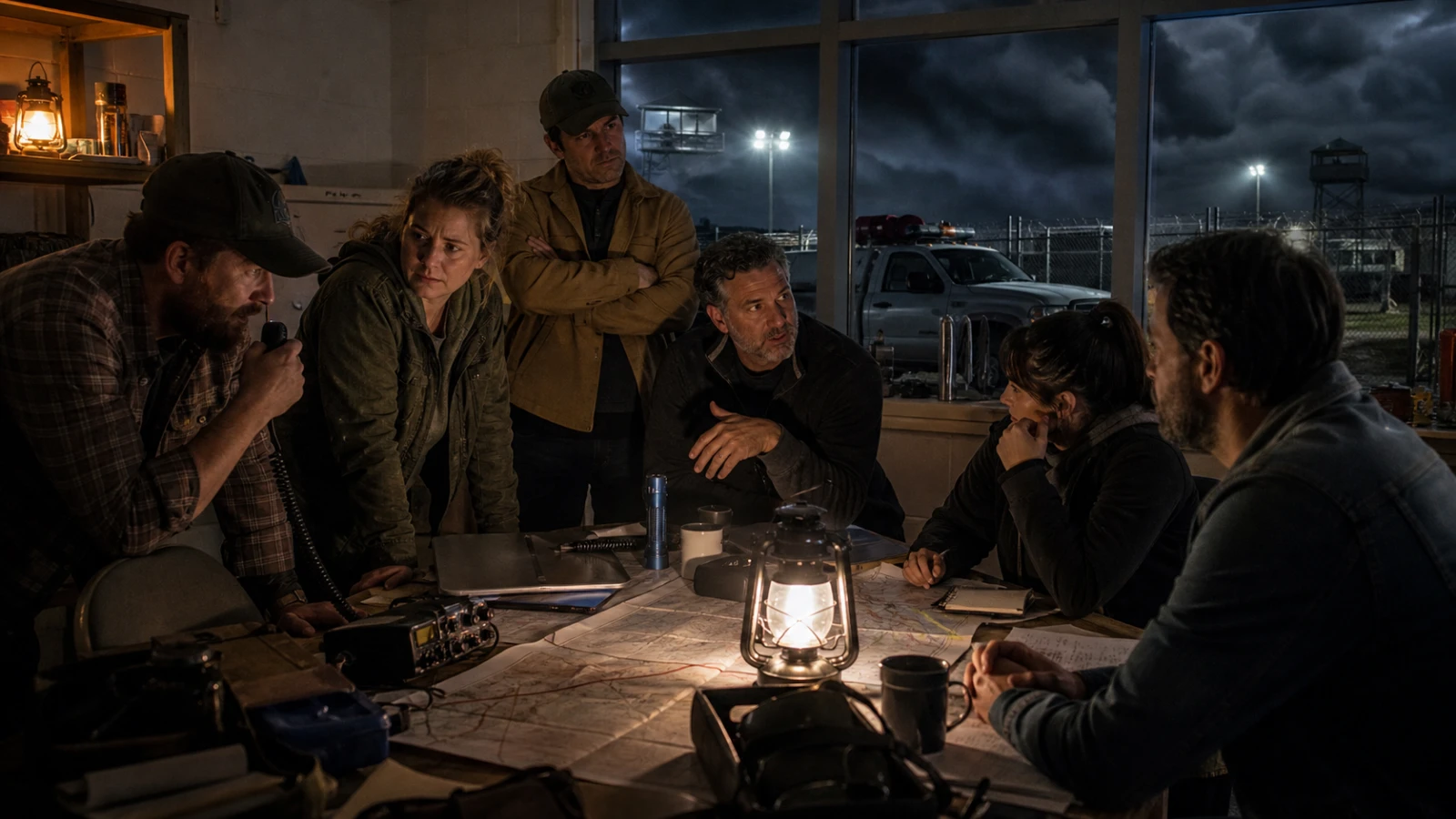
**The answer depends on which part of the Extinction Cycle you drop them into. If the question is whether the Hawkins group could survive one local monster problem, several of them absolutely could. If the question is whether the same characters could survive the full Extinction Cycle arc of outbreak shock, Variant nests, military secrecy, bioweapon confusion, mass displacement, and long-term reconstruction, the answer gets more complicated. Some of them would adapt brilliantly. Some would become invaluable specialists. Some would struggle the moment the problem stops being one town and becomes a civilization-level war.**
The timing makes the question especially interesting now. Netflix's Tudum coverage of Stranger Things Season 5 presented the final season as the show's biggest yet and emphasized that the core cast members had grown into a more mature final chapter, with friendship and chosen family still at the center. That matters because maturity changes how these characters would perform in a harsher world. They are no longer just kids on bikes solving one mystery. They are a hardened group shaped by conspiracies, monsters, improvised combat and loyalty under pressure.
Even so, the Extinction Cycle is a very different beast.
It is not merely a hidden-supernatural problem.
It is a military-science apocalypse.
To judge the Hawkins group fairly, we have to break survival into stages:
- outbreak shock
- early survival and movement
- nests and field combat
- military secrecy and state-level chaos
- long-term reconstruction
We also have to evaluate the individuals most people think about first:
- Hopper
- Eleven
- Nancy
- Steve
- Dustin
- the wider Hawkins group
Why the Hawkins Group Has Better Odds Than Some Fans Assume
At first glance, the comparison can seem unfair. The Extinction Cycle is full of trained operators, scientists and national command figures. The Stranger Things group often survives through nerve, friendship and improvisation.
But that summary undersells them.
The Hawkins group's real strengths are highly transferable:
- they investigate strange threats without freezing
- they keep functioning under secrecy
- they trust one another in dangerous situations
- they improvise with limited resources
- they do not need normal adults to validate what they already know
- they are used to fighting things other people would rather deny
That last point is especially important.
One of the most lethal features of the Extinction Cycle world is not merely the Variants. It is the number of institutions that misread or understate the threat. The Hawkins group is emotionally prepared for that kind of frustration. They have spent years living in a world where official explanations are incomplete at best and dishonest at worst.
So no, this is not a total mismatch.
It is just a mismatch of scale.
Stage One: Outbreak Shock
The first phase of the Extinction Cycle rewards three traits more than anything else:
- fast recognition
- refusal to wait for official certainty
- willingness to move
The Hawkins group is actually quite strong here.
They are not civilians who assume the strangest explanation must be impossible. They have already lived through supernatural and government-driven crises. If they saw people changing, attacking and behaving impossibly, they would not waste as much time debating whether the threat is real.
That helps immediately.
Hopper in stage one
Hopper might be the single best non-military day-one survivor in this crossover. He is physically tough, good under pressure, familiar with weapons, skeptical of official reassurances and protective in a practical rather than sentimental way. He would not need much time to understand that the situation had escaped normal policing.
His best quality is emotional hardness without emotional emptiness. In a fast collapse, that matters. He can make ugly decisions and still remain human.
Eleven in stage one
Eleven changes the board completely. A world full of sprinting infected becomes less overwhelming if one member of the group can physically interrupt attacks, create stand-off distance or turn local fights into uneven fights. She is also psychologically driven by protection. In the final-season framing Netflix emphasized that protecting her friends remained central to her character, and that maps well onto the Extinction Cycle's first-survival logic.
The downside is obvious: she becomes a strategic target instantly. A useful power is never just a gift in a world full of governments, labs and armed factions.
Nancy and Steve in stage one
Nancy adapts fast and does not need much emotional time to turn fear into planning. Steve is at his best when the problem is immediate and other people need shielding. Both would likely outperform average survivors in the first violent days.
Dustin in stage one
Dustin is less physically advantaged but extremely important intellectually. He processes patterns, technology and threat logic quickly. Early survival often turns on one person realizing how the thing actually works. Dustin is believable in that role.
Verdict on stage one
The Hawkins core group does better than average. Not flawlessly, but better than average.
Stage Two: Movement, Scarcity and Staying Alive
Many fictional crossovers overvalue battle moments and undervalue boring survival.
The Extinction Cycle does not.
Movement, shelter, food, information, transportation and trustworthy allies matter constantly. This is where the Hawkins group begins to separate into different usefulness levels.
Hopper as movement anchor
Hopper would likely emerge as the group's logistical adult. He can handle negotiations, physical risk, route decisions and ugly judgment calls. He would also be far more comfortable than the younger characters dealing with armed strangers.
Steve as morale and protection anchor
Steve's role is easy to underestimate because it is not always the "smartest" role. But survival groups fail emotionally as well as tactically. Steve keeps people together. He is useful in ugly close calls, in evacuation, in physically protecting the less hardened members, and in refusing to abandon people for convenience.
In the Extinction Cycle world, that trait can be costly. It can also be the difference between a group and a pile of individuals.
Nancy as the planner who scales up
Nancy becomes more useful the bigger the problem gets. She is not just brave. She learns systems. She asks good questions. She thinks ahead. Once the group has to ration, relocate and prepare, Nancy's value rises sharply.
Dustin as communications brain
Dustin would thrive any time radios, improvised tech or pattern recognition matter. The Extinction Cycle is full of situations where information is worth more than another rifle. Dustin is not merely comic relief in this environment. He is the kind of survivor who could become indispensable if paired with people who can physically protect him.
Eleven as force multiplier and pressure point
Eleven still helps enormously. But long-term movement also means exhaustion, visibility and dependence. A group that begins to rely on her for every fight may become tactically lazy. The best version of the Hawkins group in this world is one where Eleven expands the group's options rather than replacing them.
Stage Three: Could They Handle Variant Nests?
This is where the comparison gets brutal.
Variant nests are not just monster rooms. They are biological kill spaces. They reward discipline, reconnaissance, weapon handling and willingness to operate under suffocating uncertainty. This is where the Hawkins group's usual method of improvising a plan around local knowledge becomes less reliable.
Hopper in nests
Hopper could survive nest operations if he had military partners or experienced guides. On his own, he has toughness and judgment, but not the kind of trained clearing discipline that Team Ghost brings.
Nancy in nests
Nancy is the most plausible quick learner after Hopper. She handles firearms pressure well and tends to stay mentally active when plans fall apart. If someone in Hawkins could transition into a more serious field operator over time, it is probably Nancy.
Steve in nests
Steve is fearless, but fearlessness is not enough in a place where bad spacing and one wrong turn can kill an entire group. He would help protect people, but he is at risk of overcommitting emotionally.
Dustin in nests
Dustin should not be placed at the point of a nest-clearance action unless the alternative is catastrophic. He is simply too valuable in support roles and too exposed in close biological combat.
Eleven in nests
Eleven is the exception. Her powers allow her to compensate for several nest problems immediately. She can create distance, interrupt swarms and potentially turn enclosed-threat geometry in the group's favor. But again, the cost is strategic. Once people realize what she can do, every major player would want access, protection, leverage or control.
Verdict on nests
Without support from trained survivors, the Hawkins group struggles badly in pure nest warfare. With support, several of them become highly useful.
Stage Four: Military Secrecy, Labs and Government Confusion
This is one of the most interesting overlaps between the two franchises.
The Hawkins group understands secret labs, incomplete official narratives and the danger of institutions that believe they can control what they barely understand. In emotional terms, they are probably better prepared for the Building 8 side of the Extinction Cycle than many ordinary apocalypse casts would be.
Hopper here is elite
He has lived through cover-ups, manipulation and compromised official channels. He would not be easy to fool once patterns emerged.
Nancy and Dustin thrive here
Nancy asks investigative questions. Dustin connects technical dots. A lot of Extinction Cycle survival depends on recognizing that the public explanation is not the real explanation. They would be excellent at that.
Eleven is a red alert in this phase
This is where the crossover becomes tragic. In a world of military programs, bioweapon history and classified research, a person like Eleven becomes too valuable and too dangerous to remain merely a friend in a moving group. Every powerful institution would read her through the lens of utility.
That does not mean she could not survive.
It means her survival challenge becomes bigger than the Variants.
Stage Five: Long-Term Reconstruction
The Hawkins group can survive a crisis. Can they help build after it?
This is where the answer improves again.
The Dark Age side of the Extinction Cycle is not just about shooting Variants. It is about living inside a rebuilt world:
- defended communities
- food and transport
- local leadership
- trusted communication
- family structures
- public confidence
The Hawkins characters are better suited to that world than some people might assume.
Hopper in reconstruction
Hopper is local leadership waiting to happen. He understands community. He is not slick, but he is trustworthy in the ways that matter after collapse.
Nancy in reconstruction
Nancy becomes one of the best bridge figures between crisis and civic life. She could contribute as organizer, investigator, communicator or local decision-maker.
Dustin in reconstruction
This may be Dustin's strongest phase. Rebuilding favors smart communicators and tech-minded problem-solvers who can help make a settlement actually function.
Steve in reconstruction
Steve is ideal for the human side of reconstruction. He makes groups livable. In a rebuilt outpost, that is not trivial.
Eleven in reconstruction
Eleven is hardest to place because her power guarantees that she never gets to be ordinary. Still, if protected from exploitation, she would be one of the strongest defensive assets any settlement could possess.
Character-by-Character Final Assessment
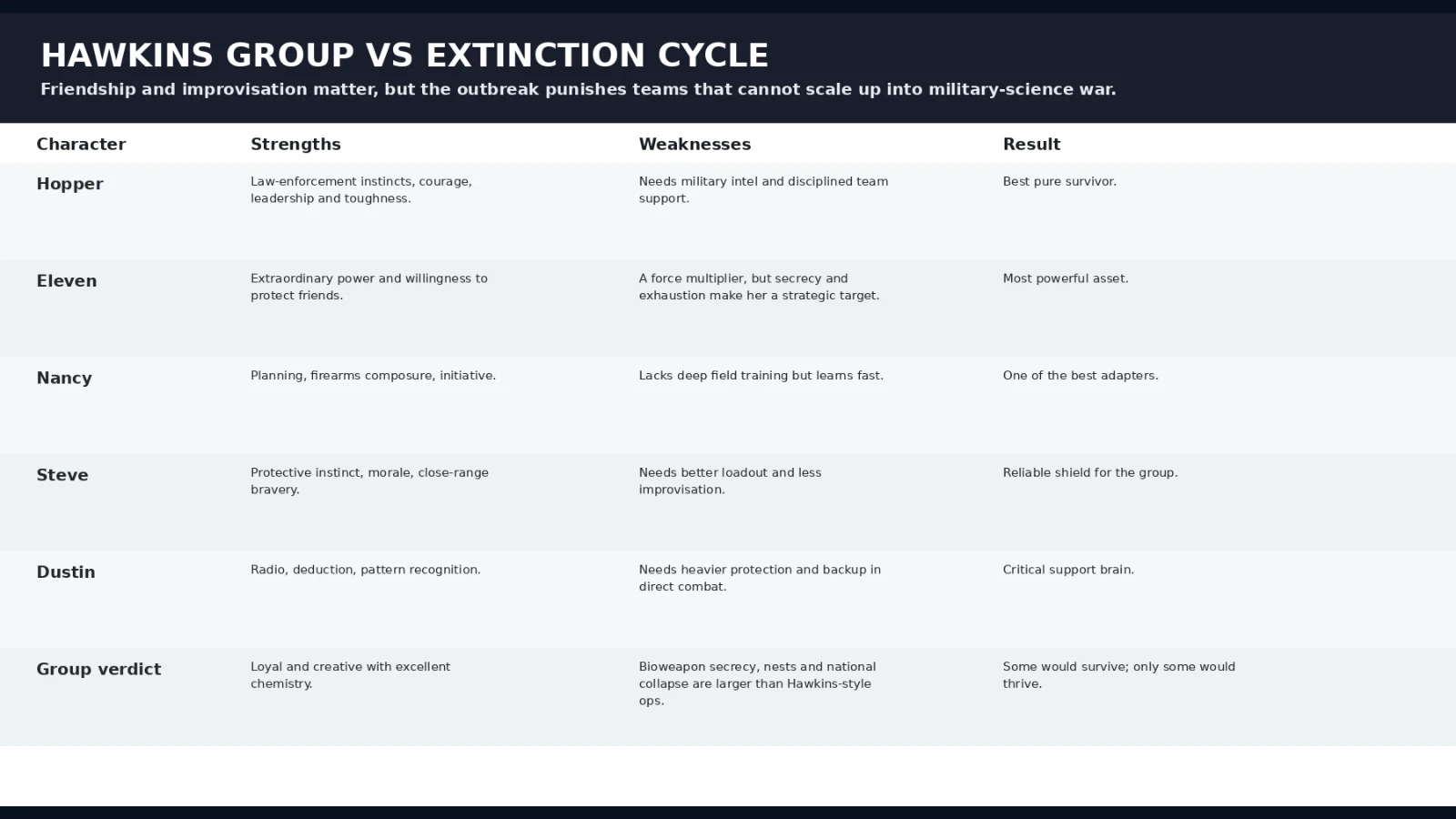
Hopper
Most likely to survive on ordinary human terms.
He has toughness, command presence, skepticism, protective instinct and practical judgment. He is not a specialist, but he is exactly the kind of adult who can keep a mixed group alive.
Eleven
Most powerful but also most strategically endangered.
She could save the group repeatedly. She could also become the focus of every scientist, commander and opportunist in the region. Her personal survivability is therefore a paradox.
Nancy
Best all-around adapter.
She scales well from investigation to field danger to reconstruction. In many ways, she is the most quietly impressive fit for the Extinction Cycle world.
Steve
Best emotional protector.
He may not become a high-level operator, but he is the kind of person who keeps vulnerable people alive long enough to matter.
Dustin
Most indispensable noncombat support asset.
He should not be wasted in direct nest combat. His value lies in communications, problem-solving and technical adaptation.
The wider Hawkins group
The broader group remains compelling because its main power is collective chemistry. They are used to each other's flaws, which is exactly what mixed survivor groups need.
What the Hawkins Group Lacks
To stay balanced, we also have to say what they do not have.
They lack:
- bioweapon science expertise at Kate Lovato's level
- military small-unit training at Team Ghost's level
- large-scale command experience
- exposure to sustained national-collapse logistics
- a built-in answer to heavily armed hostile factions
That means they would need allies in the Extinction Cycle world. They are not a self-sufficient replacement for the entire surviving state.
Best-Case and Worst-Case Outcomes
Best case
Hopper, Nancy, Dustin and Steve link up with competent survivors or military personnel early. Eleven becomes a decisive defensive asset without being permanently captured or politicized. The group transitions from local-survival unit into valuable specialists inside a larger protected community.
Worst case
The group remains isolated too long, over-relies on Eleven, lacks ammunition and training for nest warfare, and eventually gets crushed by the scale difference between Hawkins-style monster fighting and a national Variant war.
What the Hawkins Group Would Need to Learn Fast
If these characters are going to last in the Extinction Cycle world, they would need to master several things quickly.
Biohazard discipline
The group is used to supernatural danger, but the Extinction Cycle adds the colder logic of infection control, contaminated spaces and tactical movement around biological threat.
Ammunition and field logistics
Hawkins-style adventures often depend on courage and improvisation. The Extinction Cycle depends on whether you still have food, radio batteries, clean weapons and a safe place to sleep next week.
Trusting structured allies
The group often survives by working around institutions. In the Extinction Cycle they would eventually need some institutions to survive, whether military, scientific or outpost-based. Learning which structures are worth trusting would be crucial.
Not turning every mission into a rescue spiral
This is a painful point, but a true one. The Hawkins group is admirable because it protects its own. The Extinction Cycle punishes teams that let emotion repeatedly override tactical discipline. They would have to preserve their humanity without letting it destroy their spacing, route planning or extraction logic.
Who Would Integrate Best Into the Allied States World?
Hopper is the cleanest fit because every rebuilt community needs trustworthy hard-nosed adults who can lead without becoming tyrants.
Nancy may actually have the highest long-term ceiling. She can investigate, organize, communicate and make hard choices. In a functioning settlement she could become the sort of indispensable civic operator who bridges field reality and public life.
Dustin fits beautifully into the rebuilding stage because post-collapse communities always need tinkerers, communicators and pattern-spotters. He might not be the front-line hero of the world, but he could be one of the people who quietly make the world function.
Steve is the sort of person survivors end up loving because he keeps life human. He protects kids, checks on morale and makes a group feel like a group. Those are not minor strengths after collapse.
Eleven remains the wild card. A settlement would be safer with her and less stable around her, because power always attracts the wrong kind of interest.
The Emotional Advantage They Bring
One last point in the Hawkins group's favor is emotional resilience through relationship. Many apocalypse groups fall apart because everyone is meeting one another under stress for the first time. The Hawkins core does not have that problem. They already know each other's fears, blind spots and strengths. That preexisting trust is a genuine survival asset.
It would not defeat the Variants by itself.
It would, however, help them survive long enough to become more than frightened outsiders in somebody else's war.
Could They Replace Team Ghost? No. Could They Complement Team Ghost? Absolutely.
This may be the best way to think about the crossover.
The Hawkins group is not a substitute for a military special-operations unit. They do not bring the field-clearing discipline, weapon familiarity or campaign experience to replace what Team Ghost does.
But they could complement that world in meaningful ways.
- Hopper could act as trusted local leadership
- Nancy could bridge field reporting, investigation and civic organization
- Dustin could become a communications and systems asset
- Steve could protect vulnerable survivors and stabilize group cohesion
- Eleven could function as a rare strategic force multiplier if carefully protected
Seen this way, the group does not have to "beat" the Extinction Cycle on its own to belong in it. It only has to survive long enough to become useful within a larger network, which is exactly how many good Dark Age communities function.
Why Fans Feel the Comparison Works
The comparison resonates because both franchises are, at heart, about young or not-fully-empowered people learning to live inside a world adults have already compromised. That emotional structure gives the Hawkins group a believable path into the Extinction Cycle's darker universe. They know what it is like to discover that authority is imperfect, that danger has layers and that loyalty can matter more than official explanation.
Final Verdict
Would the Stranger Things characters survive the Extinction Cycle?
Some of them absolutely would. All of them together surviving indefinitely is less certain.
Hopper has the clearest ordinary-survivor profile.
Nancy might be the best all-around adapter.
Dustin would become a vital support brain.
Steve would remain crucial as protector and morale center.
Eleven could tilt local battles dramatically, but her existence would also attract every dangerous institution in the world.
The wider Hawkins group is strong where the Extinction Cycle rewards courage, quick belief in impossible threats, distrust of official lies and loyalty under pressure.
They are weaker where the series demands military-scale discipline, bioweapon expertise and the ability to survive not one secret-town crisis but a civilization-spanning war.
So the fairest answer is this:
The Hawkins group could survive the opening and parts of the middle. Whether they could thrive long-term depends on whether they join a larger structure before the world gets too big for friendship alone.
FAQ
Who from Stranger Things would survive best in Extinction Cycle?
Hopper and Nancy are the clearest answers among non-powered characters. Eleven is the most powerful but also the most strategically vulnerable.
Would Eleven make the group unbeatable?
No. She would make them much stronger, but a world of military secrecy and bioweapon politics would also make her an enormous target.
Could Dustin survive?
Yes, especially if he is protected and used as a communications and technical asset rather than thrown into the front line.
Would Steve survive?
Possibly yes. His bravery and protective instinct help a lot, but he would need better support and loadout discipline for the worst Variant environments.
Could the whole Hawkins group clear Variant nests?
Not on their own with any consistency. They would need outside support, training or a heavily favorable scenario.
Would they help reconstruction?
Yes. Hopper, Nancy, Dustin and Steve all have strengths that map well onto community rebuilding.
Editorial note
The page art for this article avoids depicting copyrighted franchise characters or minors. The imagery instead uses adult-coded atmosphere and symbolic field-survival cues to support the analysis safely.