
Fact Versus Fiction
World War Z vs. Extinction Cycle: Which Apocalypse Would Humanity Have a Better Chance of Surviving?
World War Z zombies versus Extinction Cycle Variants: compare outbreak speed, military response, evolution, safe zones and humanity's odds of rebuilding.
·
Category: Fact Versus Fiction
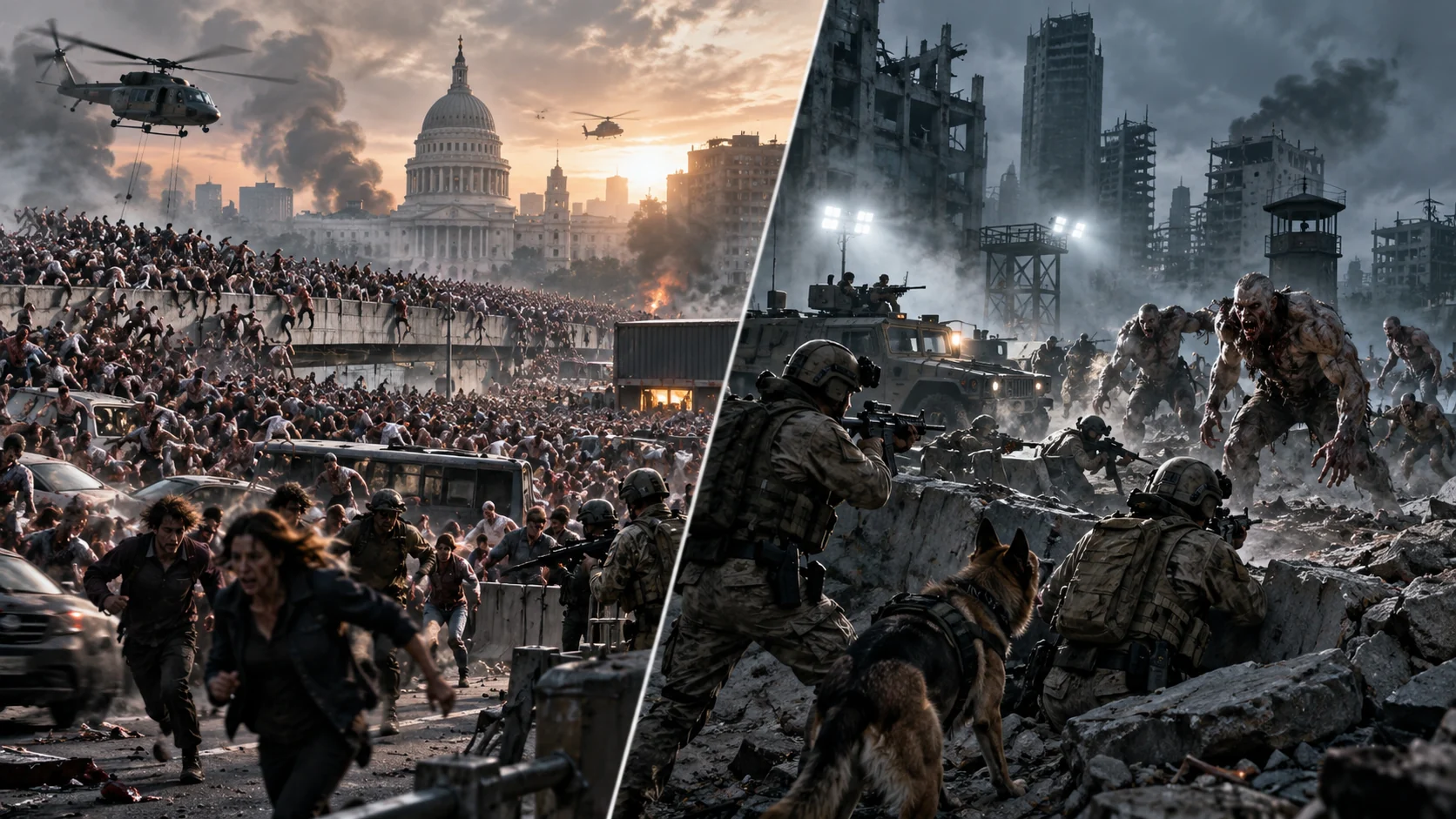
World War Z emphasizes overwhelming mass while Extinction Cycle adds individual agility, evolution and command intelligence.
Nicholas Sansbury Smith's Extinction Cycle has often been described in the same conversation as World War Z, but the comparison becomes much more interesting once you stop at the marketing shorthand and examine how the two worlds actually work.
Both franchises imagine a global collapse caused by infected or transformed humans. Both care about military response. Both ask whether governments can adapt fast enough to an enemy that does not fight according to ordinary human rules. Both move beyond individual survival and look at national or international recovery.
But their monsters create very different strategic problems.
The World War Z novel by Max Brooks is built around slow, relentless undead and the global political response to them. The 2013 film adaptation radically changes the enemy into fast-moving swarms that can overwhelm cities in minutes. Extinction Cycle goes in a third direction: living Variants created by a fictional military bioweapon, capable of speed, climbing, pack behavior, biological evolution and eventually organized warfare.
So if the same humanity had to face these outbreaks, where would survival odds be highest?
The answer depends on which version of World War Z you mean. This article compares Extinction Cycle primarily with the 2013 film's fast swarms, while also explaining how the Max Brooks novel changes the result.
Quick verdict
| Category | World War Z film | Extinction Cycle | Worse threat |
|---|---|---|---|
| Initial outbreak speed | Catastrophically fast | Catastrophically fast | Tie |
| Baseline infected speed | Extreme swarm speed | Extreme individual speed and agility | Tie |
| Vertical movement | Swarms pile over walls | Variants climb walls, roofs and tunnels individually | Extinction Cycle |
| Intelligence | Low individual strategy | Pack learning, Alphas and later engineered command | Extinction Cycle |
| Mass assault | Exceptional | Exceptional | World War Z film |
| Biological evolution | Limited compared with EC | Central feature of the saga | Extinction Cycle |
| Long-term military adaptation | Humanity discovers exploitable behavior | Humans develop multiple weapons and doctrines | Tie |
| Organized infected warfare | No | Yes in Dark Age | Extinction Cycle |
| Rebuilding potential | High once solution is found | High after Great War, then challenged again | Close |
| Worst-case future | Recurring zombie outbreaks | Rival engineered post-human civilization | Extinction Cycle |
Overall verdict: Humanity probably has a slightly better chance against the World War Z film infected once their behavioral vulnerability is understood. Extinction Cycle is harder because solving one generation of the enemy does not solve the next.
First, the huge difference between the World War Z book and movie
Any serious comparison has to begin here.
Max Brooks' World War Z: An Oral History of the Zombie War uses traditional slow undead. The horror comes from scale, persistence, political failure and the inability of modern militaries to immediately adapt doctrine to an enemy that does not fear death, bleed out normally or care about conventional suppression.
The 2013 film turns the infected into sprinting swarms.
That changes almost everything.
In the novel, distance and discipline can be decisive once armies understand the enemy.
In the movie, a wall can disappear beneath a living pyramid of bodies in seconds.
Extinction Cycle sits somewhere between these models.
Variants are fast enough to create film-style chaos, but intelligent and biologically adaptive enough to create a strategic problem closer to the novel's long war.
Outbreak day: which world collapses faster?
The film version of World War Z is brutally efficient at destroying the illusion of urban control.
Traffic jams become traps. Police lines fail. Crowds create more infected. The transformation window is so short that one breach can multiply rapidly.
Extinction Cycle is similarly devastating, especially because first responders do not initially understand what they are facing.
The difference is secrecy.
In Extinction Cycle, the outbreak is connected to classified military research. Team Ghost enters Building 8 without full knowledge of VX-99's history. Scientists and commanders receive fragments of information. Institutional delay is not simply caused by disbelief. It is also caused by compartmentalization.
That makes the first phase especially dangerous.
World War Z's authorities are slow to understand the nature of the plague.
Extinction Cycle's authorities include people who know pieces of the truth and do not share them quickly enough.
For a civilian, the result feels similar: the system collapses before useful guidance reaches you.
Baseline enemy: WWZ film zombie versus standard Variant
In a straight sprint, both are terrifying.
The film zombie's advantage is swarm behavior created by sheer momentum. Large groups move almost like a fluid. They pile on one another, climb through collective pressure and overwhelm barriers by mass.
The Variant's advantage is individual mobility.
A Variant does not need a thousand bodies to reach a rooftop. It can climb. It can use walls, windows, sewers and elevated structures as hunting terrain.
That distinction changes small-unit survival.
Against a WWZ swarm, the key is avoiding the mass.
Against Variants, the key is never assuming you are safe because you left the street.
A single Variant can follow you into the space that looked defensible.
Which enemy is easier to shoot?
This sounds like a simple question, but it exposes the difference between tactical and strategic danger.
A WWZ film zombie is fast, but it generally moves directly toward prey once activated. A massed swarm creates a terrible volume problem, yet the behavior is relatively predictable.
Variants can become less predictable.
Extinction Cycle repeatedly shows them darting, flanking, testing distance and using cover or vertical surfaces. Alphas increase coordination. Some later forms are armored enough that standard small arms become less reliable.
A machine gun firing into a WWZ swarm can kill many targets but may not stop the wave.
A machine gun firing at Variants may face fewer bodies but more complex movement.
For an infantry squad, I would rather defend against the WWZ infected from a prepared kill zone.
For a city evacuation, I would rather not face either.
The wall test
The 2013 World War Z film contains one of the most famous images in modern zombie cinema: infected bodies piling high enough to scale a massive defensive wall.
The lesson is clear.
A barrier without stand-off distance is not a complete defense.
Extinction Cycle reaches the same conclusion by a different route.
Variants climb as individuals. Alphas and advanced forms can exploit structures. Tunnels can become infiltration routes. Rooftops are not automatically safe.
If I were designing a fortress, the WWZ world would require:
- enormous clear zones around walls
- continuous automatic fire coverage
- barriers that prevent bodies from accumulating
- rapid removal or destruction of piles
- strict noise control
The Extinction Cycle world would require all of that plus:
- roof security
- tunnel sensors
- subterranean patrols
- anti-climb surfaces
- night-vision systems
- defenses against armored forms
That extra vertical complexity gives Extinction Cycle the edge in fortress-breaking danger.
The sound problem
Both enemies can punish noise.
Large numbers of WWZ film infected respond dramatically to sound and movement. That makes helicopters, gunfire and crowds potentially dangerous even when they are part of a rescue operation.
Variants also use sound and sensory cues to locate prey, but some have enhanced smell and other tracking abilities.
This matters because silence is easier to control than scent.
A WWZ survivor can sometimes avoid detection by staying still and quiet.
An Extinction Cycle survivor may be found because the creature can smell or sense him despite good noise discipline.
That makes stealth less reliable.
Which military loses harder at the beginning?
Both.
Modern militaries are optimized for human enemies.
Human enemies use cover, care about casualties, depend on logistics, communicate, retreat and make decisions based on self-preservation.
Zombie or Variant forces break those assumptions.
The novel World War Z famously explores the failure of conventional firepower and doctrine against undead masses. Shock and awe are less useful when the enemy does not panic.
Extinction Cycle creates a similar problem through speed and terrain.
Artillery and airpower can kill enormous numbers of Variants, but ground forces are often used to draw them out, producing terrible casualties. Operation Liberty becomes a lesson in what happens when commanders try to apply familiar military thinking to an unfamiliar biological enemy.
The difference is that Extinction Cycle's military also has a scientific arm racing to change the enemy itself.
War and biology become inseparable.
Which world has the better scientific solution?
The World War Z film finds a behavioral camouflage strategy.
The infected appear to avoid people with certain serious illnesses because they do not represent viable hosts. Humanity can exploit that behavior to move among the infected more safely.
This is elegant because the solution does not require eradicating the pathogen immediately.
It changes the relationship between predator and prey.
Extinction Cycle's scientific response is much more aggressive.
Kate Lovato and other researchers develop weapons designed to kill Variants or attack their changing biology. These responses can work, but every intervention risks selecting for new forms or producing unintended consequences.
In simple survival terms, the World War Z film solution is better.
In narrative terms, Extinction Cycle is more frightening because every cure can become the next chapter of the arms race.
The intelligence gap
This is the category that decides the overall comparison.
World War Z film infected are dangerous because they are fast, numerous and responsive.
They are not strategic commanders.
Extinction Cycle Variants gradually become smarter.
Alphas coordinate packs. The Bone Collector identifies priorities and rivals. Juveniles change the physical threat. Dark Age introduces Scions and Chimeras capable of using weapons and functioning under organized command.
Azrael is the endpoint.
He can plan campaigns, use captured technology, manipulate prisoners, direct human collaborators and articulate an ideology.
That turns the infected threat into warfare.
The World War Z film's zombies can destroy a city.
Azrael can decide which city to attack and why.
Could a World War Z swarm overwhelm an Allied States outpost?
Absolutely.
A sudden mass assault could be catastrophic, especially if the outpost lacked enough ammunition or failed to maintain a clear perimeter.
But the Allied States has advantages most World War Z civilians do not.
It has years of experience defending against fast infected.
Its walls are designed around Variants. Its soldiers understand biological threats. Its outposts use sensors and maintain rapid-response forces.
A WWZ swarm would be horrifying but conceptually familiar.
The defenders already know that the enemy can move quickly and attack en masse.
The greater threat would be surprise and numbers.
Against Dark Age Scions, the same outpost faces something worse: attackers capable of shooting back and choosing targets.
Could Team Ghost survive World War Z?
Yes, and probably very effectively once the rules are understood.
Team Ghost's greatest strengths are reconnaissance, adaptation and fire discipline.
The operators are used to targets that move faster and climb better than humans. Standard WWZ film infected would be frightening but not conceptually new.
Ghost would need to adjust to the extreme infection speed and the danger of body-fluid exposure.
It would also need to avoid being trapped by mass.
The unit's biggest advantage would be refusing to fight unnecessary battles.
A team that survives Variants learns quickly that ammunition is not victory if the shooting draws ten thousand more enemies.
That lesson transfers perfectly.
Would Gerry Lane survive Extinction Cycle?
Gerry's greatest weapon is observation.
He survives World War Z not because he is the strongest fighter but because he notices patterns other people miss.
That would make him unusually valuable in Extinction Cycle.
He would likely recognize quickly that Variants are not all behaving identically. He would notice the importance of Alphas, sensory differences and changing tactics.
His weakness would be physical combat.
The Extinction Cycle universe is less forgiving of close calls. A Variant that reaches him may possess greater strength and mobility than a WWZ infected.
Gerry would need Team Ghost more than Team Ghost would need Gerry in a firefight.
In an intelligence room, the relationship reverses.
The global response problem
The World War Z novel is strongest when showing how different governments respond to the same disaster.
Some hide information. Some improvise. Some collapse. Some make brutal strategic decisions. Eventually humanity adopts doctrine designed specifically for the zombie war.
Extinction Cycle has similar global breadth, especially through European campaigns, side stories, New Zealand narratives and naval operations.
But the main series remains more tightly connected to American military and scientific characters.
That difference affects what each franchise is really about.
World War Z is a history of a global war.
Extinction Cycle is a close-up of the people trying to keep the war from becoming extinction.
Which infection is easier to eradicate?
World War Z film infected appear easier once humanity understands their behavioral weakness and can organize a systematic response.
Extinction Cycle Variants are harder because the target changes.
Imagine designing a weapon that works against standard Variants.
Then armored juveniles emerge.
Imagine adapting tactics to Alphas.
Then engineered Scions appear.
The problem is not just killing enemies.
It is maintaining scientific and military superiority over an adaptive population.
That is a much harder long-term problem.
The book version changes the answer
If we compare Extinction Cycle to the Max Brooks novel instead of the film, humanity's odds improve significantly against the zombies.
The book's undead are slow.
That makes isolated communities, fortifications and disciplined infantry far more viable once the correct doctrine is adopted.
The danger remains enormous because the infected do not tire, panic or bleed out normally, and millions of bodies can create unstoppable pressure.
But time favors organized humans.
A slow enemy gives scientists, engineers and military planners time to learn.
Variants do not.
Against the book's zombies, Team Ghost would be devastatingly effective.
Against Dark Age New Gods, the World War Z militaries would face an enemy closer to another army than a plague.
Which apocalypse gives civilians the better odds?
There are two answers.
During the first week
The Max Brooks novel world is best.
The slow undead are horrifying, but distance matters.
The World War Z film and Extinction Cycle are far worse because infected can close distance almost immediately.
Ten years later
The World War Z film world may be best if the camouflage strategy has become widespread and governments have stabilized.
Extinction Cycle also reaches a rebuilding phase through the Allied States, but Dark Age proves the biological war can restart in a new form.
So the civilian's safest universe depends on whether you trust the solution to remain solved.
In Extinction Cycle, you should not.
The moral difference
World War Z asks whether humanity can become disciplined enough to survive a new enemy.
Extinction Cycle asks whether humanity can become disciplined enough not to recreate the enemy.
That second question is darker.
VX-99 is human-made.
The counterweapons are human-made.
Azrael's Scions are human-made.
The extinction cycle is not simply something nature does to people.
It is something people keep doing with knowledge and power.
That gives Extinction Cycle a different kind of pessimism.
Winning the war does not remove the cause if the cause is human ambition.
Which world rebuilds better?
Both offer recovery, but Extinction Cycle gives the reader a more detailed picture of successor-state reconstruction.
Eight years after Extinction War, the Allied States has roughly one hundred outposts, restored agriculture, manufacturing and parts of the energy grid.
By the end of Dark Age, a repaired naval vessel returns to service.
That indicates deep institutional recovery.
World War Z also imagines postwar reconstruction, especially in the novel, but the focus is retrospective and global rather than centered on one successor state.
In both cases, the real victory is the same:
Humans stop surviving meal to meal and begin planning generations ahead.
Frequently asked questions
Are World War Z zombies faster than Extinction Cycle Variants?
The 2013 film infected are extraordinarily fast in swarms. Standard Variants are also extremely fast and have superior individual climbing and urban mobility. The comparison is close in raw speed, but Variants have the broader movement toolkit.
Are Extinction Cycle Variants zombies?
The books distinguish Variants from traditional undead. They are living humans transformed by a fictional bioweapon and infection process.
Which enemy is smarter?
Extinction Cycle by a large margin. Alphas coordinate packs, and Dark Age engineered forms can communicate, use weapons and participate in planned military operations.
Could World War Z zombies climb Extinction Cycle outpost walls?
Film zombies can climb through mass piling, so yes, a large enough swarm could threaten walls. Allied States outposts would likely be better prepared than ordinary settlements because they already defend against fast Variants.
Would Team Ghost survive World War Z?
Probably. Their training and experience against fast infected would transfer well, especially once they understood transmission and swarm behavior.
Which apocalypse is easier for a lone survivor?
The Max Brooks novel version of World War Z is easiest because the zombies are slow. Between the film and Extinction Cycle, the answer depends on geography, but Variants create the more complex individual threat.
Final verdict
Humanity has the better chance in World War Z.
That conclusion may seem strange because the film's swarms are visually larger and faster than almost anything in Extinction Cycle.
But the WWZ enemy remains conceptually stable.
Once humans discover what the infected do, they can design doctrine around it.
Extinction Cycle refuses to grant that stability.
The enemy learns.
It organizes.
It reproduces into new forms.
Scientists create counterweapons, and those counterweapons alter the battlefield.
Years later, Azrael takes the same science and intentionally creates soldiers capable of using rifles and following orders.
That is the decisive difference.
World War Z asks humanity to solve a plague.
Extinction Cycle eventually asks humanity to defeat a competing model of humanity.
The first war is terrible.
The second can continue forever.
Sources and editorial notes
This comparison distinguishes Max Brooks' original novel from the 2013 Paramount film because their infected behave very differently. Film background and official synopsis information were checked against Paramount's World War Z page. Extinction Cycle analysis draws on the original series, Dark Age continuation and relevant expanded-universe stories.
External reference: https://www.paramount.com/movies/world-war-z
Recommended next pages
- lore variant evolution new gods
- series reading order
- Every Extinction Cycle Variant Ranked From Least to Most Dangerous
- The Last of Us vs. Extinction Cycle: Which Infection Would Be Harder to Survive?
- Could the Extinction Cycle Actually Happen? The Real Science Behind VX-99, Epigenetics and the Hemorrhage Virus
- Browse all Extinction Cycle editorials
Sources and editorial scope
- Canon treatment
- Independent fan analysis grounded in the supplied Extinction Cycle source audit and clearly separated from compared franchises or real-world science.
- Spoiler scope
- Spoilers for World War Z and Extinction Cycle through Dark Age