
Enclosure versus networked resilience
Silo vs. Extinction Cycle: Is a Sealed Community Safer Than an Armed Outpost?
Compare Silo and Extinction Cycle through enclosure, armed outposts, technical dependence, information control, legitimacy, and long-term resilience.
·
Category: Analysis and Opinion
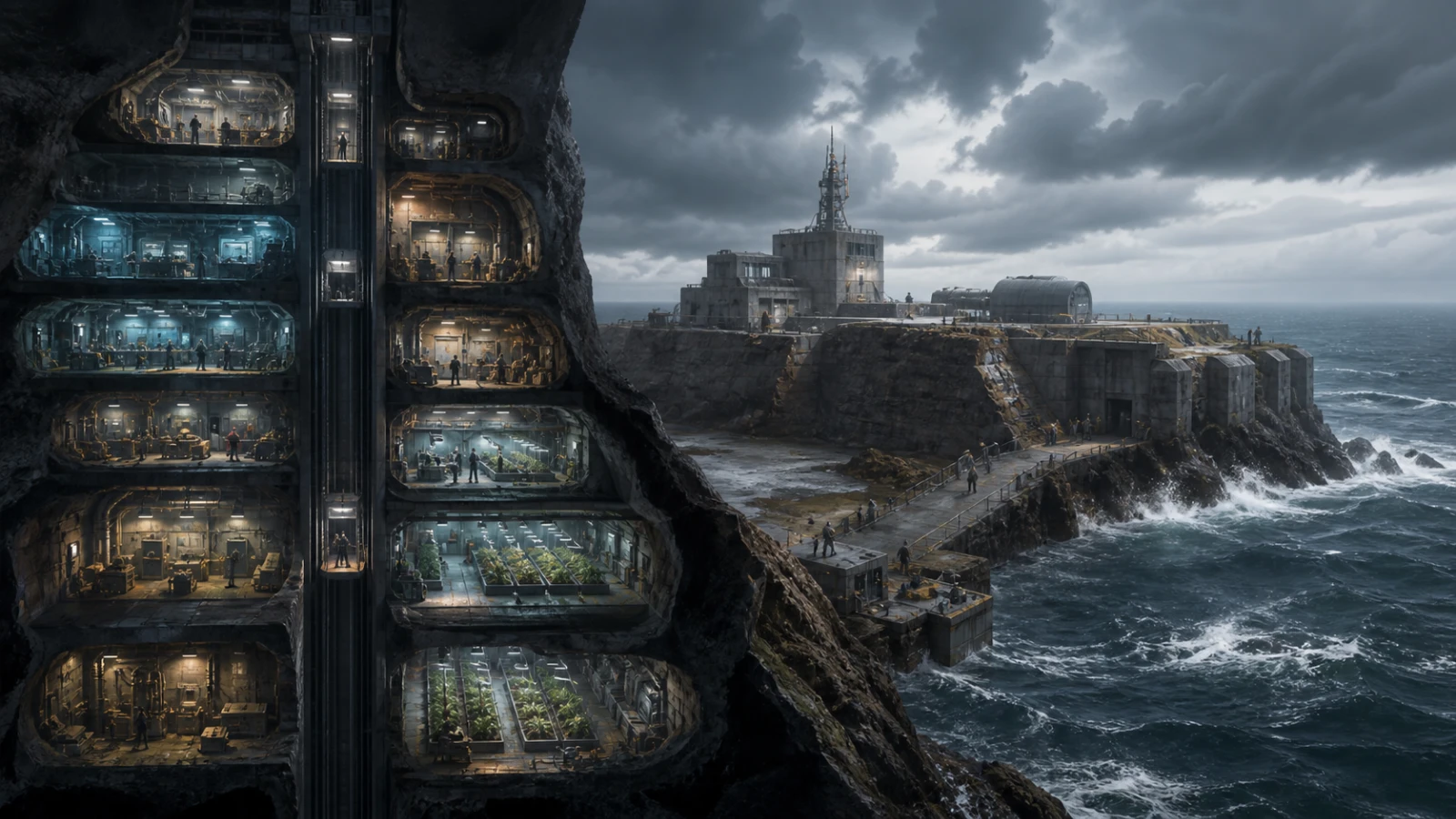
Thesis: A sealed community may survive by cutting itself off, but an armed outpost survives by learning how to live with danger instead of pretending danger can be erased.
Introduction
Few survival questions are more interesting than whether people are safer sealed away from a dangerous world or forced to defend themselves in open contact with it. That is the central tension behind a comparison between Silo and Extinction Cycle. At first glance the answer seems obvious. A sealed underground community should be safer than an exposed outpost. If the outside world is toxic, violent, or unpredictable, then lock the door, ration resources, and keep the population under technical control. That is the Silo premise in its purest form.
Extinction Cycle makes the opposite wager. Settlements such as Island 911 and other defended enclaves are not protected by perfect isolation. They are protected by alertness, perimeter discipline, communications, and the willingness to treat the world outside as an ongoing operational problem. People live with watch posts, patrols, access control, and a constant awareness that security is not a static condition. It is a daily practice.
The contrast is powerful because both models answer real post-collapse fears. The sealed community promises continuity. It can preserve population, technical systems, and social order. But it also invites secrecy, information control, and dependence on the integrity of the sealed system itself. The armed outpost promises adaptability. It can engage with allies, learn from threats, and expand its defensive footprint. But it also exposes people to infiltration, logistics stress, and exhaustion. Comparing the two shows that safety is not only about walls. It is about what kind of truth, leadership, and resilience a community is built to tolerate.
The Basic Security Logic of Each Model
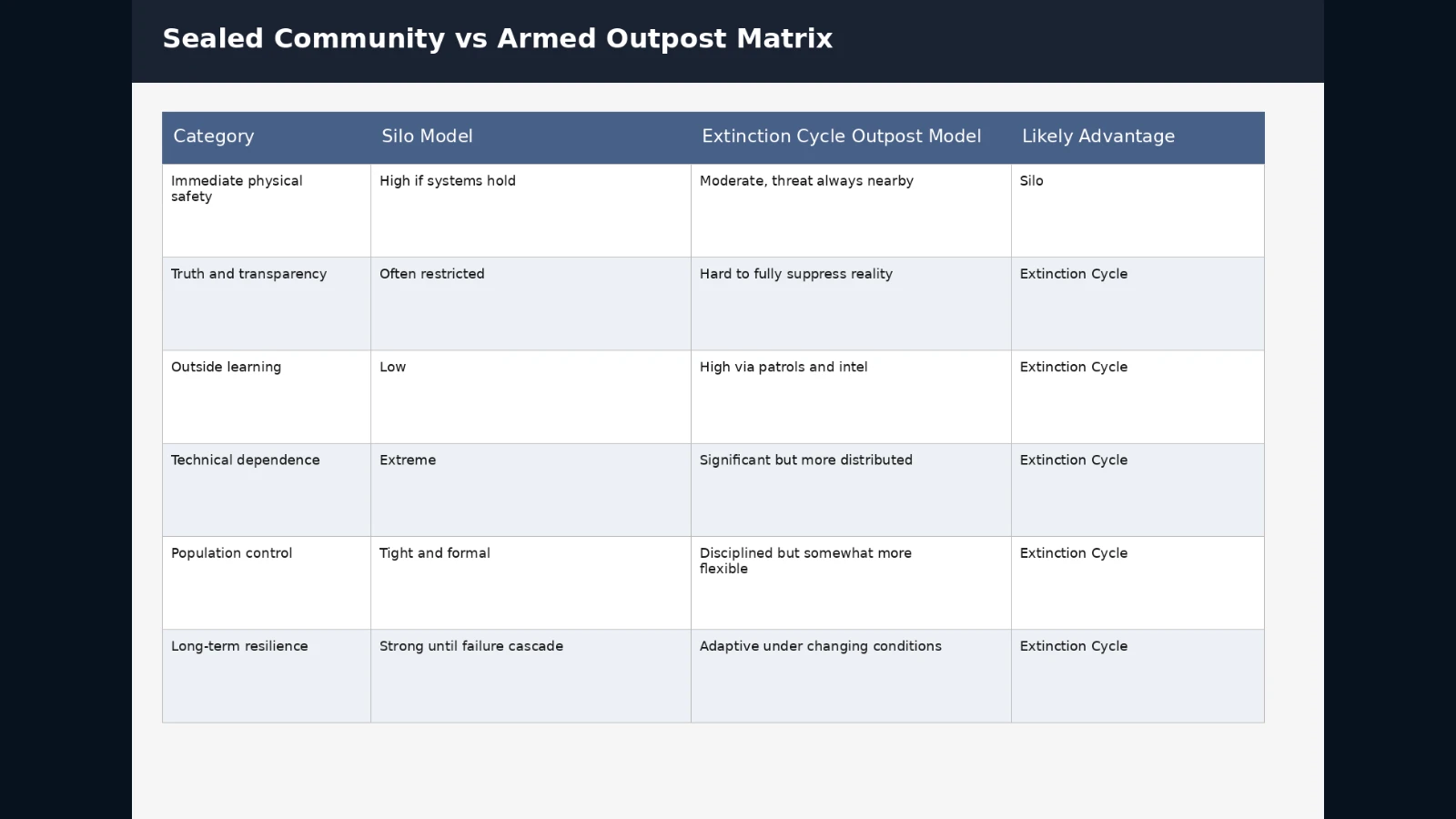
A silo community begins with exclusion. It keeps the outside out, often almost absolutely. Air, water, food production, technical repair, population management, and information flow all become part of an enclosed ecosystem. This arrangement can be incredibly strong against environmental exposure. If the outside world is deadly, a sealed habitat creates a buffer that a normal settlement cannot. It simplifies some risks by denying contact.
An Extinction Cycle outpost begins with controlled exposure. Instead of pretending contact can be reduced to zero, it assumes the world must still be navigated. People need scouting, supply movement, intelligence gathering, patrol operations, radio communication, and occasional expansion or alliance-building. Security therefore depends on trained response rather than total insulation. The community survives because it is disciplined enough to absorb contact without collapsing.
This means the two communities train different instincts. A sealed silo wants compliance, maintenance culture, and reverence for systems stability. An armed outpost wants vigilance, cross- training, and the ability to make tactical judgments under uncertain conditions. One treats outside contact as contamination. The other treats outside contact as unavoidable reality. Neither choice is automatically foolish. Each is a coherent answer to a different survival philosophy.
Secrecy, Information Control, and the Cost of Not Knowing
Sealed communities are almost always tempted by secrecy. Once a population is enclosed and dependent, information becomes a survival resource and a political weapon. Leaders may tell themselves that restricting truth protects order. If people panic, question doctrine, or lose faith in the system, stability may crack. That logic is understandable and dangerous at the same time. A silo can become physically safe while growing morally unstable. The population survives, but only under narratives carefully managed from above.
This is where Silo becomes such a rich comparison partner for Extinction Cycle. Extinction Cycle also understands secrecy, especially around military planning and scientific knowledge, but its settlements are less able to sustain complete narrative control. The outside world constantly interrupts any sealed story. Patrols come back with intelligence. Threats evolve. Supply conditions change. Civilians hear things. Soldiers see things. Scientific results have operational consequences. Information management still matters, but absolute secrecy is harder to preserve.
That difference affects trust. In a sealed community, trust can erode quietly because people suspect they are not being told the whole truth yet have little independent means of verification. In an armed outpost, trust erodes more noisily because people encounter reality directly and judge whether leaders respond competently. Ironically, the more exposed model may sustain healthier legitimacy if it tells the truth better. Exposure forces adaptation. Enclosure can allow illusion. A silo may look safe on paper while becoming fragile in culture because its people are trained to obey the system more than understand it.
Population Control and Civic Life
Safety is not only physical. It is social. A sealed community must regulate population intensely. Space, food, air, technical maintenance, medical capacity, and generational continuity all become carefully managed variables. That gives leaders strong reasons to monitor movement, labor, and behavior. The result may be orderly, but it rarely feels politically open. When a society’s survival depends on tightly bounded technical systems, freedom becomes harder to separate from risk.
Extinction Cycle outposts also regulate life, especially during active threat periods, but their social logic is somewhat broader. Space may still be limited. Supplies may still be scarce. Yet there is at least a conceptual horizon beyond the wall. People can imagine patrol work, trade links, farming expansion, recruitment, or eventual political integration into a wider network such as the Allied States. That horizon changes civic psychology. Even under discipline, the community is not purely inward-facing. It is still part of a struggle to reclaim external ground.
That distinction can matter enormously over time. Sealed communities often become psychologically compressed. Rumor grows in tight spaces. Institutional myths deepen. Ordinary disputes acquire larger symbolic meaning because there are so few outlets. Armed outposts have different stresses, but they sometimes retain more social breathing room simply because survival still involves outward action. People are not only living inside the system. They are contributing to a larger frontier of recovery.
Technical Dependence and Failure Cascades
A silo is only as strong as the systems that make enclosure possible. Air purification, water treatment, structural integrity, agriculture, waste handling, energy continuity, and repair expertise are not support functions. They are life itself. This creates a vulnerability that sealed- community fiction often dramatizes brilliantly. When technical systems fail, the community does not just become less comfortable. It may become nonviable. A few breakdowns can cascade into existential crisis because the whole population is concentrated inside one dependent machine.
Extinction Cycle outposts can also fail catastrophically, but their failure modes are different. If a generator dies, a patrol route is compromised, or a perimeter section weakens, the consequences can be terrible, yet many open communities have more improvisational flexibility. People may redistribute labor, relocate supplies, reroute communications, or even abandon one site in favor of another. Mobility remains a strategic option. A silo has far less room to reconfigure at scale. It must keep the system working from within.
This is one reason the sealed-community model is not automatically safer. It is safer against some threats and weaker against others. It suppresses exposure risk but amplifies systems risk. The armed outpost accepts exposure risk but may reduce single-point technical failure because it is not fully dependent on an enclosed total environment. The tradeoff is profound. A silo is secure when stable. An outpost is survivable when disrupted.
Outside Contact and Strategic Learning
The ability to learn from the outside world may be the most underrated advantage of the Extinction Cycle model. Outposts can scout, test assumptions, build alliances, and adjust doctrine. They can discover new routes, threats, and opportunities. They can learn from mistakes because they still interact with a living environment. This does not make them comfortable. It makes them adaptive.
A silo community often struggles to do the same. By design, it minimizes outside contact. That means it also minimizes outside feedback. Its leaders may believe they are preserving safety, but they are also limiting the community’s ability to update its worldview. Over long stretches, that can become deeply dangerous. A society with incomplete information about the world beyond its door is more likely to mistake internal stability for actual security. If conditions change outside, or if the community’s founding assumptions were incomplete, the cost of ignorance grows.
Extinction Cycle repeatedly returns to the value of operational learning. Surviving a biological apocalypse requires intelligence, field reports, evolving tactics, and the humility to accept that yesterday’s threat picture may be outdated. That mentality is difficult to sustain in a sealed society whose first reflex is containment. The more complex the outside world becomes, the more enclosure risks strategic blindness.
Island 911 and the Question of Durable Resilience
Island 911 is a useful reference point because it illustrates the disciplined outpost model at a scale that feels civic rather than purely tactical. It is protected, bounded, and governed, but it is not detached from reality. It exists through defense, organization, and logistical competence. That gives it a type of resilience a pure silo may lack. It can absorb people, use communications, manage entry, and coordinate with broader recovery efforts. It is not merely a shelter. It is part of a system.
That systemic quality matters because long-term survival is never only local. Communities need information, redundancy, and some relationship to larger political structures. A sealed community may endure for a long time if everything goes right. But if it does not connect to anything beyond itself, its margin for strategic surprise shrinks. Island 911-style settlements, by contrast, are stronger precisely because they are not self-contained myths. They are exposed enough to learn and organized enough to use what they learn.
This does not make them invulnerable. Armed outposts can be overrun, politically strained, or logistically hollowed out. But their resilience is more visible and more cumulative. It is built through active practice. A silo’s resilience is often latent until tested, which means its weaknesses can remain hidden until they become urgent.
Current Hook: Why Silo Resonates Now
Silo continues to resonate because it dramatizes the tension between safety and truth with unusual clarity. Apple’s official press materials identify the series as a dystopian story about thousands of people living underground, and its Season 3 release in 2026 renewed attention around sealed- community logic and the burden of hidden history. That current visibility gives the comparison contemporary relevance. Viewers are freshly primed to think about who controls information, why communities obey systems they did not choose, and whether a closed order is really safer than a dangerous freedom above ground.
Extinction Cycle answers those questions from a harsher tactical angle. It suggests that the world may be too active, too hostile, and too fluid for safety through enclosure alone. Survival communities eventually need contact, defense, and broader reconstruction. That contrast is exactly why the pairing works right now.
Evacuation and the Value of a Second Option
The sharpest test of either model is not how it behaves on a normal day. It is what happens when the settlement itself becomes the danger. A sealed habitat can offer extraordinary protection while its boundaries remain trustworthy. Once life-support, leadership, or structural systems fail, however, the same enclosure that kept danger out can make escape politically and physically difficult. A population trained to treat the exterior as unthinkable may have no practiced alternative when the interior stops being safe.
An armed outpost usually lives with a less comforting assumption: relocation may become necessary. That does not make evacuation easy. Moving civilians, medical capacity, records, food, and defensive personnel through a hostile landscape can be disastrous. Yet the possibility remains part of the community's strategic imagination. Routes can be compared, nearby settlements can become partners, and authority can survive a change of ground. The outpost is a place, but it does not have to become the whole world.
This is where redundancy becomes more important than apparent strength. The safer community is the one with more than one way to remain a community: multiple sources of knowledge, leadership that can be replaced, relationships beyond a single site, and a plan for continuity when the original shelter no longer works. Silo dramatizes the danger of allowing one enclosed system to define truth and survival at the same time. Extinction Cycle's networked recovery is messier, but the network gives failure somewhere to go.
The Danger of a Single Source of Truth
Enclosure also changes who can verify reality. When nearly every sensor, record, and announcement comes through one institutional chain, even honest mistakes can harden into doctrine. A sealed society does not need a cartoon villain to become brittle; it only needs leaders who confuse preserving order with preserving their own explanation of the world.
Outposts have an advantage because independent observation is difficult to eliminate. Patrols, travelers, radio contacts, and neighboring communities create competing evidence. That can make politics noisy, but it also makes correction possible. Long-term safety depends on this ability to discover that yesterday's certainty was wrong. Walls defend bodies. A healthy information system defends judgment.
Conclusion
So is a sealed community safer than an armed outpost? In the short term, often yes. If the outside is immediately deadly, enclosure can reduce exposure, preserve population, and prevent chaos. But over the long term the answer becomes more complicated. Safety without truth creates political fragility. Stability without outside learning creates strategic blindness. Technical dependence without redundancy creates existential bottlenecks. The sealed community may eliminate some risks by concentrating life inside a controlled system, yet it also concentrates failure.
Extinction Cycle’s armed outpost model is harsher, louder, and more visibly stressful, but it may be more resilient because it is designed to live with uncertainty. Settlements like Island 911 endure not by denying the outside world but by meeting it with discipline, force protection, logistics, and adaptation. Their social contract is not comfort. It is readiness.
That makes the final answer less romantic than either franchise might first suggest. A silo is safer if all you need is shelter. An armed outpost is safer if what you really need is a future. One preserves life by narrowing it. The other preserves life by training it to face risk without surrendering the possibility of rebuilding beyond the walls.
FAQ
Is a sealed habitat safer during the first stage of a catastrophe?
Often, yes. It can sharply reduce immediate exposure. The tradeoff is deeper dependence on internal machinery, leadership, and information.
Why use Island 911 as the Extinction Cycle comparison point?
It represents a defended community that remains connected to logistics, communication, and wider recovery rather than functioning as a completely closed refuge.
Does the article reveal Silo plot details?
It discusses the series' broad premise and themes of secrecy, rebellion, and underground life, but it is not an episode-by-episode recap.
Source note
Apple's official press material describes Silo as a dystopian society of 10,000 people living underground and confirms that Season 3 premiered July 3, 2026. Extinction Cycle claims are checked against current Island 911, outpost, Allied States, and logistics records.
Editorial note
This independent fan analysis uses original generic artwork and a submitted editorial comparison chart. It does not reproduce official franchise images, actor likenesses, logos, or claim a canon crossover.