
Two models for rebuilding America
Fallout vs. Extinction Cycle: Two Ways to Rebuild America After the End
Compare Fallout and Extinction Cycle through shelter systems, factions, legitimacy, technology, security, and the difficult work of rebuilding America.
·
Category: Analysis and Opinion
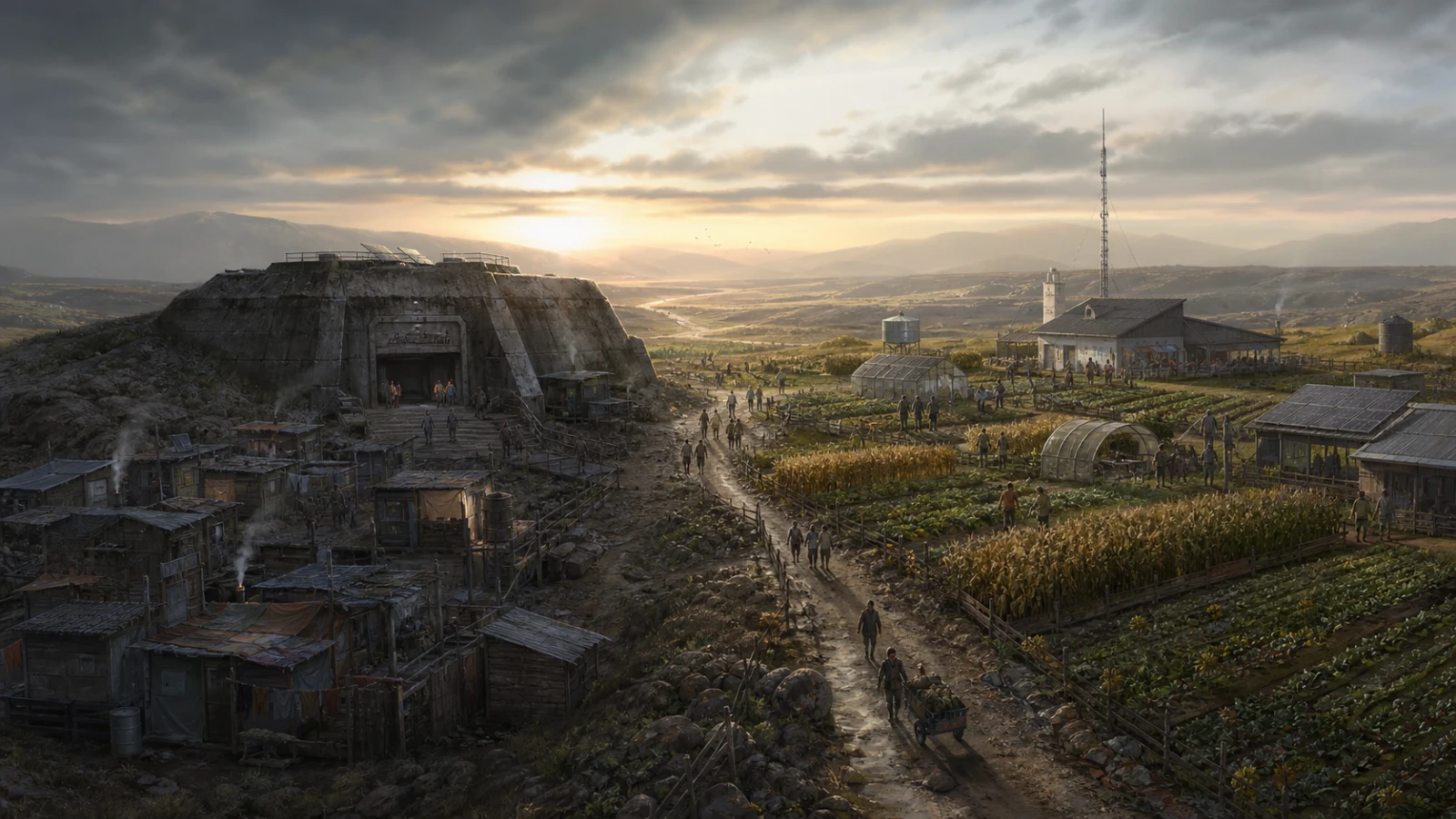
Thesis: Both worlds ask the same big question in very different ways: once the old United States breaks apart, what kind of authority deserves to replace it?
Introduction
When readers compare post-apocalyptic franchises, they often start with creatures, weapons, and ruined skylines. That is understandable. Fallout is instantly recognizable for its retro-futurist vaults, power struggles, and scavenged Americana, while Extinction Cycle stands out for its military response, Variant threat, and harsh campaign of survival against engineered biological catastrophe. Yet the more interesting comparison is not only who survives the end of the world. It is how people try to rebuild after the initial collapse.
Fallout imagines a United States shattered by nuclear war and reassembled through a patchwork of vault populations, wasteland towns, raider territories, techno-factions, and competing political experiments. Extinction Cycle imagines an outbreak-driven collapse in which military command, scientific response, defended outposts, and later the Allied States become the scaffolding for a new kind of order. Both settings contain shortages, trauma, and violence. Both ask whether a legitimate government can still exist after national institutions have failed. Both show that survival is easier to improvise than civilization.
This makes the comparison more than a fun franchise crossover. It becomes a study in reconstruction. Fallout rebuilds America from below, through improvised settlements and rival factions that often distrust any central authority. Extinction Cycle rebuilds more directly through security networks, defended enclaves, and a stronger belief that organized leadership remains necessary if humanity is going to retain infrastructure, law, and coordinated defense. The contrast reveals two very different philosophies of what stability looks like after catastrophe.
One model trusts hardened settlements, preserved technology, and negotiated coexistence among factions. The other leans harder on military competence, communications chains, scientific integration, and the gradual reassertion of post-collapse governance. Looking at them side by side helps explain why Extinction Cycle often feels more operationally grounded, while Fallout feels broader, stranger, and more politically fragmented. Each vision has strengths. Each vision carries its own danger.
The Collapse Each World Inherits
A major reason the two franchises rebuild differently is that they begin from different kinds of collapse. Fallout emerges from total strategic devastation. Nuclear exchange destroys cities, poisons landscapes, destabilizes supply chains, and ensures that the surviving population inherits a continent-sized wound. Even when some technology survives, large areas of society do not retain reliable institutions. The result is a world in which local adaptation matters more than national continuity. Settlements rise where they can, identities fragment, and legitimacy becomes negotiable. The wasteland does not merely damage America. It replaces America with hundreds of smaller experiments.
Extinction Cycle inherits a different disaster pattern. The world collapses because of biological threat, violent infected evolution, and the strategic breakdown that follows. That still produces terrifying destruction, but it also leaves more room for defended enclaves, operational command structures, and the possibility of reconnecting territory once the worst waves are contained. Roads, bases, islands, secure perimeters, and supply sites can still matter. The challenge is less about inhabiting irradiated ruins forever and more about whether humanity can transition from emergency response to durable reconstruction before new threats finish the job.
That distinction shapes everything. Fallout communities tend to look like long-settled improvisations built atop old debris. Extinction Cycle communities often feel like wartime necessities evolving into civic structures. Fallout asks what culture and politics look like after the old nation has been pulverized into legend. Extinction Cycle asks whether a war-torn civilization can reconnect enough command, agriculture, transportation, and defense to become a nation again. The first framework produces decentralized pluralism and constant rivalry. The second encourages a stronger push toward coordinated recovery.
Allied States vs. Vaults and Wasteland Settlements
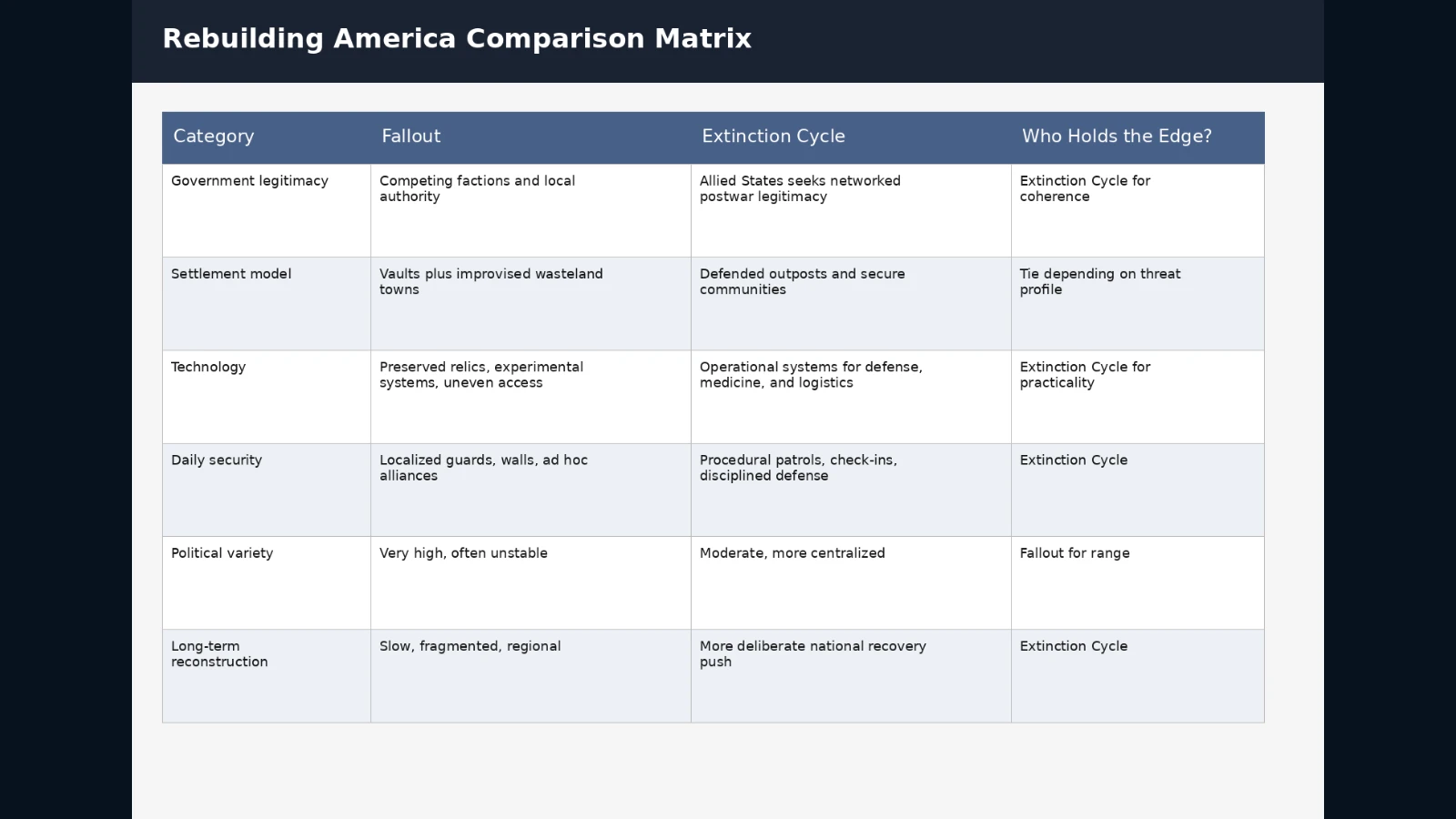
The heart of this comparison lies in the kinds of communities each franchise treats as normal. In Fallout, vaults are one of the most iconic structures in all of post-apocalyptic fiction. They are engineered shelters built around preservation, control, technical dependence, and in many cases secrecy. Even when a vault is functional, it is not automatically a healthy political community. A sealed population can be stable for a time, but that stability is often purchased through surveillance, doctrine, manipulated information, or dependence on machinery that only a few understand. Vaults preserve people, but they also preserve hierarchy and psychological pressure.
Outside the vaults, wasteland settlements evolve in a more improvised way. These towns are practical answers to immediate problems: food, water, scavenging, perimeter defense, and local trade. They are often more culturally alive than vaults because they are forced to negotiate with the outside world. But they also tend to be vulnerable. Their strength usually depends on geography, personalities, and the temporary balance of nearby threats.
Extinction Cycle settlements such as defended islands, outposts, and later Allied States communities occupy a middle ground between those two models. They are not sealed underground populations cut off from the world, but they are not casual open settlements either. Their logic is one of disciplined exposure. They survive because they regulate perimeter access, communications, command, logistics, and labor without pretending the outside world has become safe. They function more like war-born civic nodes. This makes them feel less utopian than prewar bunkers and less anarchic than wasteland towns. People are not merely hiding. They are trying to restore continuity.
That is where the Allied States becomes especially important. It represents a stronger claim to legitimate governance than many Fallout polities. Rather than living forever as isolated enclaves, Extinction Cycle pushes toward the idea that scattered safe zones can be networked into something resembling a nation. That does not make the result easy or universally accepted, but it gives the setting a reconstruction arc that Fallout often resists. Fallout is full of survival communities. Extinction Cycle is more interested in whether survival communities can become political civilization again.
Technology, Preservation, and Practical Survival
Technology is another axis where the contrast becomes revealing. Fallout loves preserved technology. Vault systems, old-world machinery, power systems, bunkers, experimental devices, and inherited technical cultures shape entire communities. Technology is treasure, leverage, and ideology. Whoever understands it can become a guardian, conqueror, or priesthood. But Fallout also treats technology with skepticism. Preserved systems are not neutral. They are often the reason communities become dependent, secretive, or stratified. The old world’s promise of control did not prevent the old world’s destruction.
Extinction Cycle uses technology in a less mythic and more operational way. Communications gear, defensive infrastructure, vehicles, medical research, scientific labs, fortification systems, and transport networks matter because they keep communities alive against an active threat. Technology is not usually a relic to worship. It is a tool chain that must stay functional under stress. This creates a more disciplined relationship between people and machines. Settlements need radios, secure power, watch structures, fuel discipline, and supply accountability. Science matters, but it must be connected to survivability. A machine that cannot serve defense, medicine, transport, or agriculture becomes much less valuable than one that can.
That difference also affects optimism. Fallout often suggests that technology can help, but it can just as easily trap a community in inherited mistakes. Extinction Cycle tends to frame technology as indispensable so long as it remains subordinate to human judgment and broader civic purpose. In other words, Fallout asks whether preserved technology can distort politics. Extinction Cycle asks whether failing to preserve enough practical capability will doom reconstruction altogether. One worldview is suspicious of the old world’s technical leftovers. The other is painfully aware that a civilization without technical continuity may never recover.
Factions, Legitimacy, and Rival Claims to Government
No comparison between these franchises works without discussing legitimacy. Fallout is defined by competing factions. Some want to revive parts of old America. Some build new ideologies from the ruins. Some care more about territory than governance. Others treat technology, military power, or cultural identity as the basis for rule. The result is a world where legitimacy is permanently contested. No single institution can assume it speaks for everyone. Government, in the Fallout sense, is often whatever organization can protect resources, impose norms, and convince enough people to accept its claims.
The Allied States in Extinction Cycle occupies a different political posture. It emerges from the idea that post-collapse humanity cannot afford endless factional drift if it hopes to resist large threats and maintain civil order. Even when local communities retain distinctive leadership, the broader project of reconstruction depends on federating authority, setting shared rules, and creating some recognizable legal framework. The claim is not merely, “We control this territory.” It is, “We are rebuilding lawful political continuity for a wider population.”
This gives Extinction Cycle a more centralized political imagination. Its limits become visible quickly. Military effectiveness does not automatically create democratic legitimacy. Security can preserve a settlement without teaching it how to govern dissent, allocate representation, or handle civilians who never agreed to martial norms. That tension is one of the richest parts of the setting. The Allied States may be more coherent than many Fallout factions, but coherence alone does not answer every political question. People eventually want more than safety. They want voice, predictability, justice, and a believable future.
Fallout, by contrast, dramatizes the cost of never fully solving legitimacy. Its communities are inventive, but they often remain trapped in cycles of rivalry because no shared political center commands durable trust. This makes the wasteland vibrant as fiction, but exhausting as governance. Extinction Cycle shows the opposite risk: a stronger center that may outrun its own civic maturity. Put simply, Fallout struggles because everyone has a different America in mind. Extinction Cycle struggles because rebuilding one America requires power before it guarantees consensus.
Security Models: Walls, Watchtowers, and the Daily Reality of Order
Daily life in these worlds is shaped by security. Fallout settlements and Extinction Cycle outposts both rely on watch posts, perimeter control, armed defenders, and careful resource management, but the reason they do so is not identical. Fallout settlements usually defend themselves against a broad mix of threats: raiders, hostile wildlife, opportunists, and rival factions. Security is constant, but it is often localized. The town wall matters. The nearby road matters. The regional alliance matters if one exists. Beyond that, much depends on the courage and reputation of whoever stands guard.
Extinction Cycle security begins from a more explicitly military logic. The enemy is adaptive, the consequences of a perimeter breach can be catastrophic, and even minor lapses may escalate into cascading loss. This creates a more procedural culture of survival. Check-ins, access rules, watch rotations, communications discipline, quarantine habits, and patrol logic become part of civic life. A defended settlement is not just armed. It is organized around the assumption that threat assessment never fully ends.
That produces a more brittle but often more efficient kind of order. When it works, people know who is in charge and why. Supplies are tracked. Responses are faster. The community can coordinate defense rather than merely react. When it fails, however, it can feel rigid or exclusionary. People who want softer civilian life may find themselves living under rules designed by wartime necessity. Fallout settlements, though looser, can sometimes feel more socially organic because they were never built around such strong command culture.
This is why the comparison is so useful. Fallout proves that people can build community with limited centralized structure, but those communities remain vulnerable to fragmentation. Extinction Cycle proves that high-discipline settlements can scale into a wider recovery network, but they must eventually evolve from survival protocol into something more political and human. Walls keep danger out. They do not, by themselves, explain what kind of society is worth defending inside them.
Why Extinction Cycle Feels More National and Fallout Feels More Continental
The two franchises also differ in geographic imagination. Fallout is continental in mood. Its ruined America is sprawling, uneven, and historically layered. Local identity matters because geography isolates communities and turns every region into a partially separate civilization. Extinction Cycle often feels more national in aspiration. Even when safe zones are scattered, the narrative energy pushes toward reconnection, alliance, and national-scale recovery. Outposts are not only endpoints. They are intended as nodes.
This matters for how readers perceive hope. In Fallout, hope often arrives through local resilience: a town survives, a caravan route opens, a faction stabilizes one region, a vault community reintegrates. The world is so broken that large-scale optimism remains fragile. In Extinction Cycle, hope is more infrastructural. If settlements can stay linked, if command can survive, if science and defense cooperate, then a future polity might emerge. The scale of the hope is therefore different. Fallout asks whether a good town can survive in a bad world. Extinction Cycle asks whether a bad world can still be knit back into a functioning country.
Conclusion
So which world offers the stronger answer to rebuilding America after the end? The honest answer depends on what one values most. Fallout offers pluralism, improvisation, and a vivid portrait of communities inventing meaning in the absence of stable national order. It is messier, more factional, and more suspicious of central authority. That can make it politically richer, but also less reliable as a model for durable recovery. Extinction Cycle offers a harder-edged path: coordinated defense, linked outposts, science-informed survival, and the Allied States’ attempt to transform wartime survival into national reconstruction. That makes it more plausible as a strategic recovery model, but also more vulnerable to the classic limits of military competence in political life.
In the end, the comparison is not really vaults versus outposts. It is two different theories of civilization after catastrophe. Fallout argues that America comes back in fragments, through local communities and rival visions that never entirely agree on what the country should become. Extinction Cycle argues that fragments must eventually be drawn into something larger or they will remain too weak to secure the future. One rebuilds from scattered identity outward. The other rebuilds from coordinated survival inward.
That is why the Allied States and the wasteland make such a compelling pair. They reveal that post- apocalyptic fiction is never just about enduring the end. It is about deciding what kind of beginning deserves to follow.
FAQ
Is this comparison about the Fallout games or television series?
It uses broad franchise-level ideas that are clearly established in the games, especially Vault survival, settlement building, and competing factions. It does not treat the television continuity as a substitute for every game storyline.
Which rebuilding model is more stable?
Extinction Cycle offers the more coordinated national recovery model. Fallout offers more local experimentation, but its fragmentation also produces chronic rivalry and uneven legitimacy.
Is this a canon crossover?
No. It is independent fan criticism comparing two fictional recovery systems.
Source note
Official Bethesda material describes Fallout survivors emerging from underground Vaults, rebuilding settlements, and navigating multiple factions. Extinction Cycle claims are checked against the wiki's current Allied States, outpost, logistics, and reconstruction records.
Editorial note
This independent fan analysis uses original generic artwork and a submitted editorial comparison chart. It does not reproduce official franchise images, actor likenesses, logos, or claim a canon crossover.