
When sound rewrites survival doctrine
A Quiet Place vs. Extinction Cycle: What Happens When Noise Becomes a Weapon?
Compare A Quiet Place and Extinction Cycle through sound-driven danger, communication, family and base survival, logistics, and quiet community design.
·
Category: Analysis and Opinion
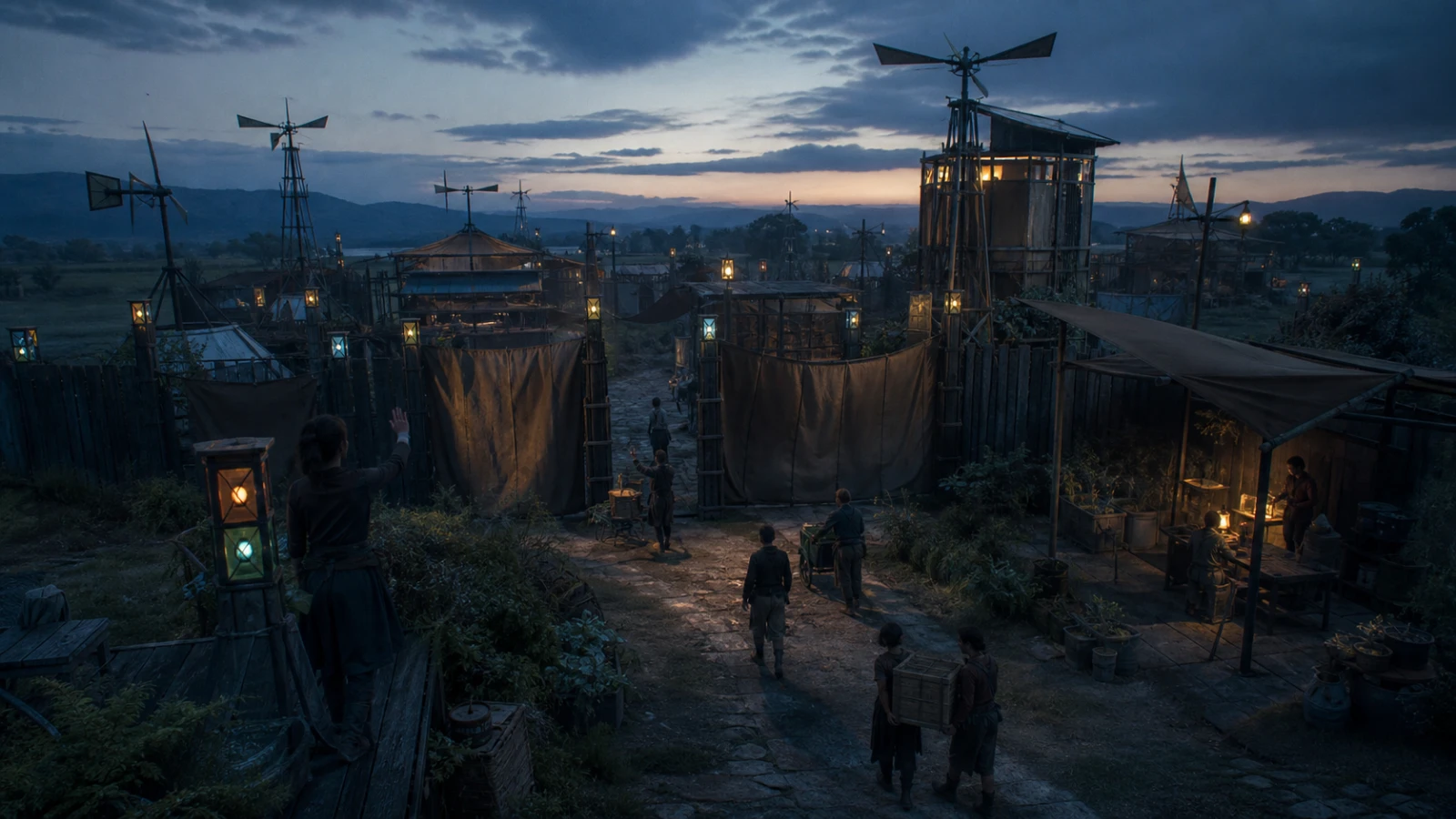
Thesis: Extinction Cycle trains people to fight and coordinate under noise. A Quiet Place asks what happens when the smallest sound becomes the thing that gets you killed.
Introduction
Most apocalypse stories treat noise as a byproduct of survival. People shout orders, fire weapons, start engines, hammer fortifications, and use radios because action requires communication and force. A Quiet Place turns that ordinary assumption inside out. In its world, noise is not just a risk. It is a targeting signal. Sound becomes a weapon against the people who produce it. That changes family life, movement, defense, and even thought itself.
Extinction Cycle makes for an especially strong comparison because it is so operationally noisy. Military missions depend on weapons, vehicles, alarms, radio coordination, and the willingness to engage violently when the moment calls for it. Outposts survive through patrols, communications, watch structures, and rapid response. Put those habits into a Quiet Place-style threat environment and many familiar strengths become liabilities overnight.
At the same time, Extinction Cycle’s disciplined survivors would not simply collapse. They are better positioned than many ordinary civilians to identify patterns, impose procedure, and adapt under pressure. The real question is how quickly they could discover the sensory rule governing the predator and how thoroughly they could redesign community life around it. That is what makes the comparison so revealing. It is not just monster versus monster. It is one survival grammar colliding with another.
When Silence Replaces Suppression
A Quiet Place survival begins by replacing suppression with silence. Normal tactical logic says that if the enemy is dangerous, you identify it, suppress it, and create enough violence to seize initiative. But if sound itself summons the threat, then the old logic reverses. The first objective is not dominance. It is non-detection. This would be profoundly disorienting for any military- oriented community.
Extinction Cycle teams are trained to move carefully, but careful is not the same as silent. Boots, gear, magazines, engines, doors, radios, power tools, and reactive gunfire all create signatures. A community accustomed to readiness would have to reinvent itself. Equipment loads would change. Building materials would change. Communication doctrine would change. Even kitchen routines and child care would change. In other words, silence would stop being a tactic and become infrastructure.
That shift is one of the deepest points of contrast between the franchises. Extinction Cycle assumes the world can still be contested audibly. A Quiet Place assumes survival begins once people abandon that assumption. The communities that live longest are not necessarily the bravest. They are the ones that learn how to reduce themselves as acoustic events.
Communications Under Sound Constraint
Communications may be the hardest area of adaptation. Extinction Cycle relies heavily on coordination. Teams need to warn one another, share threat updates, manage perimeter breaches, and synchronize movement. In a sound-driven predator environment, all of those habits become fraught. Radios are dangerous. Shouting is suicidal. Metal clatter during a hurried response can be just as fatal as a bad decision.
A Quiet Place-style survival therefore rewards visual language, prearranged signals, route discipline, and communication simplicity. An Extinction Cycle settlement would need flags, lights, written boards, hand signals, route markings, and carefully controlled emergency procedures. People would need to know not only what to do, but how to do it without turning stress into noise. Training would become behavioral, almost choreographic. The better the community drills silence, the less likely panic is to break the system.
There is a paradox here. Extinction Cycle’s command culture might actually help because disciplined organizations are good at standardizing behavior. Once the threat rule is known, a military-minded settlement can teach quiet movement, staged response, and nonverbal procedures better than a purely improvised group can. The challenge is surviving the discovery phase, when old habits remain intact and every startled reaction may call death down on the community.
Family Survival vs Base Survival
A Quiet Place is often intimate in emphasis. Family survival sits at the center, which means noise management is also emotional management. Parents must protect children, manage fear, and create routines that preserve tenderness under extreme constraint. Extinction Cycle, especially in its more military arcs, tends to think first in terms of unit survival and community defense. That does not mean families disappear, but the dominant logic is broader and more institutional.
Bringing the two together exposes an important difference. Family groups often adapt quickly because their world is small and personal. A military settlement may have greater resources, but it also has more moving parts, more people, and more tasks that naturally generate noise. Feeding a base, defending a perimeter, and maintaining equipment are louder than keeping one farmhouse alive. This means an Extinction Cycle-style community would need to scale silence, not just practice it. That is much harder.
Still, once adaptation took root, the larger settlement could potentially outperform a family unit in durability. Silent agriculture, silent signaling, scheduled movement windows, and carefully engineered defensive zones could create a robust survival system. The path to that system would simply be bloodier because the community begins with louder instincts and greater complexity.
How Quickly Would Extinction Cycle Survivors Learn the Rule?
The survival timeline depends on one thing above all: how fast the community discovers that sound drives predation. Fortunately for Extinction Cycle, its people are observant. They are used to reading patterns and updating tactics when an enemy behaves unexpectedly. That raises the odds that they would notice the sound relationship relatively early, especially if multiple attacks followed obvious noise events.
Once the rule is identified, adaptation could be swift. Patrol structures would be revised or suspended. Vehicles would be restricted. Metal discipline would become strict. Entry points would be padded or reworked. Children and vulnerable civilians would be moved into quieter spaces. Weapons would be reconsidered not only for lethality but for acoustic consequence. This is exactly the kind of doctrine pivot a hardened outpost can make if the leadership remains calm.
The early casualties would still be severe. A community built around audible readiness cannot instantly become a silent society. But compared with less structured survivors, Extinction Cycle groups would likely adapt faster because they already understand that survival depends on obeying unpleasant operational truths, not on insisting the world should behave differently.
Could Armed Outposts Still Work?
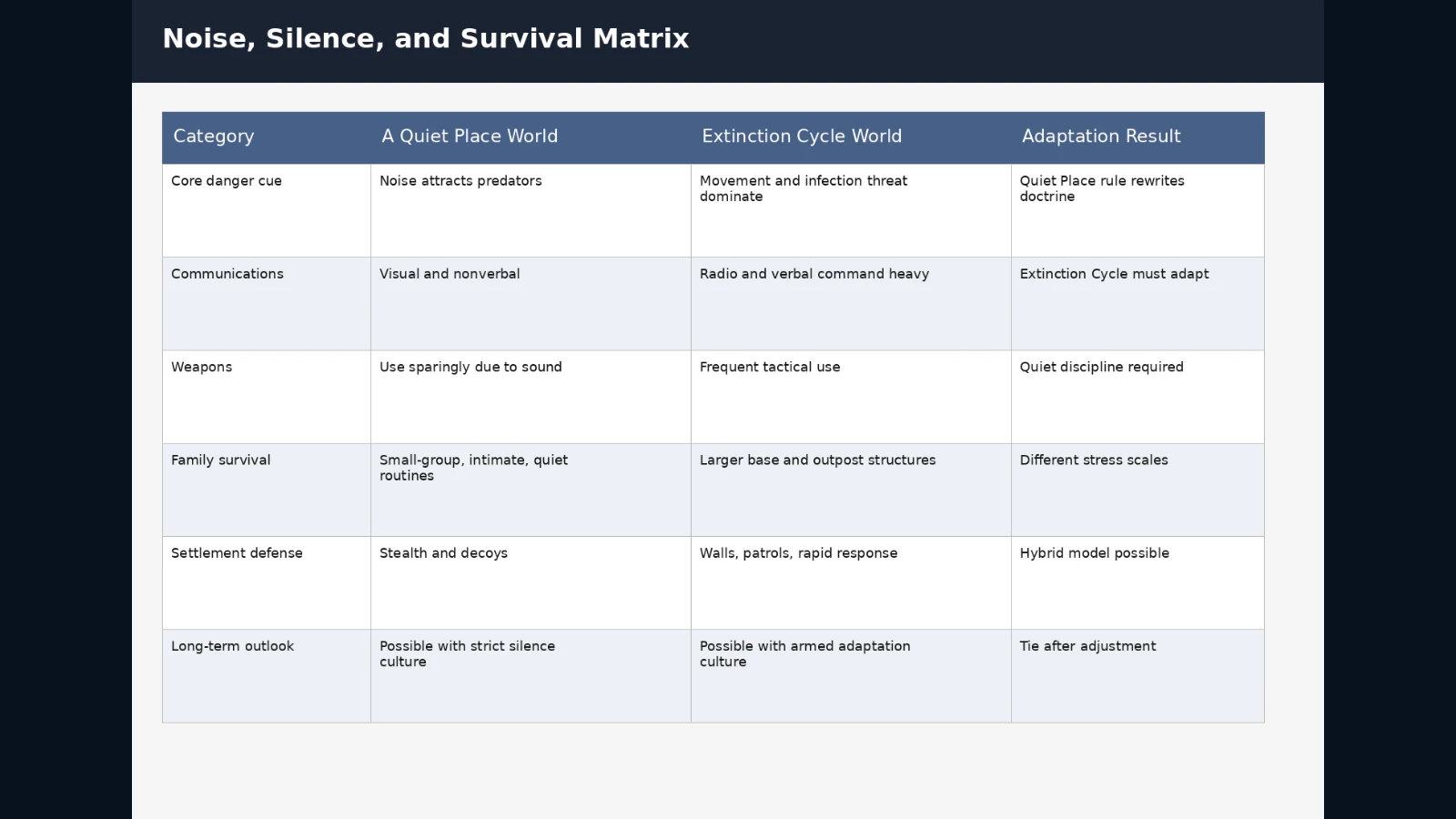
Yes, but they would cease to look like normal armed outposts. Towers, walls, and check-ins might remain, but the methods of enforcement would change. Gunfire would become a last resort. Heavy machinery would be tightly restricted. False sound lures, sacrificial noise points, and controlled decoys might replace some conventional perimeter tactics. Quiet engineering would become more important than visible force.
This is where the comparison becomes especially interesting. A Quiet Place predators’ sensory rule would not eliminate military thinking. It would redirect it. Instead of asking how to overpower an attacker, commanders would ask how to route movement, absorb emergencies silently, and manipulate enemy attention without exposing the settlement core. Noise discipline would become the equivalent of camouflage.
Such a system would likely be slower and more psychologically draining than ordinary outpost life. People cannot relax when even ordinary mistakes become invitations to catastrophe. Yet a disciplined settlement might still endure if it treated silence as doctrine instead of inconvenience.
What This Reveals About Extinction Cycle
One reason this crossover works so well is that it highlights what Extinction Cycle values most: disciplined adaptation. The franchise is not actually committed to any single tactic forever. It is committed to the idea that competent survivors learn fast, integrate evidence, and redesign their behavior around reality. A Quiet Place simply forces that lesson into a strange sensory key.
It also highlights the limits of military confidence. Firepower, radios, and rapid-response teams feel reassuring because they are familiar tools of control. But unfamiliar predators punish familiarity when familiarity makes people predictable. Extinction Cycle survivors would need humility before they could use their strengths again. That humility is not weakness. It is the doorway to survival.
Quiet Logistics at Community Scale
The hardest part of a silent settlement is not a tense patrol. It is an ordinary week. Food has to move, water systems need attention, tools break, illness does not pause, and children still need care. A small family can coordinate through familiarity, but a base contains strangers, specialists, rotating responsibilities, and tasks whose timing matters. Silence must therefore become a property of the whole system rather than a virtue expected from unusually careful individuals.
That requirement exposes the hidden loudness of modern organization. Generators, pumps, gates, kitchens, workshops, vehicles, and alarms make a settlement legible to its own people by producing sound. Removing noise can also remove feedback. A silent machine may fail without warning; a quiet gate may be harder to monitor; a visual alert may be missed by someone facing the wrong direction. A durable community would need overlapping visual and tactile signals so that reducing acoustic risk does not create blindness elsewhere.
Extinction Cycle's outpost culture offers a useful advantage here: it already treats logistics as survival rather than background scenery. Leaders understand that security fails when supply and maintenance fail. The adaptation would still be enormous, but the community has a framework for assigning responsibility, rehearsing procedures, and learning from near misses. Its best contribution to a Quiet Place-style world would not be more weapons. It would be the ability to turn fragile household improvisations into shared standards without erasing the human relationships that make people willing to follow them.
Noise as Deception and Perimeter Design
Once sound becomes a targeting cue, a perimeter can no longer be judged only by thickness or height. It must also manage where attention travels. The settlement core should not become the loudest point in the landscape every time something goes wrong. That does not mean publishing a real tactical blueprint; it means recognizing the story-level shift from stopping an attacker at a wall to preventing the wall from advertising everyone behind it.
This is why the article's phrase “noise becomes a weapon” cuts in both directions. Uncontrolled sound betrays people, while controlled sound can redirect danger. The ethical problem is that any diversion may move risk toward someone else. A disciplined outpost would have to decide whether a tactic that protects its own gate is acceptable if it threatens travelers, neighboring settlements, or animals. Extinction Cycle repeatedly connects survival choices to political legitimacy. A quiet-defense doctrine would face the same test: a community cannot call itself rebuilt civilization if every safety measure simply exports danger beyond its boundary.
The Psychological Cost of Permanent Silence
Silence also changes the emotional texture of survival. Speech is not only information; it is reassurance, argument, humor, mourning, and proof that communal life remains alive. A settlement that suppresses sound successfully may still become psychologically narrow if every spontaneous human response feels dangerous.
That pressure is greater at outpost scale because rules can become impersonal. Families may understand why a child breaks a routine. Institutions may see only a security failure. The strongest hybrid model would preserve designated spaces and moments for safe expression wherever the fictional conditions allow, rather than treating silence as a moral measure of obedience. The goal is not merely to avoid detection. It is to remain a community worth preserving.
When the Old Doctrine Returns
The final adaptation is knowing that silence cannot solve every problem. Extinction Cycle survivors are good at changing doctrine because they expect enemies to change too. If the sensory rule is disrupted, if another threat appears, or if the settlement must communicate beyond visual range, the community needs more than one survival language. Quiet procedures should expand the toolbox, not become a new unquestionable dogma. That flexibility is where Extinction Cycle's culture would matter most.
Conclusion
A Quiet Place versus Extinction Cycle is, at bottom, a comparison between two survival languages. One is built around command, defense, communication, and force. The other is built around silence, concealment, restraint, and radical sensory adaptation. At first, the sound-driven predator environment would be brutal for any Extinction Cycle community because so many of its normal strengths announce its presence. Noise would become an enemy produced from inside the settlement itself.
Yet that does not mean Extinction Cycle would lose the comparison. Once the sensory rule was learned, its disciplined survivors and outpost leaders might adapt better than many purely civilian groups. They could standardize silence, redesign routines, and build a defensive culture around nonverbal survival. The cost would be high, especially during the transition, but the eventual result could be formidable.
So what happens when noise becomes a weapon? Survival becomes less about courage in the open and more about the mastery of restraint. In that world, the best defenders are not necessarily the loudest or strongest. They are the ones who learn that silence can be the hardest kind of strategy and the most necessary one.
FAQ
Why would Extinction Cycle outposts struggle at first?
Their normal strengths—radios, vehicles, alarms, tools, and rapid armed response—create sound. The first challenge is recognizing that those strengths now reveal the settlement.
Could a large quiet community survive?
Possibly, but only if silence becomes reliable infrastructure across logistics, communication, maintenance, and family life rather than an improvised personal habit.
Is this article real emergency advice?
No. It is a fictional comparison and does not provide real security or emergency instructions.
Source note
Paramount's official synopsis establishes that the creatures in A Quiet Place hunt by sound and that the central family lives in silence to avoid them. Extinction Cycle claims are checked against current outpost, Team Ghost, communications, and logistics records.
Editorial note
This independent fan analysis uses original generic artwork and a submitted editorial comparison chart. It does not reproduce official franchise images, actor likenesses, logos, or claim a canon crossover.