
Fictional survival versus household planning
Preparedness Fiction vs. Real Emergency Kits
Compare apocalypse-fiction loadouts with practical household emergency kits using current Ready.gov and CDC guidance and clear safety boundaries.
·
Category: Fact Versus Fiction
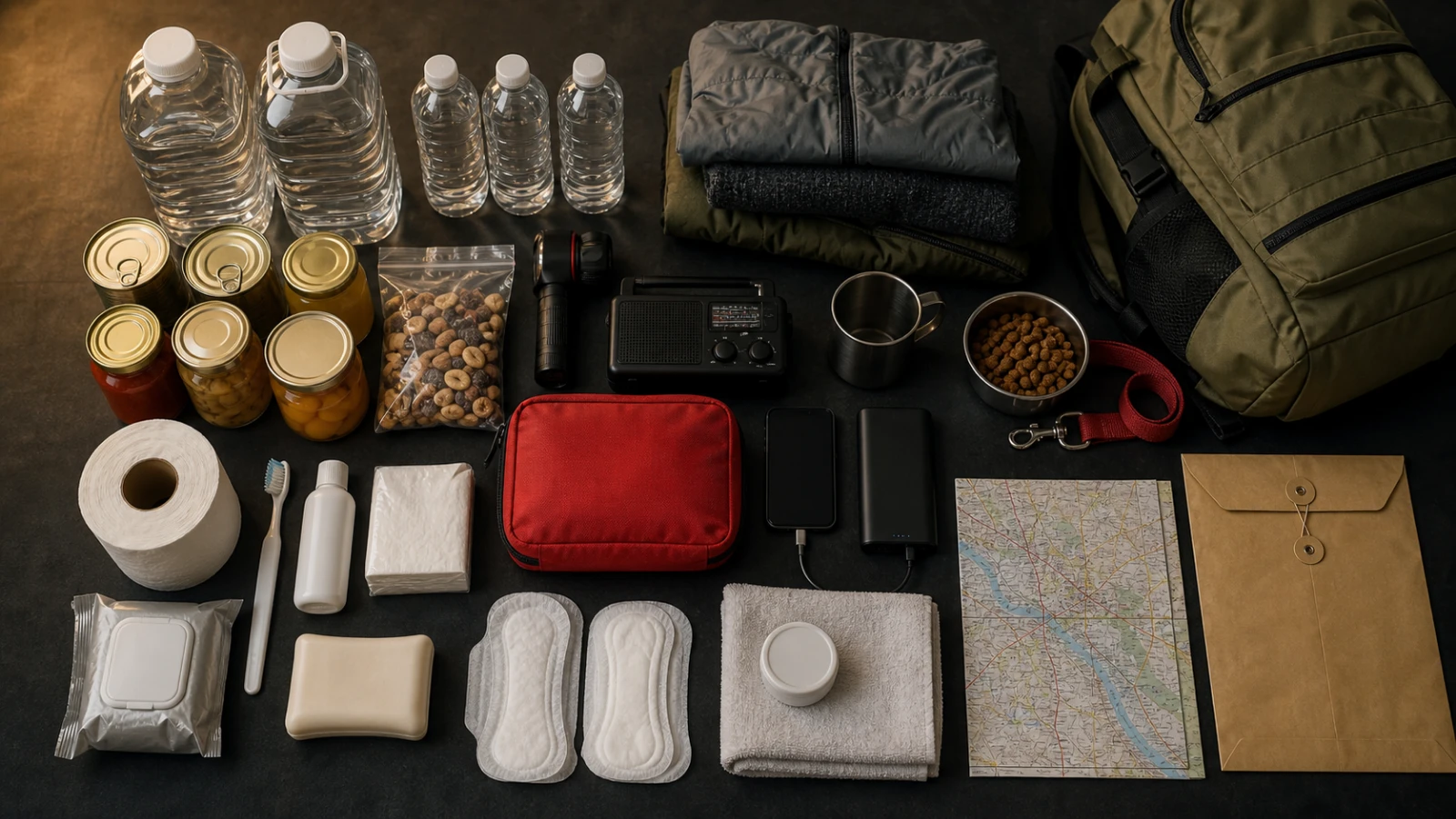
Extinction Cycle turns preparedness into a struggle against cascading national collapse, an engineered fictional virus, fast evolving predators, failed command, and years of damaged infrastructure. Real household preparedness begins from a different premise. Most emergencies have a response system, a recovery period, and official instructions. A storm, wildfire, flood, power outage, evacuation, or local disruption may be severe without becoming the end of organized society.
That difference changes what belongs in a useful emergency kit. Fiction rewards dramatic objects that help a character survive the next scene. Real guidance prioritizes ordinary supplies that help a household remain hydrated, informed, medically supported, sanitary, reachable, and able to follow local directions. The quiet items are usually more important than the cinematic ones.
Preparedness boundary: This is general educational context, not individualized emergency, medical, or evacuation advice. Hazards and household needs vary. Use current instructions from local authorities and official resources such as Ready.gov and the Centers for Disease Control and Prevention.
The central difference: real emergencies have an after
Apocalypse stories assume normal systems will not return. Characters carry tools for indefinite isolation because utilities, supply chains, emergency services, communications, and government may be gone. Every encounter must be solved with what is already on hand. A dramatic loadout makes sense when there will be no resupply, no shelter network, no public warning system, and no functioning hospital.
Real preparedness aims to bridge disruption. A household may need to remain at home while power is out, leave quickly because officials order an evacuation, spend time at a shelter, communicate when networks are congested, or manage several days before services stabilize. The kit supports those transitions. It does not replace a hazard plan, medical care, community assistance, or public response.
The most useful question is therefore not “What would Team Ghost carry?” It is “What ordinary need becomes harder when electricity, water service, transport, stores, or communication are temporarily disrupted?” That question produces water, shelf-stable food, light, radio information, medication planning, sanitation, charging, documents, clothing, and household-specific supplies before it produces specialized gear.
What official guidance prioritizes
Ready.gov’s basic emergency supply guidance centers on water and nonperishable food for several days, a battery-powered or hand-crank radio, flashlight, first-aid supplies, extra batteries, a whistle, sanitation items, a manual can opener, local maps, and cell-phone charging capability. It also encourages considering more than one kit for places where people spend time.
CDC personal-needs guidance adds the details that generic fiction often overlooks: prescription medicines, medical devices, assistive technologies, infant needs, pet supplies, and other items specific to the people in a household. CDC’s emergency-kit overview likewise emphasizes water, food, radio information, light, first aid, batteries, blankets, and practical safety supplies.
Official lists are starting points, not universal shopping prescriptions. Climate, local hazards, evacuation routes, medical needs, pets, children, caregiving responsibilities, disability access, housing, transport, and budget all affect the plan. Current local instructions take priority when an event is unfolding.
Fiction-to-reality crosswalk
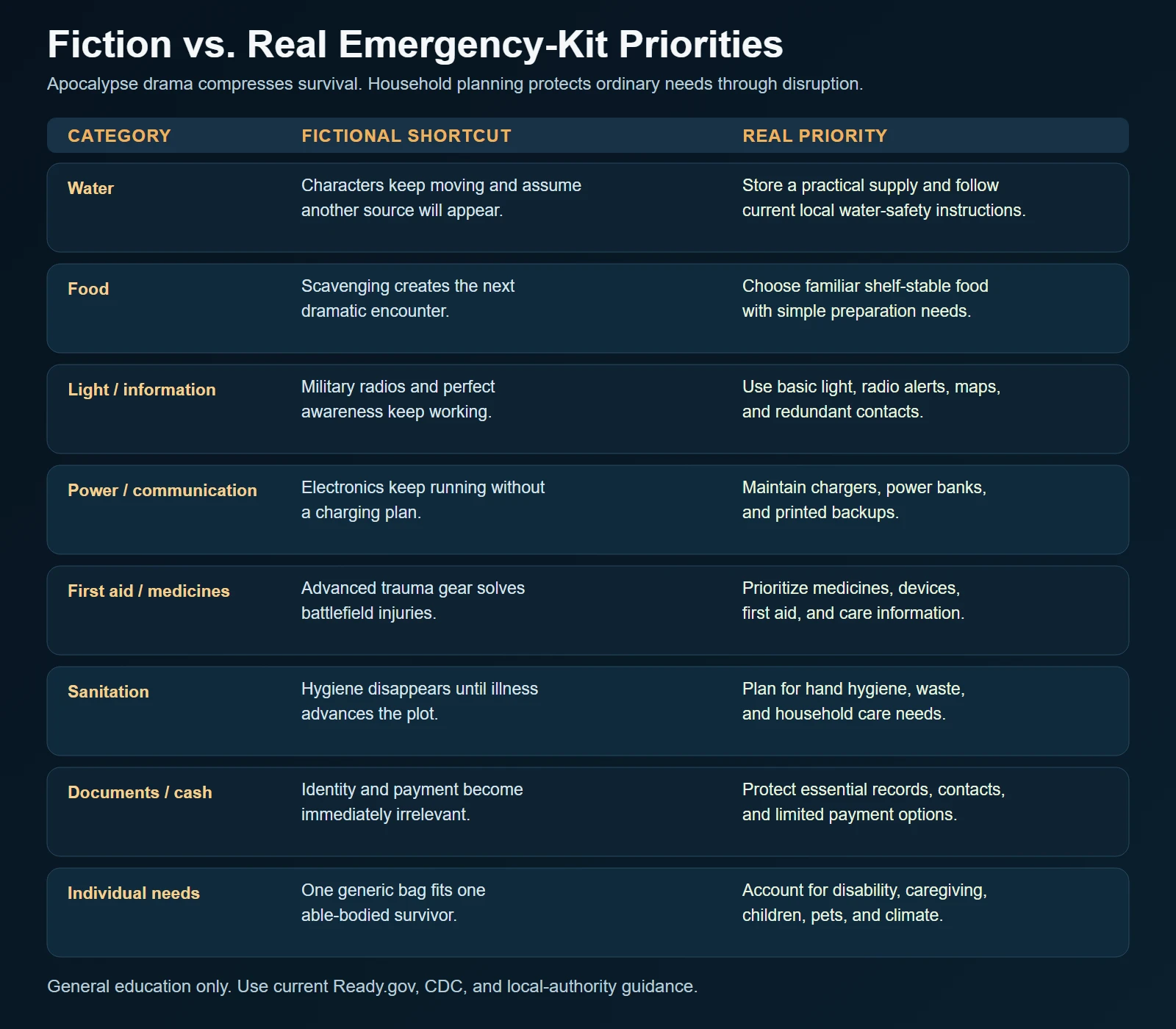
| Fictional emphasis | Real preparedness priority | Why the priority changes |
|---|---|---|
| Long-range scavenging | Stored water and ordinary food | A short disruption is safer to bridge with familiar supplies than with uncertain travel. |
| Tactical communications | Local alerts, radio, contacts, and charging | The goal is receiving official information and reconnecting with household members. |
| Trauma-focused medical gear | Medicines, first aid, devices, and care information | Routine health needs continue during emergencies and are more likely than fictional combat injuries. |
| Permanent mobility | Hazard-specific shelter and evacuation plans | Staying or leaving depends on the event and official direction, not a universal rule. |
| Individual self-sufficiency | Household and community planning | Children, older adults, disabled people, caregivers, neighbors, and pets change what support is needed. |
| Heavy multipurpose loadouts | Small, usable kits for likely settings | Supplies help only if people can reach, carry, maintain, and understand them. |
Water comes before dramatic gear
Fiction often treats water as a background problem until characters are stranded. Real guidance places it near the top because drinking, food preparation, hygiene, medication use, and some medical needs depend on a safe supply. Ready.gov commonly uses one gallon per person per day for several days as a planning benchmark, while also noting that some people may need more.
A number is only a starting point. Hot weather, pregnancy, illness, physical work, pets, and other circumstances can increase needs. Storage space and the ability to move containers matter as well. A large amount that cannot be safely stored or reached is not a complete plan.
Extinction Cycle illustrates the strategic importance of water through outposts, ships, islands, tunnels, and damaged infrastructure. The real lesson is narrower: know how a disruption could affect the local supply, store an appropriate amount where practical, and follow public-health instructions if authorities issue a boil-water or contamination notice. Fictional improvisation should never substitute for those instructions.
Food supports stability, not adventure
Scavenging creates tension because it forces characters into unfamiliar buildings and enemy territory. A real kit tries to reduce unnecessary movement. Shelf-stable food that household members already eat is usually more practical than unfamiliar “survival” products. A manual can opener matters when cans are included. Dietary requirements, allergies, infant feeding, and the needs of older adults or pets must be considered before an emergency.
Preparation requirements matter. Food that needs large amounts of water, fuel, refrigeration, or complex cooking may be a poor match for a power outage. Rotating normal pantry items can be easier and less wasteful than buying a separate cache and forgetting it. Labels, expiration dates, pest protection, and safe storage are mundane details, but preparedness is mostly made of mundane details.
The Extinction Survival series emphasizes the value of local knowledge and community decisions under extreme fictional collapse. Real households can take the planning lesson without copying the scale of the threat: use familiar supplies, account for actual people, and avoid creating a kit that requires new skills during a stressful event.
Information and power prevent bad decisions
Team Ghost often operates with degraded intelligence, and the results are costly. Real emergencies create a smaller version of the same problem. Rumors spread, cellular networks can become congested, batteries fail, and changing conditions make yesterday’s plan unsafe. Reliable information is therefore a supply.
A battery-powered or hand-crank radio can receive updates when internet or mobile service is unreliable. Phones need cables and charged power banks. Written contacts matter when a device is lost, damaged, or unavailable. Local maps can help when navigation services fail. Alerts from public agencies and local emergency management provide instructions tailored to the actual hazard.
Power planning should remain proportionate. A charged bank for communication is different from trying to reproduce an entire household electrical system. Generators and fuels introduce serious risks and require manufacturer and official safety guidance. The safe general principle is redundancy for essential communication and light, not improvisation with hazardous power sources.
First aid begins with ordinary health needs
Fictional kits are often dominated by tourniquets, trauma packs, and battlefield equipment. Real household planning begins with the people who will use the supplies. Prescription medicines, copies of essential medical information, glasses, hearing-aid batteries, mobility supports, medical-device power needs, and infant or caregiver supplies may be more important than specialized equipment no one is trained to use.
A basic first-aid kit can help with minor injuries, but owning an item does not create the knowledge to use it. Training from a qualified organization is more useful than collecting advanced tools without instruction. Serious injury or illness requires professional help whenever that help is available.
CDC guidance for people with disabilities emphasizes planning around individual needs rather than assuming one generic bag fits everyone. Backup power, communication methods, transportation, service animals, caregivers, and accessible shelters can be central parts of preparedness. Those needs belong in the plan before optional gear.
Sanitation is a core survival system
Apocalypse fiction regularly skips handwashing, waste, menstrual supplies, diapers, cleaning, oral care, and the spread of ordinary illness. A real disruption does not suspend those needs. Sanitation protects health, dignity, and the ability of people to share limited space.
Useful supplies may include soap, hand sanitizer, wipes, toilet paper, trash bags, personal hygiene items, masks appropriate to official hazard guidance, and household-specific care products. The exact mix varies. People sheltering at home, driving during an evacuation, and staying in a public shelter will not use identical kits.
The wider Extinction Cycle story shows why functioning settlements depend on systems rather than heroic individuals. The outpost system is sustained by water, food, energy, medicine, transport, sanitation, labor, and trust. Real preparedness works at a much smaller scale, but the same relationship holds: supplies are useful because they support a system of daily needs.
Documents, money, and contacts still matter
Fiction discards paperwork when institutions collapse. Real emergencies can make records more important. Identification, insurance information, medication lists, emergency contacts, account details, and copies of essential documents can support evacuation, shelter access, replacement claims, and continuity of care.
Protecting information requires judgment. Copies may need waterproof storage, secure digital backup, or both. Sensitive information should not be left exposed in an easily lost bag. Small amounts of cash may be useful if electronic payment systems are temporarily unavailable, but the amount and storage method depend on household circumstances.
A family communication plan is not a physical object, yet it can be one of the most valuable parts of the kit. Choose contacts, meeting places, and ways to reconnect if household members are separated. Make the plan understandable to children and accessible to people with communication needs. A bag cannot decide where the family will go or how everyone will know the plan has changed.
Home kit, portable kit, and vehicle supplies
One enormous “go bag” is rarely the only useful arrangement. A home kit can hold bulkier water, food, blankets, sanitation supplies, and household items. A portable kit may emphasize essential documents, medicines, communication, charging, light, clothing, and a manageable amount of water and food. Vehicle supplies depend on climate, travel patterns, and safe storage conditions.
Multiple kits do not need to be expensive duplicates. The goal is access. Someone away from home when an event begins may not be able to reach the main supplies. A smaller set at work or in a vehicle can bridge that gap. Temperature-sensitive medicines, batteries, food, and water cannot simply be left indefinitely in extreme heat or cold, so maintenance remains part of the design.
Mobility must be realistic. A bag that is too heavy for its intended user, blocks a mobility aid, or cannot be moved with a child or pet is poorly matched to the household. Test ordinary actions: lifting it, reaching it in darkness, identifying contents, and carrying it the distance the plan actually anticipates.
What apocalypse fiction gets right
Fiction can still sharpen several useful habits. Redundancy matters when a single failure would remove light, information, charging, or access to medication. Maintenance matters because neglected equipment becomes false reassurance. Situational awareness matters because the correct response changes with the hazard. Relationships matter because people rarely recover alone.
The strongest Extinction Cycle parallel is the cost of incomplete information. Teams suffer when leaders conceal risks, assume the previous threat model still applies, or fail to share what has changed. A household plan benefits from the opposite behavior: use authoritative alerts, discuss needs before stress is high, identify responsibilities, and update the plan when circumstances change.
The series also understands that logistics outlast spectacle. Ammunition may decide a battle, but water, food, medical capacity, transport, energy, agriculture, maintenance, and legitimate coordination determine whether a settlement survives. Real preparedness removes the fictional combat and retains the logistical truth.
What not to copy from Extinction Cycle
Do not treat weapons as the center of emergency readiness. Do not assume heavy tactical equipment is useful merely because it appears protective. Do not plan around endless fuel, batteries, or ammunition. Do not assume every emergency requires immediate evacuation or permanent mobility. Do not attempt risky medical procedures because a character succeeds under impossible conditions.
Most importantly, do not mistake self-sufficiency for isolation. Real response includes neighbors, caregivers, utilities, public agencies, shelters, health services, volunteer organizations, and local knowledge. A plan can include mutual aid and still protect privacy and independence. Community is not evidence that the kit failed; it is part of preparedness.
A practical maintenance cycle
Review supplies on a recurring schedule and after major household changes. Replace expired food and medicines according to appropriate guidance. Recharge power banks, test flashlights and radios, check batteries for damage, update contacts, adjust clothing for the season, and confirm that children, pets, medical needs, and transportation arrangements are still represented.
Use the review to remove items as well as add them. Unfamiliar, damaged, expired, unsafe, or excessively heavy gear can create clutter and false confidence. Keep instructions with equipment when useful. Store supplies where intended users can reach them, while securing medicines, tools, and hazardous items appropriately.
An emergency kit is evidence of a working plan only when the people involved know where it is, what it contains, and what conditions would make them use it. Preparedness is not a single purchase. It is the repeated practice of matching ordinary needs to plausible disruptions and current official information.
A short household audit
- Identify the local hazards and official alert sources most relevant to the household.
- Check water, familiar shelf-stable food, light, radio information, charging, first aid, medicines, and sanitation.
- Add needs for children, older adults, disabled people, caregivers, pets, climate, work, and transportation.
- Protect essential contacts and documents without exposing sensitive information.
- Decide where to meet and how to communicate if household members are separated.
- Test whether intended users can reach, understand, and carry the supplies.
- Choose a date to review the plan and replace what expires.
The point is not to recreate the kit of a fictional soldier. It is to make a real interruption less dangerous, less confusing, and easier to recover from.
FAQ
How many days should an emergency kit cover?
Ready.gov recommends enough basic supplies for several days. Local authorities may advise differently for particular hazards, and household medical or access needs can require additional planning.
How much water belongs in the plan?
Ready.gov commonly uses one gallon per person per day for several days as a starting benchmark. Needs can vary with climate, health, activity, pets, and other circumstances.
Is military gear necessary?
No. Official household lists emphasize water, food, information, light, first aid, sanitation, charging, documents, medicines, and individual needs.
Is one large go bag enough?
Not always. A fuller home kit and smaller portable supplies may provide better access in the places where household members spend time.
What is often overlooked?
Medication continuity, medical-device power, sanitation, documents, communication plans, pet needs, accessible transportation, and regular maintenance are easy to overlook because they are less dramatic than equipment.
Official sources reviewed
- Ready.gov: Build a Kit
- Ready.gov: Make a Plan
- CDC: Personal Needs
- CDC: Build an Emergency Kit
- CDC: Emergency Preparedness for People with Disabilities
Official material was reviewed on August 26, 2026. Current local instructions govern during an active emergency.
Recommended next pages
Sources and editorial scope
- Canon treatment
- Extinction Cycle logistics are treated as fictional context. Real preparedness claims are separately attributed to current Ready.gov and CDC sources and are not inferred from the novels.
- Spoiler scope
- Light Extinction Cycle setting and outpost spoilers only. No major character deaths or late-series identity revelations are required for the comparison.