
Locations
New York City
Quick Facts
- Role
- Locations
- Aliases
- new-york-city, NYC, Manhattan, New York
Overview
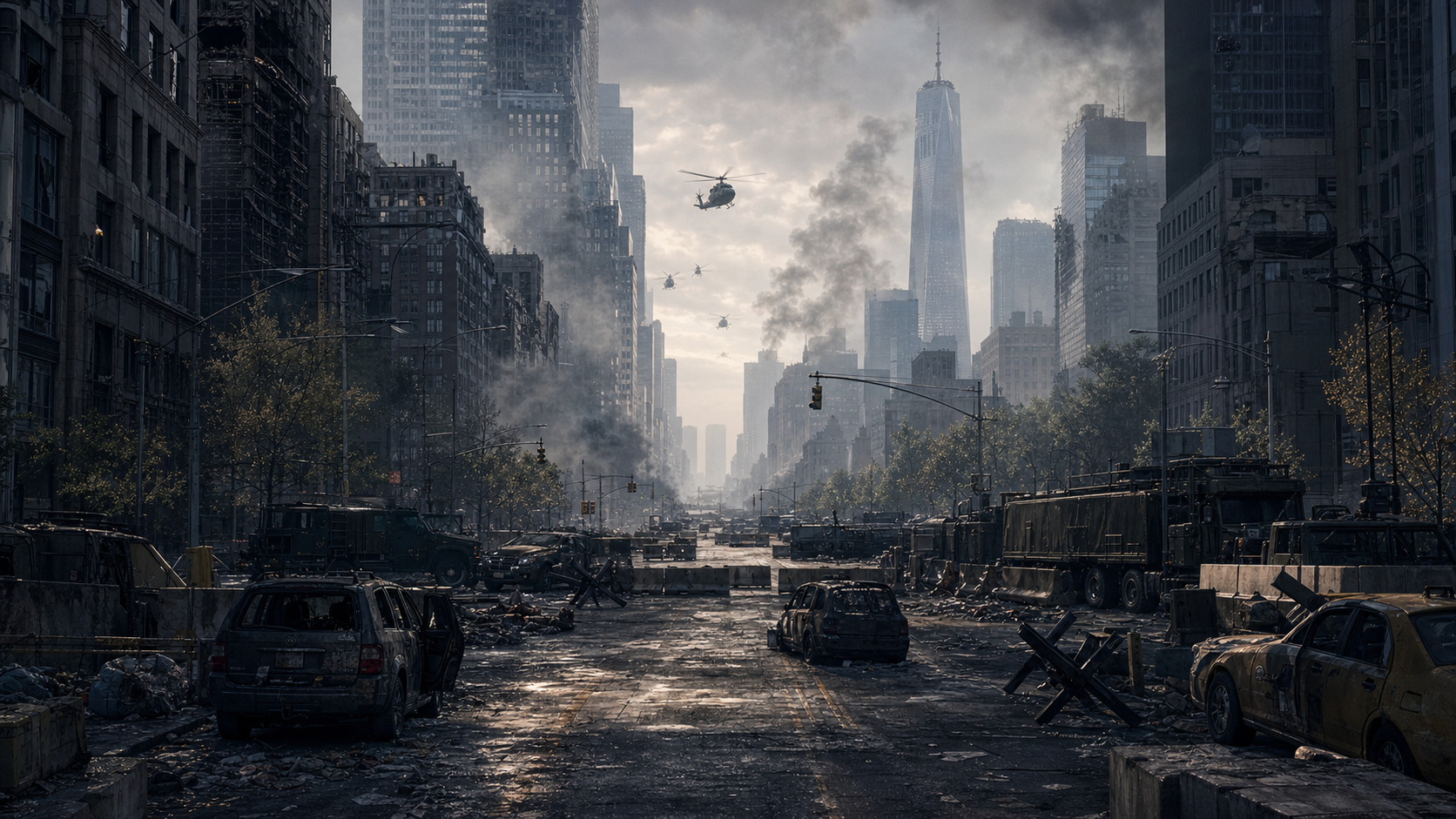
New York City is one of the principal outbreak, military, civilian-survival, and Variant-evolution settings in the Extinction Cycle continuity. The city first appears as a target in the national effort to stop the Hemorrhage Virus and later becomes the best-documented failure of conventional urban reclamation. Aerial deployment of VariantX9H9 kills much of the infected population visible above ground, but surviving Variants concentrate in skyscrapers, subway routes, sewers, utility passages, and large captive lairs. Operation Liberty enters Manhattan on the assumption that the city can be retaken by armor, infantry, bombing, and air support. The hidden population overwhelms the force and drives Reed Beckham's surviving group below the streets.
New York also has a parallel civilian history. In Emergence and the wider Redemption branch, Queens firefighter Meg Pratt, former Marine Jed Welch, and local survivors experience the collapse through houses, evacuation sites, fire stations, neighborhood roads, and improvised refuges. Meg's later rescue from a webbed Manhattan lair joins that history to the main series. The city remains an active enemy habitat after Operation Liberty and becomes the destination of another rescue after the Bone Collector's forces abduct Kate Lovato, Meg, Tasha Horn, and Jenny Horn from Plum Island.
Across these arcs, New York is never simply a ruined landmark. It is a vertical and subterranean ecosystem, a civilian home, a strategic symbol, a source of prisoners and collaborators, and a record of the cost of decisions made from incomplete intelligence.
Location information
- Field: Location; Detail: New York City, New York, United States
- Field: Principal boroughs shown; Detail: Manhattan and Queens
- Field: Important Manhattan sites; Detail: Midtown, Bryant Park and New York Public Library area, Bank of America Tower, underground tunnels and sewers, West 50th Street corridor, Pier 86, FDR Drive, East River approaches
- Field: Important Queens sites; Detail: South Jamaica, Elmhurst, homes, streets, evacuation areas, firehouse refuge, and survivor-controlled locations
- Field: First-war functions; Detail: Outbreak zone, VariantX9H9 target, reconnaissance area, Operation Liberty battlefield, Variant lair system, civilian refuge network
- Field: Later first-war functions; Detail: Operation Condor site, Bone Collector territory, captive destination after Plum Island
- Field: Principal military figures; Detail: Reed Beckham, Parker Horn, Jay Chow, Ray Jensen, Joe Fitzpatrick, Jose Garcia, Rick Thomas, Ryan Talon, and attached Marines
- Field: Principal civilian figures; Detail: Meg Pratt, Tim Pratt, Jed Welch, Jake Temper, Timothy Temper, Rex, and other Redemption survivors
- Field: Major operations; Detail: Operation Depletion, Operation Liberty, New York tunnel escape, Operation Condor capture, post-Plum Island hostage rescue
- Field: Principal enemy features; Detail: Underground concentration, vertical attack, Alpha command, juvenile protection, webbed captives, aquatic approach, human collaborators
- Field: Status; Detail: Not reclaimed during the opening campaign; remains a contested and enemy-controlled ruin during later first-war operations
City before the collapse
The scale and density that make New York economically and culturally important make it extraordinarily difficult to defend during the outbreak. Millions of residents depend on crowded transport, high-rise housing, electrical systems, emergency services, hospitals, bridges, and tunnels. Once the Hemorrhage Virus spreads, the same systems concentrate people and narrow escape routes.
Early information arrives through news reports and incomplete official warnings. Residents hear about Chicago and other outbreaks before they understand how quickly infection becomes violent transformation. Familiar public-health language encourages some people to wait for instructions suited to an ordinary epidemic. Others flee into roads already too crowded to carry the city.
The Redemption narrative gives this phase a domestic scale. Meg Pratt and her husband Tim begin April 19, 2015, at home in South Jamaica. Tim recognizes that the crisis is worse than the reports and urges an immediate departure toward family outside the city. Meg, trained as a firefighter, feels obligated to help. A stranger's plea brings infection to their door, and Tim is exposed while protecting her. His rapid transformation turns the metropolitan disaster into the loss that defines Meg's later decisions.
Jed Welch experiences the same collapse through Elmhurst and the neighborhood networks around his criminal employment, family, and damaged Marine history. People he knows become infected, improvised armed groups fail, and formal verification of identity becomes impossible. His movement into emergency military formations begins a long attempt to make service real again through conduct.
VariantX9H9 and the apparent clearing of the city
The surviving government develops VariantX9H9 to kill people and creatures carrying the VX-99 enhancement agent. New York is among the principal cities targeted during the aerial phase of Operation Depletion. Raptor flight releases the agent over the metropolitan area while similar missions cover other population centers.
The deployment appears successful when bodies fill the streets and visible movement falls. Estimates suggest that the weapon kills most infected targets, but the percentage that survives represents an enormous population in a city of New York's size. Survival also selects for organisms that found shelter, possessed resistance, or adapted quickly enough to avoid lethal exposure.
Team Ghost's post-strike reconnaissance discovers that surface quiet is misleading. Creatures remain inside buildings and below ground. The city has not become empty; the surviving population has redistributed into terrain that limits air observation and favors its sensitivity to darkness, climbing ability, smell, speed, and pack movement.
This distinction drives every later New York failure. A biological strike can reduce numbers without restoring streets, utilities, bridges, hospitals, or government. It can also leave human survivors in apartments and shelters alongside an enemy that becomes harder to see.
Operation Liberty
General Richard Kennor develops Operation Liberty as a rapid national effort to retake approximately one hundred American cities. New York becomes its most visible test. A reorganized Marine company, Bradley fighting vehicles, Humvees, air support, Team Ghost, and other surviving personnel advance into Manhattan after bombardment.
Scientific and field intelligence warns that the plan is based on the wrong map of the enemy. Kate's laboratory observations show increased sensitivity to ultraviolet light. Satellite estimates account for too few bodies on the surface. Lieutenant Colonel Jensen requests delay and reconnaissance of subways, storm tunnels, sewers, and utility routes. Kennor refuses to move the schedule.
The force enters Midtown through smoke, rain, wreckage, and streets covered with the dead from earlier attacks. Noise from armor and weapons announces the formation. Instead of encountering scattered survivors of the bioweapon, the troops draw out a mass able to attack from buildings, walls, roofs, and underground approaches.
The city neutralizes several advantages of conventional force. Vehicles provide protection and firepower but must follow blocked streets. Aircraft cannot strike below ground and cannot safely separate humans from Variants when the two are close. Bombing reduces visibility, collapses routes, and may move creatures rather than kill them. Understrength formations cannot protect every vertical surface and access point.
Jake and Timothy Temper
During the Midtown movement, the force encounters Jake Temper and his son Timothy, living proof that the supposed dead zone contains civilians. Their rescue changes the retreat from a purely military withdrawal into a test of whom the surviving force is willing to carry.
Jake cannot move at the pace of an unburdened assault team while protecting Timothy. Beckham's group accepts responsibility for them. Jake and Timothy also receive space. Beckham, Jensen, Chow, Jinx, Timbo, Ryan, Valdez, and others remain outside.
The decision preserves three family lines while exposing experienced fighters to the final swarm and air strike. It also gives the later Allied States a direct generational link to the city. Timothy survives childhood inside New York and later enters service in the Dark Age era. Jake becomes part of the wider island and outpost community.
Retreat below Manhattan
As the convoy withdraws and an air strike approaches, the remaining soldiers open a manhole and enter the sewer system. They survive the immediate bombing by moving into the terrain that intelligence had identified as Variant habitat.
The tunnel group is reduced to Beckham, Chow, General Jensen, Timbo, Jinx, Ryan, and Valdez. Beckham has a shrapnel injury, ammunition is low, maps are incomplete, and the organized campaign above them has collapsed. Rank and national objectives become secondary to finding a route out.
The group discovers a large chamber containing hundreds of people attached to walls and ceilings by organic webbing. Some are alive and injured, preserved as prey rather than killed at first contact. Seven exhausted survivors cannot free and carry an entire chamber through enemy tunnels. The discovery converts earlier observations of intelligence into a documented system of capture, storage, and territorial organization.
Meg Pratt remains conscious near an accessible ledge. Beckham and Chow cut her free despite severe leg injuries that will slow the group. Beckham uses grenades against the lair, killing nearby Variants and prisoners whom the team cannot save. The act prevents pursuit from immediately closing but adds another civilian cost to an operation already built on strategic sacrifice.
Surface escape and Pier 86
The group reaches a manhole and emerges into fire-damaged Manhattan on May 7. Jinx is seized during the street movement. His teammates attempt recovery, but he is killed. They take his body with them, preserving the promise not to leave a comrade when recovery is still possible.
A Humvee gives the survivors enough mobility to cross Midtown toward Pier 86. The route passes evidence of Operation Liberty's collapse: abandoned equipment, burned streets, bodies, and blocked corridors. The military expedition has become a source of salvage for a handful of people escaping the city it was meant to liberate.
At the Hudson waterfront, a Black Hawk extraction arrives with Horn aboard. Variants converge from surrounding streets and approach through the water, confirming that open water is not a reliable defensive boundary. Ryan and Valdez are killed during the final stand while the aircraft lifts Beckham, Chow, Jensen, Timbo, Meg, and Jinx's body away from the pier.
The escape provides the surviving government with living witnesses to the campaign's conceptual failure. New York contains an enemy habitat and a prisoner population beneath its visible ruins. Any future attack must account for both.
Queens survivor network
While national command treats Manhattan as an objective, the Redemption branch follows people attempting to preserve small areas of Queens. Houses become traps once infected family members enter. Ambulances and emergency vehicles may offer tools while attracting attention. Rooftops provide observation but remain accessible to climbing Variants. Fire stations combine equipment, heavy shutters, recognizable civic authority, and enough noise to draw a siege.
Meg reaches a firehouse and helps form a temporary refuge with Rex and other survivors. Jed arrives during an attack and fights beside her. Their alliance is built through action because records and institutions can no longer prove identity. Meg cannot restore the fire department, and Jed cannot restore the Marine Corps or erase his bad-conduct discharge. They can keep watch, share supplies, protect a door, and return for people whom escape would leave behind.
Later conflict involves a small Marine remnant led by Alexandra Gallegos and human collaborators associated with Tucker. The collaborators exploit prisoners and the Variant threat to buy security or power. This human economy parallels the lairs found by Team Ghost without proving that every collaborator serves one chain of command. New York supports multiple forms of predation because no lawful authority can maintain a citywide monopoly on force.
Meg's capture and rescue in Manhattan create the clearest direct junction between Redemption and the main series. She reaches the tunnel chamber with a history, profession, marriage, and survivor network already established. Team Ghost does not create her importance by finding her. The rescue preserves a life shaped elsewhere in the same city.
Operation Condor and the Bone Collector
New York remains active after Operation Liberty. During Operation Condor, military teams search urban lairs for juvenile Variants that can be tested against Kryptonite. Joe Fitzpatrick and Apollo become separated while tracking forces associated with the Bone Collector, an Alpha that commands other creatures and uses human collaborators.
Beckham, Horn, Chow, Garcia, Thomas, and Tank return to locate their missing allies and obtain a specimen. Inside a lair, they find adults defending six armored juveniles. The soldiers capture one alive, but Chow suffers severe wounds and the team must extract before Fitz and Apollo are located.
Fitz follows the Bone Collector's movement toward the East River and observes collaborators loading Variants into boats. The scene shows why city occupation extends beyond tunnels. Humans can operate engines, carry weapons, navigate waterways, and convert the Alpha's biological command into regional mobility. New York is a base from which the enemy can threaten Plum Island, not merely a ruin containing isolated creatures.
Fall of Plum Island and return to New York
The later assault on Plum Island confirms that threat. Forces associated with the Bone Collector breach the scientific and family refuge. Alex Riley and Major Smith are among the immediate losses. Kate Lovato, Meg Pratt, Tasha Horn, and Jenny Horn are taken alive and moved back toward New York.
Their value differs. Kate carries scientific knowledge essential to Operation Extinction and is pregnant with Beckham's child. Tasha and Jenny are Horn's surviving daughters after Sheila's death at Fort Bragg. Meg is a firefighter and established survivor whose bond with Riley gives the abduction an additional grief. The enemy's ability to transport all four shows planning beyond feeding.
Team Ghost and the Variant Hunters reenter the city for a limited rescue rather than another reclamation campaign. They use knowledge accumulated through Operation Liberty, the tunnel escape, Condor, and encounters with collaborators. Indiscriminate bombing is impossible because the people they seek are inside the target system.
The captives are recovered and the Bone Collector is killed during the culminating conflict. The success preserves Kate's scientific work, reunites Horn with his daughters, and returns Meg to the survivor network. It does not restore Plum Island, Riley, Smith, or the belief that any refuge near New York is beyond the enemy's reach.
Urban ecology
New York's post-outbreak environment has several connected layers:
These layers explain why destroying a visible horde does not equal control. A successful patrol can cross one avenue while a larger population moves underneath it. A bomb can close a tunnel and trap both creatures and captives. A cleared building can be reoccupied through an adjacent shaft or roof.
- Surface streets: Provide vehicle routes and fields of fire but are blocked by wreckage and exposed to attacks from several elevations.
- High-rises: Offer observation and shelter while creating thousands of rooms, stairs, shafts, and exterior surfaces that cannot be cleared quickly.
- Subways and sewers: Hide populations from aircraft, connect distant neighborhoods, and support lairs, captive chambers, and concealed movement.
- Rivers and waterfronts: Support extraction and transport but also aquatic Variant approaches and collaborator-operated boats.
- Civilian refuges: Preserve people inside zones that command may classify as empty or hostile.
- Lairs: Combine adults, juveniles, captives, webbing, food storage, Alpha leadership, and defensive behavior.
Strategic and political significance
Operation Liberty makes New York the principal warning against reclamation driven by symbolism and schedule. Kennor's plan seeks to show that the country can take its cities back. Its failure demonstrates that a flag, armored column, or air strike cannot create control without accurate intelligence, extraction capacity, civilian accounting, and a force able to hold what it enters.
The city later influences the Allied States debate over conscription and frontier policy. Mark Cornelius and the Freedom Party argue that abandoned cities cannot be left to organized enemies. Ringgold's coalition remembers that mass entry can waste the population needed for reconstruction. New York supports both concerns: permanent abandonment allows lairs and collaborators to grow, while premature assault turns troops and captives into casualties.
The durable lesson is conditional rather than pacifist. Urban operations require science, reconnaissance, limited objectives, and plans for the people found inside. Team Ghost repeatedly achieves recoveries in New York because it enters for specific persons or specimens. The large campaign fails because it confuses arrival with reclamation.
Cultural and narrative significance
New York joins the main and Redemption branches by presenting the catastrophe at incompatible but equally necessary scales. From command, it is a target area containing millions, underground routes, and strategic infrastructure. From a Queens home, it is the room where Tim dies. From a tunnel ledge, it is where Meg calls for help. From a Bradley, it is the place Jake and Timothy are given seats that others cannot take.
The city also charts enemy development. Early Variants hide and swarm. Later populations store captives, protect offspring, obey Alphas, cooperate with humans, use boats, and attack a laboratory island. Each return reveals a more complex social and biological system.
Because New York is not decisively reclaimed during these arcs, it remains an archive of unresolved loss. People escape it and carry its memory to Plum Island, Galveston, the Allied States, and later communities. The city persists in the continuity through survivors even when the narrative moves elsewhere.
Important connections
- Operation Depletion: Aerial VariantX9H9 campaign that reduces visible infected numbers without reclaiming the city.
- Operation Liberty: Failed conventional campaign whose New York theater exposes hidden Variant strength.
- Reed Beckham and Team Ghost: Repeated reconnaissance, tunnel escape, specimen-capture, and hostage-rescue presence.
- Meg Pratt: Queens firefighter whose civilian arc joins the main series through tunnel rescue and later captivity.
- Jed Welch: Redemption survivor whose damaged military identity is rebuilt through conduct after New York's collapse.
- Jake and Timothy Temper: Civilian father and son recovered during the Operation Liberty retreat.
- The White King and Bone Collector: Alpha figures associated with juveniles, command behavior, captives, and collaborators.
- Juvenile Variants: New generation protected in urban lairs and targeted during Operation Condor.
- Plum Island: Scientific refuge threatened by forces able to move outward from New York.
- Allied States: Later government whose reclamation debate is shaped by the city's military lesson.
Chronology and consequences
- Extinction Horizon - National outbreak, countermeasure development, and New York's place in the early strategic map.
- Emergence - April 19 collapse in Queens, Tim's death, Meg and Jed's separate routes, and the firehouse survivor network.
- Extinction Edge - Post-Depletion reconnaissance, Fort Bragg interval, Operation Liberty, Temper rescue, retreat, and descent underground.
- Extinction Age - May 7 tunnel escape, webbed chamber, Meg's rescue, Jinx's death, and Pier 86 extraction.
- Penance - Continued Redemption conflict involving Gallegos's Marine remnant, survivors, and collaborators.
- Extinction Evolution - Operation Condor, juvenile lair, Bone Collector, Fitz and Apollo, and live specimen capture.
- Extinction End - Fall of Plum Island, transport of Kate, Meg, Tasha, and Jenny into New York, and their recovery.
- Resurgence - Later movement of Redemption characters into Texas and Galveston-linked recovery.
New York Rooftops
New York Rooftops is a micro-location page for the exact kind of place superfans remember after the larger location summary is not enough.
New York Rooftops is a sublocation or scene-focused setting. It connects to the broader location page and from the missions, characters, and lore that depend on it.
Defines a precise physical place inside a larger setting.
Connects memorable scenes to characters and consequences.
Helps readers move from broad geography to exact scene memory.
New York Rooftops matters because the Extinction Cycle's geography is emotional. Fans remember rooms, graves, tunnels, rooftops, labs, and bridges because those places change what characters carry afterward.
Continue Exploring
Connected Universe
Books and Stories
Groups and Factions
Sources
- Extinction Edge and Extinction Age: VariantX9H9, Operation Liberty, the Temper rescue, Manhattan tunnels, and Pier 86.
- Emergence and later continuity: the Queens civilian network, Operation Condor, the Bone Collector, and the return to New York after Plum Island.
- Extinction Edge, Extinction Edge - Chapter 1
- Extinction Edge, Extinction Edge - Chapter 2
- Extinction Age, Extinction Age - Chapter 1
- Extinction Age, Extinction Age - Chapter 2
- Extinction End, Extinction End - Chapter 1
- Extinction End, Extinction End - Chapter 2