
Missions and Operations
Fort Bragg Search for Horn's Family
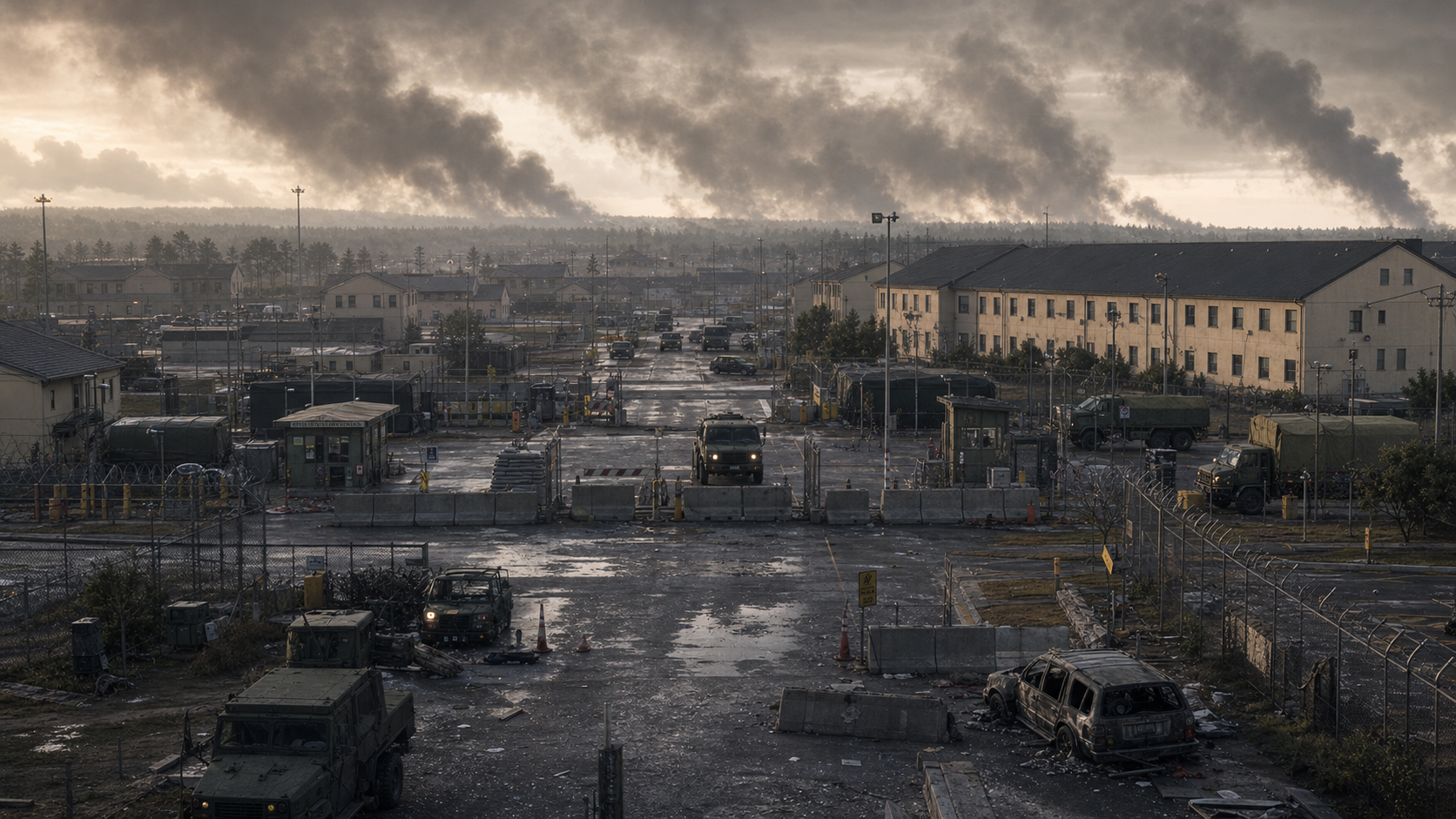
The Fort Bragg search for Horn's family is an improvised rescue operation led by Master Sergeant Reed Beckham and Sergeant First Class Parker Horn during the opening phase of Extinction Edge. Conducted after Team Ghost's first post-Depletion reconnaissance in New York and before Operation Liberty, the mission begins as a search for Horn's wife, Sheila, and daughters, Tasha and Jenny. It expands into the evacuation of fifty-two survivors from the collapsed military installation, including civilians, children, Rangers, Delta Force personnel, and Master Sergeant Joe Fitzpatrick.
Open the interactive Fort Bragg Search for Horn's Family view
Quick Facts
- Role
- Missions and Operations
- Aliases
- fort-bragg-search-horn-family, Fort Bragg Search for Horn’s Family
Overview
The search has no independent national objective. Beckham obtains transport by promising General Ray Jensen that he will lead the Plum Island team assigned to Operation Liberty after a thirty-six-hour trip to Fort Bragg and back. What appears to be a personal exception becomes strategically important when the rescuers discover a functioning survivor network in the tunnels beneath the U.S. Army John F. Kennedy Special Warfare Center and School. The operation reunites Horn with his daughters, confirms Sheila's death, restores Fitz to the larger Team Ghost story, and recovers trained personnel who later fight in New York.
Mission information
- Field: Type; Detail: Family search, survivor recovery, and emergency air evacuation
- Field: Period; Detail: After the first New York reconnaissance and before Operation Liberty
- Field: Location; Detail: Fort Bragg, North Carolina, especially the JFK Special Warfare Center and School area and its tunnel system
- Field: Initial team; Detail: Reed Beckham and Parker Horn
- Field: Later allies; Detail: Jay Chow, Jinx, Joe Fitzpatrick, two Delta operators, six Rangers, helicopter crews, and surviving personnel at the base
- Field: Persons sought; Detail: Sheila Horn, Tasha Horn, and Jenny Horn
- Field: Civilian survivors; Detail: Approximately fifty people in the tunnel refuge before extraction
- Field: Total extracted; Detail: Fifty-two survivors aboard three Black Hawks
- Field: Principal threats; Detail: Variants, a coordinated former-soldier leader, darkness, smoke, damaged infrastructure, limited ammunition, and a long movement with children and wounded civilians
- Field: Family outcome; Detail: Sheila is confirmed dead; Tasha and Jenny are found alive and reunited with Horn
- Field: Strategic outcome; Detail: Survivors and trained fighters are evacuated; Beckham returns for Operation Liberty
- Field: Primary work; Detail: Extinction Edge; related family-side material in The Fall of Fort Bragg
Background
Fort Bragg is both Team Ghost's home installation and the center of Horn's family life before the outbreak. That dual role gives the base unusual weight after national command collapses. It may contain weapons, trained soldiers, communications, and shelter, but for Horn it contains something more urgent than any military asset: the last known location of Sheila, eight-year-old Tasha, and five-year-old Jenny.
The early outbreak severs Horn from his family while Team Ghost is repeatedly deployed. Reports from the base become fragmented, and the destruction of Womack Army Medical Center makes the installation appear lost. The last transmissions indicate that some personnel may have moved into tunnels around the Special Warfare Center. There is no reliable confirmation that the children survived, and no intact local command able to mount a search.
Beckham understands the request as both a promise to Horn and a test of what command still means. Team Ghost has spent the outbreak serving objectives selected by distant leaders, including Building 8, Atlanta, Niantic, and New York. If the surviving institution demands every sacrifice while refusing even a limited attempt to recover operators' families, loyalty will become an empty word.
Bargain with Jensen
General Jensen is preparing Operation Liberty, a large attempt to retake major cities after Operation Depletion. Beckham's experience in post-strike New York makes him one of the few leaders able to explain how dangerous the surviving Variants remain. Jensen needs him at Plum Island for planning and field command.
Beckham uses that need as leverage. He agrees to lead the Plum Island component if Jensen provides transport to Fort Bragg and back within thirty-six hours. The request is limited in time and assets, but it creates a precedent the general fears. Every surviving soldier may have missing relatives, and the military cannot send helicopters on an equal search for each family.
Jensen approves because the bargain serves both trust and strategy. A unit whose leaders abandon one another's children will not remain cohesive through another near-suicidal mission. He also recognizes that people, especially trained and motivated survivors, are now scarcer than vehicles or territory. The possibility of finding a larger group at Bragg turns the search into a potential personnel recovery even before that group is confirmed.
Kate Lovato offers chemical, biological, and radiological protective suits. Beckham declines because the heavy equipment would reduce mobility during close combat. Operation Depletion has lowered the immediate transmission risk, and the principal danger at Bragg is now attack by surviving Variants. The decision is calculated rather than evidence that contamination no longer matters.
Insertion and approach
Only Beckham and Horn make the initial ground movement. The helicopter inserts them south of the base because fires, wreckage, and enemy activity make a direct landing near Womack unsafe. Electrical grids are down. An abandoned M1 Abrams and other military debris show that conventional force did not preserve the installation.
The two operators follow a route through the All American Expressway, Gruber Road, and Zabitosky Road area toward the Special Warfare Center. Familiar places have become navigation hazards. Roads designed to move soldiers now channel Variants, wrecks block fields of fire, and the absence of civilian light makes every structure a concealed position.
Beckham and Horn are lightly supported and cannot afford prolonged contact. Their objective is information and family recovery, not clearing Fort Bragg. Even so, the creatures repeatedly force them to fight. A major engagement near the Kangaroo Express consumes ammunition and draws more attackers. After roughly fifteen minutes of sustained combat, the two are close to being overwhelmed.
Contact with Bragg survivors
Precision rifle fire strikes the Variants from outside Beckham and Horn's position. The shooters are Jay Chow and Jinx of Team Titanium, supported by Rangers who have survived the base's fall. Chow's use of an MK11 and the group's disciplined fields of fire distinguish them from an unknown scavenger band.
The reunion answers Horn's question in stages. Chow confirms that Tasha and Jenny are alive in the tunnels. He also tells Horn that Sheila is dead. Relief and grief arrive together, leaving no moment in which the rescue can feel uncomplicated. Horn has found the children he came for and lost the adult partner with whom he expected to raise them.
The survivors have built a refuge in old underground passages associated with the Special Warfare complex. Smoke from the burning medical-center area helps deter creatures that rely heavily on scent, while the tunnel system provides concealment and controlled approaches. It also risks becoming a trap if Variants discover the entrances or fire consumes the air.
Inside are wounded personnel, civilians, and children, along with two Delta operators, six Rangers, Chow, Jinx, and Joe Fitzpatrick. Fitz has survived catastrophic injuries and now uses prosthetic running blades. His presence shows both the cost of the base's collapse and the refusal of its survivors to define usefulness through an intact body.
Horn's reunion with Tasha and Jenny
Horn finds Tasha and Jenny alive. The girls have survived the disappearance of normal adults, the death of their mother, and confinement in a refuge surrounded by creatures. Their reunion is the emotional objective that justified the mission, but it immediately creates a new command problem. Horn cannot extract only his daughters while leaving the other children and wounded adults behind.
The decision is not presented as a separate vote. The structure of Team Ghost's loyalty makes the larger evacuation inevitable. Tasha and Jenny survived because soldiers and civilians protected one another. Removing the two children alone would convert that collective sacrifice into a private privilege.
Beckham contacts Jensen and asks for three Black Hawks. The request is much larger than the original search bargain, yet the discovery changes the resource calculation. Fifty-two survivors include trained Rangers and special operations personnel needed for the approaching New York campaign. Jensen agrees to the extraction.
Evacuation plan
The safest concealment is not the easiest route to the landing zone. The survivors must travel approximately a mile and a half through tunnels contaminated by bodies, waste, smoke, and evidence of earlier attacks. Moving aboveground would expose them to wider Variant concentrations, while waiting underground risks discovery and the loss of the helicopter window.
The force organizes around the civilians. Four Delta operators and six Rangers provide security. Adults are paired with children so that fear, exhaustion, or injury does not break the column. Smoke grenades are distributed because the creatures' reliance on scent gives the survivors one of their few environmental advantages. Rooftop or elevated shooters prepare to cover the final movement, and the helicopters must arrive close enough to suppress the landing zone without striking the people below.
This formation reverses normal assault priorities. The operators cannot move at the speed of the strongest person. They must protect the slowest child and most badly wounded adult. Every halt expands the time available for Variants to mass, while every rushed corner risks leaving someone in the dark.
Tunnel movement and coordinated attack
The route is filled with corpses and reminders of how the base fell. Survivors who have endured the refuge must pass through the physical record of the collapse rather than being lifted directly out. The environment tests discipline before the main enemy appears.
The Variants attack under the direction of a muscular former soldier. He does not behave as an isolated predator. He signals, positions other creatures, and uses knowledge of human movement to press the column. His retained military bearing turns Fort Bragg's training culture against its survivors.
Smoke disrupts the attackers' scent picture, but it also reduces human visibility. The escorts use controlled fire and movement rather than attempting to kill every creature. Their task is to preserve a corridor long enough for the civilians to cross it. Helicopter weapons add suppression as the column reaches the open extraction area.
Beckham is tackled by the leader and badly injured. Horn and Fitz intervene, demonstrating the reciprocity at the center of the mission. Beckham came to Bragg for Horn's family; Horn and Fitz keep him alive long enough to leave. Fitz's prosthetic blades do not exclude him from the decisive fight.
Extraction
Three Black Hawks receive the survivors under fire. The aircraft carry fifty-two people away from the base. Ranger Steve suffers a flesh or shrapnel wound, and Beckham requires treatment after the leader's attack, but the evacuation does not lose the civilian group during the final movement.
The extraction transforms the meaning of the original thirty-six-hour request. What began as a personal search has saved an entire refuge and returned experienced personnel to the national fight. It does not make the mission cost-free. Sheila remains dead, Fort Bragg remains lost, and the children leave the only community that kept them alive after the base fell.
Beckham must also honor his bargain. He returns to the Operation Liberty effort rather than using the rescue as grounds to withdraw. The personnel recovered at Bragg, including Fitz and the other operators, become part of the force available for the next campaign.
Command, family, and the survivor network
The mission establishes family as a military factor rather than a private distraction. Horn can fight because he believes his commander treats Tasha and Jenny as people worth saving. Beckham can lead because his team knows he will spend political capital on their lives outside combat.
At the same time, Jensen's concern about unequal rescue remains valid. The state cannot promise every family a helicopter. Fort Bragg works because there is a credible location, a narrow timetable, and a larger group whose recovery has national value. The narrative does not offer a universal policy; it presents a morally necessary exception whose benefits exceed the reason it was first requested.
Tasha and Jenny later become part of the extended family around Horn, Beckham, Kate, Meg, Riley, and other survivors. Their continued presence gives postwar decisions a generational consequence. The first extinction war is not being fought only so veteran operators can survive. It is being fought so children who already lost parents can have lives beyond bunkers and tunnels.
Relationship to The Fall of Fort Bragg
The main novel follows the search primarily through Beckham and Horn. The connected side-story material supplies the parallel perspective of the base's collapse and the Horn family's survival before the rescuers arrive.
The search page's core chronology does not require unsupported reconstruction of every action Sheila, Tasha, Jenny, Fitz, Chow, Jinx, or the Rangers take before contact. What matters to the main operation is the refuge they preserve, Sheila's confirmed death, the girls' survival, and the fighting force that can guide Beckham and Horn through the ruined installation.
Outcome and legacy
The mission succeeds in recovering Tasha and Jenny and expands into one of the largest early survivor extractions conducted by a very small reconnaissance team. It preserves fifty-two people, including personnel with rare combat experience, while demonstrating that even apparently destroyed military sites may contain organized communities.
Its longer legacy is emotional. Horn becomes a widowed father whose duty to the team is inseparable from duty to his daughters. Beckham's leadership is defined by his willingness to recognize that bond. Fitz's recovery helps carry Team Ghost beyond its original roster, and the children become part of the social world eventually built around the surviving operators.
Fort Bragg also provides a tactical warning. The former-soldier leader shows that Variant coordination is not unique to New York. Military installations can supply altered creatures with terrain knowledge, equipment, and bodies that retain fragments of trained behavior.
Important connections
- Parker Horn: Father whose search for Sheila, Tasha, and Jenny initiates the mission.
- Reed Beckham: Field leader who negotiates the transport, enters the base with Horn, and expands the rescue to all survivors.
- Sheila Horn: Horn's wife, confirmed dead before the reunion.
- Tasha and Jenny Horn: Surviving daughters recovered from the tunnel refuge.
- Joe Fitzpatrick: Injured Delta survivor whose reappearance reconnects the base to Team Ghost continuity.
- Jay Chow and Jinx: Team Titanium operators who save Beckham and Horn during the initial approach.
- Ray Jensen: Commander who approves the thirty-six-hour search and later commits three Black Hawks.
- Operation Liberty: Strategic campaign for which Beckham promises to return and for which recovered fighters are urgently needed.
- Fort Bragg tunnel refuge: Community whose mutual protection makes the larger extraction possible.
Chronology and consequences
- Extinction Horizon - Establishes Team Ghost, Fort Bragg, Horn's separation from his family, and the national collapse that makes contact impossible.
- Extinction Edge - Beckham's bargain with Jensen, two-man insertion, Chow and Jinx contact, confirmation of Sheila's death, reunion with Tasha and Jenny, fifty-two-person movement, Variant attack, and air extraction.
- The Fall of Fort Bragg in the Extinction Cycle: Missions continuity - Parallel family and base-survivor perspective preceding the main novel's rescue.
- Later main-series and Dark Age works - Show the long-term family network and the adult consequences of children raised after the first war.
Continue Exploring
Connected Universe
Books and Stories
Locations, Events, and Lore
Sources
- Extinction Edge, Extinction Edge - Chapter 1
- Extinction Edge, Extinction Edge - Chapter 2