
Infection fiction and survival systems
The Last of Us vs Extinction Cycle: Infection, Adaptation, and Survival
Compare infection, adaptation, military response, settlements, and survival in The Last of Us and Extinction Cycle while keeping real fungal biology separate.
·
Category: Fact Versus Fiction
Two apocalypse stories begin with infection, but they imagine radically different relationships between biology, human institutions, and survival.
Canon and science note: Unless otherwise stated, references to The Last of Us infection mechanics use the game continuity, because official PlayStation material explicitly describes spores and the infected stages. The HBO adaptation changes important transmission details and should be treated separately. Real fungal biology is discussed only in clearly labeled sections and must not be presented as proof that either fictional outbreak is medically plausible.
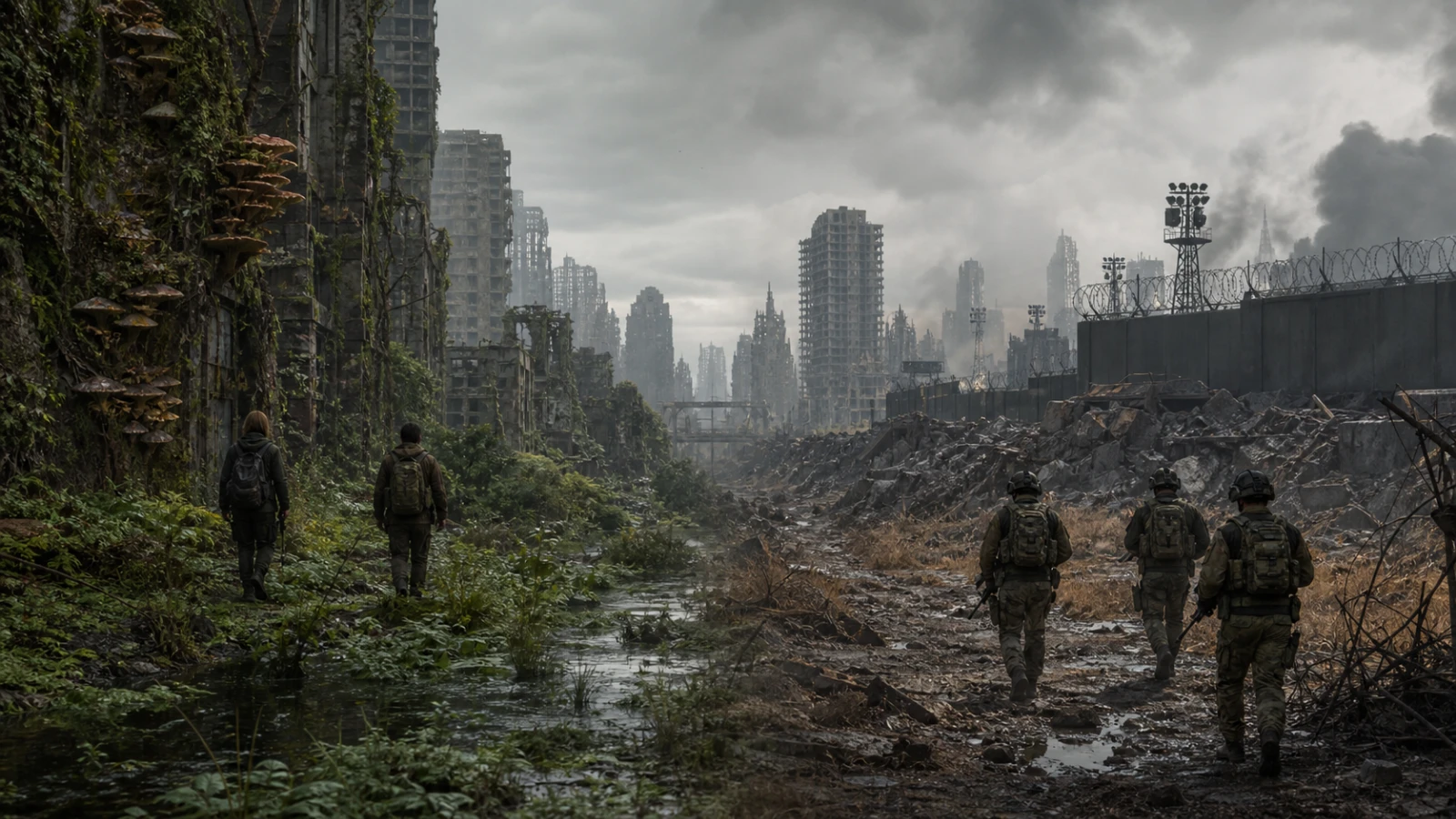
Post-apocalyptic fiction often asks the same question in different forms: what happens when the systems that make ordinary life possible stop working?
The Last of Us and the Extinction Cycle both answer with infected humans, ruined cities, military authority, scavenging, fortified communities, and the long moral aftermath of collapse. From a distance, they appear to occupy the same part of the genre. Get closer and the differences become more important than the similarities.
The Last of Us imagines an ecological nightmare. Its fictional Cordyceps infection turns the natural world into an enemy that persists after governments fail. The infected develop into recognizable stages, abandoned buildings become fungal habitats, spores make enclosed spaces dangerous in the game continuity, and survivors live within an environment that has been permanently changed. The disaster becomes part of the ecology.
The Extinction Cycle imagines something more militarized. Its catastrophe begins with a secret human program, VX-99, whose history reaches back to Vietnam and an effort to create enhanced soldiers. The fictional Hemorrhage Virus and the Variants that follow are not presented as supernatural undead. They are the consequences of engineered biological ambition, secrecy, institutional failure, and a threat that repeatedly evolves faster than military planners can comfortably understand.
That distinction changes everything.
One world asks what happens when nature reclaims civilization and humans become another species fighting for space inside a hostile ecosystem.
The other asks what happens when humanity weaponizes biology, loses control of it, and then has to fight a war against the evolutionary consequences of its own decisions.
The result is two very different models of infection, adaptation, military collapse, settlement design, and survival culture.
At a Glance
| Category | The Last of Us | Extinction Cycle |
|---|---|---|
| Outbreak concept | Fictional human Cordyceps infection inspired by real insect-parasitic fungi | Fictional military bioweapon and Hemorrhage Virus rooted in VX-99 |
| Primary infected threat | Progressive infected stages | Variants and increasingly specialized forms |
| Adaptation model | Long-term fungal development and ecological persistence | Rapid in-universe Variant evolution and specialization |
| Government response | Military quarantine zones and FEDRA authority, with insurgent opposition | Conventional military operations, scientists, Team Ghost, strategic bioweapon countermeasures |
| Settlement model | QZs, isolated enclaves, survivor towns, Jackson | Safe zones, fortified outposts, research hubs, Allied States network |
| Core long-term problem | Living inside a permanent infected ecology | Staying ahead of a changing enemy while rebuilding institutions |
| Main social pressure | Scarcity, trauma, factional violence, trust | War, intelligence failures, logistics, politics, reconstruction |
| Real biology status | Inspired by genuine parasite-host phenomena, but human zombie infection is fictional | Uses real terms such as epigenetics, but Variant transformation is fictional |
First, Separate Real Biology from Both Fictional Outbreaks
The most important scientific point belongs near the beginning, not buried in a disclaimer at the end.
Real fungi can cause severe human disease. Real fungal pathogens can infect the lungs, bloodstream, skin, and other tissues. Some are difficult to diagnose and some are becoming resistant to treatment. The Centers for Disease Control and Prevention also notes that most fungi cannot survive at normal human body temperature, while warming environments could place evolutionary pressure on some fungi to tolerate higher temperatures.
That is real.
So is the bizarre biology that helped inspire The Last of Us. Species in the Ophiocordyceps unilateralis complex infect carpenter ants and alter their behavior in ways that help the fungus reproduce. Peer-reviewed work describes infected ants leaving normal activity patterns, moving into locations favorable to the parasite, attaching themselves to vegetation, and dying in positions that support fungal development and spore dispersal. Other studies show that this manipulation is highly host-specific.
What is not real is the leap from those insect systems to a human civilization-ending Cordyceps zombie pandemic.
Nothing in the research on zombie-ant fungi establishes that Ophiocordyceps can infect people and seize human motor control. The existence of fungal behavioral manipulation in insects is fascinating precisely because parasite-host relationships can be extremely specialized. It is inspiration for fiction, not evidence that The Last of Us is a realistic forecast.
The same boundary is necessary with the Extinction Cycle.
Epigenetics is real. Cells can change gene activity without changing the underlying DNA sequence, and environmental factors can influence gene regulation. The Extinction Cycle, however, uses epigenetic language as part of a fictional transformation mechanism in which VX-99 activates dormant biological potential and produces Variants. That transformation belongs to the story world.
The cleanest way to compare the franchises is therefore not to ask which fictional infection is "more scientifically possible." The better question is how each story uses a different kind of science to create a different apocalypse.
The Last of Us: Infection as Ecology
Official PlayStation material describes the Infected as humans afflicted by the Cordyceps infection. In the game continuity, infection can spread through bites, scratches, and inhaled spores. Infected develop through stages, with early forms remaining more recognizably human and later forms becoming increasingly distorted by fungal growth.
The most familiar progression includes Runners, Stalkers, Clickers, and Bloaters, with later material adding Shamblers and the Rat King. The exact path is not a simple timer that guarantees every infected person becomes every later form. Environment, survival time, and circumstance matter. The larger point is that the organism changes the host over time.
That gives The Last of Us a powerful ecological logic.
The enemy does not need a central commander. It does not need military doctrine. It does not need a research program continuously designing new monsters. The infection persists because infected bodies, contaminated spaces, and fungal growth become part of the environment.
A dark basement can remain dangerous years after the original outbreak.
A sealed interior can become a reservoir.
A dead infected host can continue contributing to transmission in game canon through spores.
The horror is not merely that infected people attack. It is that the world itself has changed in ways that make old human spaces biologically hostile.
This is one reason abandoned buildings in The Last of Us feel different from abandoned buildings in many zombie stories. They are not only empty structures waiting to be searched. They are habitats. Water, darkness, enclosed rooms, decaying bodies, fungal colonies, and poor ventilation can all influence how survivors approach them.
The outbreak therefore produces a style of survival based heavily on environmental reading.
Do not enter every room.
Do not assume silence means safety.
Understand airflow.
Listen before moving.
Conserve filters and protective equipment where the game continuity requires them.
Know whether you are dealing with human raiders, recently infected Runners, sound-sensitive Clickers, or something heavier.
The ecology sets the rules.
Extinction Cycle: Infection as a Weapon That Escapes Its Makers
The Extinction Cycle starts from a fundamentally different moral premise.
Its outbreak is not framed as a natural pathogen crossing into humanity. Its history is tied to a military program. Extinction Red Line places VX-99 in the Vietnam era during Operation Burn Bright, where Marines are exposed to an experimental substance connected to the idea of creating superior soldiers. The program does not produce controlled enhancement. It produces horror.
By the main series, the consequences have been buried inside classified history and revived through later experimentation. Extinction Horizon turns that secret into immediate catastrophe. Team Ghost enters a classified emergency without understanding the full background of the threat. Scientists and soldiers are forced into an alliance because neither side can solve the disaster alone.
The Dark Age introduction later summarizes the fictional mechanism directly: VX-99 is a military bioweapon associated with a supersoldier program, and the series describes it as activating dormant genes through epigenetic changes that transform humans into Variants.
Again, the important phrase is "the series describes."
This is in-universe science.
What matters for the comparison is how that premise shapes the story.
The Last of Us infection is terrifying because humans have become vulnerable to an ecological process they cannot meaningfully command.
The Extinction Cycle outbreak is terrifying because humans deliberately attempted to control biology and created an enemy that escapes control.
That produces a different relationship to guilt.
In The Last of Us, institutional failure is largely about response: quarantine, authoritarianism, scarcity, failed research, revolutionary opposition, and the inability to restore the old world.
In the Extinction Cycle, institutional failure begins earlier. The institution is implicated in creating the threat.
The military is therefore both part of the disaster's history and one of humanity's most important tools for surviving it.
That contradiction drives much of the franchise.
Adaptation: Infected Stages Versus an Evolutionary Arms Race
Both series feature enemies that change, but they use adaptation differently.
In The Last of Us, the infected stages represent progression and environmental persistence. A Runner is not the same tactical problem as a Clicker. A Bloater changes the risk calculation again. Different stages change how survivors move, what weapons they use, and how close they are willing to get.
The system is frightening because infection matures.
The Extinction Cycle is more explicitly built around an arms race.
Extinction Evolution makes that idea central. Variant Hunters approach Key West to observe how the creatures are changing. The mission is reconnaissance because the military needs updated intelligence. Reports that Variants may be able to swim immediately threaten assumptions about islands, ships, coastlines, and evacuation routes.
The series repeatedly creates new danger by invalidating old safety rules.
If a wall works, the question becomes whether the enemy can climb it.
If a coastline seems defensible, the question becomes whether the enemy can swim.
If a bioweapon appears to reduce one threat, the question becomes what survives the pressure.
If military forces believe scattered Variants are starving remnants, Dark Age asks what those remnants may have been doing beyond surveillance.
That creates a very different tone from the infected taxonomy of The Last of Us.
The Last of Us survivor learns categories.
The Extinction Cycle soldier learns that categories may stop being reliable.
That difference explains why intelligence collection is so important to Team Ghost and the Variant Hunters. Combat is not only about eliminating the enemy in front of them. Every encounter may contain evidence that changes how the next mission must be planned.
In that sense, the enemy is not simply biological.
It is informational.
Which Enemy Is More Predictable?
The Infected of The Last of Us are horrifying, but experienced survivors can build practical doctrine around them.
Clickers have recognizable sensory behavior. Runners behave differently. Later forms have identifiable strengths. The infected remain dangerous because an error can be fatal, not because the rules are rewritten every week.
The Extinction Cycle deliberately undermines that comfort.
Variants begin as fast predatory transformations and then become a larger taxonomy of specialized threats across the broader universe. Intelligence, climate, geography, radiation, experimentation, selection pressure, and other story conditions contribute to a world where military doctrine can become outdated.
That makes the average Variant encounter strategically heavier.
A patrol that sees something new may be carrying the first evidence of a new form.
A failed settlement may reveal an enemy behavior nobody expected.
A mission can succeed tactically while still proving that the larger war has become more dangerous.
This is one of the biggest thematic differences between the series.
The Last of Us asks whether humans can live inside an altered ecology.
The Extinction Cycle asks whether humans can adapt faster than the enemy they created.
Institutional Collapse in The Last of Us
The Last of Us world survives through fragments of authority.
Official PlayStation material describes Joel beginning his journey in a military quarantine zone. Behind that simple phrase is an entire political model: surviving government authority has contracted into defended spaces where civilians live under strict control because the outside world is too dangerous and the old national system no longer functions normally.
The Fireflies emerge in opposition to that order. Official PlayStation faction material describes them as a revolutionary militia formed in response to oppression in military-run quarantine zones, with goals connected to restoring democracy and order. Their search for a cure makes them both political insurgents and scientific hope.
That creates a fractured landscape.
FEDRA represents centralized emergency authority stripped down to survival governance.
The Fireflies represent revolutionary resistance and the belief that authoritarian survival is not enough.
Independent survivors represent another path entirely, from solitary self-sufficiency to violent predation.
Jackson, Wyoming becomes the most important counterexample. Official PlayStation material for The Last of Us Part II describes Joel and Ellie living among a thriving community of survivors that provides peace and stability despite the continuing threat of infected and hostile humans.
Jackson proves that the world can still produce community.
But it is local community.
It is not the restored United States.
Institutional Collapse in Extinction Cycle
The Extinction Cycle initially destroys institutions at extreme speed.
Its early books repeatedly show military bases, cities, research centers, ships, command networks, and evacuation plans failing under a threat they do not understand well enough. Team Ghost operates as a mobile instrument inside that failure, moving between scientific rescue, direct action, security, reconnaissance, and extraction.
The difference becomes clearest later.
The original series does not end with permanent fragmentation.
By Dark Age, eight years after Extinction War, the surviving United States has become the Allied States. The introduction describes approximately one hundred outposts, mostly in the Midwest and East Coast. It also states that President Jan Ringgold's administration has restored basic infrastructure, agriculture, manufacturing, and the energy grid.
That is a fundamentally different post-apocalyptic endpoint from The Last of Us.
The Allied States is not the old country restored exactly as it was.
But it is a state.
It has an administration.
It has elections.
It has military forces.
It has logistics between outposts.
It has agriculture and industrial recovery.
It can assign Team Ghost to frontier missions over a period of years.
This makes reconstruction a central part of the Extinction Cycle rather than merely background texture.
Humanity has to defeat enough of the immediate threat to create a second problem: how do you govern the world that survived?
Military Response: FEDRA and Quarantine Versus a War Machine
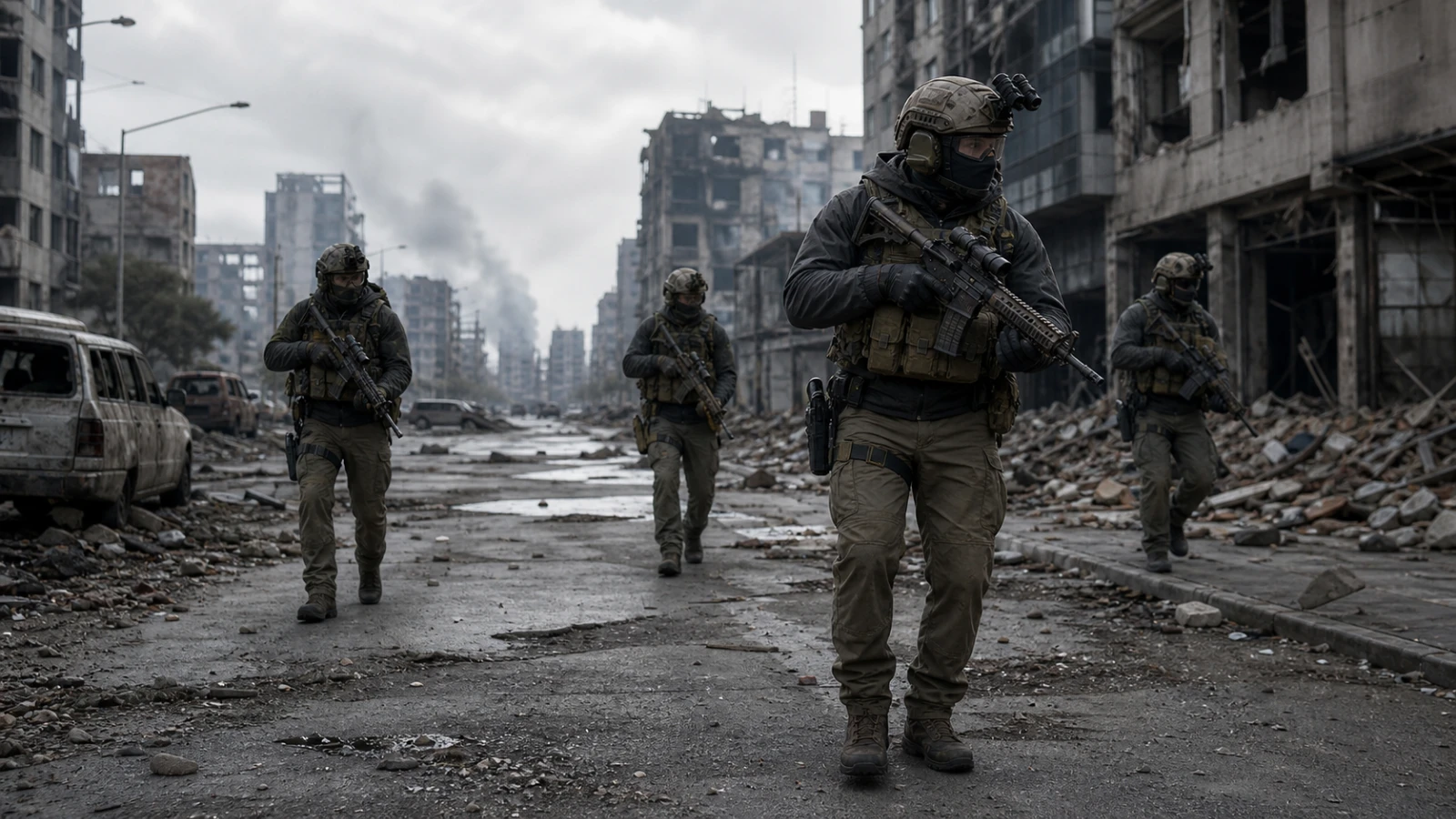
The two franchises also imagine military power differently.
In The Last of Us, the military response is strongly associated with quarantine zones and control. The Boston QZ is a heavily militarized community in which civilians survive under FEDRA authority. This is a logical response to a contagious disaster that has shattered normal government, but the story emphasizes the human cost of that system.
The military remains powerful locally while national civilization remains broken.
The Fireflies challenge that political arrangement rather than functioning as an extension of it.
In the Extinction Cycle, military response remains one of the primary engines of the plot.
Team Ghost is not simply guarding a wall. It escorts scientists, conducts raids, moves through Variant territory, participates in large operations, gathers intelligence, captures specimens, supports strategic weapons, and later continues frontier hunts and prisoner rescues.
The Variant Hunters add another layer by turning battlefield observation into scientific intelligence.
Naval assets, hardened facilities, aircraft, special operations units, and surviving national command all matter because the conflict is treated as a war.
That produces a different relationship between civilians and the military.
In The Last of Us, the military often represents the last rigid structure of the old world, and its survival can feel oppressive.
In the Extinction Cycle, military power is morally compromised by secrecy and past experimentation, but it is also indispensable to large-scale human survival.
The same institution can conceal the truth and still be the only organization capable of flying a team into a collapsing city to rescue scientists.
That tension is central to Reed Beckham's story.
Settlement Design: What Kind of Walls Does Each Apocalypse Build?
Settlement design reveals what each world fears most.
The Last of Us
Military quarantine zones are designed around containment, rationing, surveillance, and controlled access. Their basic assumption is that infection and disorder are outside, while authority must maintain a hard boundary inside.
Jackson reflects a more communal model. It is a place where people can build stable relationships, patrol the surrounding area, maintain food production, and create a life that is more than emergency shelter.
The danger remains local and persistent.
A settlement needs perimeter security, food, maintenance, patrols, and enough trust to prevent internal fracture.
The natural environment also matters. Overgrowth can hide movement. Buildings decay. Fungal contamination can make interiors dangerous. A settlement is therefore partly a negotiation with ecology.
Extinction Cycle
The Dark Age outposts operate at a more militarized and networked scale.
The books describe walled communities connected to a larger Allied States system. Outpost Turkey River, for example, is presented as a defended agricultural community with food and clean water, a substantial steel wall, towers, sensors, military personnel, dogs, solar-equipped buildings, and rail exports that support the larger network.
Other outposts and strategic locations serve different purposes: government continuity, coastal defense, research, regional security, refugee reception, transportation, and trade.
The key difference is interdependence.
Jackson can be understood primarily as a strong community.
An Allied States outpost is also a node.
It must contribute to a larger system.
One location grows food.
Another may hold command infrastructure.
Another may defend a corridor.
Another may receive refugees.
That creates resilience, but it also creates vulnerability. If trains stop, radios fail, political leadership fractures, or multiple outposts go dark at once, the problem is no longer local.
Reconstruction recreates complexity.
Complexity recreates dependence.
The Communities Each World Produces
The infected do not merely kill people. They shape the social structures that remain.
The Last of Us produces intimate communities
The strongest communities in The Last of Us are often small enough that personal relationships matter directly to survival.
Trust is tangible.
Someone stands the watch.
Someone repairs the fence.
Someone knows who failed to return from patrol.
The social scale encourages deep bonds and intense feuds. Political systems may exist, but the story usually makes them personal because communities remain relatively localized.
Even larger organizations such as FEDRA and the Fireflies are experienced through individual relationships rather than through a fully restored national bureaucracy.
The world produces survivors who are experts in scarcity, suspicion, improvisation, and intimate loyalty.
Extinction Cycle produces institutions under pressure
The Extinction Cycle starts with small-team survival too, but it keeps expanding outward.
Scientists need soldiers.
Soldiers need command networks.
Command needs ships, aircraft, fuel, bases, communications, and logistics.
Safe zones need government.
Outposts need agriculture, manufacturing, trade, elections, and transportation.
That scale produces a different kind of survivor.
Not everyone has to be a scavenger.
Some people become farmers again.
Some become administrators.
Some become researchers.
Some join patrol units.
Some grow up inside walls without remembering the first outbreak.
That is one of the most important changes in Dark Age. Civilization has recovered enough to create citizens again, not merely survivors.
And citizens create politics.
Human Enemies Matter Differently Too
Neither franchise reduces apocalypse to infected versus uninfected.
Human violence is often the more morally complicated danger.
In The Last of Us, raiders, oppressive authorities, revolutionary groups, militias, and ideological communities demonstrate that the end of the old state does not end politics. It makes politics smaller, harder, and more personal.
In the Extinction Cycle, human factions can become strategic threats on a scale comparable to the Variants themselves. Extinction War makes this explicit when the Resistance of Tyranny uses infection as a weapon against safe-zone populations.
That changes the meaning of biological security.
In one moment, a wall is meant to keep monsters out.
In the next, the greater threat is a human being who understands how to put the infection inside.
The weaponization of contagion fits the larger theme of the series: biology becomes most dangerous when human institutions try to use it.
What Survival Looks Like After Twenty Years Versus Eight Years
The timelines produce another revealing contrast.
The Last of Us Part I takes place roughly twenty years after the pandemic. The old United States has not been restored. The country remains fractured among quarantine zones, militias, independent enclaves, abandoned territory, and infected ecosystems.
That long duration changes the meaning of survival.
The apocalypse is not a temporary emergency.
It is the world.
People have been born into it.
The old civilization has become memory.
The Extinction Cycle: Dark Age jumps eight years beyond Extinction War, and the opposite trend has occurred. The surviving population has consolidated into an Allied States network that is actively rebuilding.
The time gap is shorter, but institutional recovery is greater.
Why?
The simplest answer is that the stories are built around different premises.
The Last of Us infection becomes a permanent ecological condition that remains distributed across the landscape.
The Extinction Cycle frames the original crisis as a war that can be pushed back far enough for reconstruction to begin, even though the enemy is not truly gone.
That does not make one world more realistic.
It shows what each story wants to examine.
The Last of Us is interested in people who live after the world has become permanently broken.
The Extinction Cycle is increasingly interested in people who rebuild enough of the world to become vulnerable to losing it again.
Which World Creates the More Stable Society?
At first glance, the Allied States clearly wins.
It has more organized government, broader infrastructure, a standing military, inter-outpost logistics, and national political continuity.
But stability creates its own danger.
People begin trusting the walls.
Leaders begin trusting old threat assessments.
Trade routes become predictable.
Infrastructure becomes essential.
Citizens begin expecting ordinary life.
Dark Age weaponizes that recovery by attacking the assumption that the worst is over.
The Last of Us communities are often less ambitious, but that modest scale can reduce systemic dependence. A small community that grows its own food and controls its own perimeter may be politically fragile, yet it is not waiting for a national rail network to deliver grain.
The tradeoff is clear.
The Last of Us offers less civilization and fewer cascading systems to fail.
The Extinction Cycle offers more civilization and therefore more to lose.
Which World Produces the Better Military Survivor?
If the question is formal tactical performance, the Extinction Cycle has the advantage.
Team Ghost and the Variant Hunters are professional military units operating with doctrine, specialized equipment, communications, reconnaissance, and combined support. Their baseline training is far beyond the average survivor.
The Last of Us produces a different type of competence.
Its survivors become masters of improvisation, scavenging, stealth, local terrain, and functioning without institutional support. Joel's world teaches people to survive when no helicopter is coming and no command center is listening.
The ideal survivor would combine both.
Team Ghost discipline with Jackson's community resilience.
Military intelligence with environmental patience.
The ability to call an airstrike when one exists and the ability to disappear into the wilderness when it does not.
Infection as Theme: Nature Versus Human Ambition
The deepest difference between the franchises is thematic.
The Last of Us infection is a story about human vulnerability to nature.
The world becomes overgrown because humanity is no longer the dominant organizing force. Cities decay. Plants return. Fungal life occupies spaces humans once controlled. The visual language constantly reminds the audience that the planet does not require civilization.
The Extinction Cycle turns the mirror around.
Its disaster comes from human ambition directed through science and military secrecy. Nature is not attacking humanity from outside. Humanity has created a weapon that turns human biology against itself.
That is why the series' military-science partnership is so complicated.
The people trying to save civilization work inside institutions related to the institutions that endangered it.
The cure and the catastrophe belong to the same technological civilization.
That makes the Extinction Cycle less a story of nature reclaiming the world and more a story of humanity trying to survive its own capacity to engineer disaster.
Real Science Box: What Climate Change Actually Means for Fungi
A comparison like this can easily slide from fiction into sensationalism, especially because The Last of Us popularized the idea that warming could help fungi cross a temperature barrier.
The careful real-world version is narrower.
CDC notes that only a small fraction of fungal species can infect people and that most fungi cannot survive at normal human body temperature. CDC also notes that environmental warming may help some fungi adapt to warmer conditions and may change where fungal diseases occur.
That is a legitimate public-health research concern.
It does not mean warming is turning insect Cordyceps into human mind-control pathogens.
The meaningful real-world issues are things such as geographic expansion of fungal pathogens, antifungal resistance, diagnostic challenges, severe infections in vulnerable patients, and the possibility that changing environments alter which fungi can survive in human hosts.
The fictional leap remains fictional.
What Each World Teaches About Preparedness
Despite their different science-fiction mechanisms, both franchises converge on a few practical themes.
Institutions need transparency
The Extinction Cycle repeatedly shows the cost of compartmentalized information. Team Ghost enters missions without knowing enough about the threat because classified programs and command structures withhold crucial context.
The Last of Us shows a different information problem: surviving institutions can become so focused on maintaining order that legitimacy collapses.
People do not only need protection.
They need reasons to trust the people providing it.
Walls are not enough
A wall can stop a body.
It cannot stop bad intelligence.
It cannot fix food shortages.
It cannot guarantee political legitimacy.
It cannot prevent every infected breach.
Both worlds eventually demonstrate that fortifications are systems, not solutions.
Science needs field evidence
The Extinction Cycle makes this explicit through Kate Lovato, Team Ghost, and the Variant Hunters. Soldiers see changes in the enemy, scientists interpret them, and military strategy has to update.
The Last of Us uses a more intimate version of the same idea through Ellie's immunity and the Fireflies' search for a cure. Knowledge exists because someone survived long enough to become evidence.
Community is strategic infrastructure
Jackson matters because it gives people something worth protecting.
The Allied States outposts matter for the same reason.
Food, schools, families, trade, medicine, and ordinary routines are not decorative signs that the apocalypse is ending.
They are the reason survival matters.
So Which Apocalypse Is Harder to Survive?
There is no clean answer because the danger is distributed differently.
The Last of Us world is brutally persistent.
Even decades later, the infection remains embedded in the environment. Government authority is fragmented. Travel can expose survivors to infected, spores in game canon, hostile humans, structural collapse, and long distances without support.
The average person has little institutional safety net.
The Extinction Cycle is more explosively militarized.
Variants are faster, physically extreme, and increasingly adaptive. Early collapse moves with terrifying speed. Large operations can fail because the enemy changes faster than intelligence. The war introduces specialized biological countermeasures, major military campaigns, and human enemies willing to weaponize infection.
But if a civilian survives long enough to reach the Dark Age Allied States, that person may have access to a more organized society than most people in The Last of Us ever see.
That leads to a useful distinction.
The Last of Us may be the harder world to live in indefinitely.
The Extinction Cycle may be the harder world to survive during active escalation.
One grinds civilization down and keeps it fragmented.
The other nearly annihilates civilization, then lets humanity rebuild before testing whether the recovery can survive a new evolutionary war.
Final Verdict
The Last of Us and the Extinction Cycle both use infected humans to explore collapse, but their real subjects are different.
The Last of Us is about adaptation to a world humanity no longer controls. Its infection becomes ecology. Twenty years after the outbreak, people still live among quarantine zones, infected landscapes, local communities, and broken national authority. The fungal premise gives the world a sense of permanence. Civilization did not simply lose a war. It lost its place at the center of the environment.
The Extinction Cycle is about adaptation to a weapon humanity created and cannot stop redesigning itself. Its outbreak becomes an evolutionary arms race. Scientists, soldiers, governments, and survivor communities remain connected to the conflict because the enemy keeps changing and because civilization eventually rebuilds enough infrastructure to fight at scale.
The difference is visible in the settlements.
Jackson is a triumph because a community has carved out a life inside a broken world.
An Allied States outpost is a triumph because communities have begun reconnecting into a civilization.
The difference is visible in the enemies.
A Clicker is terrifying because the infected ecology has reached a mature and lethal stage.
A new Variant form is terrifying because it may mean yesterday's doctrine is already obsolete.
And the difference is visible in the science.
The Last of Us takes inspiration from a real and remarkable host-parasite relationship in insects, then imagines it crossing a biological boundary into humans.
The Extinction Cycle takes real vocabulary from genetics and epigenetics, then imagines a military program unlocking a predatory transformation that real epigenetics does not support.
Neither outbreak should be mistaken for a medical forecast.
Both are effective because they take something real enough to recognize and push it far enough to expose a different fear.
In The Last of Us, the fear is that nature does not need us.
In the Extinction Cycle, the fear is that humanity may be clever enough to destroy itself and disciplined enough to rebuild, but still not wise enough to stop creating the next battlefield.
Quick Comparison Verdict
More ecological outbreak: The Last of Us More militarized outbreak: Extinction Cycle More persistent environmental contamination: The Last of Us Faster enemy adaptation: Extinction Cycle More fragmented long-term government: The Last of Us More extensive postwar reconstruction: Extinction Cycle More formal military response: Extinction Cycle More intimate local survival culture: The Last of Us Most important science rule: Both human outbreak mechanisms are fictional and must remain clearly separated from real fungal biology and real epigenetics.
FAQ
Is The Last of Us Cordyceps infection scientifically possible?
Not as depicted. Real Ophiocordyceps fungi can manipulate the behavior of specific insect hosts, especially ants, but there is no evidence that they can infect humans and create the fictional neurological transformation shown in The Last of Us. Real human fungal diseases are important public-health concerns, but they are different biological systems.
Are Variants in Extinction Cycle caused by real epigenetics?
No. Epigenetics is a real field involving regulation of gene activity, but the transformation of humans into Variants through VX-99 and the Hemorrhage Virus is fictional. The site should describe this as in-universe science rather than real medical plausibility.
Does The Last of Us use spores or tendrils?
The games use spores as part of transmission, and official PlayStation material describes infection through bites, scratches, and inhaled spores. The HBO adaptation changes important infection mechanics, including replacing the game's airborne-spore emphasis in many scenes with a tendril-based concept. The two continuities should not be silently merged.
Which universe has the more organized government after the outbreak?
By the Dark Age period, the Extinction Cycle has the Allied States, roughly one hundred outposts, restored infrastructure, agriculture, manufacturing, an energy grid, elections, and continuing military operations. The Last of Us retains military quarantine zones and organized communities such as Jackson, but the former United States remains much more fragmented.
Which infected enemy adapts faster?
Within their respective fictional rules, Variants change more aggressively as an evolutionary military problem. The Last of Us infected progress through stages and persist as part of a fungal ecology, while the Extinction Cycle repeatedly emphasizes new Variant capabilities that force military doctrine to change.
Which world is safer for ordinary civilians?
It depends on the period. During the first Variant war, the Extinction Cycle is extraordinarily lethal and fast-moving. In the Dark Age Allied States, many civilians live inside organized outposts with more infrastructure than typical The Last of Us survivors. The Last of Us world remains persistently fragmented decades after its pandemic.
Sources and Canon Basis
Extinction Cycle primary canon
- Nicholas Sansbury Smith, Extinction Horizon
- Nicholas Sansbury Smith and Tom Abrahams, Extinction Red Line
- Nicholas Sansbury Smith, Extinction Evolution
- Nicholas Sansbury Smith, Extinction War
- Nicholas Sansbury Smith and Anthony J. Melchiorri, Extinction Cycle: Dark Age
The Last of Us official franchise sources
- PlayStation, "Discover The Last of Us": https://www.playstation.com/en-us/the-last-of-us/
- PlayStation, The Last of Us Part I: https://www.playstation.com/en-us/games/the-last-of-us-part-i/
- PlayStation, The Last of Us Part II Remastered: https://www.playstation.com/en-us/games/the-last-of-us-part-ii-remastered/
- PlayStation official faction guide for the Fireflies and quarantine-zone context
Real fungal biology sources
- CDC, "About Fungal Diseases": https://www.cdc.gov/fungal/about/index.html
- CDC, "Climate and Fungal Diseases": https://www.cdc.gov/fungal/about/climate-change-and-fungal-diseases.html
- Hughes et al., research on Ophiocordyceps behavioral manipulation in ants, available through PubMed Central
- de Bekker et al., research and reviews on host-specific behavioral manipulation by Ophiocordyceps, available through PubMed Central
Editorial Disclosure
This is independent comparative fan criticism. The Last of Us and Extinction Cycle are separate fictional properties owned by their respective rights holders. The crossover comparison does not imply shared canon, endorsement, or affiliation. Generated images supplied with this package are unofficial editorial illustrations and should not be presented as official franchise artwork or television stills.
Recommended next pages
Source and canon pack
- Canon treatment
- Independent comparative criticism. The Last of Us uses game continuity unless explicitly noted; Extinction Cycle claims are checked against the novels and source-indexed canon records; real fungal biology remains separate from both fictional mechanisms.
- Primary wiki source plan
- Extinction Horizon and the original-series VX-99, Hemorrhage Virus, outbreak, military-response, Team Ghost, and Variant records; the later Dark Age outpost, Allied States, reconstruction, and renewed-evolution records; local source-indexed science, settlement, mission, and character pages.
- Spoiler scope
- Major world-building and story spoilers for The Last of Us games and the Extinction Cycle through the later Dark Age era.
- Safety boundary
- Fictional infection mechanisms are not medical guidance or forecasts. Real fungal-disease context remains general and defers to current CDC information. No long quotations, official art, screenshots, posters, logos, actor or game-character likenesses, affiliation claims, ads, affiliate links, or graphic gore are used.
- Program article ID
- EC-11
- Scheduled publication
- 2026-08-28T09:00:00-04:00