
Civilian courage meets military structure
Train to Busan vs. Extinction Cycle: Civilian Survival Versus Military Survival
Compare Train to Busan and Extinction Cycle through civilian panic, military discipline, confinement, mobility, trust, sacrifice, and long-term survival.
·
Category: Analysis and Opinion
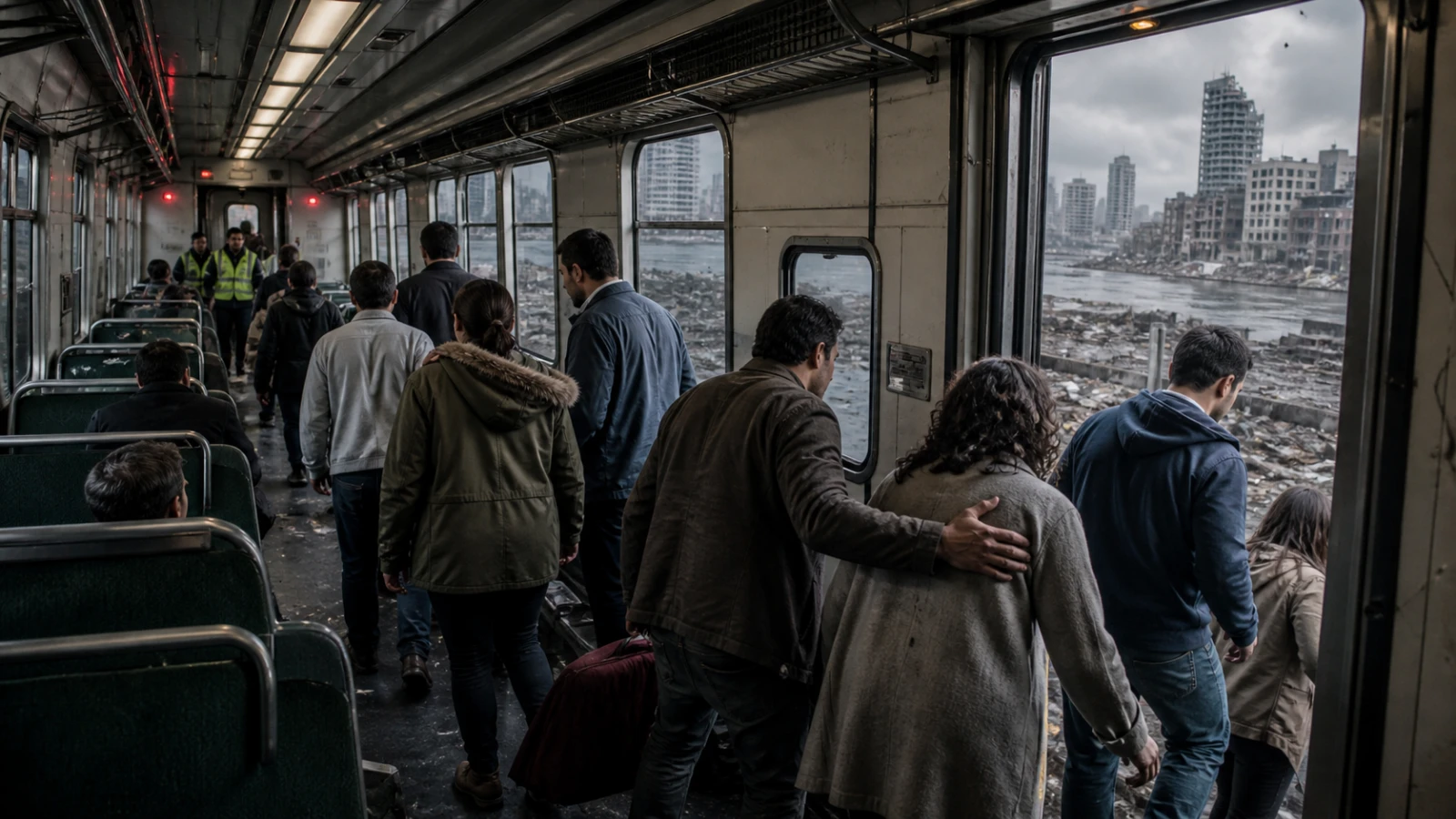
Thesis: Train to Busan compresses survival into civilian panic inside a moving trap, while Extinction Cycle stretches survival across disciplined operations, fortified outposts, and the harsh logic of military adaptation.
Spoiler and Scope Note
This article is a speculative comparative analysis. It is not a claim of official crossover canon. The Extinction Cycle discussion is grounded in recurring canon themes, while the outside-franchise side is treated as a thematic comparison rather than a scene-by-scene recap.
Introduction: One Train Car vs. an Entire War Zone
Train to Busan and Extinction Cycle appear, at first glance, to occupy different scales of apocalypse. One is intimate, claustrophobic, and driven by the desperate movement of civilians through a confined train system. The other is expansive, militarized, and concerned with the survival of settlements, the coordination of missions, and the evolutionary danger posed by Variants. Yet these differences make the comparison unusually revealing. Train to Busan shows what survival looks like when people have almost no preparation and almost no room. Extinction Cycle shows what survival looks like when preparation matters enormously but can still be overrun by a faster, smarter, and more organized threat.
This means the contrast is not simply civilians versus soldiers. It is immediacy versus structure. The passengers in Train to Busan are forced to discover rules while already trapped inside them. Information is fragmentary, movement is limited, and every human decision is visible at close range. Extinction Cycle operates in a world where the rules are learned through blood, then institutionalized into patrol discipline, command decisions, outpost systems, and tactical doctrine. Civilians still matter, but the core survival grammar often comes from trained operators and organized response.
The result is a compelling study in moral compression. Train to Busan squeezes trust, fear, selfishness, sacrifice, and leadership into minutes and compartments. Extinction Cycle stretches those same qualities across campaigns, defensive lines, and the grim long haul of rebuilding after catastrophe. Comparing the two helps answer a broader question: how much does training really change survival, and what human truths remain the same even when one world has Team Ghost and the other has commuters, families, and ordinary strangers trying not to die?
Civilian Panic and the Price of Inexperience
Train to Busan is at its strongest when showing how quickly ordinary life dissolves once the threat becomes immediate. Civilians are not stupid, but they are unprepared. They do not begin with a common doctrine, a chain of command, or a shared language for risk. Their responses therefore vary wildly. Some panic, some freeze, some become selfish, and some discover courage they did not know they had. This produces emotional intensity because survival is inseparable from character revelation.
Extinction Cycle also contains civilians, but it repeatedly demonstrates how much inexperience costs when facing a fast-moving infected threat. The difference is that the broader world contains people who have already been forced to turn lessons into systems. The presence of trained teams, fortified positions, and battlefield intelligence means some hard-earned knowledge can be transferred. Not everyone has to invent survival from scratch in the same moment the threat arrives.
This contrast does not diminish the heroism of Train to Busan. In fact, it deepens it. Courage under conditions of total unpreparedness carries a distinct moral weight. A father protecting his child or a stranger helping another passenger is not executing doctrine. He is choosing solidarity under chaos. Extinction Cycle, by comparison, often asks its characters to preserve solidarity under conditions where fear can be rationalized as tactical realism. Its best leaders are admirable because they can remain human without abandoning discipline.
Both stories, then, understand panic as more than noise. Panic is the first test of whether a group can become something larger than its fear. Train to Busan dramatizes the test in raw form. Extinction Cycle dramatizes the test after institutions have tried to make fear manageable.
The Moving Trap vs. Planned Operations
A train is one of the best possible environments for comparing with Extinction Cycle because it weaponizes confinement. Passengers in Train to Busan have limited exits, limited visibility, and almost no strategic depth. Every door matters. Every compartment becomes a temporary safe zone or death zone. The environment forces split-second decisions because there is no room to create distance or restructure the battlefield. Survival becomes a matter of timing, improvisation, and whether people can cooperate under physical compression.
Extinction Cycle usually grants its characters more operational space, but that space is deceptive. Missions can be planned, routes chosen, and defensive lines established. Team Ghost and similar units operate with maps, objectives, equipment, and situational awareness to a degree unimaginable for civilians on a train. Yet the series is careful to show that planning does not cancel danger. Variants exploit mistakes, overwhelm static assumptions, and punish anyone who thinks operational control equals safety.
This makes the comparison especially sharp. Train to Busan reveals the psychology of survival when the battlefield is imposed upon you. Extinction Cycle reveals the psychology of survival when you try to impose structure back onto the battlefield. One is reactive almost by definition. The other is strategic by necessity. Neither is comfortable, but the availability of structure changes everything from who leads to how sacrifice is judged.
If Team Ghost were placed on a Train to Busan-style moving platform, they would likely improve perimeter control, movement discipline, and casualty management dramatically. But the film’s deeper lesson would still apply. Confinement compresses not just space, but time. Even trained teams would feel the squeeze. That is precisely why the train works so well as a comparison device. It strips survival down to coordination under compression.
Trust, Exclusion, and the Moral Cost of Fear
Few things make Train to Busan memorable like its portrayal of how fear corrodes trust. When survivors begin dividing into acceptable and unacceptable bodies, the social wound can become as dangerous as the infected outside the door. The film understands that group survival is never purely technical. It is also moral. People decide who deserves entry, who is too risky to help, and whether self-protection has become an excuse for cruelty.
Extinction Cycle knows this problem well, though it operates on a broader scale. Outpost rules, quarantine concerns, intelligence uncertainty, and pressure from repeated losses can all harden communities. Fear of infiltration or contamination may have more operational justification in a world of fast, adaptive threats, but the political consequence is similar. Once a community begins defining survival as permission to discard difficult people, it starts narrowing its own legitimacy.
This is where civilian survival and military survival overlap most clearly. Neither civilians nor soldiers escape the temptation to protect themselves by morally shrinking the circle. The difference is that military or quasi-military environments can mask exclusionary behavior as necessity more easily. A hard call may truly be necessary. But hard calls also create opportunities for cowardice disguised as realism.
Train to Busan lays that temptation bare because its social scale is small and emotionally legible. We can see people refuse one another. Extinction Cycle distributes the same issue through command decisions, checkpoint rules, outpost discipline, and settlement governance. The stakes are larger, but the moral issue is the same. Fear that begins as a tool of preservation can become a habit of dehumanization unless leaders consciously resist it.
Mobility: Running for the Next Car vs. Owning the Route
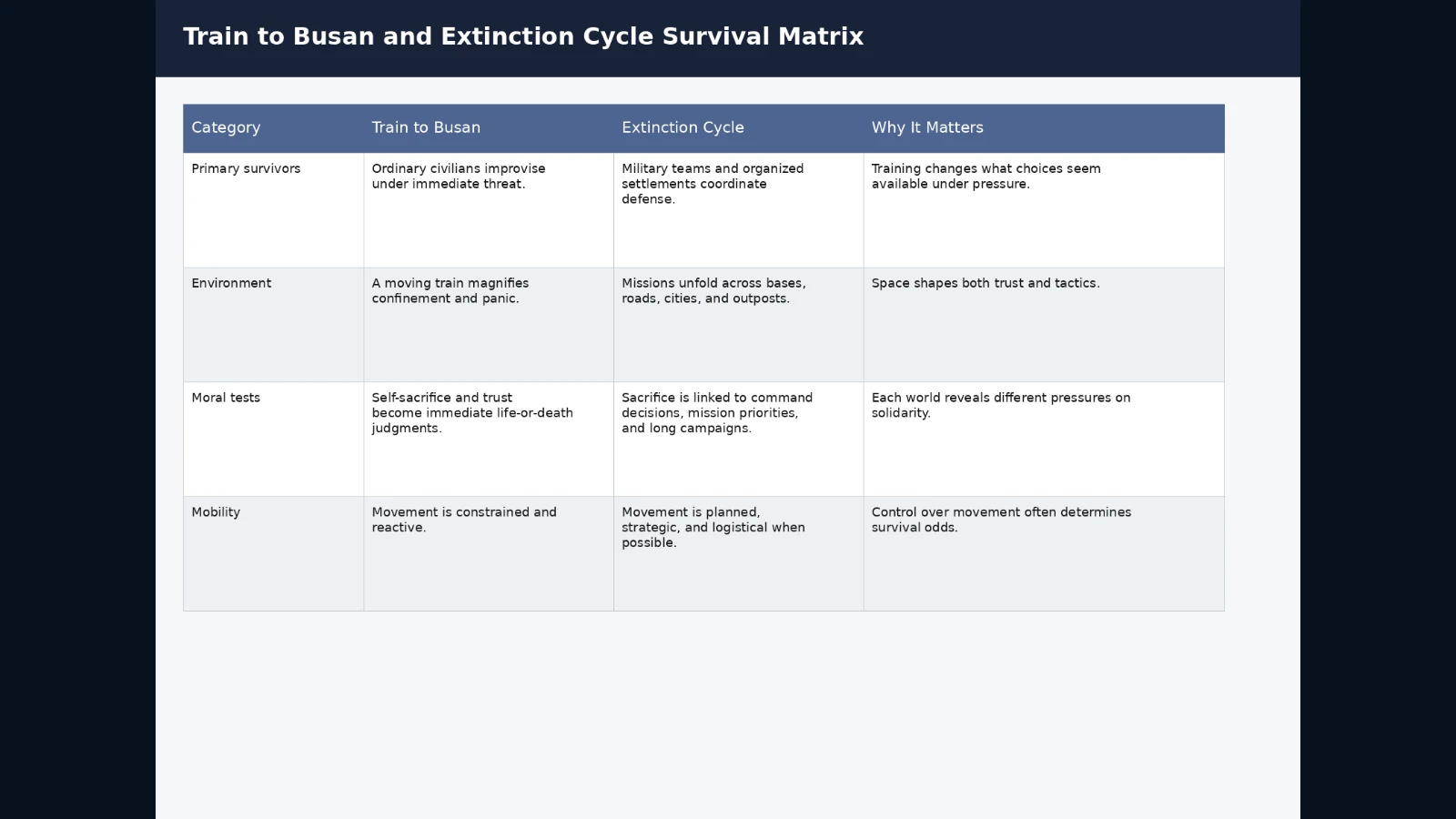
Movement is survival in both stories, but it functions differently. In Train to Busan, movement is reactive and local. Survivors move from car to car, trying to create momentary pockets of safety. They do not own the route. They are carried by it. Their problem is not only danger but dependence. The system moving them forward is also trapping them. Every choice is shaped by architecture they did not design and cannot meaningfully control.
Extinction Cycle makes mobility strategic. Vehicles, patrol routes, extraction plans, staging areas, and resupply corridors matter enormously. Movement can be planned and defended, even if never perfectly. The ability to choose when and where to move is a form of power that civilians on the train almost never possess. It allows Team Ghost and other organized actors to set objectives instead of merely fleeing toward the next locked door.
This difference illuminates one of Extinction Cycle’s major strengths as a survival world. It treats logistics seriously. Moving people, ammunition, medicine, intelligence, and leadership between threatened spaces is not background detail. It is one of the foundations of survival. Train to Busan reminds us what the loss of that foundation looks like. Once mobility is no longer yours to shape, panic intensifies and sacrifice becomes more improvised.
Still, the train narrative also exposes a vulnerability military worlds can forget: the fragility of control. Under the wrong conditions, every planned route can collapse into trapped movement. That is why the comparison matters. It shows the difference between mobility as hope and mobility as illusion.
Sacrifice in the Civilian Mode and the Military Mode
Sacrifice exists in both stories, but it does not carry the same narrative texture. In Train to Busan, sacrifice is profoundly personal. It arises between family members, between strangers forced into brief solidarity, and between individuals who decide that another person’s survival matters more than their own immediate chance to live. Because the social scale is small, the emotional impact is immediate and intimate.
Extinction Cycle also contains personal sacrifice, but it often links sacrifice to mission logic. A soldier may risk himself because the team must escape, a scientist because the countermeasure work must continue, or a leader because civilians depend on the mission succeeding. The sacrifice is no less real, but it is embedded in a larger framework of strategic consequence. The act is measured both emotionally and operationally.
Neither version is superior. They simply reveal different truths. Civilian sacrifice demonstrates that moral courage does not require training. Military sacrifice demonstrates that courage can be sustained inside systems of duty and coordinated action. In both cases, the meaning of sacrifice depends on trust. People risk themselves for others when they believe the others matter and that the act serves something larger than panic.
What Train to Busan offers Extinction Cycle readers is a stripped-down view of why sacrifice matters at all. Before there are missions, there are people. Before there is doctrine, there is the decision to refuse total selfishness. Extinction Cycle adds the next layer by showing how institutions can either honor or squander that human willingness to give everything.
Who Adapts Faster?
This question sits near the center of the comparison. If a group of Train to Busan survivors were dropped into Extinction Cycle, who would adapt fastest? Probably the answer would not be the loudest or most conventionally brave. The best adapters would be those who learn quickly, cooperate under pressure, and accept harsh realities without losing the ability to care for others. Those traits travel well across survival worlds.
Still, Extinction Cycle’s environment raises the bar dramatically. Variants are not merely fast infected threats appearing in one transport corridor. They force sustained adaptation over time. Learning one rule is not enough. Teams must adapt repeatedly as enemy behavior evolves, settlements come under pressure, and intelligence shifts. This favors trained operators and civilians willing to submit to disciplined structures rather than purely improvised movement.
That is where Team Ghost’s world is both harder and clearer. Harder, because the threat does not stay confined. Clearer, because survival eventually requires acknowledging that good intentions alone are insufficient. The most sympathetic civilian in Train to Busan still needs training, weapons discipline, and a logistics framework to last long-term in Extinction Cycle.
Yet the reverse is also revealing. Extinction Cycle survivors entering Train to Busan would bring competence, but they would also be reminded that the heart of survival is relational. A technically sound plan means little if fear destroys the group from inside. Adaptation is therefore not only tactical. It is social.
Final Verdict: What Civilian and Military Survival Teach Each Other
Train to Busan and Extinction Cycle ultimately examine the same human problem from opposite ends of the preparedness spectrum. Train to Busan asks how ordinary people behave when there is no doctrine and almost no time. Extinction Cycle asks how trained and organized people behave when doctrine exists but the threat keeps evolving past it. One is survival in the raw. The other is survival under organized strain.
This makes the comparison fruitful rather than forced. Train to Busan reminds Extinction Cycle readers that the emotional core of apocalypse fiction lies in trust, sacrifice, and the refusal to abandon one another. Extinction Cycle reminds Train to Busan readers that long-term survival requires structure, discipline, logistics, and leaders who can translate fear into action. Civilian courage and military competence are not enemies. They are incomplete without each other.
If one had to choose which model is more durable, Extinction Cycle’s is clearly better built for prolonged catastrophe. Team Ghost-style planning, outpost discipline, and operational mobility give survivors a framework the passengers on the train do not have. But if one had to choose which model most clearly reveals what survival costs at a human level, Train to Busan may cut deeper. Its confined world leaves nowhere to hide from cowardice or grace.
Together, the two stories show that apocalypse does not only test strength. It tests whether people can remain morally legible to one another when fear is moving faster than thought. That is true in a train corridor, and it is true on a battlefield.
FAQ
What does the train setting add to the comparison?
It compresses movement, trust, exclusion, and sacrifice into a confined space where civilians have almost no time to learn the threat or create strategic distance.
Does military training solve the problem?
It improves coordination, route control, and logistics, but it cannot replace the trust and solidarity that determine whether a frightened group remains functional.
Is this a canon crossover?
No. It is independent fan criticism comparing civilian and military survival systems.
Source note
Well Go USA's official synopsis establishes a father-daughter trip transformed by a zombie outbreak and a fight for survival aboard a speeding train. Extinction Cycle claims are checked against current Team Ghost, outpost, mission, logistics, and Variant records.
Editorial note
This independent fan analysis uses original generic artwork and a submitted editorial comparison chart. It does not reproduce official franchise images, actor likenesses, logos, or claim a canon crossover.
Recommended next pages
Source and canon pack
- Canon treatment
- Well Go USA establishes the train, father-daughter journey, and outbreak premise. Team Ghost, Variant, and outpost claims follow local records; the survival comparison remains interpretive.
- Primary wiki source plan
- Team Ghost, Variant, outpost, mission, mobility, logistics, and civilian-protection records provide the Extinction Cycle baseline.
- Spoiler scope
- Broad premise and thematic spoilers for Train to Busan plus broad Team Ghost and Variant context, without recapping character fates.
- Safety boundary
- Independent transformative fan criticism. No official Train to Busan imagery, actors, characters, train sets, screenshots, logos, violence, real tactical or emergency instruction, or claim of canon crossover is published.
- Program article ID
- EC-38
- Scheduled publication
- 2026-08-26T18:29:00-04:00