
When the threat may already be inside
The Thing vs. Extinction Cycle: Infection, Paranoia, and Trust Inside a Military Base
Compare The Thing and Extinction Cycle through hidden infection, quarantine, evidence, command succession, paranoia, and trust inside an isolated base.
·
Category: Analysis and Opinion
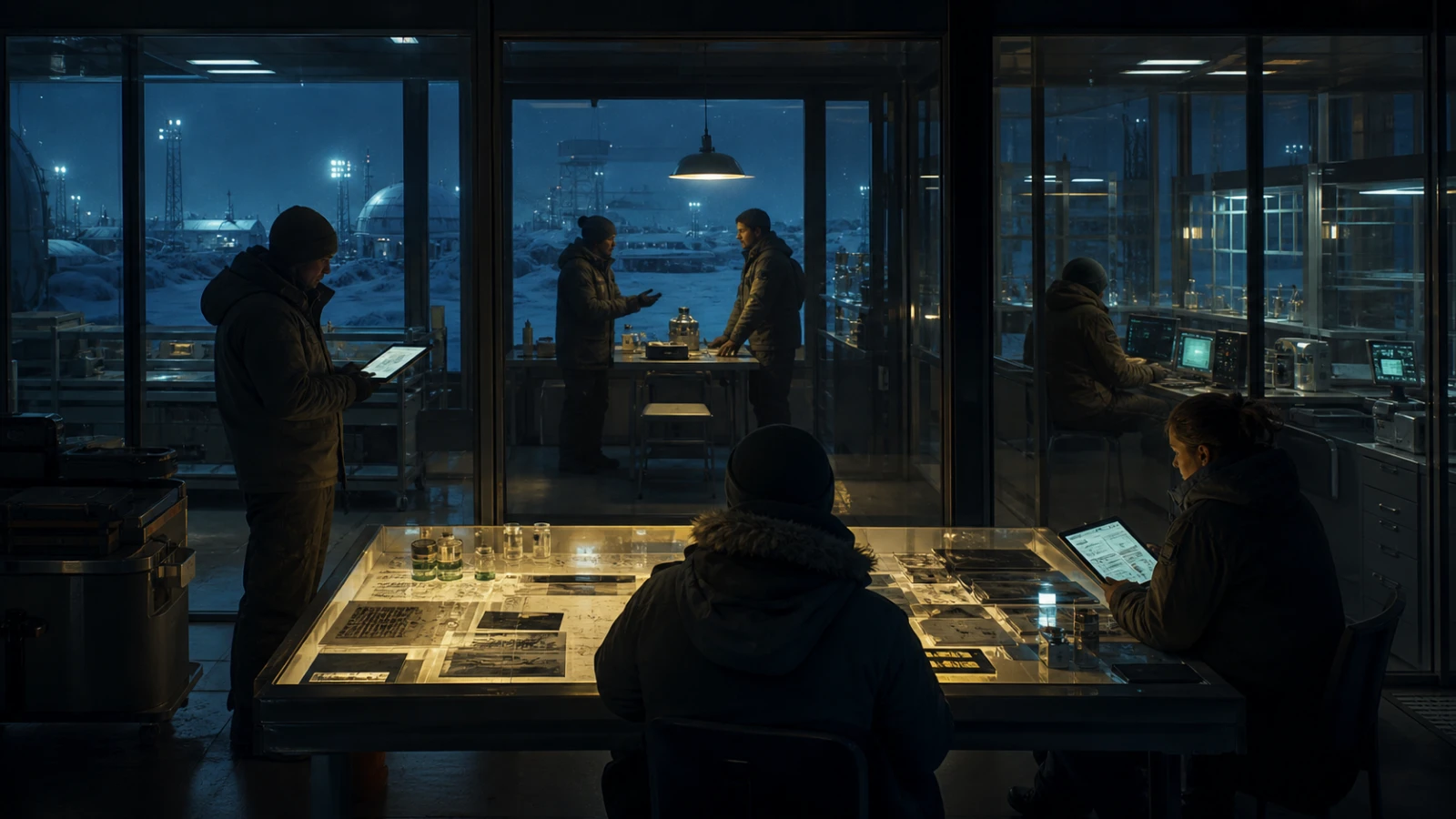
Thesis: Extinction Cycle usually asks how to kill the threat. The Thing asks a nastier question first: how do you know the threat is not already standing beside you?
Introduction
Military-base horror often depends on pressure from outside the wire. Extinction Cycle is built for that kind of pressure. Teams operate against visible biological enemies, defended settlements hold perimeters, and tactical units learn to fight fast, adaptive threats through discipline and aggression. The Thing changes the problem. It turns the base itself into contested ground. The enemy is not only dangerous. It is unknowable, imitative, and psychologically corrosive. Under those conditions, the question of victory begins long before the shooting starts. The first battle is trust.
That makes The Thing one of the sharpest comparison partners for Extinction Cycle. Both worlds feature biological danger, containment urgency, and the possibility that ordinary procedures are no longer enough. But they force institutions to fail in different ways. Extinction Cycle tests readiness, logistics, and tactical doctrine against open threat. The Thing tests social cohesion under epistemic collapse. Once nobody can be fully sure who is human, quarantine itself becomes destabilizing. Procedures that should protect the group can also destroy it.
Bringing Team Ghost or any Extinction Cycle-style military unit into a Thing-like scenario reveals the limits of ordinary outbreak competence. A team can be brave, well-armed, and highly trained yet still be vulnerable if the enemy turns uncertainty into weaponized suspicion. This article explores exactly that problem: how infection, paranoia, and base trust would interact if Extinction Cycle’s tactical culture were forced into a closed, distrust-driven military environment.
Visible Threat vs Hidden Threat
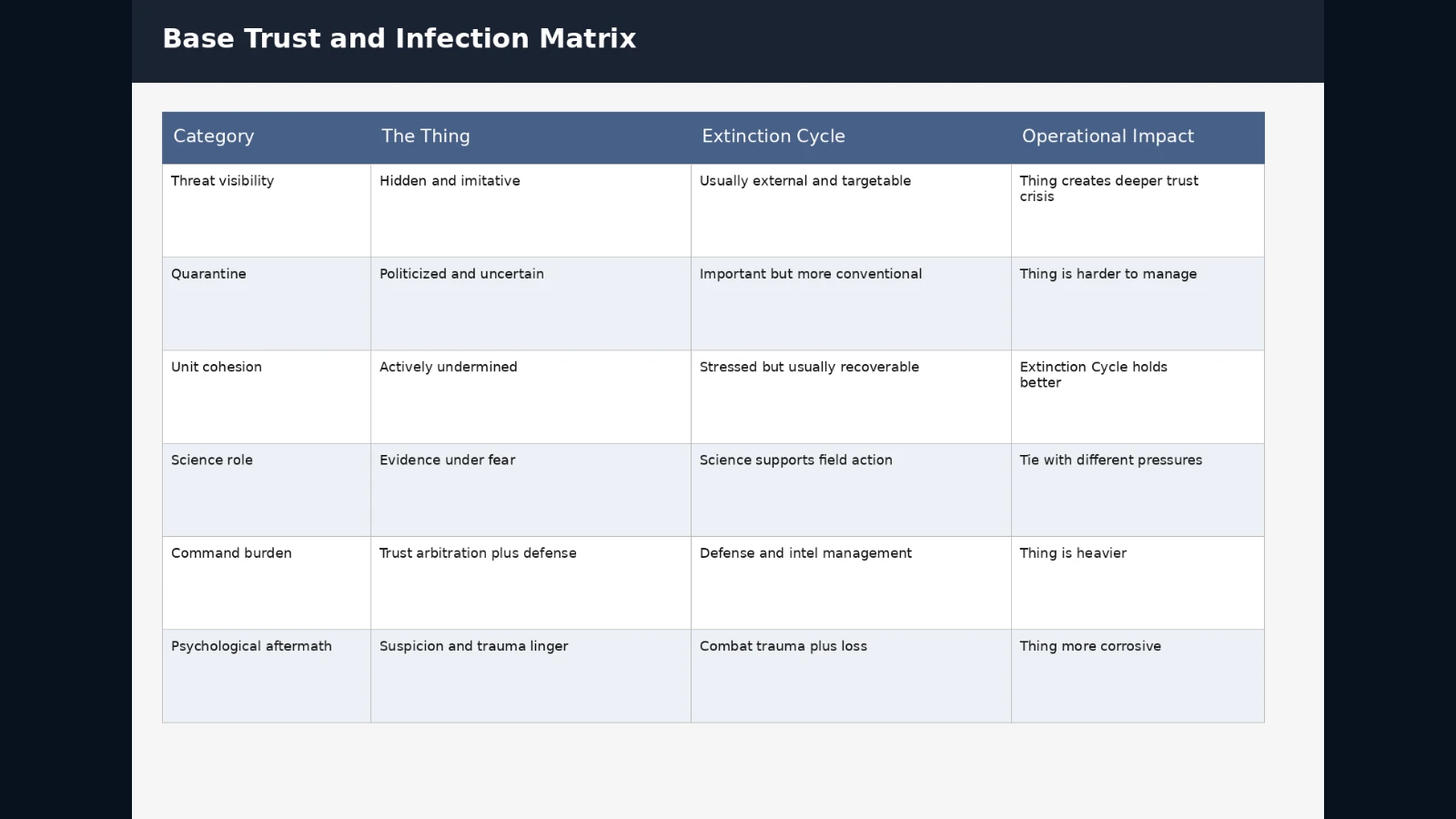
The most important difference between these settings is visibility. Extinction Cycle’s enemies are terrifying because they are fast, brutal, and increasingly adaptive, but they are still usually treated as hostile forces operating in space. You hunt them, evade them, contain them, or fortify against them. Even when intelligence is incomplete, the operational frame is still recognizable. The threat is external enough to support normal military thinking.
The Thing refuses that comfort. Visibility cannot be trusted. Contact may be invisible. Observation may mislead. The enemy can wait, imitate, and exploit the natural human assumption that familiar faces mean familiar loyalties. This creates a battlefield that is not merely tactical. It is epistemological. Commanders cannot confidently sort friend from threat. Every conversation becomes a diagnostic exercise. Every injury, delay, or inconsistency acquires terrifying significance.
That shift matters because military systems depend on role clarity. People must know who can be trusted to guard, treat casualties, relay orders, and handle weapons. The Thing corrupts that architecture from within. If Extinction Cycle units are usually strongest when they can move aggressively against known danger, they are most vulnerable when forced into a scenario where certainty itself collapses. The team must slow down, test assumptions, and accept that overconfidence may be deadlier than hesitation.
Quarantine Procedures and Their Limits
Ordinary quarantine procedure presumes that contaminated individuals can be isolated from a still- trustworthy group. The Thing immediately destabilizes that assumption. The group cannot know who is contaminated or whether the tests themselves are secure enough to command trust. In that setting, quarantine becomes political. Who gets isolated first? Who decides? What happens when the commander is suspected? Every containment step risks looking like either prudence or panic.
Extinction Cycle has strong reasons to value quarantine. Biological threat, field exposure, and evolving enemy behavior make medical caution essential. But much of that caution still occurs within a world where the group can usually agree that exposure happened in some identifiable way. The Thing makes even the timeline of exposure uncertain. People may fear they were compromised hours earlier or that the person running the test is already no longer human.
That uncertainty can destroy unit cohesion. If the command team pushes too hard, people interpret procedure as coercion. If it moves too slowly, the infection spreads. The best response would require a rare combination of firmness and procedural transparency: multiple observers, controlled isolation, redundant verification, tightly limited movement, and ruthless preservation of evidence. Even then, morale would erode. The lesson is stark. Under a Thing-like threat, quarantine stops being a medical support activity and becomes the central theater of command.
How Team Ghost Would Respond
A Team Ghost-style unit would begin with several real advantages. It would take biological danger seriously from the outset. It would not dismiss the need for cordons, weapons discipline, or layered security. It would establish watch rotations faster than a normal civilian group. It would preserve communications as long as possible and likely create physical separation between subgroups once suspicion emerged. These instincts matter. The team’s survival culture would prevent some of the denial that kills weaker groups.
However, those strengths are not the same as immunity. Team Ghost thrives when it can coordinate under pressure using earned trust and shared operational expectations. A Thing-like enemy attacks exactly that trust. The team would eventually face brutal questions: do you keep everyone armed; do you divide the group; do you allow anyone to move alone; how do you treat the medic if the medic becomes a suspect; what if the chain of command itself fractures? Once those questions intensify, the team’s tactical competence could become a double-edged sword. Armed professionals are more dangerous to each other when suspicion peaks.
Beckham-style leadership would matter enormously here. The commander would need to keep the team focused on process rather than emotion. Testing, isolation, paired observation, evidence preservation, and strict control of access points would have to outrank instinctive loyalty. The team would also need a leader willing to say the most painful sentence in base-horror fiction: nobody gets the benefit of the doubt simply because they are one of us. That is the only way to preserve the group, but it also risks breaking the social fabric that made the group effective in the first place.
Paranoia as an Operational Weapon
One reason The Thing remains so powerful is that paranoia is not just atmosphere. It is operational effect. The enemy benefits when humans waste time accusing one another, misreading signals, or withholding information out of fear. The more suspicion rises, the less efficient the base becomes. Guards miss details because they are watching their own partners. Scientists cannot collaborate. Medics lose authority. Sleep becomes unsafe. Every procedure takes longer because trust has to be rebuilt around it.
Extinction Cycle understands morale stress, but usually in a more conventional combat frame. Losses hurt, secrecy damages trust, and hard orders can strain relationships, yet units still generally know that cooperation is better than collapse. The Thing turns cooperation itself into a source of exposure. Stand too close and you may die. Trust too freely and you may doom the base. Distrust too broadly and you may paralyze the response. It is a masterpiece of contradictory pressure.
This is what makes the crossover so rich. Team Ghost would not fail because it lacked courage. It would fail, if it failed, because the social operating system that makes tactical units work would be under direct biological assault. That is a much more intimate battlefield than a Variant nest or perimeter breach.
Science, Testing, and the Politics of Evidence
Scientific process would become both hope and source of tension. In a Thing-like event, evidence matters desperately, but evidence is hard to generate under fear. Who designs the test? Who verifies it? How fast can it be deployed? What counts as enough proof to justify lethal force? These are not abstract issues. They determine whether the base responds rationally or disintegrates into competing hunches.
Extinction Cycle often pairs military action with scientific urgency, which is why its framework fits this discussion so well. The strongest response would come from a close alliance between field command and credible science. The scientific side would need to communicate clearly, acknowledge uncertainty, and avoid appearing politically aligned with any single suspect group. The military side would need to preserve order without pretending science can move faster than it can.
In practice, that means any base facing a Thing-level infiltration threat would need a command structure that values transparent evidence more than reassuring myths. The desire to calm people by oversimplifying would be fatal. If the test is preliminary, say so. If the sample is inconclusive, say so. If the commander is subject to the same rules as everyone else, demonstrate it. Trust under paranoia is not rebuilt through charisma. It is rebuilt through visible fairness.
Why This Threat Is More Socially Destructive Than a Variant Attack
A Variant assault can shatter walls, kill defenders, and overrun territory. But if a community survives the attack, it can still recover psychologically around a familiar story: the enemy came from outside, people resisted, and the survivors remain themselves. The Thing leaves behind a more poisonous legacy. Even success feels contaminated because the community has spent its worst hours distrusting itself. People carry guilt over who they suspected, who they restrained, and who they killed.
This is why the base setting matters so much. Military communities depend on trust more intensely than casual populations do. They rely on buddies, chain of command, medics, technicians, and controlled procedure. The Thing attacks every one of those categories at once. Extinction Cycle settlements would find that lesson brutal. A base can survive a firefight and still be politically or psychologically ruined if its people no longer believe in one another.
Command Succession When Every Order Is Suspect
A closed-base crisis becomes even more dangerous when authority depends on personal trust. Normal succession assumes that the next person in the chain remains recognizably themselves and accepts the same mission. A Thing-like threat removes that comfort. If one leader is isolated, another must act, but every transfer of authority can look like a seizure of control. The unit can split into rival groups that each believe they are preserving the last trustworthy command.
The strongest Extinction Cycle response would therefore rely less on one heroic commander and more on a process visible to everyone. Decisions would need witnesses, limited scope, and clear conditions for review. No single person should control testing, communications, weapons access, and detention at the same time. That separation would not prove anyone human, but it would make quiet capture of the whole base more difficult and reduce the chance that panic grants unchecked power to the wrong person.
Beckham's leadership remains valuable because he understands mission priorities under stress. Yet the most important thing he could do in this scenario is make his own authority auditable. Trust would have to move away from familiarity and toward behavior that others can inspect. That is a painful adjustment for a close team, but it offers a middle path between blind loyalty and total paralysis.
What Counts as Credible Evidence?
Paranoia thrives when every clue can support opposite conclusions. A delay may suggest infection or simply fear. A failed test may expose a threat or expose a broken procedure. The answer is not endless suspicion; it is disciplined uncertainty. Evidence should be preserved, observations recorded independently, and conclusions separated from guesses. Most important, one ambiguous result should not be allowed to decide an irreversible response by itself.
This is where The Thing applies a different kind of pressure than the Variants. Extinction Cycle teams often need faster recognition and faster action. A hidden imitator punishes speed when speed outruns verification. The base survives only if it can remain cautious without becoming inert and decisive without pretending certainty. That balance is harder than winning a firefight because it asks people to cooperate while admitting that trust can no longer be absolute.
Recovery After the Immediate Threat
Even a successful containment would leave damage. Survivors would remember accusations, isolation, and moments when colleagues pointed weapons at one another. Restoring ordinary command would require more than declaring the base clear. Records, decisions, and mistakes would need review, while survivors would need space to distinguish justified caution from personal betrayal. Extinction Cycle is often interested in the aftermath of violence; a Thing-like incident would make the aftermath primarily social. The enemy's final victory would be a group that survives biologically but can no longer function together.
Conclusion
The Thing versus Extinction Cycle is ultimately a comparison between two kinds of biological terror. Extinction Cycle asks how a disciplined force fights an adaptive external enemy. The Thing asks whether a disciplined force can stay a force at all once certainty about identity disappears. Team Ghost would begin with advantages: seriousness about infection, command presence, quarantine instincts, and tactical calm. But the very strengths that help it defeat open threats would be stressed by a closed environment where suspicion becomes unavoidable.
If Extinction Cycle is a story of tactical response, The Thing is a story of trust collapse. Put them together and the result is a harsh insight about military survival: firepower and courage are never enough when the enemy’s best weapon is the destruction of shared reality. The unit that survives is not just the one that shoots well. It is the one that can preserve process, fairness, and enough human trust to keep acting like a unit while every instinct tells its members to turn on each other.
That is why this comparison lingers. It reminds readers that the deadliest infection in some apocalypses is not the one in the blood. It is the one that enters the group and makes nobody certain that “we” still exists.
FAQ
Why is a Thing-like threat harder to quarantine than a Variant attack?
Because identity and exposure may both be uncertain. Containment can no longer begin with a clearly trustworthy group separating a clearly identified patient.
Would Team Ghost's discipline help?
Yes, especially with watch structure, evidence preservation, and controlled movement. The same team's close trust could also become a vulnerability when suspicion turns inward.
Is this a canon crossover?
No. The scenario is a speculative comparison between established story premises.
Source note
Universal's official synopsis establishes the 1982 film's Antarctic research team and form-changing alien premise. Extinction Cycle claims are checked against current Team Ghost, quarantine, Variant, and command records.
Editorial note
This independent fan analysis uses original generic artwork and a submitted editorial comparison chart. It does not reproduce official franchise images, actor likenesses, logos, or claim a canon crossover.