
Reed Beckham against an unseen hunter
Predator vs. Extinction Cycle: Could Reed Beckham Defeat the Ultimate Hunter?
Could Reed Beckham defeat a Predator-style hunter? Compare recognition, camouflage, team cohesion, terrain, adaptation, and the limits of a one-on-one verdict.
·
Category: Analysis and Opinion
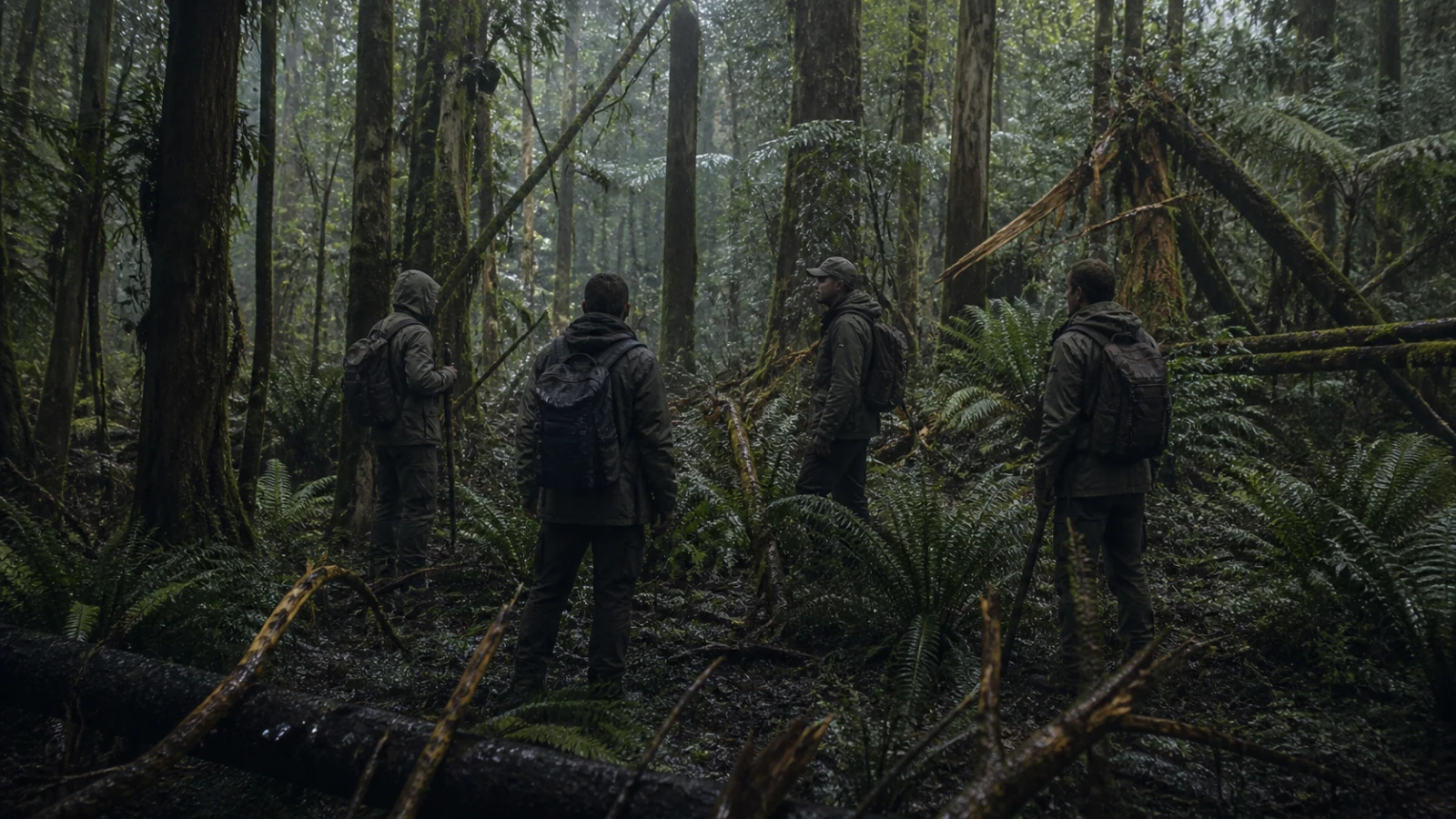
Thesis: Reed Beckham is built to lead men against terrible odds. The real question is whether he can stay alive long enough to realize he is not fighting prey at all, but a hunter who has already chosen him.
Introduction
Crossovers work best when they force a hero into a threat that attacks his assumptions. That is exactly what happens when Reed Beckham is placed against a Predator-like ultimate hunter. Beckham is at his best in the Extinction Cycle world because he combines tactical leadership, calm under pressure, and the ability to adapt once a mission stops behaving according to plan. He knows how to move teams, read terrain, distribute risk, and keep focus when the enemy is faster, stronger, or more numerous than expected.
A Predator-style opponent presents a very different challenge. It is patient, selective, technologically superior in crucial ways, and psychologically invested in the hunt. It is not simply trying to overrun a position. It is trying to outclass its target. Camouflage, tracking, vertical mobility, misdirection, and deliberate choice of battlefield all matter more here than brute force alone. That makes the matchup interesting because Beckham has enough field intelligence to avoid becoming easy prey, but he must recognize the nature of the hunt quickly or his strengths may arrive too late.
The comparison therefore becomes less about who is tougher in the abstract and more about whether Beckham can transition from conventional tactical thinking to counter-hunter thinking before the engagement is decided. If he can, he becomes dangerous. If he cannot, the environment begins working for the hunter long before Beckham knows the game has changed.
Tracking and Counter-Tracking
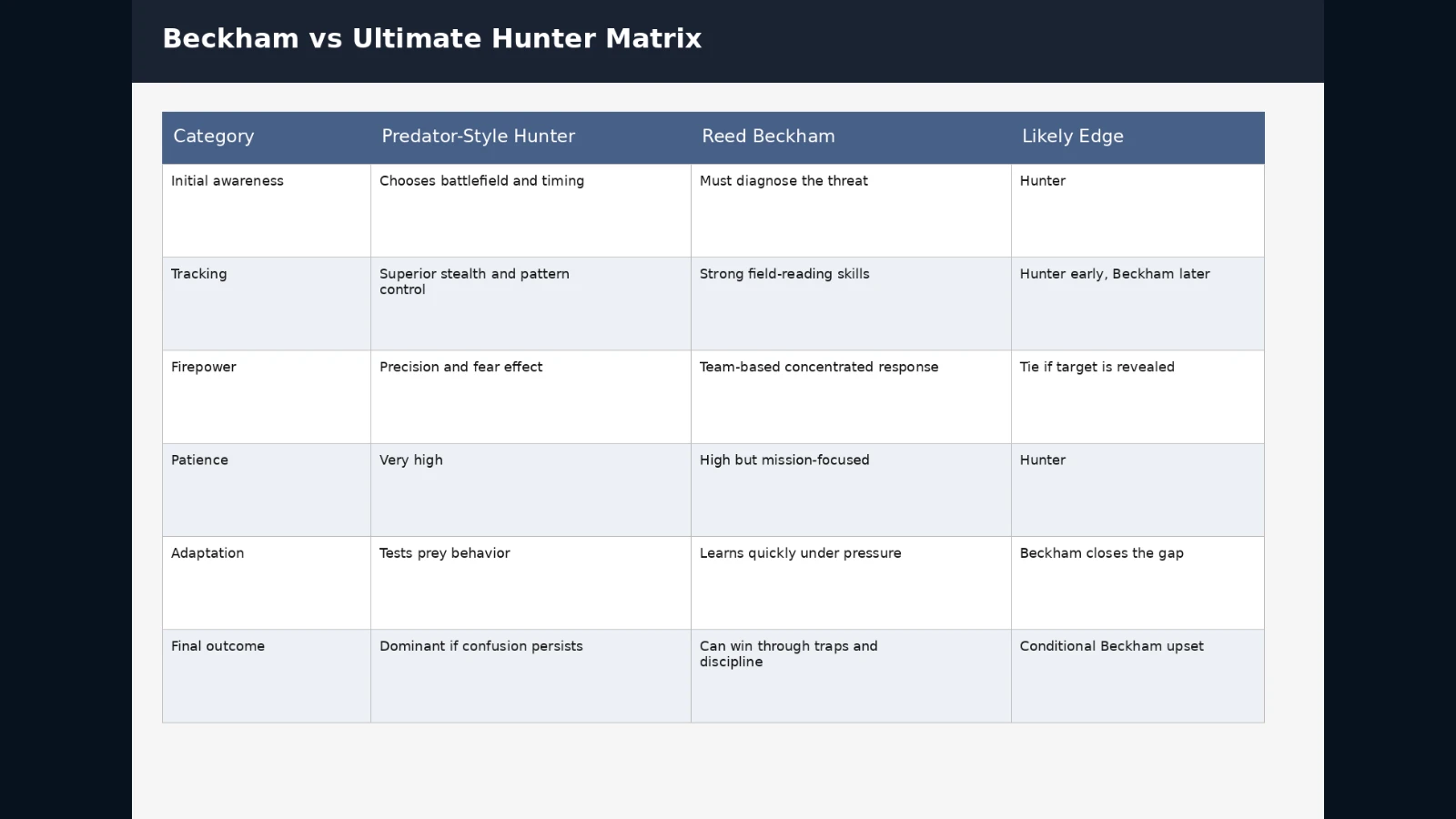
Beckham’s greatest initial asset is his respect for evidence in the field. He is not a reckless frontman. He pays attention to what tracks, silence, broken patterns, and incomplete information imply. In a jungle, forest, or ruined wild zone, that matters. A Predator-like hunter thrives against opponents who panic or chase shadows. Beckham is less likely than most leaders to do either. He would notice irregular kill patterns, strange sight lines, unnatural concealment, or the fact that the enemy seems to know where the team is before the team knows where the enemy is.
But the hunter’s counter-tracking ability is still a major edge. It can mask presence, move above or around normal search patterns, and exploit any assumption that danger will appear on human terms. Beckham can read terrain, yet the Predator changes how terrain behaves. Trees, ridgelines, and gaps in visibility are not just obstacles. They are part of the hunter’s sensory and ambush system. Beckham must therefore do more than track. He must change the team’s geometry to deny the hunter clean angles and predictable movement.
This is where his professionalism helps. Once he realizes they are being stalked deliberately, he is exactly the kind of operator who would tighten spacing, establish mutually supporting arcs, and start thinking in counter-ambush patterns. He will not solve the hunt instantly, but he will make himself far more difficult to isolate than a less disciplined leader would.
Camouflage, Patience, and Battlefield Control
A Predator-style enemy wins by controlling tempo. It does not need to rush. It can study. It can test. It can force humans to reveal habits. That patience is one of the biggest threats to Beckham because Extinction Cycle missions often reward proactive leadership. He is accustomed to taking ground, responding decisively, and acting before fear spreads. Here, decisiveness must be rebalanced with caution. Move too aggressively and the hunter exploits exposure. Dig in too passively and the hunter studies static patterns until it finds the weak seam.
Camouflage compounds the problem. Beckham is not facing a visible horde or an enemy who wants the psychological announcement of open assault. He is facing something that wants to remain partly mythic until the moment of contact. That can induce overcorrection. Teams begin firing at uncertainty, wasting ammunition and confidence. Or they become so cautious that the hunter dictates every move.
Beckham’s best response would be to turn patience back on the hunter. He would likely create false routines, dummy exposure points, layered observation, and terrain traps once he recognized the adversary’s habits. The question is whether he survives the learning period required to reach that stage. Against a true master hunter, the first several minutes of real contact may matter more than the rest of the mission combined.
Firepower and the Limits of Firepower
Beckham is no stranger to superior enemies, and one reason he remains effective is that he understands when firepower solves a problem and when it merely makes him feel less vulnerable. Against a Predator, that distinction becomes critical. Ordinary rounds and suppressive volume can still matter. They can deny space, damage concealment, and protect movement. But firepower alone is not enough if the team cannot reliably identify the target or predict where the next strike will come from.
This makes Beckham more likely to succeed than a stereotypical action lead who simply shoots harder. He would look for ways to connect firepower to information. That means baiting movement, narrowing approach lanes, using sound and terrain to force a tell, and trying to convert an invisible threat into a briefly visible one. Once that happens, concentrated violence becomes useful again.
Still, the hunter retains a lethal advantage if the encounter remains asymmetrical. Advanced attack methods, superior vantage selection, and psychological control of the fight can neutralize even skilled shooters. Beckham’s goal is not to overpower the hunter early. It is to survive long enough to make the hunter fight a fairer battle than it wants.
Team Tactics and the Value of Cohesion
One of Beckham’s clearest advantages over many lone-wolf protagonists is that he is not actually a lone wolf. He is at his best when coordinating a team. That matters because the Predator’s favorite battlefield is one where humans become separated, emotionally reactive, or tactically noisy. A cohesive team denies some of those openings. Overlapping fields of observation, disciplined movement, casualty management, and shared signals can all reduce the hunter’s freedom.
At the same time, teams create signatures. More people mean more sound, more mistakes, more possible panic, and more opportunities for the hunter to provoke rescue impulses. Beckham would have to decide whether keeping the team concentrated or splitting into controlled elements offers better survival. That is a difficult call. Concentration preserves mutual support but increases the emotional shock if the hunter penetrates the formation. Division may create better observation but also gives the hunter isolation opportunities.
His most likely answer would be controlled modularity: close enough for mutual support, separated enough to complicate a single decisive strike. That is very much Beckham’s style. He trusts people, but he does not trust chaos. If anyone can keep a team acting like a system while under deliberate predation, it is him.
Terrain, Adaptation, and the Moment of Recognition
The true pivot of this matchup is recognition. Before Beckham understands what he is facing, the hunter holds the overwhelming edge. After recognition, the contest tightens dramatically. Beckham has repeatedly shown that once he sees the actual contours of a threat, he adapts with speed and seriousness. He stops wasting motion. He reassigns priorities. He looks for the enemy’s pattern, not its mythology.
Terrain will influence how much time he gets to make that adjustment. Dense jungle or heavily forested terrain favors the hunter. Broken urban terrain may narrow some advantages by constraining movement lanes and increasing opportunities for engineered kill zones. Open desert or coastal ground could diminish concealment benefits, though the hunter’s patience and range may still dominate.
The best-case Beckham scenario therefore involves surviving the initial hunt, preserving enough of the team to create a trap, and forcing the hunter to choose between ego and caution. The worst-case scenario is simpler: the hunter kills the most capable operators first, disrupts cohesion, and never gives Beckham enough information to shift the terms of engagement.
Could Beckham Actually Win?
Yes, but with conditions. Beckham can defeat the ultimate hunter if the scenario rewards his strongest traits: adaptive leadership, respect for field evidence, emotional control, and team-based counter-ambush thinking. He does not need to match the hunter’s technology. He needs to deny it a clean hunt. Once the hunter’s assumptions are disrupted, Beckham becomes extremely dangerous because he is willing to learn fast and fight dirty when necessary.
However, the matchup remains stacked against him at the start. The hunter chooses the battle, understands the prey dynamic better, and possesses camouflage and sensory advantages that would punish ordinary soldiers. Beckham’s survival depends on shortening the period of confusion. Every minute spent misreading the threat increases the hunter’s lead.
That means the final answer is neither easy victory nor certain defeat. It is a narrow, earned possibility. Beckham would not beat the hunter by being stronger. He would beat it by becoming the rare target that learns the hunt while still inside it.
Why This Is a Team Problem, Not a Duel
The title asks whether Reed Beckham could win, but Beckham's real advantage has never been isolated spectacle. His strength is turning trained people into a shared decision system. A one-on-one contest would remove the very trait that makes him a distinctive Extinction Cycle leader. Against a hunter with cloaking technology and extensive combat skill, individual toughness is not enough to repair the information gap.
Team structure changes that gap. Several observers can compare what each person saw, preserve attention in more than one direction, and prevent one frightening event from becoming the group's entire picture. A hunter can still exploit the team, but it must work harder to make every person accept the same false assumption. Beckham's most credible route to success is therefore not a cinematic duel. It is keeping enough of the group coordinated that the adversary cannot reduce the encounter to a series of isolated victims.
This also changes what “defeat” means. Beckham does not need to prove superiority in every category. If he protects the team, denies the hunter easy separation, and creates a safe withdrawal, he has already broken the logic of the hunt. A final kill may be possible, but it is not the only form of victory. Mission survival is a better measure than personal dominance.
Conditions That Reverse the Hunt
The matchup changes only after the team converts mystery into a pattern. The official Predator premise gives the alien the opening advantage through concealment, combat skill, and deliberate hunting. Beckham's advantage appears later, when repeated observations allow him to stop reacting to individual attacks and start judging the adversary's choices.
Three conditions matter most at the story level. First, the team must remain coherent long enough to learn. Second, the terrain must offer more than hiding places for the hunter; it must also give the humans ways to control where attention goes. Third, Beckham must resist turning the contest into an ego test. The hunter's mystique is strongest when its targets behave predictably out of fear or pride.
The best-case result is not that Beckham suddenly matches alien technology. It is that he makes technology less decisive by denying clean observation and forcing commitment. The worst case is that losses arrive before the team understands that it is being selected and studied. That is why the opening phase remains the honest favorite for the hunter, while the later phase becomes a plausible Beckham upset.
The Verdict Depends on Mission Context
A rescue, reconnaissance mission, or forced passage creates different success conditions from a deliberate hunt. Beckham is more likely to prevail when he can define a finite objective and leave once it is achieved. He is less likely to prevail if he accepts the hunter's invitation to pursue it simply to settle the score. The comparison ultimately favors his judgment more than his firepower.
Conclusion
Predator versus Extinction Cycle is really a test of whether Reed Beckham’s excellence transfers from battlefield leadership to anti-predator survival. The evidence suggests that it does, but only after a brutal learning curve. Beckham’s discipline, ability to read the field, and instinct for coordinated response make him one of the best possible Extinction Cycle characters for this crossover. He will not dismiss a strange threat. He will not keep repeating failed assumptions. He will not let ego outrun reality for long.
But those strengths do not erase the hunter’s opening superiority. Camouflage, patience, verticality, and selective violence create exactly the kind of asymmetry that kills good teams before they have time to adapt. Beckham wins only if he preserves enough cohesion, gathers enough evidence, and turns the battlefield into a place where the hunter can no longer remain comfortably invisible.
That is why the matchup feels compelling instead of gimmicky. It is close because the hunter is terrifying and Beckham is worthy. The ultimate hunter would see him as a prize target. Beckham’s task would be to survive long enough to prove that the hunt cuts both ways.
FAQ
Could Reed Beckham win alone?
It is possible in a highly favorable scenario, but the credible Extinction Cycle case depends on his leadership of a cohesive team rather than lone-hero power.
What gives the Predator the opening advantage?
Official studio material establishes cloaking technology, extensive combat skill, and deliberate hunting behavior. Those traits create an immediate information imbalance.
Is the winner certain?
No. The verdict is intentionally conditional because terrain, mission goals, recognition time, and team survival change the outcome.
Source note
20th Century Studios' official synopsis establishes the 1987 Predator's cloaking technology, extensive combat skill, and hunting motive. Extinction Cycle claims are checked against current Reed Beckham, Team Ghost, mission, and leadership records.
Editorial note
This independent fan analysis uses original generic artwork and a submitted editorial comparison chart. It does not reproduce official franchise images, actor likenesses, logos, or claim a canon crossover.