
When survival stops meaning supremacy
Planet of the Apes vs. Extinction Cycle: What Happens When Humanity Is No Longer Dominant?
Compare Planet of the Apes and Extinction Cycle through evolution, intelligence, territory, coexistence, extermination, and the moral limits of human rule.
·
Category: Analysis and Opinion
Introduction: The End of Human Exceptionalism
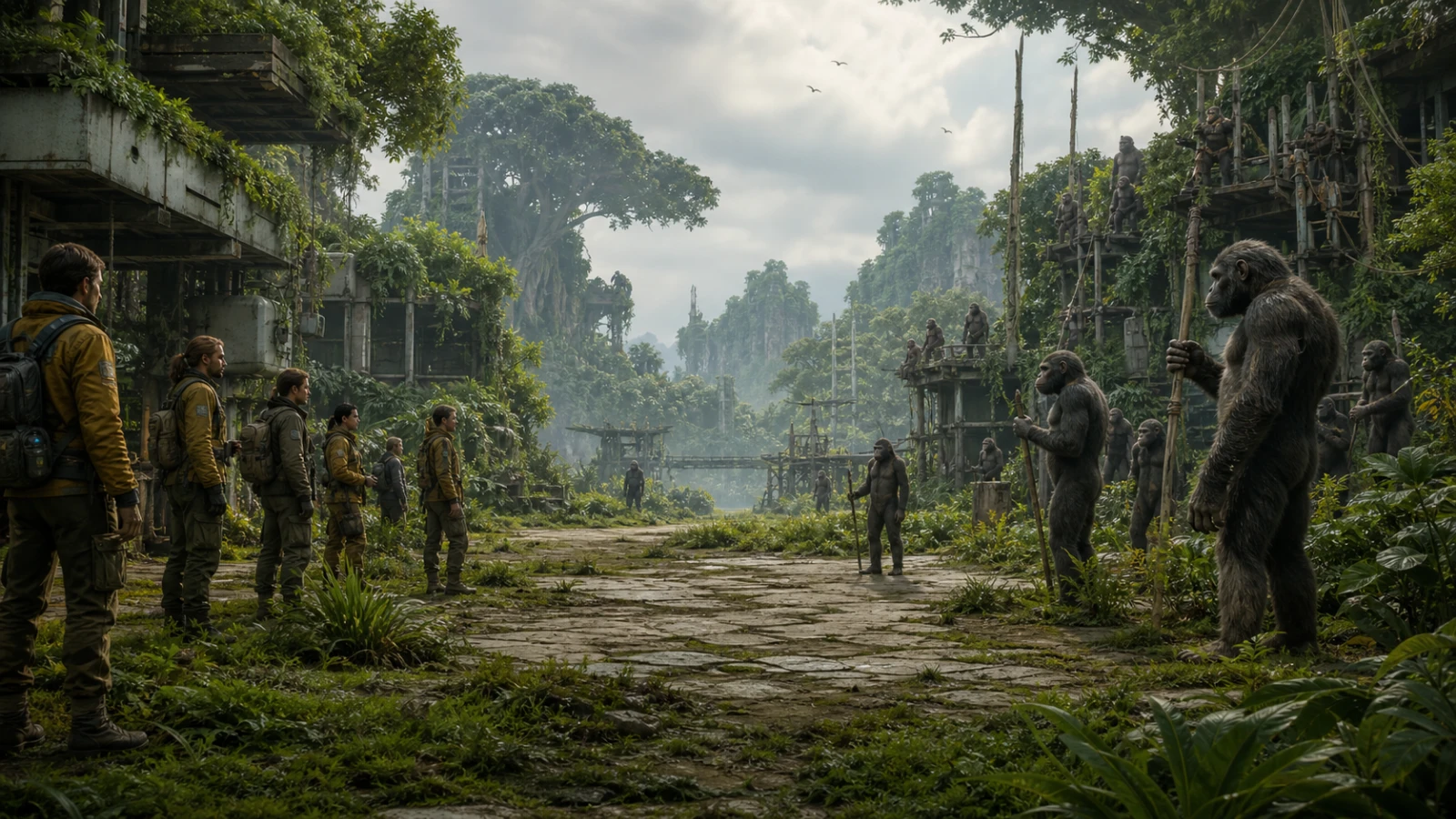
Planet of the Apes and Extinction Cycle begin from different catastrophes, but both eventually destabilize the same assumption: human beings are the natural masters of the world. In one franchise, intelligent apes emerge as a social and political force capable of challenging human dominance. In the other, engineered biological disaster creates Variants and later forms whose speed, resilience, organization, and evolutionary momentum threaten to reduce humanity from ruling species to hunted remnant. The emotional effect is similar even when the moral structure is not. Humanity is forced to imagine a world in which being human no longer guarantees control.
That is why this comparison is richer than asking whether an ape soldier could defeat a Variant. The real subject is dominance. What happens when a species that built nations, armies, laboratories, and cities discovers that intelligence and organized force are no longer exclusively human assets? Does survival itself grant humanity the right to retake every piece of territory? If another intelligent species can build communities and remember injustice, does coexistence become a moral obligation rather than a tactical convenience? And what changes when the rival species is not a political civilization in the familiar sense but an evolutionary threat born from human scientific failure?
The modern Planet of the Apes stories repeatedly force viewers to see conflict from both sides of an emerging species divide. Extinction Cycle is more firmly human-centered because Variants begin as immediate predators and existential enemies. Yet Dark Age complicates even that certainty by pushing the enemy toward hierarchy, communication, and forms of organized post-human identity. The comparison therefore sits on a spectrum. At one end is coexistence between rival intelligent peoples. At the other is survival against a biological system that appears to leave little room for coexistence. Between them sits the question that matters most: at what point does an enemy become a civilization, and what moral duties follow once that happens?
Evolution Changes More Than the Battlefield
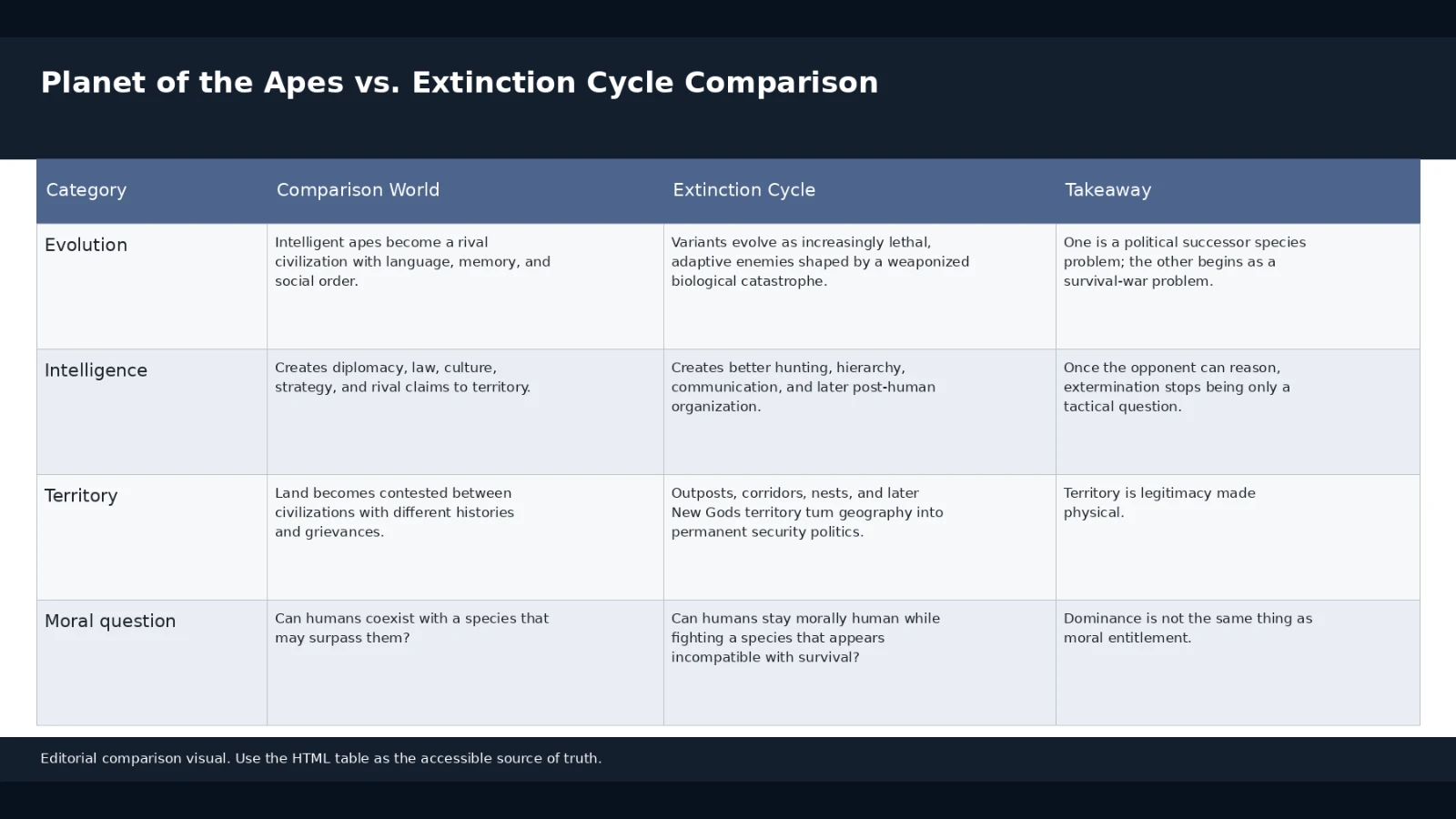
Evolution in both franchises is politically explosive because it changes what survival means. In Planet of the Apes, the rise of intelligent apes is not simply the emergence of a stronger animal. It is the emergence of another community capable of memory, loyalty, language, hierarchy, grief, and strategic reasoning. Once those capacities exist, the conflict can no longer be reduced to pest control. Every territorial decision is also a decision about another thinking population.
Extinction Cycle initially places evolution inside a more frightening military frame. The Variants are living consequences of VX-99 and the Hemorrhage Virus, and their changing capabilities make yesterday's doctrine dangerous. Humans are not asked to welcome them as a new people. They are asked to avoid being killed. That difference is important because moral judgment depends on what the other side is actually doing. Coexistence is difficult to demand from people who are being hunted by an adaptive predator species.
Yet the longer the Extinction Cycle continues, the more evolution becomes organizational as well as physical. Alphas, masterminds, Chimeras, Scions, Thralls, and the New Gods reveal a world in which post-human forms can no longer be described only as diseased individuals. They occupy roles, networks, hierarchies, and territorial systems. That does not make them morally equivalent to the ape civilizations. It does make the human assumption of exclusive intelligence less secure.
Both worlds therefore use evolution to humiliate human certainty. Biology does not promise to preserve the species that currently holds power. Intelligence is not a permanent monopoly. The question becomes what humanity does after it learns that lesson. It can adapt politically, adapt militarily, or refuse the reality until the cost becomes irreversible.
Intelligence Turns Extermination Into a Moral Problem
The easiest enemy to justify exterminating is one imagined as mindless. The moment the enemy demonstrates language, strategic memory, social bonds, or political purpose, the moral vocabulary changes. Planet of the Apes builds its central tragedy from this transition. Humans who insist on seeing apes as animals can rationalize domination long after the evidence of personhood is impossible to ignore. Apes who see humans only as former oppressors can make the reverse mistake. Intelligence does not automatically produce empathy. It merely removes ignorance as an excuse.
Extinction Cycle approaches the same threshold from another direction. Variants become more intelligent without becoming less dangerous. That produces a darker problem. What if intelligence does not lead toward coexistence? What if it allows the enemy to organize predation more effectively? Human defenders cannot treat emerging intelligence as evidence that the war is ending. It may mean the opposite.
This distinction prevents false equivalence. Planet of the Apes asks whether two intelligent species can share a world despite fear, trauma, and incompatible claims. Extinction Cycle asks what moral restraint looks like when the more intelligent enemy remains committed to human subjugation or destruction. In one case, extermination can become a crime against another people. In the other, refusing to fight may become a crime against the people under your protection.
Still, both franchises warn against lazy category-making. If humans decide in advance that every nonhuman rival is beneath moral consideration, they risk becoming the kind of civilization their own stories condemn. If they assume every intelligent opponent can be reasoned with, they risk fatal naivety. Moral seriousness requires evidence, not instinctive species loyalty.
Territory, Borders, and the Right to Reclaim the World
Territorial conflict is where philosophy becomes practical. Humans may believe they have a historical right to cities, farms, infrastructure, or entire regions simply because humans once controlled them. Planet of the Apes challenges that claim by imagining a world in which another intelligent species has lived, organized, and sacrificed on the same land. A map cannot be morally settled by pointing to the old owner's flag.
Extinction Cycle's Allied States has a different reclamation problem. Much of the postwar landscape is empty, abandoned, infested, or strategically unusable. The state's desire to recover territory is understandable because territory means farms, roads, energy, population movement, and national confidence. But expansion also creates risk. Every frontier patrol can become a contact event. Every reclaimed corridor requires defenders. Every assumption that a region is safe can be disproven by a new Variant form.
These two models reveal different kinds of territorial legitimacy. Planet of the Apes asks whether occupation by a new intelligent population creates new rights. Extinction Cycle asks whether survival capacity creates a duty to expand at all. A government may have a historical claim to territory and still lack the practical or moral capacity to hold it safely.
The broader lesson is that reclaiming the world is never simply a military act. It is a claim about who belongs where, who gets to decide, and what risks can be imposed on the people expected to defend the boundary. Humanity's emotional attachment to old dominance can become strategically reckless if it confuses nostalgia with legitimacy.
Coexistence vs. Extermination
Planet of the Apes makes coexistence visible enough that its failure hurts. Peace is not easy, but the possibility exists. Characters can recognize one another across species lines, share interests, negotiate, and imagine futures not built entirely on domination. That possibility gives every escalation moral weight. War may be understandable without becoming inevitable.
Extinction Cycle is much less generous. Coexistence with early and mid-stage Variants is almost impossible to imagine because their role in the story is predatory and exterminatory. Later post- human organization complicates the world, but it does not automatically create a trustworthy diplomatic partner. The New Gods do not simply request recognition. They seek power over humanity.
This difference matters when asking whether humanity has a moral right to rule. Humans do not have an automatic right to rule intelligent apes merely because humans were dominant first. But humans do have a right to defend themselves from forces seeking to kill or enslave them. The relevant moral category is behavior, not species.
That conclusion sounds simple but becomes difficult under fear. Humans may use legitimate self- defense as a pretext for species supremacy. Rival intelligent beings may use historical grievance as a pretext for reciprocal domination. Both franchises show how survival rhetoric can slide into moral absolutism.
The strongest human future in either setting would therefore reject two extremes: surrendering survival out of guilt, and treating survival as a license for permanent rule over every other intelligent form of life.
Science and the Responsibility for Evolutionary Disaster
Both franchises place human science close to the origin of the crisis, although the details differ. This creates a profound responsibility problem. If human institutions helped create the conditions that elevated, transformed, or weaponized another species, then humanity cannot treat the resulting world as an entirely external invasion. The enemy is partly a consequence.
Extinction Cycle makes this especially explicit through VX-99, Building 8, and later countermeasure decisions. Kate Lovato's arc is powerful because she inherits a catastrophe caused by older systems and still has to make morally dangerous scientific choices to stop it. Responsibility is layered. The people trying to save humanity may not be the people who caused the original disaster, but they are forced to act inside its legacy.
Planet of the Apes similarly gains moral force when human control over biology becomes inseparable from what follows. Once intelligence emerges beyond humanity, the old experimental mindset becomes morally untenable. You cannot create or accelerate another intelligent population and then insist it has no claim to autonomy.
Both franchises therefore turn science into a political inheritance. Scientific action can create beings that outlast the institution that created them. The moral responsibility survives the lab. This is why secrecy and narrow strategic thinking are so dangerous. They encourage decision-makers to treat living consequences as assets or threats instead of future political realities.
Would the Allied States Seek Peace With Intelligent Apes?
A speculative crossover makes the moral contrast concrete. If the Allied States encountered a stable intelligent ape society that was defensive rather than aggressively exterminatory, the government would face a problem unlike anything Team Ghost was designed to solve. Military intelligence would still matter. Perimeter discipline would still matter. But the central question would become diplomatic legitimacy.
Reed Beckham's greatest strength in this scenario would not be marksmanship. It would be his willingness to update his understanding when evidence changes. A disciplined commander who initially approached the border as a threat zone could, in principle, recognize that the other side was organized, communicative, and capable of negotiated restraint. The worst possible response would be to classify every ape as a Variant-equivalent threat because nonhuman intelligence feels unfamiliar.
The Allied States would also face internal political resistance. People traumatized by Variants might be psychologically primed to see any rising nonhuman intelligence as the beginning of another extinction war. Politicians could exploit that fear. Veterans might reasonably demand extraordinary security guarantees. Scientists would become mediators as much as researchers.
This scenario reveals an important truth about the Extinction Cycle world: rebuilding after an extinction war does not automatically make a society good at coexistence. It may make it more suspicious, more security-minded, and more willing to equate difference with danger. Survival creates strengths, but it can also create moral blind spots.
Does Survival Create a Right to Rule?
The title question reaches its sharpest point here. Humanity's survival does not automatically grant humanity a moral right to rule every intelligent being that appears afterward. Survival creates a right to self-defense and a responsibility to future generations. It does not create permanent species sovereignty.
Planet of the Apes makes this intuitively clear because the apes can become political subjects rather than biological objects. Extinction Cycle makes the question harder because the rival forms are initially violent and often remain so. Yet even there, the moral lesson should not be that humans are entitled to dominate anything nonhuman. The lesson is that political rights and military judgments must be based on behavior, capability, and evidence.
A human civilization that survives extinction only to rebuild the ideology of absolute dominance has learned less than it thinks. It may be safer, stronger, and more organized, yet still reproduce the arrogance that contributed to catastrophe. Conversely, a civilization that abandons self-defense in the name of moral humility will not last long enough to practice justice.
The better answer is conditional coexistence backed by credible defense. Humanity should not rule because it survived. It should govern itself well enough to distinguish a rival civilization from an existential predator and respond proportionately to each.
Final Verdict: Dominance Is Not the Same as Humanity
Planet of the Apes and Extinction Cycle both strip away the comforting idea that the human species sits permanently at the top of nature. Planet of the Apes does it by creating another intelligent civilization with its own memories, losses, and territorial claims. Extinction Cycle does it by creating a biological enemy that outpaces ordinary human assumptions about strength, speed, adaptation, and organization.
The moral conclusions differ. Planet of the Apes leaves far more room for coexistence because its rival species can become a political partner or political enemy in recognizable terms. Extinction Cycle remains more skeptical because Variant evolution repeatedly turns intelligence into a more efficient threat. Yet both worlds warn that species pride can become strategically and morally disastrous.
Humanity's survival gives it the right to defend itself. It does not give it an automatic right to rule every intelligent future. That distinction is the central takeaway.
A civilization proves its humanity not by remaining dominant, but by knowing when dominance is necessary for survival, when coexistence is possible, and when fear is merely disguising the desire to control what comes next.
FAQ
Which Planet of the Apes continuity does this comparison use?
It uses broad franchise themes that recur across several continuities, especially intelligent ape societies, human decline, territorial conflict, and the possibility or failure of coexistence. It does not merge every film into one timeline.
Does human survival create a right to rule another intelligent species?
No. The article distinguishes a right of self-defense from a permanent claim to species supremacy. Behavior, evidence, and the possibility of coexistence matter more than which group was dominant first.
Is this a canon crossover?
No. It is independent fan criticism comparing two separate fictional worlds.
Source note
Official 20th Century Studios material establishes the modern films' experimental origin for ape intelligence, the fragile trust between ape and human communities, and the conflict over both species' futures. Extinction Cycle claims are checked against current VX-99, Variant evolution, Allied States, and New Gods records.
- 20th Century Studios: Rise of the Planet of the Apes
- 20th Century Studios: Dawn of the Planet of the Apes
- 20th Century Studios: War for the Planet of the Apes
Editorial note
This independent fan analysis uses original generic artwork and a submitted editorial comparison chart. It does not reproduce official franchise images, actor likenesses, logos, or claim a canon crossover.
Recommended next pages
Source and canon pack
- Canon treatment
- Official 20th Century Studios summaries establish the ape-intelligence, human-decline, fragile-trust, and interspecies-conflict premises. Extinction Cycle claims follow local records; the moral and political comparison remains interpretive.
- Primary wiki source plan
- VX-99, Variant evolution, Allied States, territorial-recovery, webbing, and New Gods records provide the Extinction Cycle baseline.
- Spoiler scope
- Broad franchise and Dark Age worldbuilding spoilers without merging incompatible Planet of the Apes continuities or recapping individual endings.
- Safety boundary
- Independent transformative fan criticism. No official Planet of the Apes imagery, actors, characters, creature designs, costumes, sets, screenshots, logos, or claim of canon crossover is published.
- Program article ID
- EC-39
- Scheduled publication
- 2026-08-26T18:50:00-04:00