
Two ways to survive the road
Days Gone vs. Extinction Cycle: Hordes, Nests, and Survival on the Road
Compare Days Gone and Extinction Cycle through Freakers, Variants, motorcycles, convoys, territory clearing, scarcity, and lone-versus-team survival.
·
Category: Analysis and Opinion
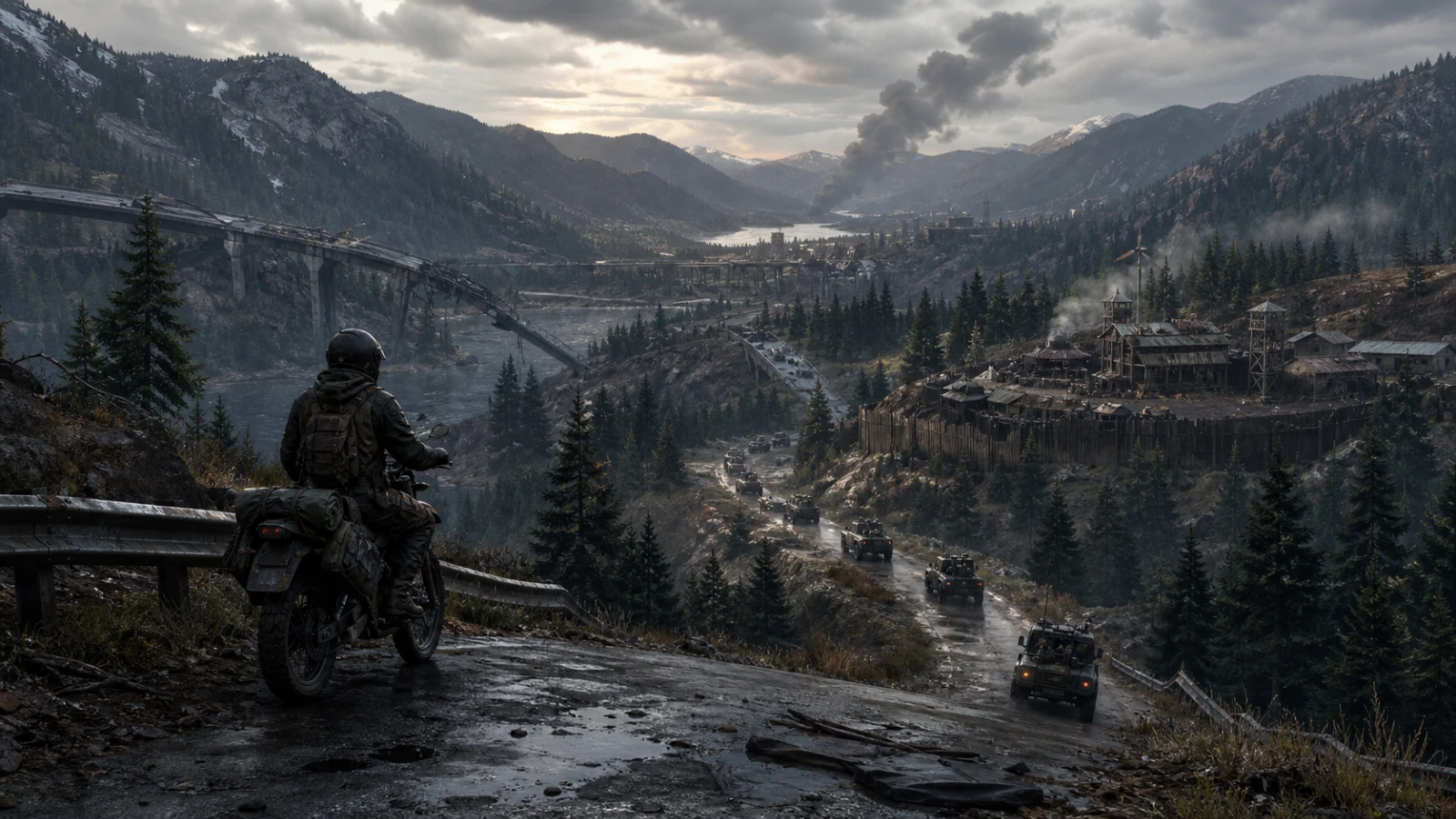
Thesis: Days Gone and Extinction Cycle both care about mobile survival in dangerous terrain, but they differ sharply over whether the road belongs to lone operators improvising between camps or organized teams fighting an adaptive war.
Spoiler and Scope Note
This article is a speculative comparative analysis. It is not a claim of official crossover canon. The Extinction Cycle discussion is grounded in recurring canon themes, while the outside-franchise side is treated as a thematic comparison rather than a scene-by-scene recap.
Introduction: The Road as Freedom and Exposure
Days Gone and Extinction Cycle are ideal comparison partners because both understand that post- apocalyptic survival is not only about what waits in the safe zone. It is about the dangerous space between safe zones. The road is where information is gathered, supplies are won, threats are avoided or confronted, and the illusion of independence is tested. In both worlds, people live by moving through territory that can turn lethal very quickly. Yet their survival philosophies differ sharply. Days Gone is fundamentally interested in the drifter, the rider, and the fragile freedom of operating alone or in very small groups. Extinction Cycle is much more interested in what happens when the road becomes part of a larger war fought by organized teams, defended communities, and missions with consequences far beyond the rider’s next tank of fuel.
This comparison therefore hinges on more than monsters. It is about operating models. Do you survive better as a mobile lone operator who knows every trail, choke point, and nest in the region? Or do you survive better as part of a disciplined structure able to share intelligence, move in strength, and tie movement to broader strategy? Days Gone often romanticizes the first model, even while showing its costs. Extinction Cycle respects personal grit but consistently reveals the limits of going it alone against a threat as adaptive as the Variants.
The road, in other words, is both promise and trap. It offers escape, reconnaissance, and agency. It also strips away safety, forces tough choices about fuel and noise, and reminds survivors that mobility means exposure. That shared logic makes Days Gone and Extinction Cycle natural conversation partners. Both are road survival stories. They simply disagree about how much one capable person can really carry alone.
Freakers vs. Variants: Threats That Redefine Movement
Freakers and Variants both transform terrain into an active survival problem. A road is no longer a road in any neutral sense. It is a line running through predation, uncertainty, and the possibility of sudden overwhelming contact. In Days Gone, hordes and nests shape how players and characters read the environment. Mobility is constantly negotiated around concentrations of danger. A rider may appear free, but that freedom is conditional on local awareness and the ability to avoid drawing the wrong attention.
Extinction Cycle raises the difficulty. Variants are not simply numerous infected threats whose behavior can be learned and worked around. They evolve. They coordinate. They become enemies that punish stale assumptions. Movement under those conditions becomes more than stealth and route familiarity. It becomes a strategic act requiring updated intelligence, team support, and contingency planning. A road that was survivable yesterday may become a kill corridor today.
This distinction makes Extinction Cycle harsher on lone optimism. In Days Gone, a skilled rider can often survive by mastering regional patterns and acting decisively. In Extinction Cycle, skill remains crucial, but the threat environment is more hostile to static mastery. Knowing the terrain matters, yet the enemy’s capacity to change means the knowledge expires faster.
That does not make the road less important. It makes it more demanding. In both worlds, movement is a survival skill. In Extinction Cycle, it is also a strategic vulnerability. That is why organized response begins to matter more. When the threat redefines the meaning of movement itself, surviving the road requires more than courage and a full gas tank.
Motorcycle Independence vs. Military Transport
One of the most visible differences between the two worlds is the kind of mobility they celebrate. Days Gone uses the motorcycle as an identity machine. The bike is not only transportation. It is autonomy, style, speed, and vulnerability bound together. The rider’s relationship to the machine shapes every decision about fuel, repair, route choice, and exposure. The result is a compelling portrait of post-collapse independence. Surviving means keeping the bike running and understanding how every trip can become a gamble.
Extinction Cycle values mobility too, but it tends to frame transport less romantically and more operationally. Vehicles, convoys, extraction plans, and mission platforms are tools of survival within a larger structure. A vehicle matters because it moves people, resources, and firepower where they need to go. Its meaning is collective before it is personal. Even when characters move under intense pressure, transport remains tied to broader objectives.
This is not simply a stylistic difference. It shapes survival psychology. Days Gone encourages a road ethic built on self-reliance and improvisation. Extinction Cycle encourages a route ethic built on support, planning, and shared consequences. If a bike breaks down in Days Gone, the rider is in trouble. If a convoy fails in Extinction Cycle, an outpost or mission may collapse with it. The scale of dependency is different.
Still, Days Gone contributes an insight that Extinction Cycle benefits from. Personal familiarity with terrain, maintenance, and quiet movement matters. Big systems can become clumsy. Lone mobility can sometimes see what organized transport misses. The strongest survival doctrine might therefore combine intimate route knowledge with structured movement support.
Hordes, Nests, and the Problem of Clearing Territory
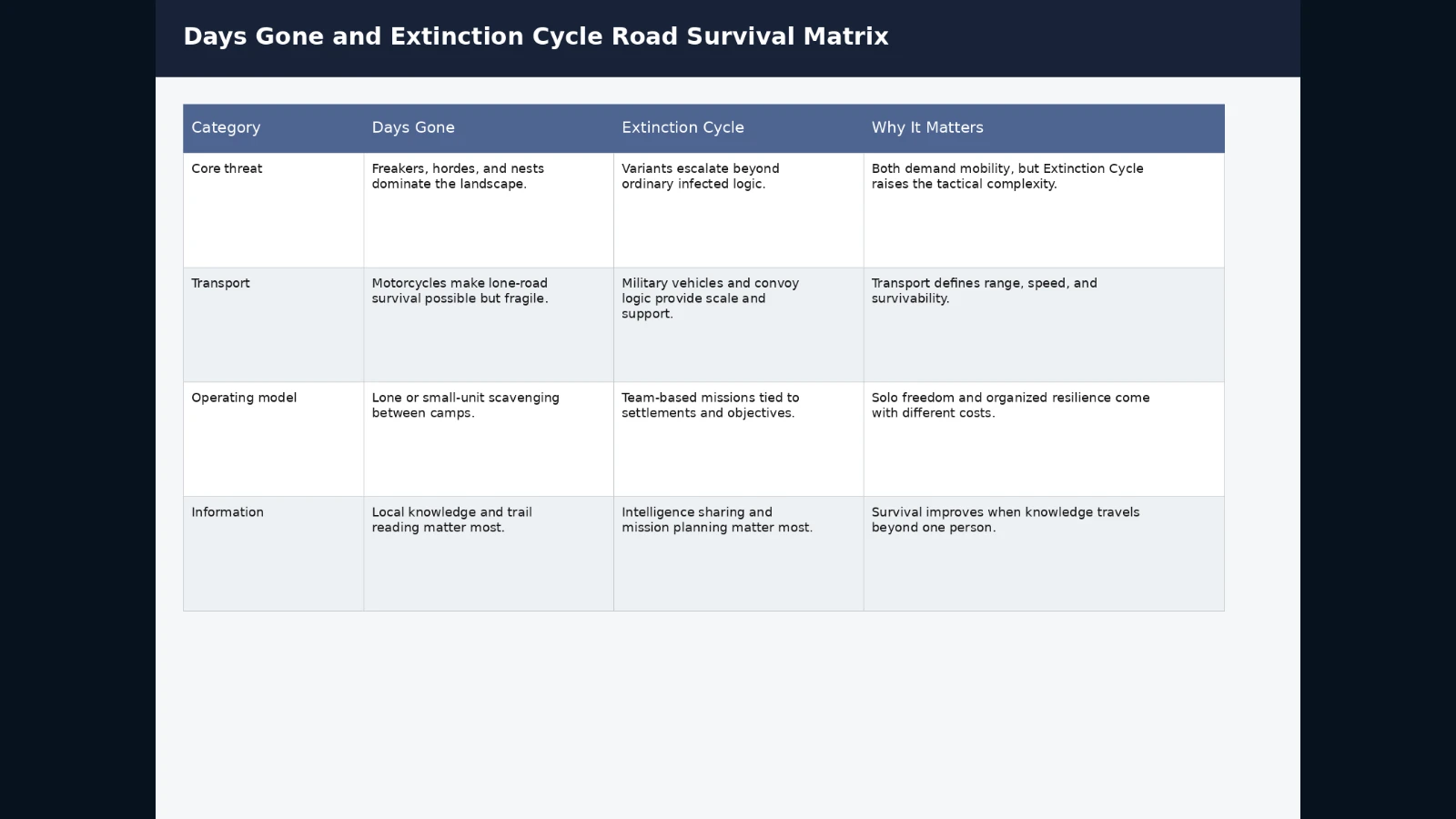
Both settings understand that survival improves when dangerous spaces are not merely avoided but actively reshaped. In Days Gone, nests and hordes are not background decoration. They are environmental anchors of fear. Clearing them is both a tactical necessity and a statement about reclaiming territory. The act is risky, resource-intensive, and often deeply personal because the survivor doing it may be operating with limited backup.
Extinction Cycle treats territory denial in a broader military sense. Destroying a nest-equivalent threat, securing a corridor, or striking at concentrations of Variants is rarely just a local housekeeping task. It affects evacuation routes, settlement security, scientific priorities, and future mission options. Territory is not cleared simply so one rider can breathe easier next time. It is contested as part of a war effort.
This difference changes how action is valued. Days Gone emphasizes the bravery and burden of the individual clearing danger out of a landscape. Extinction Cycle emphasizes how the same action slots into a larger survival system. One is intensely experiential. The other is system-aware. Neither is shallow. They just illuminate different scales of meaning.
The comparison also shows why intelligence matters. A nest is never just a nest if it sits on a critical route. A horde is never just a horde if its movement changes the survival map. Days Gone lets readers and players feel this viscerally. Extinction Cycle formalizes it. The road is safest when danger is mapped, interpreted, and acted upon before it surprises you.
Fuel, Scarcity, and the Economics of Movement
Scarcity makes the road honest. In Days Gone, fuel is not a small detail. It is one of the central realities organizing movement. Every trip carries an economic logic: can the ride be justified, will the return path remain viable, and what level of risk is acceptable given the state of the machine and the world? Scarcity keeps the fantasy grounded. The road feels liberating only because it can also strand you.
Extinction Cycle deals with scarcity at a larger scale but with the same underlying principle. Ammunition, fuel, medical supplies, food, and vehicle access all shape what missions are possible. The difference is that scarcity has communal consequences. A bad use of resources may weaken a whole outpost or operation, not just one traveler. Logistics therefore becomes one of the hidden heroes of the series. Survival belongs partly to the people who make movement sustainable.
This gives Extinction Cycle a strategic gravity that complements Days Gone’s experiential immediacy. Days Gone makes scarcity tactile. Extinction Cycle makes scarcity structural. Both are necessary perspectives. If you ignore the tactile side, logistics becomes an abstraction. If you ignore the structural side, road survival becomes too individualized to explain how communities endure.
Fuel, then, is not just fuel. It is a way of asking how much future a survivor can buy with the next decision to move. On a motorcycle or in a convoy, that question sits at the heart of survival.
Lone Operator Myth vs. Team-Based Reality
Days Gone is deeply attached to the lone-operator myth. That myth is emotionally powerful because it promises that one competent, stubborn person can navigate a ruined world through grit, local knowledge, and relentless movement. The story is not naive; it shows loneliness, trauma, and the fragility of independence. But it still draws much of its energy from the image of survival as something carried on the back of one rider and one machine.
Extinction Cycle repeatedly interrogates that fantasy. It values individual courage, but it is skeptical that one person can remain enough for long. Variants, logistical strain, settlement defense, scientific urgency, and reconstruction all exceed the capacity of lone competence. Team Ghost matters precisely because organized trust and distributed skill outperform solitary resilience when the world becomes this dangerous. One person can scout or survive a route. A team can change the conditions of survival for others.
This is not to say Days Gone is wrong. Lone operators often do emerge in collapsed worlds, and local heroes matter. But Extinction Cycle is stronger on the question of durability. Can the operating model scale? Can it defend children, scientists, supply chains, and political reconstruction? The lone drifter may save lives, but he cannot become an entire civilization.
The comparison therefore clarifies the tradeoff. Lone operation maximizes flexibility and local intuition. Team operation maximizes resilience, continuity, and cumulative capability. The harsher the world, the more the second model wins.
What Happens When the Rider Meets Team Ghost?
A crossover thought experiment helps sharpen the contrast. If a Days Gone-style road survivor entered Extinction Cycle, he would likely contribute immediate value in reconnaissance, route reading, scavenging efficiency, and improvisational survival. Someone used to the road, to nests, to fuel math, and to operating with low support would be useful. He might see path-level risks that larger units miss. He might also adapt quickly to austere movement under pressure.
But he would also confront the limits of going alone faster than in his own world. Variants would punish predictable patterns. Large-scale mission consequences would force him to think beyond his own survival radius. Most importantly, he would need to accept command structure and shared discipline if he wanted to matter over time. Extinction Cycle’s biggest lesson to the road drifter would be simple: your skills are real, but the war is bigger than your route.
The reverse is also revealing. Team Ghost members in Days Gone would probably excel in route security, nest-clearing coordination, and camp defense. Yet they might initially over-centralize decisions in a world where intimate local knowledge and informal networks can matter more than official planning. The best outcome would be a synthesis: the drifter’s intuition with the team’s structure.
That synthesis may be the deepest point of the article. The road is survived best when instinct and organization stop competing and start cooperating.
Final Verdict: Who Owns the Road?
Days Gone and Extinction Cycle both love the road, but they imagine ownership differently. Days Gone imagines the road as a narrow path of agency through a dangerous wilderness. The rider who knows it best can survive by staying mobile, reading the land, and accepting loneliness as part of the cost. Extinction Cycle imagines the road as a strategic artery linking survival nodes across a much broader war. Knowing the route matters, but defending and sustaining it matters more.
If the question is who survives better moment to moment on isolated stretches of dangerous terrain, Days Gone makes a strong case for the experienced lone operator. If the question is which world offers the more durable model for long-term human survival, Extinction Cycle wins decisively. Variants, settlements, reconstruction, and large-scale logistics all demand coordinated response. The road cannot remain a private frontier forever. It becomes part of a civilization struggle.
That is the real difference between the two worlds. Days Gone asks whether a person can keep moving long enough to remain free. Extinction Cycle asks whether movement can be organized well enough to let a society live again. Both questions matter. But only one is really built to outlast the road itself. That is why Extinction Cycle ultimately frames mobility not as an end, but as a means to something larger than any one survivor.
FAQ
How do Freakers differ from Variants?
Days Gone presents infected Freakers whose hordes and nests shape local movement. Extinction Cycle presents a more explicitly adaptive enemy that turns route knowledge into intelligence that can expire.
Which setting has the stronger road-survival model?
Days Gone is stronger at intimate route knowledge and individual improvisation. Extinction Cycle offers the more durable long-term model because movement is supported by teams, shared intelligence, logistics, and defended communities.
Is this a canon crossover?
No. It is independent fan criticism comparing two fictional survival systems.
Source note
Official PlayStation material establishes Days Gone as an open-world survival setting built around Freakers, hordes, the Pacific Northwest, and motorcycle travel. Extinction Cycle claims are checked against current Variant, Team Ghost, outpost, logistics, and mission records.
- PlayStation Blog: How and Why You'll Fight to Survive in Days Gone
- PlayStation Blog: Inside Bend Studio
Editorial note
This independent fan analysis uses original generic artwork and a submitted editorial comparison chart. It does not reproduce official franchise images, actor likenesses, logos, or claim a canon crossover.
Recommended next pages
Source and canon pack
- Canon treatment
- Official PlayStation material establishes the Days Gone premises. Variant, Team Ghost, outpost, and logistics claims follow local records; the road-survival verdict remains interpretive.
- Primary wiki source plan
- Variant, Team Ghost, outpost, convoy, mission, mobility, and logistics records provide the Extinction Cycle baseline.
- Spoiler scope
- Broad franchise-level spoilers about Freakers, hordes, Variants, outposts, and survival systems without recapping late-game or late-book outcomes.
- Safety boundary
- Independent transformative fan criticism. No official Days Gone imagery, characters, actors, game costumes, branded motorcycles, screenshots, logos, real survival instruction, or claim of canon crossover is published.
- Program article ID
- EC-34
- Scheduled publication
- 2026-08-26T18:25:00-04:00