
Where realistic response ends and military horror begins
Contagion vs. Extinction Cycle: Real Pandemic Response Versus Weaponized Apocalypse
Compare Contagion and Extinction Cycle through surveillance, risk communication, countermeasures, misinformation, public trust, and fictional escalation.
·
Category: Fact Versus Fiction

Introduction: Where Realistic Pandemic Fiction Ends
Contagion and Extinction Cycle both begin with a frightening premise: a biological event spreads faster than institutions can comfortably absorb. The similarities are enough to make the comparison useful. Scientists race to understand an emerging threat. Governments struggle with communication. Rumors and misinformation can change behavior. Medical countermeasures matter. Political leaders face choices about scarcity, movement, public trust, and risk.
Then the paths separate dramatically.
Contagion is compelling because much of its tension comes from recognizable public-health systems. Surveillance, epidemiology, laboratories, public communication, vaccine development, and distribution all matter. It dramatizes the enormous difficulty of coordinating a response without turning the disease into a supernatural enemy.
Extinction Cycle deliberately leaves that realistic frame behind. VX-99, the Hemorrhage Virus, Variant transformation, extreme predation, and subsequent evolution turn outbreak management into military apocalypse. Public health does not disappear, but it is rapidly subsumed into a species- level war.
This article uses that divergence as its main argument. Contagion is useful because it shows what realistic response actually looks like when a dangerous pathogen moves through society. Extinction Cycle is useful because it imagines the point at which ordinary outbreak response would be insufficient if the pathogen were weaponized, transformational, and capable of creating adaptive predators.
The real-world material here should be read cautiously. Current CDC and WHO preparedness frameworks emphasize surveillance, emergency coordination, risk communication, community protection, clinical care, and access to medical countermeasures. None of that resembles Variant warfare. Extinction Cycle is speculative fiction, not a model of how real pandemics behave.
The comparison works best when the seam between reality and fiction remains visible.
Surveillance: Finding the Outbreak Before It Becomes the Story
Real pandemic response depends heavily on surveillance. Public-health agencies need to know what is happening, where cases are appearing, how patterns are changing, and which populations are at risk. WHO's current health-emergency framework describes collaborative surveillance as one of the core systems required to detect and respond to health emergencies. CDC preparedness standards likewise treat surveillance and intelligence as essential capabilities.
Contagion dramatizes this logic well because disease intelligence is not glamorous. It depends on data, interviews, samples, patterns, and repeated correction. The public may want certainty, but epidemiology often advances by narrowing uncertainty rather than eliminating it instantly.
Extinction Cycle begins with the same basic need and then transforms it into something closer to battlefield intelligence. Once the infected become Variants, surveillance is not just about transmission chains. It is about where the enemy nests, how it moves, what new forms are appearing, which environments have become unsafe, and whether earlier countermeasures changed the population.
That is one of the clearest points where the fiction crosses out of realism. Real outbreak surveillance does not become reconnaissance against climbing, coordinated predators. It remains a public-health process focused on disease detection, transmission, severity, and response capacity.
The thematic similarity remains useful, however. Both worlds punish bad information. Contagion punishes delayed or fragmented health intelligence. Extinction Cycle punishes military and scientific institutions that keep critical knowledge compartmentalized or cling to outdated assumptions. In both, the first requirement of survival is the same: describe the problem honestly enough to act on it.
Public Communication: Be First, Be Right, Be Credible
Risk communication is one of the most realistic points of comparison. CDC's Crisis and Emergency Risk Communication program emphasizes evidence-based communication during emergencies, while WHO describes risk communication as a lifesaving public-health function. People need accurate, understandable information in order to make decisions that protect themselves and others.
Contagion understands this intuitively. Public communication is not background exposition. It shapes trust, panic, compliance, rumor, and social order. A scientifically correct message delivered too late can fail. A confident message that later proves false can damage credibility beyond the original error.
Extinction Cycle approaches communication from a world where official secrecy is much more deeply embedded. Classified research, military decision-making, and the hidden history of VX-99 make public trust harder to preserve. Even good leaders inherit a credibility problem created by institutions that concealed dangerous information.
This creates a useful contrast between realistic emergency communication and fictional national- security logic. Public health generally benefits from explaining what is known, what is uncertain, what people should do, and how guidance may change. Military operations often benefit from withholding specific information. The danger appears when operational secrecy expands into broad public deception.
The two franchises therefore agree on a principle even when the circumstances differ: information is an intervention. Poor communication can increase harm. Good communication cannot replace medical or tactical response, but it can make every other response more effective.
Misinformation and the Economics of Fear
Pandemics create markets for certainty. When official institutions cannot answer every question quickly, other actors step into the gap. Some offer sincere interpretation. Others offer rumor, conspiracy, or profit-driven misinformation.
Contagion makes this dynamic part of the outbreak itself. The false-information ecosystem becomes a secondary hazard because frightened people change behavior based on what they believe. Misinformation can redirect demand, undermine trust, and create anger toward legitimate institutions.
This remains realistic. Public-health agencies devote significant attention to risk communication and community engagement precisely because information environments influence response outcomes. The goal is not to suppress disagreement but to ensure people can access credible, timely, actionable information.
Extinction Cycle intensifies the problem because some official secrecy is genuinely real within the fiction. That makes conspiratorial thinking more difficult to dismiss. If institutions actually hid biological research, people who distrust them are not irrational in the abstract. The problem becomes determining which suspicions are evidence-based and which are opportunistic.
The lesson is uncomfortable: institutions reduce misinformation not only by speaking more loudly, but by behaving in ways that deserve trust. Once a public discovers serious deception, the information environment becomes much harder to stabilize.
This is another point where Extinction Cycle turns a realistic pandemic concern into a deeper state- legitimacy crisis.
Vaccine Research and Medical Countermeasures
Countermeasures are one of the biggest places where realism and fiction diverge. CDC pandemic- planning materials describe vaccines, antivirals, therapeutics, diagnostics, respiratory protection, and other medical countermeasures as central parts of pandemic response. WHO frameworks similarly emphasize access to countermeasures as one of the systems required for preparedness and response.
Contagion's vaccine storyline fits that general logic. Research must move through scientific development, testing, manufacturing, distribution, public communication, and prioritization. Even when fiction compresses time, the overall frame remains recognizably public health.
Extinction Cycle weaponizes the concept. VariantX9H9, Kryptonite, and later interventions function in a world where the infected population is not only sick but militarily predatory. Countermeasures become strategic weapons as much as medical tools. That is a deliberate science-fiction escalation.
This distinction must remain clear. Real vaccine research does not resemble species-selective extermination technology. Real public-health countermeasures are developed to prevent disease, reduce severity, support care, and protect populations. The Extinction Cycle inventions belong to the fictional biology of the novels.
The comparison is still valuable because both stories reveal the same governance problem: who gets access first, who accepts risk, who decides when evidence is sufficient, and how much public trust exists when the countermeasure arrives?
Countermeasures do not solve a crisis by existing. They have to be manufactured, distributed, accepted, and used appropriately. Contagion understands that as a public-health challenge. Extinction Cycle transforms it into wartime logistics.
Political Decisions Under Uncertainty
Political leadership in a pandemic is difficult because leaders are judged on outcomes before evidence is complete. Close too much too early and the public may see overreaction. Move too slowly and exponential spread punishes hesitation. Allocate scarce resources one way and every alternative constituency feels abandoned.
Contagion treats these decisions as difficult but still recognizable. Governments coordinate with health authorities, manage public behavior, and struggle with scarce medical resources.
Extinction Cycle pushes political decision-making into a more extreme setting. Once the outbreak becomes an extinction war, leaders are not only balancing public-health interventions. They are deciding where military assets go, which communities can be defended, how secrecy is handled, and whether the remaining state can preserve legitimacy while making impossible triage decisions.
The difference is important. Real pandemic response should not be militarized by default simply because apocalyptic fiction dramatizes military control. Public health relies on expertise, healthcare systems, community participation, legal authority, and transparent risk communication.
Extinction Cycle deliberately imagines a fictional point at which those systems are overtaken by a threat no realistic framework is designed to address. Variants do not merely transmit disease. They physically attack the people and institutions trying to respond.
That is the line between pandemic fiction and weaponized apocalypse.
What Contagion Gets Right About Institutions
One of Contagion's strengths is that competence is distributed. No single heroic scientist or soldier solves everything. Surveillance, laboratories, clinical systems, communication, manufacturing, policy, and ordinary public behavior all contribute.
This is close to how real preparedness frameworks think. WHO's health-emergency model emphasizes interconnected systems rather than one super-agency. Current frameworks identify surveillance, community protection, scalable care, access to countermeasures, and emergency coordination as connected capabilities.
Extinction Cycle eventually reaches a similar systems view, but only after the military-horror frame expands. Team Ghost matters. Kate matters. Ringgold matters. Outposts matter. Agriculture and logistics matter. No one domain is sufficient.
That convergence is important. Even the most militarized apocalypse ultimately becomes a systems story if it lasts long enough.
The difference is that Contagion begins there. Extinction Cycle has to fight its way there.
Where Extinction Cycle Deliberately Leaves Realism Behind
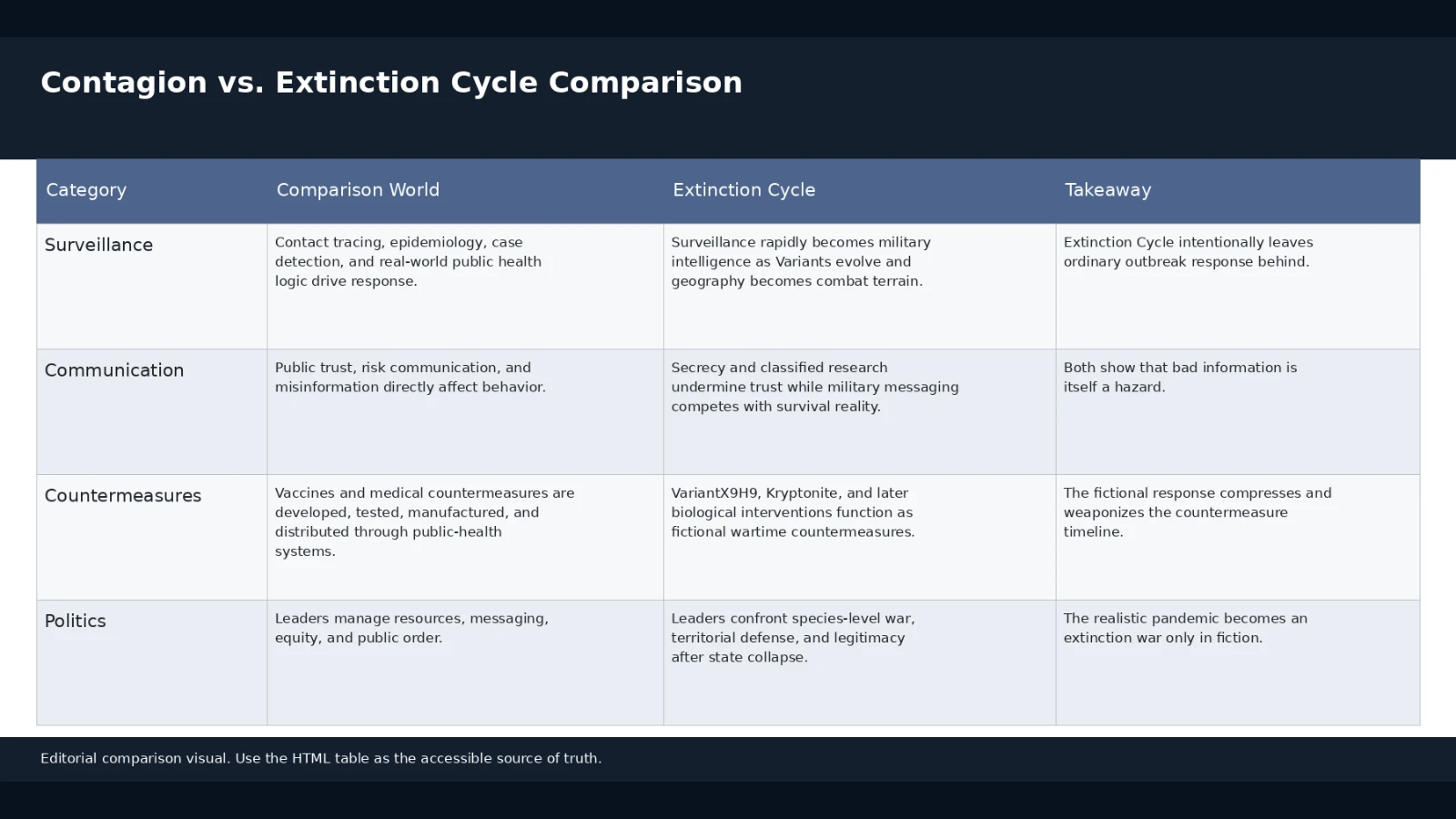
Several elements of Extinction Cycle should be explicitly separated from real outbreak science.
First, VX-99 is fictional. The Hemorrhage Virus is fictional. Variant transformation is fictional. Real viral infection does not create wall-climbing post-human predators, rapid superhuman evolution, or New Gods hierarchies.
Second, realistic pandemic response is not built around annihilating infected populations as military targets. Patients are people who need care, infection prevention, and public-health support.
Third, real countermeasures do not operate like the fictional biological weapons of the novels.
Fourth, emergency management does not become more accurate merely because the military is involved. Real outbreak response depends on medical, laboratory, epidemiological, logistical, legal, and community systems.
Keeping these boundaries visible strengthens the site. The Extinction Cycle is compelling because it exaggerates realistic institutional anxieties into military horror. Its plausibility comes from recognizable organizations, not realistic Variant biology.
Final Verdict: Contagion Is the Baseline, Extinction Cycle Is the Nightmare Beyond It
Contagion and Extinction Cycle are most useful together when one is treated as a baseline and the other as a deliberate break from it.
Contagion asks what happens when a dangerous pathogen moves through a modern interconnected society. The answer involves surveillance, communication, healthcare capacity, vaccine research, misinformation, political judgment, and public trust.
Extinction Cycle asks what happens if that entire framework is overwhelmed by an engineered threat that produces a physically transformed enemy population and turns outbreak management into armed conflict.
The realistic lesson belongs to Contagion's side of the comparison. Early detection matters. Honest risk communication matters. Collaborative surveillance matters. Countermeasure development and access matter. Coordination matters. Public trust matters.
The Extinction Cycle lesson is literary rather than medical: secrecy, militarized science, and institutional arrogance can transform a crisis into something much worse than the people in charge ever intended.
That is the final seam between the two worlds. Contagion shows how difficult real pandemic response already is. Extinction Cycle imagines the nightmare that begins when the pathogen stops behaving like a real pathogen and the response has to become a war.
FAQ
Is Extinction Cycle realistic pandemic guidance?
No. VX-99, the Hemorrhage Virus, Variant transformation, and the novels' biological countermeasures are fictional. Real health questions should be taken to current CDC, WHO, or local public-health guidance.
What does Contagion contribute to the comparison?
It keeps the response centered on interconnected public-health systems: surveillance, laboratories, communication, healthcare, countermeasure development, distribution, and public trust.
Is this article medical advice?
No. It provides general fact-versus-fiction context and links to authoritative public-health sources; it does not diagnose, treat, or instruct readers to manage an emergency.
Public-health source note
The real-world discussion is limited to current, general preparedness concepts from CDC and WHO. Those sources emphasize coordinated surveillance, emergency capabilities, risk communication, clinical systems, and access to medical countermeasures. The fictional Variant material is kept explicitly separate.
- CDC: Crisis and Emergency Risk Communication
- CDC: Public Health Emergency Preparedness and Response Capabilities
- CDC: Vaccine and Other Medical Countermeasures
- WHO: Defining collaborative surveillance
- WHO: 2026 framework for national public-health-agency emergency capabilities
Editorial note
This independent fan analysis uses original generic artwork and a submitted editorial comparison chart. It does not reproduce official franchise images, actor likenesses, logos, or claim a canon crossover.
Recommended next pages
Source and canon pack
- Canon treatment
- Current CDC and WHO sources establish the real preparedness baseline. VX-99, the Hemorrhage Virus, Variant transformation, and fictional countermeasures follow local canon records and remain explicitly separated from real disease.
- Primary wiki source plan
- VX-99, Hemorrhage Virus, Variant, countermeasure, military-response, and institutional-secrecy records provide the fictional baseline.
- Spoiler scope
- Broad premise spoilers plus fictional Extinction Cycle outbreak mechanics; no medical advice, diagnosis, treatment, or real emergency instruction.
- Safety boundary
- General fact-versus-fiction context only. No diagnosis, treatment, containment, laboratory, biodefense, tactical, or emergency instruction; real health questions are deferred to current official sources and local authorities.
- Program article ID
- EC-41
- Scheduled publication
- 2026-08-26T18:52:00-04:00