
Fictional outbreak versus medical reality
Variants vs Viral Hemorrhagic Fevers: Fiction and Reality
Separate the Extinction Cycle’s fictional Hemorrhage Virus, VX-99, and Variants from real viral hemorrhagic fevers using current CDC and WHO guidance.
·
Category: Fact Versus Fiction
The Extinction Cycle borrows the language of virology, hemorrhage, genetics, laboratory containment, and outbreak response to make its apocalypse feel medically close to home. The resemblance stops much earlier than the Variants do. VX-99, the fictional Hemorrhage Virus, instant predatory transformation, and Variant evolution belong to the story. Real viral hemorrhagic fevers are a diverse group of serious infectious diseases with very different causes, transmission patterns, clinical courses, and public-health responses.
Medical caution: This is a fiction-versus-reality article, not a diagnostic guide. Real viral hemorrhagic fevers are uncommon in many settings, early symptoms can overlap with numerous more common illnesses, and suspected cases require professional medical and public-health evaluation rather than self-diagnosis.

The name sounds plausible enough to create confusion.
Hemorrhage Virus.
In the Extinction Cycle, those two words identify the fictional infectious engine that turns a hidden military experiment into a civilization-ending catastrophe. The virus spreads. People bleed. Human bodies change. VX-99 awakens something buried in their biology. The infected become Variants: living predators that are faster, stronger, more resilient, and increasingly capable of adaptation, coordination, and social hierarchy.
In the real world, the phrase viral hemorrhagic fever, usually shortened to VHF, means something very different.
It does not describe one virus.
The U.S. Centers for Disease Control and Prevention describes viral hemorrhagic fevers as a group of diseases caused by several distinct families of viruses. They can affect multiple organ systems and, in severe disease, disrupt the vascular system and the body's ability to regulate itself. The category includes diseases with very different natural reservoirs and routes of transmission. Some are associated with bats or rodents. Some are transmitted by ticks or mosquitoes. Some can spread from person to person through infectious body fluids. They do not share one universal incubation period, one universal fatality rate, or one universal treatment strategy.
Most importantly, they do not turn people into Variants.
That sounds obvious when stated plainly. It is still worth stating because the Extinction Cycle deliberately uses recognizable scientific vocabulary. Nicholas Sansbury Smith's fictional world reaches back to Vietnam-era military experimentation, draws on Ebola imagery, invokes epigenetic changes, places scientists in high-containment laboratories, and builds its horror around the fear that an engineered pathogen could escape human control.
Those details make the story vivid.
They should not be mistaken for a description of real hemorrhagic fever biology.
The Short Version
If you only remember five distinctions, remember these:
- VX-99 is fictional. It is a military experimental compound and program created for the Extinction Cycle story.
- The Hemorrhage Virus is fictional. The books use an engineered Ebola-linked viral architecture as part of the fictional outbreak, but there is no real "Hemorrhage Virus" that behaves this way.
- Variants are fictional transformed humans. Real viral infections do not create superhuman strength, wall-climbing predators, Variant hierarchies, or instant species-like evolution.
- Viral hemorrhagic fever is a real medical category, not one disease. Ebola disease, Marburg virus disease, Lassa fever, Crimean-Congo hemorrhagic fever, and other illnesses have different reservoirs, transmission patterns, clinical features, and countermeasures.
- Real outbreak response is public health and medicine, not monster warfare. Surveillance, exposure assessment, infection prevention and control, diagnostics, contact tracing, supportive care, community engagement, and disease-specific vaccines or therapeutics are the real tools.
At-a-Glance Comparison
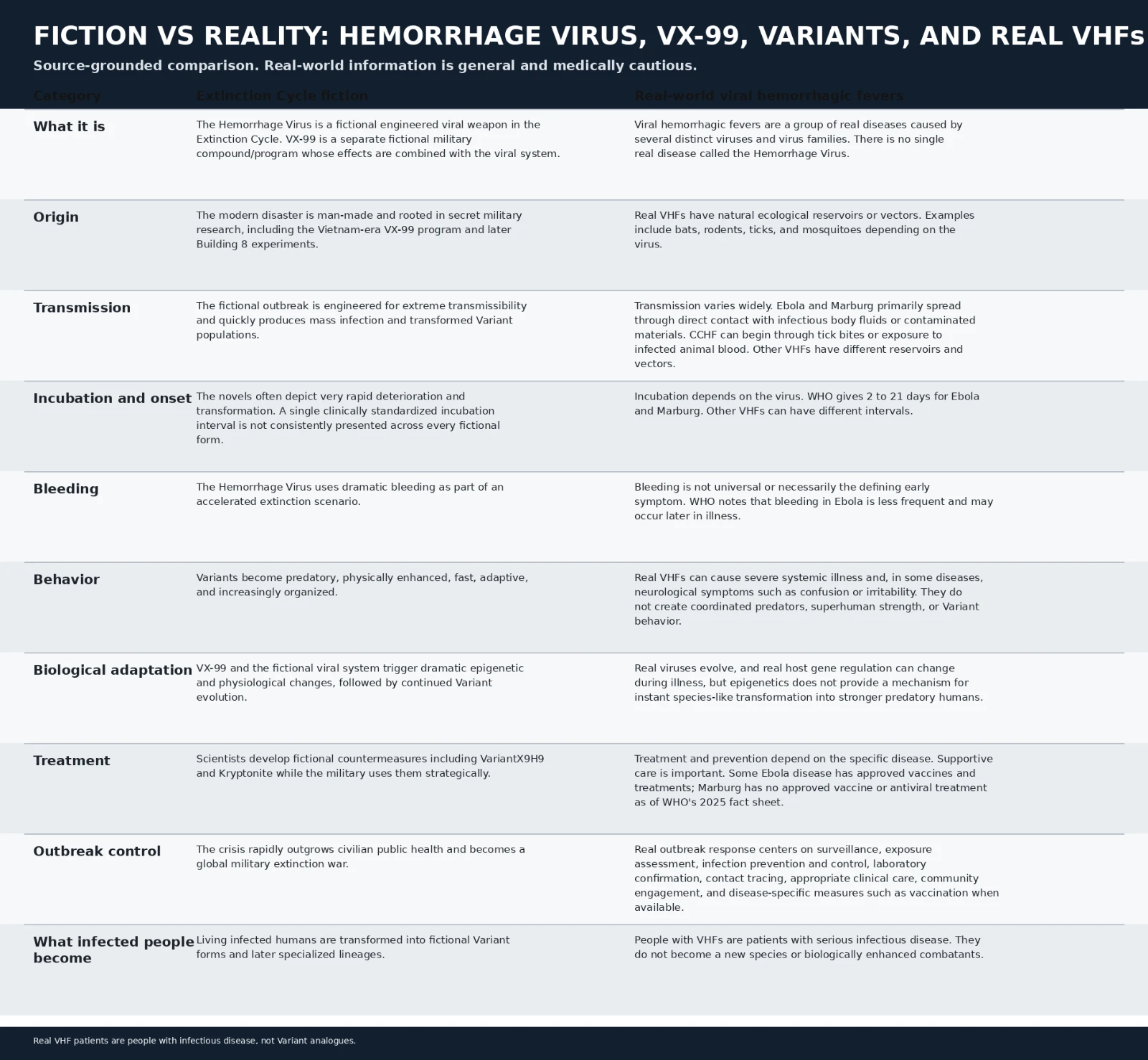
| Category | Extinction Cycle fiction | Real-world viral hemorrhagic fevers |
|---|---|---|
| What it is | The Hemorrhage Virus is a fictional engineered viral weapon in the Extinction Cycle. VX-99 is a separate fictional military compound/program whose effects are combined with the viral system. | Viral hemorrhagic fevers are a group of real diseases caused by several distinct viruses and virus families. There is no single real disease called the Hemorrhage Virus. |
| Origin | The modern disaster is man-made and rooted in secret military research, including the Vietnam-era VX-99 program and later Building 8 experiments. | Real VHFs have natural ecological reservoirs or vectors. Examples include bats, rodents, ticks, and mosquitoes depending on the virus. |
| Transmission | The fictional outbreak is engineered for extreme transmissibility and quickly produces mass infection and transformed Variant populations. | Transmission varies widely. Ebola and Marburg primarily spread through direct contact with infectious body fluids or contaminated materials. CCHF can begin through tick bites or exposure to infected animal blood. Other VHFs have different reservoirs and vectors. |
| Incubation and onset | The novels often depict very rapid deterioration and transformation. A single clinically standardized incubation interval is not consistently presented across every fictional form. | Incubation depends on the virus. WHO gives 2 to 21 days for Ebola and Marburg. Other VHFs can have different intervals. |
| Bleeding | The Hemorrhage Virus uses dramatic bleeding as part of an accelerated extinction scenario. | Bleeding is not universal or necessarily the defining early symptom. WHO notes that bleeding in Ebola is less frequent and may occur later in illness. |
| Behavior | Variants become predatory, physically enhanced, fast, adaptive, and increasingly organized. | Real VHFs can cause severe systemic illness and, in some diseases, neurological symptoms such as confusion or irritability. They do not create coordinated predators, superhuman strength, or Variant behavior. |
| Biological adaptation | VX-99 and the fictional viral system trigger dramatic epigenetic and physiological changes, followed by continued Variant evolution. | Real viruses evolve, and real host gene regulation can change during illness, but epigenetics does not provide a mechanism for instant species-like transformation into stronger predatory humans. |
| Treatment | Scientists develop fictional countermeasures including VariantX9H9 and Kryptonite while the military uses them strategically. | Treatment and prevention depend on the specific disease. Supportive care is important. Some Ebola disease has approved vaccines and treatments; Marburg has no approved vaccine or antiviral treatment as of WHO's 2025 fact sheet. |
| Outbreak control | The crisis rapidly outgrows civilian public health and becomes a global military extinction war. | Real outbreak response centers on surveillance, exposure assessment, infection prevention and control, laboratory confirmation, contact tracing, appropriate clinical care, community engagement, and disease-specific measures such as vaccination when available. |
| What infected people become | Living infected humans are transformed into fictional Variant forms and later specialized lineages. | People with VHFs are patients with serious infectious disease. They do not become a new species or biologically enhanced combatants. |
VX-99: A Fictional Military Program, Not a Real Virus
The first distinction is easy to lose because the series eventually layers several fictional biological agents together.
VX-99 is not the Hemorrhage Virus.
The books establish VX-99 as a Vietnam-era military experiment tied to ambitions for stronger or more capable soldiers. In Extinction Red Line, Lieutenant Trevor Brett and other Marines receive an experimental dose during Operation Burn Bright. The result is not ordinary infection. Brett experiences severe physical and neurological changes, heightened senses, aggression, and long-term transformation.
That is fictional super-soldier horror.
Decades later, the modern outbreak emerges when Building 8 research connects the old VX-99 legacy to a highly contagious viral system. Extinction Horizon describes Dr. Medford working with VX-99 and an Ebola-based viral architecture, producing the modern Hemorrhage Virus crisis.
The important word is fictional.
Real Ebola viruses do not contain a hidden pathway that can be combined with a chemical to awaken a dormant predatory human form. Real genetics does not work like a locked monster mode.
The novels take real concepts such as gene regulation, virology, mutation, selection, and high-containment research and amplify them into speculative bioweapon fiction.
That is part of the genre.
It is not a real-world mechanism.
The Hemorrhage Virus Is Not the Same Thing as "Viral Hemorrhagic Fever"
This is the most important terminology distinction in the comparison.
In the Extinction Cycle, Hemorrhage Virus is a proper name for the fictional engineered pathogen driving the outbreak.
In medicine, viral hemorrhagic fever is a broad descriptive category.
CDC's current overview says VHFs are caused by several distinct virus families. Its list includes illnesses associated with filoviruses, arenaviruses, nairoviruses, phenuviruses, flaviviruses, and other groups. Reservoirs and vectors differ. Geography differs. Incubation differs. Prevention differs.
That means there is no single real "VHF virus."
Ebola disease is not Marburg virus disease.
Marburg is not Crimean-Congo hemorrhagic fever.
Crimean-Congo hemorrhagic fever is not Lassa fever.
They can share some clinical patterns, including severe systemic illness and bleeding in some patients, without being versions of one pathogen.
The fictional Hemorrhage Virus compresses those complexities into one dramatic engineered threat because a thriller needs a coherent antagonist.
Real infectious disease is messier.
Why the Word "Hemorrhagic" Can Mislead
Popular culture tends to treat hemorrhagic fever as shorthand for dramatic bleeding.
That is medically misleading.
Bleeding can be important in severe viral hemorrhagic fever, but it is not universal, and it is often not the first or most defining symptom.
WHO's Ebola fact sheet specifically warns against the popular assumption that bleeding is common in every case. Ebola can begin with fever, fatigue, malaise, muscle pain, headache, and sore throat, followed by gastrointestinal symptoms such as vomiting and diarrhea. Internal or external bleeding may occur later in some patients, but WHO describes it as less frequent than the public stereotype suggests.
Marburg virus disease can also cause hemorrhagic manifestations in severe illness, including bleeding from the nose, gums, gastrointestinal tract, or needle sites. Again, those features occur inside a severe multisystem disease. They do not mean every patient presents as a visibly bleeding figure.
This matters for the Extinction Cycle comparison because the novels use hemorrhage as a fast visual signal that something catastrophic has happened.
Real clinicians cannot diagnose a viral hemorrhagic fever from that image.
CDC emphasizes exposure history, clinical assessment, appropriate laboratory testing, infection-control precautions, and public-health consultation.
Real VHF Patients Do Not Become Predators
The fictional transformation from infected human to Variant is the largest biological departure from reality.
Variants are not simply sick people.
They become a new predatory state.
The books describe them as fast, strong, sensory-driven, and capable of physical feats ordinary humans cannot match. Across the series they climb, move through tunnels and buildings, coordinate, adapt to human tactics, reproduce, form hierarchies, develop regional forms, and eventually become part of much more complex post-human systems.
Nothing comparable occurs in real viral hemorrhagic fevers.
Severe infections can affect the nervous system. WHO notes that Ebola disease can involve confusion, irritability, and aggression in some patients. WHO similarly describes neurological involvement in severe Marburg disease.
Those symptoms should not be sensationalized.
Confusion or agitation in a critically ill patient is not the beginning of Variant behavior.
Real patients do not acquire superhuman strength.
They do not become coordinated hunters.
They do not grow claws.
They do not gain wall-climbing ability.
They do not become a new biological caste.
A real VHF patient is a person with a serious infection who needs professional care and appropriate infection-control measures.
That difference is not merely scientific.
It is ethical.
Language that makes sick people sound monstrous can increase stigma and fear during real outbreaks.
Fictional Epigenetics vs Real Gene Regulation
The Extinction Cycle frequently invokes epigenetic change as part of its explanation for Variant transformation.
Epigenetics is real.
The fictional outcome is not.
In real biology, epigenetic mechanisms help regulate how genes are expressed. Cells can change patterns of gene activity without rewriting an organism into another species. Infection, inflammation, aging, environment, development, and many other processes can influence gene regulation.
What epigenetics does not provide is a scientifically established switch that turns an adult human into an enhanced predator by reactivating some intact ancestral animal body plan.
Humans do not carry a hidden complete anatomical program for instant fangs, superhuman muscles, new locomotion, and specialized Variant castes waiting to be unlocked by one pathogen.
The fiction borrows the idea that gene expression can change and asks a horror-story question:
What if an engineered compound could push that process far beyond anything biologically plausible?
That is speculative storytelling.
Real Viruses Evolve, but Not Like Variants
Another place where fiction and reality use the same word differently is evolution.
Real viruses evolve.
Mutations arise.
Natural selection can favor variants that spread effectively under particular conditions.
Population immunity, host ecology, transmission opportunities, and other pressures can influence which lineages persist.
But that is not the same as the Extinction Cycle's enemy progression.
The fictional Variants change at multiple levels at once. Individual physiology is altered. Later generations and specialized forms emerge. Intelligence and social organization increase. Regional forms exploit different environments. Human engineering later contributes to additional complexity.
This is closer to accelerated speculative macroevolution plus bioengineering than to ordinary viral evolution.
A real viral lineage can change genetically over time.
It does not redesign an infected adult into a physically stronger predatory organism within hours or days.
Ebola: A Real Disease, Not the Extinction Cycle Template
Ebola is the real disease most likely to be confused with the fictional Hemorrhage Virus because the novels explicitly draw on Ebola-based research in the Building 8 backstory.
WHO describes Ebola disease as rare but severe.
Person-to-person spread occurs through direct contact, through broken skin or mucous membranes, with infectious blood or other body fluids, or with materials contaminated by those fluids. WHO states that people do not transmit Ebola disease before symptoms begin.
The incubation period is 2 to 21 days.
The disease can include fever, fatigue, muscle pain, headache, sore throat, vomiting, diarrhea, abdominal pain, rash, and organ dysfunction. Bleeding can occur, but it is less frequent than the stereotype suggests.
Early intensive supportive care improves survival.
For Ebola virus disease caused by Ebola virus, vaccines and treatments are available. WHO notes that comparable approved products are not yet available for every orthoebolavirus that can cause human disease.
Nothing in that medical profile resembles Variant transformation.
The Extinction Cycle uses Ebola as recognizable narrative raw material, then departs sharply into engineered science fiction.
Marburg: Similar Clinical Family, Different Fictional Meaning
Marburg virus disease is another filovirus disease that is often mentioned alongside Ebola.
WHO describes it as severe and often fatal.
Its initial animal-to-human spillover has been associated with Rousettus fruit bats, especially in mines and caves. Once introduced into people, Marburg can spread through direct contact with infectious body fluids or contaminated materials.
Its incubation period is also 2 to 21 days.
Early illness can involve fever, severe headache, malaise, muscle pain, diarrhea, abdominal symptoms, nausea, and vomiting. Hemorrhagic manifestations can occur later in severe illness.
WHO's 2025 fact sheet reported no approved vaccine or antiviral treatment for Marburg virus disease, although candidates were under development. Supportive care remains important.
Again, this is a severe real disease.
It is not a behavioral transformation.
A Marburg patient is not a proto-Variant.
Crimean-Congo Hemorrhagic Fever Shows Why "VHF" Is Not One Transmission Model
Crimean-Congo hemorrhagic fever is especially useful for showing why the category cannot be reduced to "Ebola-like body-fluid viruses."
CDC describes CCHF as a rare serious disease that can spread to humans through infected hard-tick bites or exposure to infected animal blood. Human-to-human transmission can occur through contact with infectious blood or body fluids, and healthcare-associated transmission is a recognized risk when infection-control precautions are inadequate.
Symptoms can begin 1 to 14 days after exposure.
CDC notes that severe bruising and uncontrolled bleeding may develop in some patients.
Supportive care is important, and CDC reports no specific cure and no widely available approved vaccine for human use.
The major lesson is not the exact details of one disease.
It is that real VHF transmission depends on which virus you are discussing.
There is no universal VHF rule that can be transferred from one disease to another.
Lassa Fever and the Importance of Reservoirs
Lassa fever adds another different ecological pattern.
The disease is associated with Mastomys rodents in parts of West Africa. Human infection can occur through exposure to contaminated rodent urine or feces, while person-to-person transmission can also occur through infectious body fluids, particularly in healthcare settings without adequate precautions.
That reservoir relationship is fundamentally different from the fictional Extinction Cycle model.
The Hemorrhage Virus is designed as a human catastrophe.
Real zoonotic disease is embedded in ecosystems.
Understanding reservoirs, vectors, geography, human behavior, housing, occupational exposure, healthcare systems, and community practices can be as important as understanding the virus itself.
That is one reason real outbreak control looks less dramatic than Team Ghost and more complicated than a single countermeasure.
Real-World Examples
| Disease | Common transmission pattern | Incubation note | General care / prevention note |
|---|---|---|---|
| Ebola disease | Person-to-person spread through direct contact with infectious blood or other body fluids, or contaminated materials. Animal-to-human spillover can occur. | 2 to 21 days | Early intensive supportive care improves survival. Approved vaccines and treatments exist for Ebola virus disease caused by Ebola virus. |
| Marburg virus disease | Initial spillover can involve Rousettus fruit bats; human spread occurs through direct contact with infectious body fluids or contaminated materials. | 2 to 21 days | Supportive care improves survival. WHO's 2025 fact sheet reported no approved vaccine or antiviral treatment. |
| Crimean-Congo hemorrhagic fever | Tick bites and contact with infected animal or human blood or body fluids. | 1 to 14 days according to CDC | Supportive care is central. CDC reports no specific cure and no widely available approved human vaccine. |
| Lassa fever | Often linked to exposure to infected Mastomys rodents or their excreta; person-to-person spread can occur through body fluids. | Commonly described in public-health guidance as up to about 3 weeks | Requires professional clinical evaluation and public-health management; not every febrile illness in an endemic area is Lassa fever. |
This table is intentionally general.
It should not be used to decide whether a particular illness is or is not a VHF.
CDC specifically notes that early symptoms can resemble many other febrile illnesses, and that most febrile patients presenting in U.S. healthcare settings do not have a VHF.
How Real Public Health Responds
One of the more realistic parts of the Extinction Cycle is not the biology.
It is the institutional stress.
Scientists need samples.
Clinicians need protective equipment.
Laboratories need containment.
Officials need surveillance.
Responders need to know who has been exposed.
Hospitals need protocols that protect staff while allowing patients to receive care.
Those pressures are real.
The tools are different.
CDC guidance for suspected VHFs emphasizes structured screening based on exposure history and symptoms. Relevant questions include recent contact with a suspected or confirmed case or contaminated materials, travel in areas with active outbreaks or endemic disease, and laboratory work involving high-consequence pathogens.
When suspicion is significant, CDC guidance includes isolation in an appropriate healthcare setting, infection prevention and control, appropriate PPE, limiting room entry to essential trained personnel, and notifying the facility's infection-control program and public-health authorities.
That is a long way from a fictional military cordon collapsing into gunfire.
It is also more effective for the real diseases because the real diseases do not create Variants.
What Real Outbreak Control Actually Looks Like
WHO's Ebola guidance describes outbreak control as a package rather than one miracle technology.
That package includes:
- supportive clinical care
- infection prevention and control
- disease surveillance
- contact tracing
- laboratory services
- safe and dignified burial practices
- vaccination when relevant
- community engagement and social mobilization
Marburg guidance similarly emphasizes appropriate clinical isolation, hygiene, infection-control practices, contact monitoring, community communication, and properly equipped laboratories.
Real outbreak control is therefore organizational.
It depends on trust.
If people are afraid to seek care, contact tracing becomes harder.
If health workers lack PPE or training, healthcare-associated transmission can occur.
If communities distrust responders, even technically sound interventions can fail.
This is one area where Extinction Cycle fiction and real public health share a thematic truth without sharing biology:
institutional failure can magnify an outbreak.
High-Containment Laboratories: Real but Not a Sign of Secret Super-Soldier Work
The series uses Building 8 and Plum Island to make high-containment research feel ominous.
High-containment laboratories are real.
They exist because some pathogens require specialized facilities, procedures, engineering controls, and trained personnel.
That does not mean such laboratories are secretly creating Variants.
Maximum containment is a safety system.
It is designed to reduce risk to laboratory workers, communities, and the environment when dangerous agents are studied.
WHO notes that non-inactivated samples suspected of containing Marburg virus should be handled under maximum biological containment conditions.
The existence of that safety requirement is not evidence for the fictional scenario.
It is evidence that real laboratories take hazardous pathogens seriously.
What the Extinction Cycle Gets Emotionally Right
Separating fiction from reality does not mean dismissing every scientific theme in the novels.
Some of the fears are real in a broader sense.
Secrecy can damage trust
Public-health response depends on credible communication. When institutions conceal risks or contradict themselves, people may become less willing to cooperate.
The novels exaggerate that problem into a conspiracy surrounding VX-99, but the trust issue itself is real.
Early information can be incomplete
Outbreaks begin with uncertainty.
Clinicians may not immediately know what a patient has.
Scientists may need time to characterize a new pathogen.
Officials may revise guidance as evidence improves.
The existence of uncertainty is not evidence of deception.
It is often a normal part of scientific investigation.
Healthcare workers can face real occupational risk
Ebola, Marburg, and CCHF have all caused healthcare-associated infections when appropriate precautions were not in place.
That is why infection-control training, PPE, staffing discipline, and laboratory procedures matter.
Support systems matter
The fictional collapse shows what happens when logistics disappear.
In real outbreaks, the availability of trained staff, hydration, oxygen, diagnostics, safe transport, protective equipment, laboratory capacity, and community communication can influence outcomes.
These are less cinematic than a Variant assault.
They are more medically important.
What the Extinction Cycle Gets Scientifically Wrong on Purpose
The story is not a textbook, and its central biological mechanisms are intentionally speculative.
Instant predator transformation
There is no real VHF mechanism that turns people into faster, stronger predators.
Ancestral gene activation as monster creation
Real gene regulation cannot transform adults into Variant morphology in the way the fiction depicts.
Hyper-accelerated adaptive anatomy
Real evolution does not redesign human anatomy at Variant speed.
One engineered outbreak producing a stable new post-human population
Real infectious diseases can cause chronic effects, immune complications, persistence in particular tissues, or evolutionary changes in the pathogen. They do not create a self-sustaining hierarchy of predatory human forms.
Military countermeasures that function like species-selective extinction switches
VariantX9H9 and Kryptonite are story devices.
They are not real treatments.
None of these invented mechanisms should be treated as a real bioweapon or medical strategy.
Real Patients Are Not the Enemy
This deserves its own section because zombie and outbreak fiction can shape how people imagine disease.
During a real outbreak, infected people are not combatants.
They are patients.
Families may be frightened.
Healthcare workers may need protective equipment.
Public-health authorities may restrict some activities to reduce transmission.
None of that changes the person's humanity.
Real outbreak communication works best when it combines accurate risk information with dignity and compassion.
WHO's Marburg guidance explicitly emphasizes respect, dignity, compassion, survivor care, and community reintegration.
The comparison to Variants should therefore stop at the edge of the fictional page.
The real-world column should never use terms such as monster, carrier threat, infected horde, or elimination target.
A Note on Aggression and Confusion
WHO material for Ebola and Marburg notes that neurological symptoms can include confusion, irritability, or aggression.
Those descriptions should be interpreted clinically.
Severe systemic illness can affect cognition and behavior.
That does not mean a person becomes strategically violent or predatory.
It does not imply loss of humanity.
It does not make a VHF patient analogous to a Variant.
Using a shared word such as "aggression" to bridge those two concepts would be medically misleading.
Could a Real VHF Cause an Extinction Cycle-Scale Collapse?
The comparison works only if it resists dramatic certainty in either direction.
Real VHFs can cause devastating outbreaks.
Ebola has caused thousands of deaths and severe disruption in affected communities.
Marburg can have very high fatality in some outbreaks.
CCHF is a serious occupational and public-health concern in regions where it circulates.
But the Extinction Cycle scenario adds fictional properties that radically change the scale:
- engineered extreme transmissibility
- extremely rapid transformation
- predatory behavior
- enhanced mobility and strength
- continued Variant adaptation
- global synchronized collapse
- military-bioweapon history
- specialized post-human forms
Remove those fictional elements and the scenario becomes a different problem.
Real VHF preparedness is therefore based on the epidemiology of real viruses, not on zombie-apocalypse assumptions.
Fiction vs Reality: The Central Lesson
The Extinction Cycle becomes frightening by placing invented biology inside recognizable institutions.
CDC scientists.
Military laboratories.
Biohazard suits.
Viral sequencing.
Hemorrhage.
Quarantine.
Government briefings.
Those things are familiar enough that the invented parts can feel close.
The most important role of a fiction-versus-reality page is to identify the seam.
On one side of that seam is real outbreak science:
different viruses, different reservoirs, exposure assessment, patient care, laboratory diagnostics, infection control, contact tracing, vaccination where available, and communities trying to limit transmission without abandoning sick people.
On the other side is the Extinction Cycle:
VX-99, the engineered Hemorrhage Virus, Variant transformation, rapid epigenetic escalation, Alphas, juveniles, Chimeras, New Gods, and a biological war that becomes an existential military conflict.
The series can borrow the vocabulary.
It cannot borrow the evidence.
Final Verdict
Real viral hemorrhagic fevers are serious enough without turning them into science-fiction monsters.
That is the paradox at the heart of this comparison.
The Extinction Cycle needs to make the threat biologically extraordinary because its story is about civilization losing control of weaponized science. The Hemorrhage Virus has to spread faster. VX-99 has to transform bodies. Variants have to become predators. Evolution has to behave like an arms race the human species can visibly lose.
Real viral hemorrhagic fevers do not need any of those fictional properties to matter.
They can cause severe illness.
They can strain health systems.
They can put clinicians and families at risk if infection-control measures fail.
They can produce fear, stigma, misinformation, and community disruption.
And they are managed through evidence-based public health and clinical care, not monster doctrine.
That is the boundary that matters.
VX-99 is fiction.
The Hemorrhage Virus is fiction.
Variants are fiction.
Ebola, Marburg, Lassa fever, Crimean-Congo hemorrhagic fever, and other VHFs are real diseases affecting real people.
The scientific terms may overlap.
The biology does not.
Quick Facts
Is VX-99 real? No. It is fictional.
Is the Extinction Cycle Hemorrhage Virus real? No.
Is "viral hemorrhagic fever" a real medical term? Yes. It refers to a group of illnesses caused by different viruses.
Do all VHFs cause dramatic bleeding? No.
Do real VHF patients become aggressive Variants? No.
Can some severe VHFs involve confusion or neurological symptoms? Yes, but that is clinical illness, not Variant transformation.
Are Ebola and Marburg airborne like the fictional Hemorrhage Virus? WHO describes person-to-person transmission of Ebola and Marburg primarily through direct contact with infectious body fluids or contaminated materials. Do not generalize this to every VHF because transmission varies by disease.
Can VHFs be treated? Treatment depends on the disease. Supportive care matters, and some Ebola disease has specific vaccines and treatments. Other diseases have fewer approved countermeasures.
FAQ
Is the Hemorrhage Virus in Extinction Cycle based on Ebola?
The fictional outbreak uses an Ebola-linked research concept in its backstory, but the resulting Hemorrhage Virus is invented. Real Ebola viruses do not cause Variant transformation or VX-99-style genetic effects.
Is VX-99 a real chemical or virus?
No. VX-99 is a fictional military experimental compound and program created for the Extinction Cycle. It should not be confused with any real pathogen or chemical agent.
What is a viral hemorrhagic fever?
CDC uses the term for a group of serious viral diseases caused by several distinct virus families. The diseases differ in reservoir, geography, transmission, incubation, symptoms, and prevention.
Does viral hemorrhagic fever always cause bleeding?
No. WHO notes, for example, that bleeding in Ebola is less frequent than the popular stereotype suggests. Some patients with severe VHFs can develop bleeding, but it is not a universal presentation.
Can Ebola make people violent?
Ebola can affect the nervous system in severe illness and WHO notes that confusion, irritability, or aggression may occur in some patients. This is not comparable to the coordinated predatory behavior of fictional Variants.
How does Ebola spread?
WHO describes Ebola person-to-person transmission primarily through direct contact, via broken skin or mucous membranes, with infectious blood or other body fluids, or with materials contaminated by those fluids. People are not considered infectious before symptoms begin.
How does Marburg spread?
WHO describes initial spillover from Rousettus fruit bats and later human-to-human transmission through direct contact with infectious body fluids or contaminated materials.
How does Crimean-Congo hemorrhagic fever spread?
CDC states that CCHF can spread through infected hard-tick bites and through contact with blood or body fluids of infected animals or people.
What should someone do if they are worried about a real VHF exposure?
Do not self-assess a possible exposure from fiction or a general comparison. CDC guidance emphasizes exposure history and professional evaluation. A person with a credible exposure concern or compatible illness should contact appropriate healthcare and public-health services for guidance.
Are the Extinction Cycle countermeasures real treatments?
No. VariantX9H9 and Kryptonite are fictional technologies in the novels.
Real-World Medical Sources
The medical information below was reviewed on August 25, 2026. Current guidance is available directly from the cited public-health agencies.
Centers for Disease Control and Prevention
- About Viral Hemorrhagic Fevers
- Screening and Evaluating an Ill Person for Viral Hemorrhagic Fevers
- About Crimean-Congo Hemorrhagic Fever
World Health Organization
Editorial Disclosure
This is an independent fan analysis combining fictional source material with general public-health information. It is not medical advice, diagnosis, treatment guidance, or outbreak-response instruction. Real-world health information should always be checked against current CDC, WHO, or local public-health guidance.
Recommended next pages
Sources and editorial scope
- Canon treatment
- The fictional claims remain grounded in the books and local canon records. Real disease claims are separately attributed to current CDC and WHO sources and are never used to imply that Variant biology is medically plausible.
- Spoiler scope
- Full fictional-science and Variant-evolution spoilers across Extinction Red Line, the original Extinction Cycle, and Dark Age. Real-world material is general public-health context, not medical advice.