
Team Ghost inside a confined hive
Alien vs. Extinction Cycle: Could Team Ghost Survive a Xenomorph Hive?
Could Team Ghost survive a confined Alien hive? Compare discipline, weapons, command, nest experience, acid hazard, mission limits, and extraction.
·
Category: Analysis and Opinion
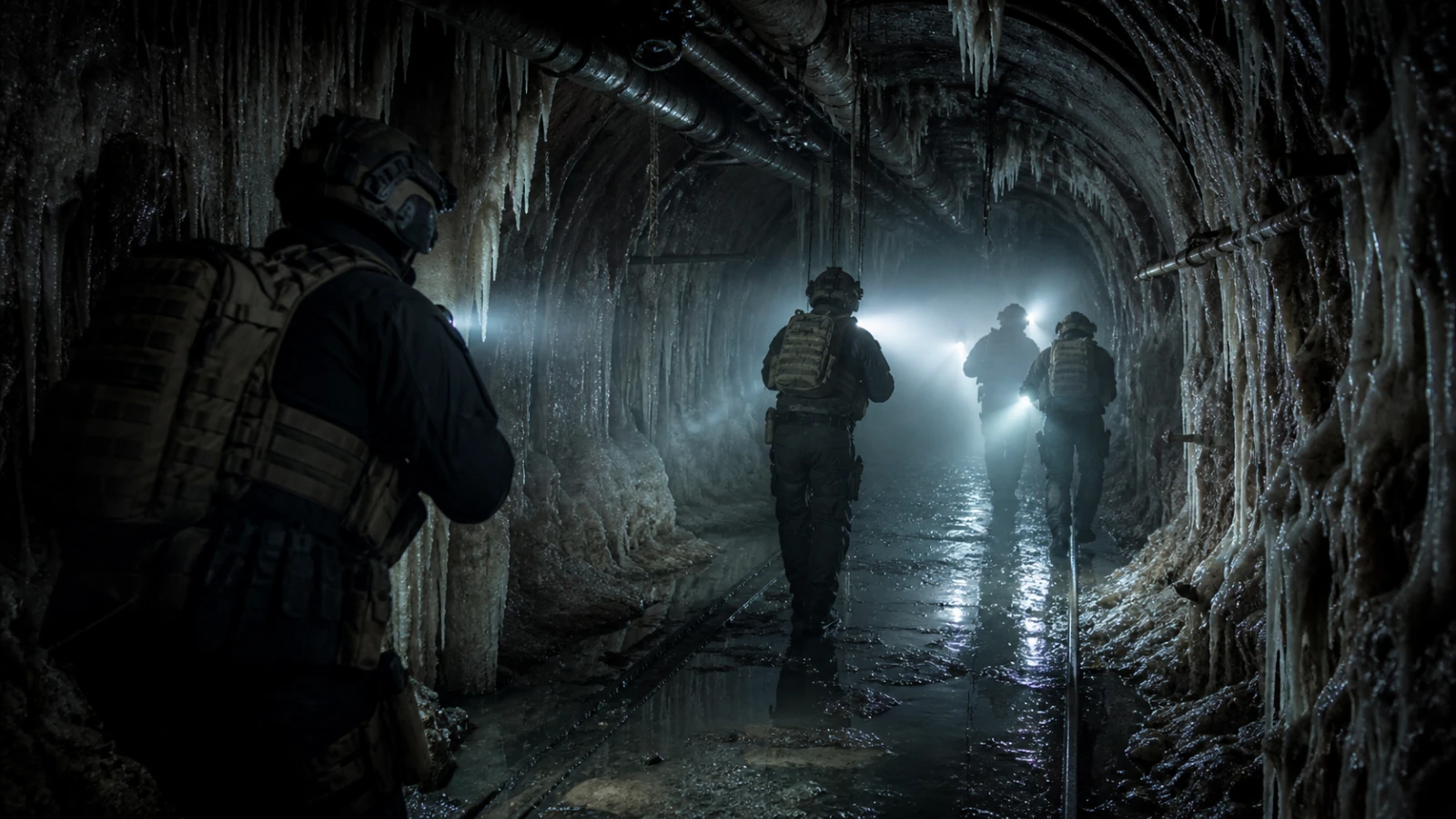
The short answer is yes, Team Ghost could survive a Xenomorph hive. The more honest answer is that survival would look nothing like one of their cleaner Variant missions. A hive strips away sightlines, punishes noise, turns every wall into threat space, and makes the act of killing dangerous because acid blood changes the geometry of a firefight. Team Ghost's discipline, command structure and experience against nests would give them a better chance than almost any ordinary military unit. But a Xenomorph hive is designed to erase assumptions, and that means the right question is not whether Ghost is brave enough. It is whether Ghost can adapt fast enough.
This comparison is a tactical thought experiment, not a fan-casting contest.
The goal is to examine whether the things that make Team Ghost effective in the Extinction Cycle would transfer into one of science fiction horror's most unforgiving environments:
- a confined hive
- uncertain enemy numbers
- restricted mobility
- compromised communication
- biological hazards
- constant ambush risk
Why Team Ghost Is the Right Unit for This Test
If you wanted to send one Extinction Cycle unit into a nightmare environment, Team Ghost would be the obvious choice.
That is not because they are superhuman.
It is because they have already been shaped by exactly the kinds of stresses that ruin less disciplined people:
- poor intelligence
- close-quarters violence
- unconventional enemies
- shifting mission goals
- biological uncertainty
- responsibility for civilians and scientists
- command disruption
From the first book onward, Team Ghost survives because it can keep thinking after the plan starts failing. Reed Beckham's version of the team is not the biggest force in the series. It is the force most comfortable living in the gap between perfect planning and reality.
That matters in a hive, because a hive is reality stripped of comfort.
What a Hive Does to Soldiers
Before judging Team Ghost, it helps to define the battlefield.
A Xenomorph hive is not just a place where monsters live.
It is a combat system.
The environment itself becomes part of the enemy advantage:
- narrow corridors
- organic walls and overhead surfaces
- uncertain entrances and exits
- choke points
- darkness and obscured visibility
- egg chambers or brood spaces
- limited fallback lanes
- noise and echo distortion
- constant risk of attack from ceilings and flanks
This is not a battlefield where conventional superiority automatically matters. A larger better-equipped force can actually perform worse than a smaller disciplined one if it cannot maintain sectors, spacing and fire control.
That is the first good sign for Team Ghost.
Team Ghost's First Advantage: Discipline
Many fictional squads die in a hive because they panic, overreact or stop functioning as a team.
Ghost's best trait is not marksmanship.
It is discipline.
Beckham's unit understands:
- sectors of fire
- movement intervals
- cross-coverage
- verbal economy
- what happens when one man chases a target alone
- what happens when a unit outruns its information
In a hive, those habits would matter immediately.
Ghost would not enter like tourists.
They would clear deliberately.
They would check ceiling lines.
They would secure the rear.
They would pause at intersections.
They would identify fallback routes instead of improvising them after contact.
That does not guarantee safety, but it sharply reduces the chance of catastrophic first-contact stupidity.
The Transfer Value of Variant Experience
Variants are not Xenomorphs.
That has to be said clearly.
Still, the Extinction Cycle teaches its fighters lessons that transfer surprisingly well into hive conditions.
1. Never assume the enemy occupies only floor space
Ghost has spent too much time in tunnels, ruins and contaminated urban terrain to think like a flat-range rifle team. Ceiling threat awareness would already be part of their mindset.
2. Nests are never only nests
Variant nests are not merely places where bodies pile up. They are spaces where the human understanding of terrain has already failed. That intuition would help Ghost treat the hive as a living danger rather than a location to be "checked off."
3. Sound and silence matter
Ghost understands listening discipline. In a hive, that becomes a survival multiplier.
4. Bad intelligence kills more teams than bad courage
Ghost has repeatedly lived through operations where the briefing was wrong. A hive operation would benefit from that suspicion. They would be less likely than a conventional unit to trust the first headcount.
So the transfer value is real.
But it is incomplete.
Variants never fully prepare them for what happens when the enemy's body itself creates a new hazard after the kill.
The Biggest New Problem: Acid Blood
This is where Team Ghost's learning curve becomes painful.
Against Variants, the problem with getting too close is usually physical danger from the enemy.
Against Xenomorphs, the problem continues after the hit lands.
Acid blood changes all the math.
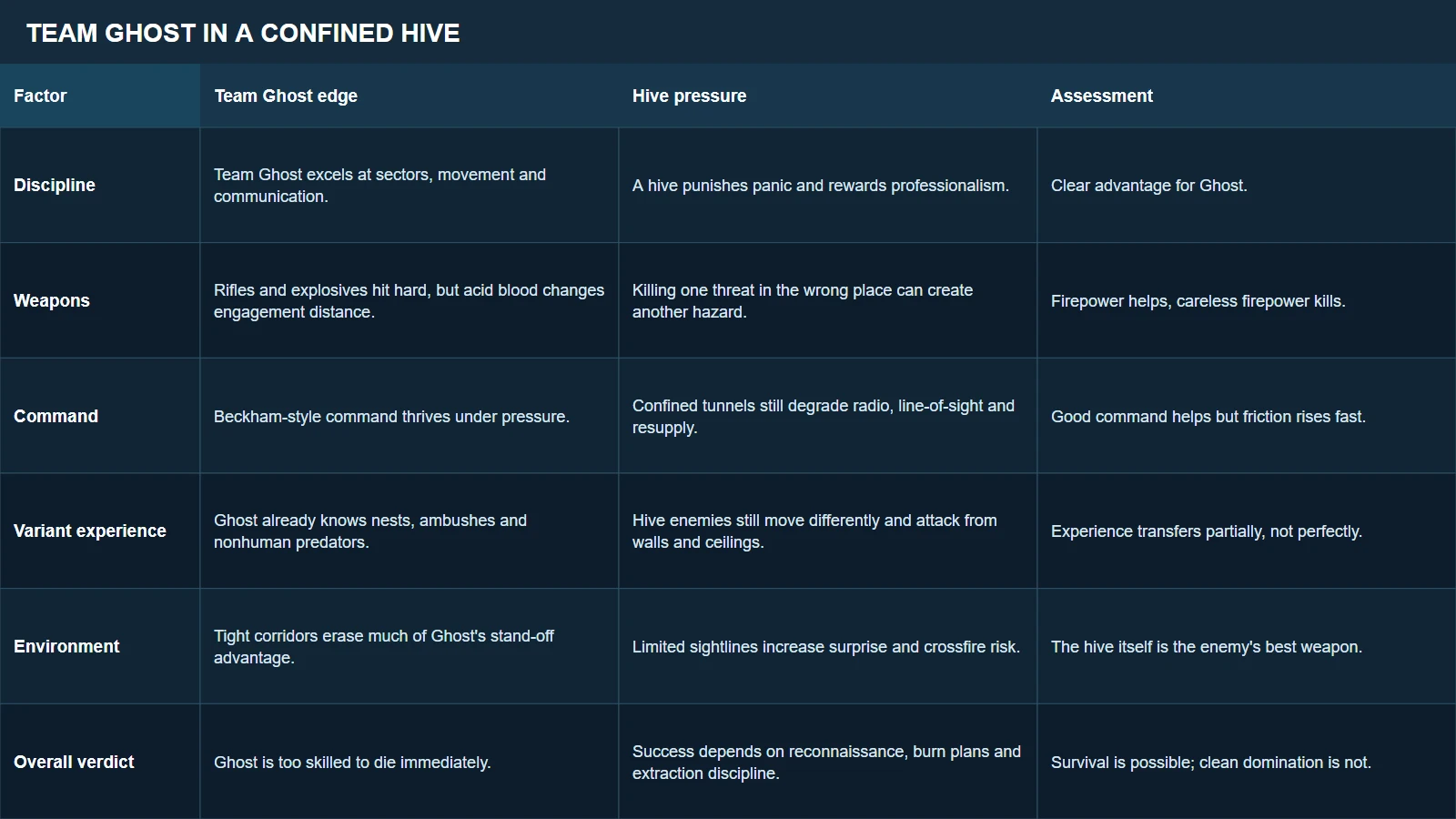
A room-entry kill at close range may open a path for the enemy and simultaneously destroy your own cover, splash the shooter, compromise boots or melt a line of retreat. A burst that would be tactically clean against a Variant can become tactically reckless inside a hive tunnel.
That means Team Ghost could not simply "do what it always does but harder."
It would have to alter:
- distance discipline
- ammunition selection
- preferred engagement lanes
- melee contingency
- casualty extraction
- breach methods
Ghost is adaptive enough to make these changes.
The cost is that early casualties become more likely before the lesson fully settles.
Weapons: Would Ghost's Firepower Transfer?
The answer is yes, but imperfectly.
Team Ghost routinely uses professional-grade military weapons, and a Xenomorph is not magically immune to being shot. In open areas, Ghost's precision, volume of fire and composure would be deadly.
The problem is not whether bullets work.
The problem is whether the environment allows the right kind of shooting.
Rifles
Useful, but only with careful lane discipline. Overpenetration, ricochet and acid splash matter more than raw stopping power.
Explosives
Situationally powerful, but extraordinarily risky in enclosed biological structures. A tool for shaping escape or denial zones, not a default answer.
Flamers or incendiaries
Potentially excellent if available. Fire gives stand-off value and may allow destruction of eggs or brood spaces without closing distance. But ventilation and backblast become concerns.
Shotguns or close-quarters options
Potentially dangerous if they encourage the wrong distance. In a hive, "effective" is not the same as "smart."
Ghost would therefore remain dangerous, but the hive would shrink the margin for tactical carelessness.
Command Structure: Beckham Would Matter More Than Raw Firepower
The decisive advantage Team Ghost brings is leadership under confusion.
Beckham is at his best when command has to stay human under inhuman pressure. He does not need a complete picture to act. He needs enough information to make the next correct choice and enough trust to keep his people moving together.
That profile is almost ideal for a hive mission.
Confined horror environments punish officers or NCOs who freeze while waiting for perfect data.
They reward leaders who can:
- simplify the problem
- establish immediate priorities
- preserve unit cohesion
- prevent lone-hero mistakes
- decide when the mission is no longer worth the body count
This last point matters most.
A major reason fictional squads die in hive stories is that they continue pursuing the wrong objective long after the environment has proven the objective was framed foolishly.
Beckham would be capable of saying, "We are not clearing the whole hive. We are retrieving, burning or exiting."
That kind of mission compression saves teams.
Would Team Ghost Keep the Right Mission?
This may be the hinge of the entire thought experiment.
A hive mission could be framed in several ways:
- rescue survivors
- gather biological intelligence
- kill a queen or command center
- destroy brood chambers
- open an extraction path
- simply survive contact and escape
Ghost is most likely to survive if the mission remains finite.
The moment the job becomes "clear the hive," odds crash.
A hive is the wrong place for sweeping certainty. It favors targeted, brutal, limited objectives. Ghost has the temperament for that kind of mission because so many of its best operations depend on a sharp distinction between winning the war and surviving this room.
Why the Hive Environment Still Favors the Enemy
Even if everything above is true, the hive remains a nightmare for six reasons.
1. Line of sight collapses
Ghost loses part of its stand-off advantage every time a corridor bends.
2. Verticality increases surprise
The team can check ceilings, but it cannot remove the risk completely.
3. Numbers are rarely known
A confident estimate is probably false.
4. Casualty extraction is slow
In tight terrain, one wounded operator can distort the movement of everyone else.
5. Noise is a trap
Every loud success risks becoming a beacon.
6. Rest does not exist
A hive is exhausting even without constant contact. Stress compounds fast.
These pressures do not make Team Ghost helpless.
They make any victory expensive.
How Ghost Would Adapt After First Contact
Assuming the team survives initial contact and learns quickly, several tactical adjustments are likely.
Burn, do not linger
If brood areas are identified, destruction would matter more than prolonged clearance.
Fight for corridors, not rooms
The team would prioritize controlling engagement lanes rather than chasing targets into complex side spaces.
Rear security becomes sacred
In a hive, the rear is never administrative. It is combat space.
Movement slows
Haste becomes bait.
Extraction criteria become stricter
A clean exit route matters more than an extra enemy body count.
Specimen capture becomes almost impossible to justify
This is a major difference from some Extinction Cycle missions. Against Variants, dangerous specimen logic can still make strategic sense. Inside a Xenomorph hive, the margin for capture operations is so poor that Ghost's best leadership would likely reject it unless national survival somehow depended on it.
Which Team Ghost Traits Would Fail to Transfer?
It is worth identifying the places where Ghost's normal strengths could become liabilities.
Confidence in aggression
Ghost often survives because it is willing to move decisively toward danger. In a hive, overconfidence in offensive momentum could drag the team into kill geometry.
Habit of pressuring the enemy after contact
A hive sometimes rewards breaking contact rather than exploiting contact.
Belief that firepower can stabilize uncertainty
Sometimes it can. Sometimes it only melts the place you were about to step.
Willingness to accept mission risk for bigger strategic gain
One of Team Ghost's nobler habits is also one of the most dangerous in hive combat. The higher command logic of "we need this badly enough to risk it" becomes very easy to abuse in a space this hostile.
Could the Team Actually Kill the Hive?
This depends on what "kill the hive" means.
If it means exterminate every organism room by room, the answer is probably no, not at acceptable cost.
If it means destroy the queen, the brood infrastructure, or the major reproductive center and then escape, the answer becomes more plausible.
Ghost does not need to dominate the environment to win.
It needs to sever the hive's continuity.
That distinction makes the mission survivable.
Casualty Expectations
A fair version of this comparison has to admit that Team Ghost probably takes losses.
The hive neutralizes too many advantages at once for a no-casualty fantasy to feel honest.
The most likely pattern looks something like this:
- strong initial discipline prevents total disaster
- first contact teaches the acid-blood lesson brutally
- Beckham or equivalent leadership compresses the mission
- the team adopts more conservative spacing and burn tactics
- objective is reduced to survival plus key strike or extraction
- one or more casualties are possible, maybe likely
- total wipe is avoided because the team refuses panic
That may not sound like a triumphant win.
Inside a hive, that is an impressive performance.
How Team Ghost Compares to Typical Hive Victims
The easiest way to appreciate Ghost's chance of survival is to compare them with the kinds of groups that usually fail in these scenarios:
- under-briefed corporate security
- arrogant paramilitary teams
- fragmented science expeditions
- groups with weak rear security
- units whose chain of command breaks at first contact
Ghost is better than all of those groups at all the things that matter most under nightmare pressure.
That is why the answer remains yes.
They could survive.
Just not comfortably.
The Extraction Problem
Hive stories are not won only by fighting well. They are won by leaving.
This matters enormously because Team Ghost is one of the few units in the Extinction Cycle that consistently thinks about extraction while still under pressure. Less experienced teams often treat extraction as the reward that follows success. Ghost understands that extraction is part of success.
In a hive, extraction would require:
- pre-marked route discipline
- redundancies in case the initial corridor is compromised
- clear casualty movement rules
- rear security that remains intact even after apparent success
- a willingness to abandon equipment if it preserves lives
This is also why Beckham's leadership would be so valuable. The leader has to decide when a mission has moved from "difficult but feasible" to "technically successful but strategically stupid to continue." Hive environments tempt units to chase momentum. The disciplined answer is often to leave sooner than pride prefers.
Which Team Members or Roles Matter Most?
The article does not need to lock itself to one exact roster to make a useful point. A Ghost-style team survives through roles.
Point man
Needs restraint as much as courage. The point man in a hive cannot chase every flicker of movement.
Rear security
Possibly the most important role after first contact. In a three-dimensional threat environment, the rear is where confidence goes to die.
Comms and navigation
A hive degrades orientation quickly. Any operator who keeps the team grounded in direction, timing and route memory becomes essential.
Demolitions or burn-capable operator
If the mission includes brood denial, this role may determine whether the operation actually changes the battlefield.
Medic
The medic in a hive is under a double burden. He has to treat trauma while also respecting acid hazard, contamination and the fact that every casualty slows everyone else.
Thinking in roles rather than personalities highlights the central point: Team Ghost is better suited to this environment than most crossover squads because its culture respects interdependence.
Best-Case and Worst-Case Mission Framing
Best case
Ghost enters for rescue, targeted destruction or extraction of trapped personnel. The team gets enough early warning to learn the acid lesson before catastrophic losses. Beckham narrows the objective, uses burn options and withdraws as soon as the key task is complete.
Worst case
Higher command wants a specimen. The team is told the hive is smaller than it is. Ghost presses too deep, kills effectively but in poor geometry, loses movement lanes and has to fight on the way back with one or more casualties. That is the scenario where the hive turns professional excellence into attrition.
Could Team Ghost Work With Scientists in This Environment?
Extinction Cycle teams often operate alongside or because of science priorities. In a hive, that relationship becomes even more dangerous. Scientists may be useful for understanding life cycles, brood behavior or environmental vulnerabilities. They can also distort the mission if curiosity outruns survivability.
Ghost's best chance comes when the science agenda stays subordinate to operator reality. The moment the mission becomes "just go a little deeper" because a specimen or observation opportunity appears, the hive starts controlling the human chain of command.
The Psychological Pressure of a Hive
The hive is not only dangerous because of claws, ambushes or acidic fluid. It is dangerous because it attacks the unit's mental rhythm. Good teams survive by keeping a predictable cycle of observe, communicate, move and cover. A hive keeps breaking that cycle. Sounds echo strangely. Distances become hard to judge. Every bend promises a new contact point. The team never gets the emotional reset that a normal exterior battlefield can provide.
This matters because Team Ghost's professionalism includes psychological control. They are better than most squads at remaining functional when the environment becomes unnerving. They do not need to feel comfortable to stay lethal. Still, even for them, the hive would create decision fatigue. The longer they remain inside, the more every small error compounds.
Would Variants Ever Be Harder Than the Hive?
There is a fair counterpoint here. Some late-stage Variant environments can become so unpredictable and biologically hostile that they rival the hive in pure stress. That comparison actually strengthens the argument for Team Ghost. If there is any human unit from the Extinction Cycle capable of looking at an impossible nonhuman battlespace and finding a way through it, it is the one that has already been tested by repeated encounters with nests, tunnels and enemy evolution.
The conclusion remains the same. Ghost is not automatically superior to the hive. It is simply one of the only teams prepared enough to make survival plausible.
Final Verdict
Could Team Ghost survive a Xenomorph hive?
Yes.
Could Team Ghost clear a hive the way it clears a known Variant nest?
No.
That distinction is the heart of the crossover.
Ghost's discipline, sector awareness, command structure, willingness to adapt and hard-earned experience in contaminated kill spaces would make it one of the few Extinction Cycle units with a believable chance of getting in and getting out.
But the hive would strip away easy heroism. Acid blood changes basic shooting discipline. Confined tunnels erase standoff comfort. Unknown numbers and vertical ambushes punish every mistake. The enemy does not have to beat Ghost in a fair stand-up fight because the environment is already unfair.
The result is a clear but qualified judgment:
Team Ghost could survive a hive if it keeps the mission narrow, adapts to acid-blood reality, and prioritizes extraction over domination.
If it tries to own the whole maze, the hive eventually wins.
FAQ
Would Team Ghost be better than a normal marine squad in a hive?
Yes. Their experience against unconventional predators and their superior discipline would give them a clear edge.
What is the biggest thing Ghost would need to learn?
Acid blood changes how close you can afford to be when you kill the enemy.
Would Beckham be a good hive commander?
Yes. His strength is leadership under uncertainty, which is exactly what hive combat requires.
Do Variant nests really prepare them for hive combat?
Partially. Nests, tunnels and ambush awareness transfer. Xenomorph biology and acid hazards do not.
Could Team Ghost clear the entire hive?
Probably not without unacceptable losses. A limited strike or extraction mission is far more realistic.
What would be the best Ghost tactic?
Short objective, disciplined sectors, burn options, rear security and fast extraction once the key task is complete.
Editorial note
Page imagery for this article is intentionally generic. It evokes adult tactical movement in an alien hive-like environment without reproducing franchise character art or recognizable film stills.