
Who governs knowledge when survival is at stake?
3 Body Problem vs. Extinction Cycle: Who Controls Science During an Existential Crisis?
Compare 3 Body Problem and Extinction Cycle through classified science, strategic secrecy, scientific autonomy, public trust, and existential risk.
·
Category: Analysis and Opinion

Introduction: Science Becomes a Battlefield
Science in ordinary times is already entangled with politics, funding, institutions, and power. In an existential crisis, that entanglement becomes impossible to ignore. 3 Body Problem and Extinction Cycle both imagine moments when scientific knowledge is no longer merely a public good or intellectual pursuit. It becomes strategic terrain. Research agendas can determine whether the species survives. Scientists can become targets, assets, dissidents, or instruments of state power. Leaders begin asking not simply what is true, but who is allowed to know it and how fast it can be turned into advantage.
That makes Kate Lovato and the scientific world of Extinction Cycle a strong comparison with the scientists and strategic leaders preparing for the San-Ti in 3 Body Problem. The scale and timeline are almost opposites. The Extinction Cycle catastrophe develops at emergency speed. There is no century for peer review, political debate, or gradual institution-building. The Hemorrhage Virus and Variants force people to make scientific decisions while cities are falling. In 3 Body Problem, the alien threat introduces a much longer strategic horizon. Humanity has time, but that time creates its own dangers: bureaucracy, ideology, secrecy, factionalism, scientific despair, and the temptation to control knowledge centrally for generations.
The current Netflix hook makes the comparison especially timely. Netflix announced in November 2025 that Season 2 had begun production in Budapest after the series was renewed through Season 3. The company's own framing emphasizes that the story grows larger and more cosmic as it moves forward. That expansion fits the central question of this article: the bigger the threat becomes, the more dangerous it is to assume that one institution should monopolize the scientific response.
Who should control science when extinction is on the table? Scientists themselves? Military planners? Democratic governments? Intelligence agencies? Some emergency coalition? Both franchises suggest the same unsettling answer: no one group is trustworthy enough to control it alone.
Immediate Crisis vs. Four-Century Crisis
Time changes governance. A threat arriving tomorrow creates one kind of authority. A threat arriving centuries from now creates another. This is one of the largest differences between the two franchises and one of the most useful.
Extinction Cycle science operates under compression. Kate Lovato and other researchers have to move from observation to intervention with almost no margin. Soldiers are dying, bases are failing, and incomplete information becomes operationally lethal. The normal safeguards around research do not vanish morally, but they become difficult to preserve procedurally. This is why the series is full of ethically dangerous shortcuts, classified decisions, and countermeasure work that carries enormous consequences.
3 Body Problem gives humanity something that looks like an advantage: time. The San-Ti are not an infected wave crossing a city by nightfall. Humanity can imagine research programs lasting generations. But time creates institutional temptation. Leaders may construct long-term strategic monopolies. Scientific fields may be prioritized or suppressed according to defense logic. Decisions made by one political generation can bind people who are not born yet. Long horizons create the possibility of planning and the danger of bureaucratic destiny.
The comparison reveals that neither short nor long time horizons solve the control problem. Emergency speed can justify reckless concentration of authority. Long preparation can justify permanent concentration of authority. In both cases, the threat becomes a reason to suspend ordinary pluralism.
The better model has to recognize that urgency changes procedure without erasing legitimacy. A society may need emergency coordination, but it also needs mechanisms for challenge, revision, and accountability. The longer the crisis lasts, the more important those mechanisms become.
Kate Lovato and the Scientist Who Cannot Stay Outside the War
Kate Lovato is compelling because she does not occupy a safe moral space outside military crisis. Her scientific work becomes part of the war whether she wants it to or not. Specimens must be captured. Countermeasures must be tested. Commanders want usable answers before the evidence is complete. Political leaders need the public to believe someone understands what is happening. The scientist becomes part researcher, part adviser, part strategic asset.
This is exactly where Extinction Cycle rejects the fantasy that science remains independent simply because scientists value truth. Institutions around the lab still control access, security, funding, samples, transport, and deployment. Kate may preserve personal integrity, but she works inside systems that can turn knowledge into force.
3 Body Problem takes this relationship and stretches it across a global strategic framework. Scientists become central not just because they may discover one cure or one countermeasure, but because the future balance between civilizations may depend on the direction of entire fields. The scientist becomes part of a species-level defense industrial base.
The danger is obvious. Once scientists are treated primarily as strategic assets, their autonomy narrows. Research that does not serve the immediate plan can be dismissed as irrelevant. Dissent can look like sabotage. Uncertainty can look like weakness. Political leaders may begin to prefer compliant science over accurate science.
Kate's example suggests the opposite principle. The scientist is most valuable when she can tell power what power does not want to hear. A research system designed only to confirm strategy is not scientific support. It is strategic theater.
Classified Research and the Logic of Building 8
Building 8 is one of the clearest warnings in the Extinction Cycle universe about the control of science. The danger is not merely that secret research exists. Some research genuinely requires security. The danger is that secrecy narrows the circle of accountability while increasing the stakes of error.
When projects are classified, outside criticism weakens. Ethical oversight can become internal. Leaders may frame disclosure as a security risk even when disclosure would reveal a scientific problem. Compartmentalization means no one actor holds the full picture. In a normal program, that can create inefficiency. In a species-level crisis, it can create catastrophe.
3 Body Problem operates in a world where secrecy may genuinely protect strategy from an adversary capable of learning from humanity. That makes the issue more difficult. Full transparency can be dangerous too. A society preparing for the San-Ti cannot simply publish every strategic intention and assume openness is always virtuous.
The key distinction is between operational secrecy and institutional secrecy. Operational secrecy protects a specific plan. Institutional secrecy protects an institution from scrutiny. The first may be necessary. The second is where abuse grows.
Extinction Cycle repeatedly demonstrates the cost of institutions protecting themselves with national-security logic. The 3 Body Problem setting demonstrates why some secrets may still be necessary. Put together, they argue for a controlled transparency model: protect tactical details, expose governance structures, preserve independent oversight, and make sure no classified program can become its own moral universe.
Who Sets Research Priorities?
An existential crisis creates scarcity even when time is abundant. There are never enough researchers, facilities, resources, or political attention to pursue every possible line of work equally. Someone has to set priorities. That someone gains enormous power.
In Extinction Cycle, research priorities are shaped by immediate survival. Anything that can help understand or defeat Variants becomes valuable. This makes sense, but it also creates tunnel vision. Work that does not have immediate operational payoff may be neglected, and the same institutions that caused the crisis can influence the science intended to solve it.
In 3 Body Problem, prioritization can happen at civilization scale. Which branches of physics, engineering, computing, or space technology receive investment? Which programs are treated as strategic dead ends? What happens to curiosity-driven science when every major decision is filtered through an invasion horizon?
The danger is that a species facing extinction can accidentally turn all science into applied defense work. That may feel rational, yet it damages the very scientific culture needed for unexpected breakthroughs. History repeatedly shows that useful knowledge often emerges from questions that were not originally asked for strategic reasons.
A robust response therefore needs portfolio thinking. Some science must be directed toward urgent countermeasures. Some must remain open, decentralized, and protected from short-term political demands. The species needs both mission science and exploratory science. Giving total priority power to generals risks stagnation. Giving total power to researchers risks strategic incoherence. The crisis requires coordination without intellectual capture.
Public Trust, Scientific Trust, and the Cost of Manipulation
Science does not operate only in laboratories. It operates inside public belief. That matters enormously during existential crisis because the population is asked to accept difficult sacrifices based on claims it cannot independently verify.
Extinction Cycle shows what happens when trust is already damaged by secrecy. People can reasonably wonder what leaders knew, what researchers were doing, and whether official explanations are complete. Even good scientists inherit the credibility damage caused by bad institutions.
3 Body Problem adds a different trust problem. The threat is so vast and so temporally distant that many present-day sacrifices may feel abstract. Governments can ask people to accept policies justified by dangers no living citizen will personally witness. That creates ideal conditions for conspiracy, nihilism, factionalism, and political manipulation.
The solution is not naive transparency. It is trustworthy process. Citizens do not need access to every classified formula to know who has authority, how that authority is reviewed, what ethical rules apply, and whether independent experts can challenge official conclusions.
This is where scientific governance becomes inseparable from democracy. A society can survive a period of uncertainty if it believes the institutions managing uncertainty are honest about what they do not know. It becomes brittle when leaders manufacture certainty to keep control.
Both franchises suggest that public trust is not soft infrastructure. It is part of the survival architecture.
The Military's Role: Protection, Coordination, or Capture?
The military is indispensable in Extinction Cycle because the threat is immediate, violent, and territorial. Scientists need secure labs, specimens, transport, and protection. Civilians need evacuation and perimeter defense. The armed response is not optional.
That does not mean the military should control the scientific system. Military institutions are designed to generate action under command. Science is designed to generate provisional knowledge through challenge and revision. The cultures overlap in discipline but diverge in how they treat uncertainty.
A command structure can be tempted to ask, 'What answer do we need to act?' A scientist must ask, 'What answer does the evidence support?' Those questions are not always the same.
3 Body Problem raises the stakes because strategic defense may stretch across generations. If military or intelligence leaders dominate science for centuries, science itself risks becoming an arm of a permanent security state.
The more defensible model is partnership with boundaries. Military institutions should define operational needs, protect infrastructure, and coordinate emergency deployment. Scientific institutions should retain authority over method, uncertainty, and peer challenge. Civilian political institutions should define the ethical and legal boundaries around both.
No one corner of that triangle should be trusted with permanent supremacy.
Sacrifice Today for a Threat Tomorrow
The San-Ti threat creates one of the hardest ethical features in this comparison: people living today may be asked to sacrifice for people centuries in the future. That is the inverse of Extinction Cycle, where people die today because the threat is already inside the room.
Immediate crisis makes sacrifice emotionally legible. You can see who is being protected. Long- horizon crisis creates moral distance. A government can justify enormous investments, secrecy, surveillance, or restrictions by appealing to descendants who cannot consent.
This is where democratic legitimacy matters most. The further the threat lies from ordinary experience, the more careful leaders must be about converting strategic forecasting into permanent political authority.
Extinction Cycle provides a useful warning because emergency measures tend to normalize themselves. Structures built for one crisis can survive into reconstruction. A centuries-long existential preparation would magnify that tendency beyond anything Dark Age imagines.
A civilization preparing for the San-Ti therefore needs sunset mechanisms, generational review, institutional pluralism, and a culture willing to revise strategy. Otherwise the defense of humanity can become a civilization-scale justification for freezing political life around one strategic mission.
Who Should Control Science?
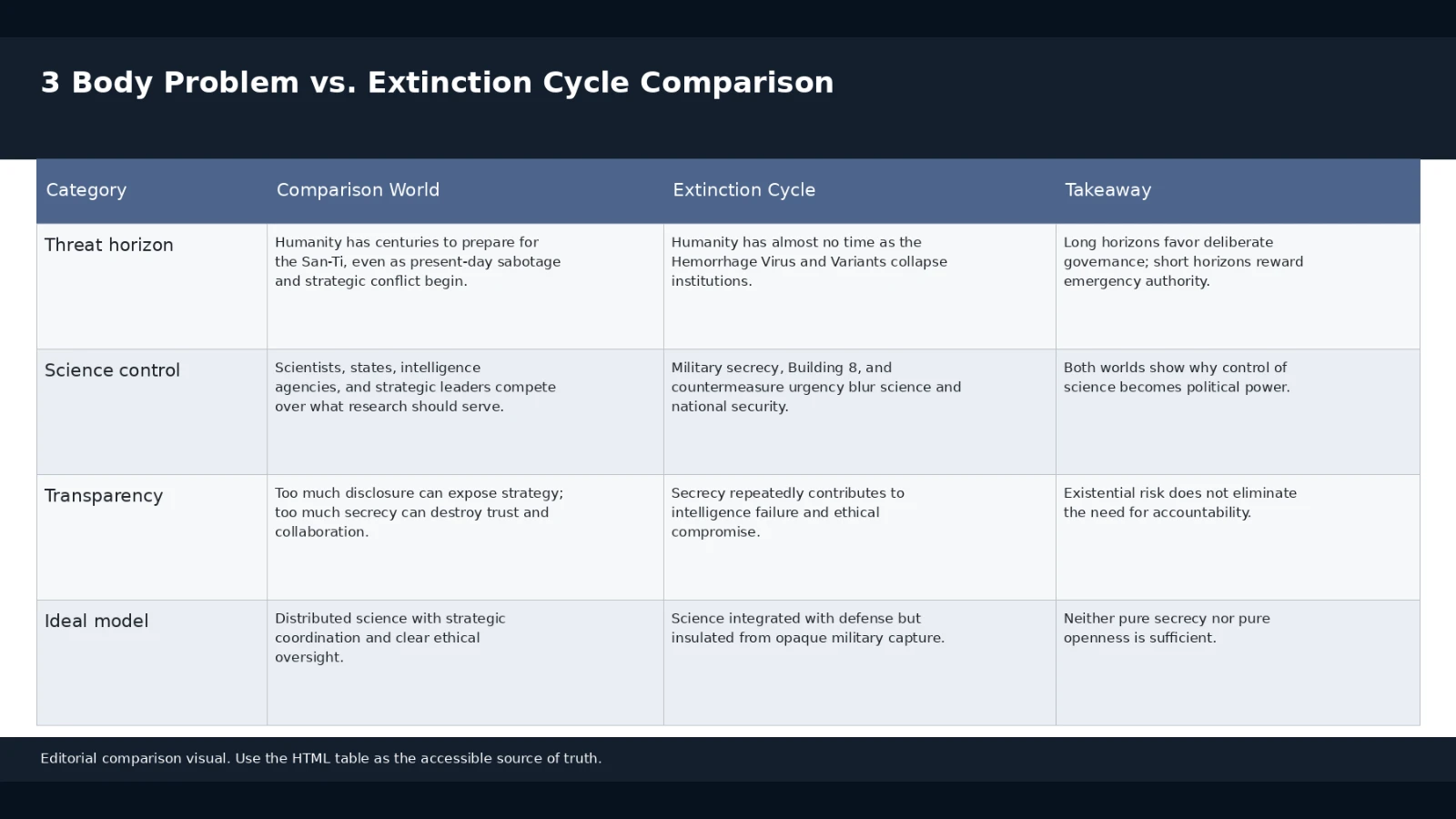
The best answer is deliberately unsatisfying: science during an existential crisis should be coordinated, not owned.
Scientists alone cannot decide military strategy, resource allocation, or public sacrifice. Generals alone cannot decide what is scientifically true. Intelligence agencies alone cannot decide what knowledge society is allowed to possess. Politicians alone cannot decide which hypotheses deserve survival.
Control should therefore be distributed.
Scientists control method, evidence standards, and honest uncertainty. Strategic leaders coordinate objectives and protect critical infrastructure. Civilian political institutions set ethical boundaries and maintain legitimacy. Independent oversight bodies examine classified programs without requiring full public disclosure. International or interregional networks reduce the danger that one institution becomes the single point of scientific failure.
This model is slower than dictatorship. That is a feature, not a bug, as long as emergency procedures exist for immediate danger. The species needs the ability to act quickly without turning temporary necessity into permanent monopoly.
Extinction Cycle shows the cost of too much secrecy and military capture. 3 Body Problem shows why total openness may also be strategically irresponsible. The answer lies between them.
Final Verdict: Survival Needs Science That Can Say No
The comparison between 3 Body Problem and Extinction Cycle ultimately leads to a simple principle: the most valuable science in an existential crisis is science that remains capable of saying no.
No to unsupported certainty. No to politically convenient conclusions. No to turning every laboratory into a weapons program. No to sacrificing ethical oversight because the threat is large. No to assuming that secrecy is the same thing as security.
At the same time, science must remain capable of action. It cannot retreat into purity while soldiers, civilians, and future generations carry the cost of indecision. Kate Lovato's best moments come from this tension. She is valuable because she acts without pretending action is morally clean.
The San-Ti crisis magnifies the same problem across centuries. Humanity needs coordinated research, but it also needs to remain a civilization worth saving by the time the threat arrives.
That is the strongest lesson both franchises offer. Science should not belong to the military, the state, the laboratory, or the public alone. It should belong to a system of distributed responsibility strong enough to move fast and humble enough to be corrected.
FAQ
Who should control science during an existential crisis?
No single institution should own it. Scientists should retain authority over evidence and method, strategic leaders should coordinate operational needs, civilian institutions should set ethical limits, and independent oversight should remain able to challenge classified programs.
Why compare a four-century threat with an immediate outbreak?
The opposite timelines expose the same governance danger. Emergency speed can concentrate authority quickly, while a long threat horizon can normalize concentrated authority across generations.
Is this a canon crossover?
No. It is independent fan criticism comparing science and governance in two separate fictional worlds.
Source note
Netflix's official material confirms that the San-Ti arrival horizon is roughly four hundred years, that humanity is organizing a response to an existential threat, and that Season 2 entered production in Budapest in November 2025 after renewal through Season 3. Extinction Cycle claims are checked against current Building 8, VX-99, Kate Lovato, countermeasure, and scientific-secrecy records.
Editorial note
This independent fan analysis uses original generic artwork and a submitted editorial comparison chart. It does not reproduce official franchise images, actor likenesses, logos, or claim a canon crossover.
Recommended next pages
Source and canon pack
- Canon treatment
- Official Netflix material establishes the San-Ti threat horizon, humanity-scale response, and current series status. Building 8, Kate Lovato, and scientific-secrecy claims follow local records; the governance model remains editorial analysis.
- Primary wiki source plan
- Building 8, VX-99, Kate Lovato, countermeasure, military-command, and science-ethics records provide the Extinction Cycle baseline.
- Spoiler scope
- Broad science-governance and threat-premise spoilers without recapping character outcomes or later-book resolutions.
- Safety boundary
- Independent transformative fan criticism. No official 3 Body Problem imagery, actors, characters, show-specific technology, screenshots, logos, real policy instruction, or claim of canon crossover is published.
- Program article ID
- EC-40
- Scheduled publication
- 2026-08-26T18:51:00-04:00