
Rage Virus versus Hemorrhage Virus
28 Days Later vs Extinction Cycle
Compare the Rage Virus and Extinction Cycle’s Hemorrhage Virus by speed, transmission, containment, military response, evolution, quarantine, and rebuilding.
·
Category: Analysis and Opinion
Both franchises helped define the modern "fast infected" nightmare, and both insist on an important point: the enemy is alive. But the Rage Virus and the fictional Hemorrhage Virus produce very different apocalypse systems. The 28 films are built around explosive aggression, quarantine failure and the fragility of ordinary civilization. The Extinction Cycle adds a military-super-soldier history, engineered countermeasures, long-term Variant evolution, special-operations warfare and eventually a rebuilt nation fighting a second extinction war.
This comparison uses 28 Days Later and 28 Years Later as the main reference points.
28 Weeks Later is relevant background to the franchise's military-containment history, but it is not treated as the primary text here.
Sony's official synopsis for 28 Days Later describes infected chimpanzees carrying a deadly virus that drives victims into murderous rage and nearly wipes out the population in the days after release.
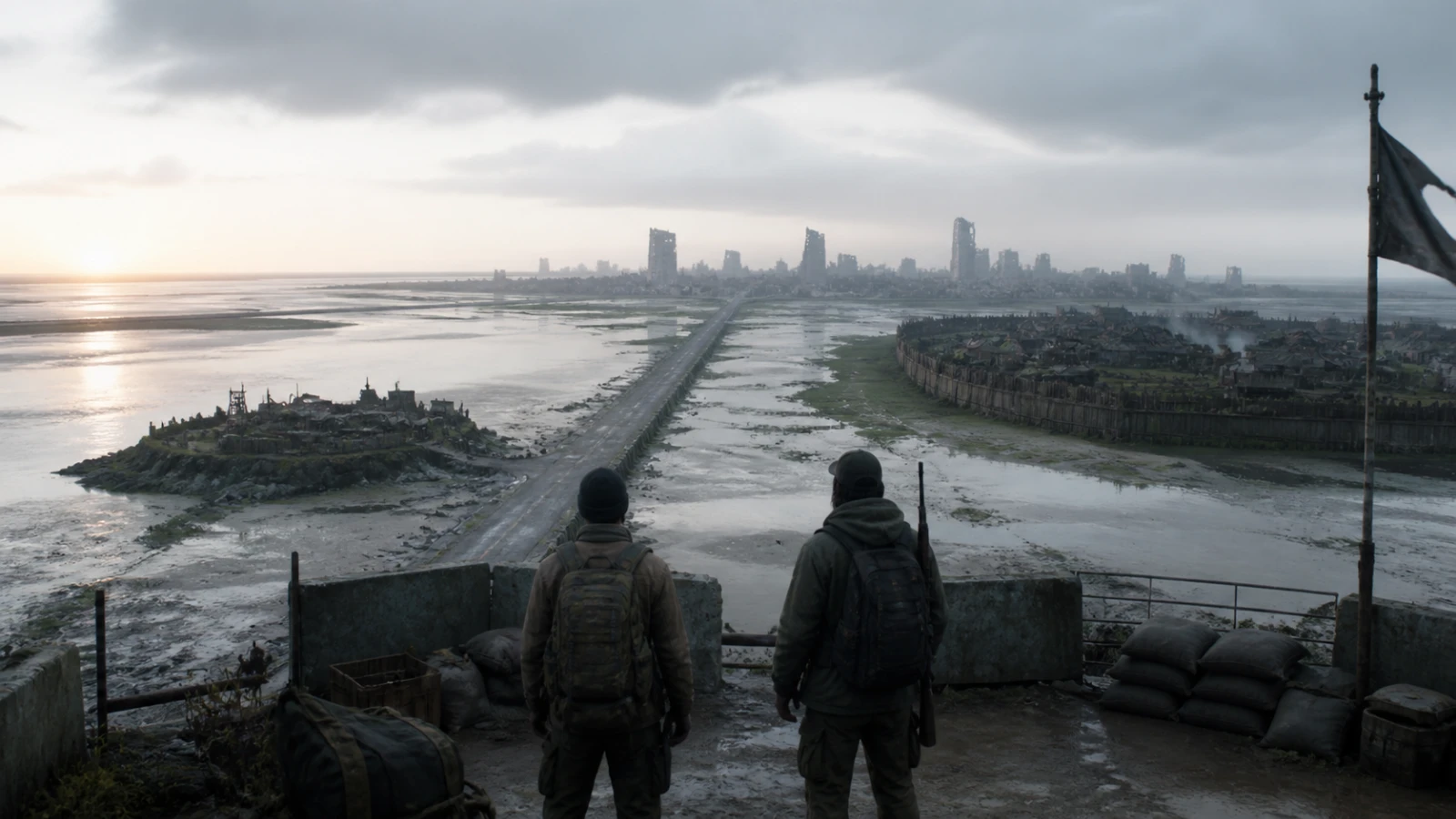
Sony's 28 Years Later synopsis gives the long-term frame: almost three decades after the Rage Virus escaped a biological weapons laboratory, the area remains under ruthlessly enforced quarantine. Some survivors have built communities, including a small island connected to the mainland by a heavily defended causeway. The film also states that the long isolation has changed both infected and survivors.
That is enough to create a fascinating contrast with Dark Age.
Both worlds survive for decades.
Only one rebuilds something like a nation.
First Similarity: They Are Not Undead
The most important shared trait is easy to miss because both franchises are routinely grouped with zombie fiction.
The Rage infected are living humans.
The Variants are living transformed humans.
Neither system depends on corpses reanimating after death in the classic Romero sense.
That difference changes the emotional and tactical logic.
A living infected person has metabolism.
They can starve.
They can suffer physiological damage.
Their bodies are still biological systems even when behavior has become catastrophic.
That gives both stories a different relationship to cure, containment and time than World War Z.
The Rage Virus Is a Behavioral Catastrophe
The original 28 Days Later concept is terrifying because it is simple.
The virus does not need to redesign humanity into a new species.
It turns living people into engines of rage.
The infected sprint.
They attack.
They transmit.
The speed of social collapse comes from the fact that one ordinary human body can become an immediate violent threat to everyone nearby.
The films portray the transition as extremely fast.
No official exact number is necessary unless a cited film source supplies it. The important comparison is "near-immediate in dramatic terms," not whether a fan estimate says twenty seconds or thirty.
The Hemorrhage Virus Is a Transformation System
The Extinction Cycle's fictional biology is more elaborate.
The modern catastrophe combines the Hemorrhage Virus with the legacy of VX-99, a fictional Vietnam-era military program.
The result is not only behavioral.
Bodies change.
Senses change.
Physical capability changes.
Later generations and forms change further.
The Variants eventually become a biological lineage rather than one repeating infected state.
That is the central difference between the two outbreaks.
Rage infection makes humans catastrophically aggressive.
Extinction Cycle infection creates a platform for continued post-human evolution.
Transformation Speed: Rage Wins the First Minute
If the question is which infection is more terrifying in the first moments after exposure, Rage has the cleaner advantage.
The visual language of 28 Days Later is built on the terror that the person beside you can become a violent threat almost immediately.
There is almost no emotional processing window.
The practical consequence is that trust collapses with transmission.
A bite or contaminated fluid exposure is not merely a future medical problem.
It becomes a present group-survival crisis.
The Extinction Cycle also depicts rapid catastrophic infection, but the franchise invests more storytelling energy in what comes after the first stage.
Variants heal.
Adapt.
Produce new forms.
Organize.
The Rage world wins the speed shock.
The Variant world wins the longevity of escalation.
Transmission: Both Are Close-Exposure Nightmares, but the Story Logic Differs
The 28 films repeatedly use blood and direct exposure as transmission engines.
The franchise does not need an elaborate epidemiological explanation.
The audience understands the rule through scenes: infected fluid reaching another person's vulnerable tissue can turn a safe room into a crisis.
That makes barriers and quarantine intuitive.
The Extinction Cycle deliberately builds a more militarized bioweapon scenario.
The Hemorrhage Virus is fictional, engineered and linked to a classified research history.
Its spread becomes global fast enough that government and military systems are overwhelmed before countermeasures can catch up.
The result is a different containment problem.
The Rage world can imagine a geographic quarantine.
The Extinction Cycle quickly loses the luxury of one infected territory.
Containment Failure
28 Days Later
The first film shows a country effectively emptied by a rapid outbreak.
The later franchise preserves the idea that containment is geographic.
Britain becomes a quarantined space.
That does not mean the response is successful in human terms.
It means the infection can be conceptualized as something inside a boundary.
28 Years Later
The quarantine still exists almost three decades later.
That is extraordinary.
It means the outside world has maintained enough state capacity to preserve separation.
Inside the quarantined territory, however, civilization has not returned at national scale.
Survivors find local solutions.
The island community is one.
Its causeway is defensible because geography does part of the work.
Extinction Cycle
There is no comparable national quarantine success.
The outbreak becomes worldwide.
The response therefore changes from containment to war.
That is why Team Ghost, Plum Island, the George Washington, Raven Rock, European forces and later Allied States outposts all matter.
Humanity cannot simply keep the disease "over there."
It has to survive in the same world as the Variants.
The Infected Themselves
Rage infected
The Rage infected are terrifying because they retain human speed and physical immediacy without normal restraint.
Their violence is the weapon.
They do not need a master plan to collapse a crowded society.
Put enough rapidly transforming aggressive people in transportation hubs, streets and homes and normal life becomes impossible.
Variants
Variants become hunters.
The distinction grows over time.
They climb.
Track.
Use darkness.
Exploit tunnels.
Develop leadership.
Dark Age pushes the concept further into organized command and post-human political structure.
The difference is the difference between uncontrolled violent infection and emergent enemy civilization.
Which Is Harder for Soldiers?
The answer changes by phase.
Initial contact: Rage
A military or police unit surprised by near-instant conversion inside a crowd faces an extremely dangerous identification problem.
Anyone close to the exposure can become a threat before a formal chain of command processes what happened.
Sustained campaign: Variants
Once soldiers understand Rage behavior, the enemy remains comparatively direct.
Variants become harder over time because the threat model keeps changing.
The tactics that work against an adult Variant may fail against a juvenile form or a later Alpha.
The Dark Age enemy can also coordinate and exploit human collaborators.
For sustained military operations, Variants are the more complex enemy.
Military Institutions in the Two Worlds
The 28 franchise is fascinated by the failure of the military to become a moral substitute for civilization.
Soldiers can have guns, walls and orders while still becoming part of the danger.
That theme appears early and continues into the broader franchise.
28 Years Later shifts the focus toward communities that have survived around rather than inside a restored national state.
The Extinction Cycle treats surviving military institutions more positively, while still criticizing secrecy and bad command.
Team Ghost is often the reason civilians and scientists survive.
Ringgold's government is flawed but necessary.
The Allied States eventually turns military survival into civil reconstruction.
This is one of the biggest thematic differences.
The 28 world distrusts the idea that a military structure equals recovery.
The Extinction Cycle argues that military continuity can become one component of recovery if it is joined to legitimate government and civilian life.
The Island vs the Outpost
The survivor island in 28 Years Later and the Allied States outposts make an excellent comparison because both use walls, controlled access and geographic logic.
They are not equivalent.
The 28 Years Later island
Its strength is separation.
A causeway limits access.
The sea provides natural defense.
The community can control contact with the mainland.
The model is local.
The Allied States outpost
Its strength is network membership.
An outpost may grow food, move refugees, support science, defend a corridor, anchor government or participate in trade.
The wall is important.
The network is more important.
That difference explains why the Extinction Cycle world can rebuild a country while the 28 world remains fragmented.
Why 28 Years Later Is More Interesting After Dark Age
Before Dark Age, a comparison would have been simple.
Two fast-infected catastrophes.
Military failure.
Survivors.
After Dark Age, the more interesting comparison is historical time.
Both universes ask what happens decades after the initial shock.
The answers are different.
The Allied States rebuilds institutions and then becomes complacent.
The 28 world preserves survival pockets inside a long quarantine and develops cultures shaped by isolation.
One world reconstructs and risks forgetting.
The other survives locally and risks never reconstructing.
Mutation and Evolution
Sony's official 28 Years Later description says the long period has mutated not only the infected but other survivors.
That expands the Rage Virus concept beyond the first movie's relatively uniform infected.
Still, the franchise's long-term biological system remains less elaborate than the Extinction Cycle's.
Variant evolution is one of the main plot engines across the novels.
The human side studies it.
Names it.
Builds missions around it.
Creates countermeasures that alter selection.
Dark Age eventually turns biology into infrastructure through the webbing network.
The 28 world has mutation.
The Extinction Cycle has an evolutionary arms race.
Science and Countermeasures
This may be the largest strategic gap between the worlds.
The original 28 Days Later is not a story about scientists building a cure.
It is about surviving social collapse.
28 Years Later expands the long-term world and later franchise material deepens scientific interest, but the central survival method remains separation, adaptation and local community.
The Extinction Cycle gives science a front-line role from the beginning.
Kate Lovato's work directly changes military plans.
Countermeasures kill infected populations.
New treatments target Variant biology.
Later researchers attack communication systems.
If both worlds received the same scientific infrastructure, the Rage outbreak may be the easier problem to study because the infected state is less evolutionarily complex.
Could the Rage World Rebuild?
Yes.
The existence of a long-lived island community already proves stable human organization is possible.
The harder question is scale.
The 28 Years setting, as presented by Sony, remains a quarantined landscape with isolated groups surviving among the infected.
That is not the same thing as restored national logistics.
To rebuild further, communities would need:
- secure transport corridors
- reliable food surplus
- communication between settlements
- medical systems
- political trust
- energy and manufacturing
- a workable policy toward the mainland
The Extinction Cycle's Allied States demonstrates exactly that list.
Could the Extinction Cycle Use the Island Strategy?
Absolutely.
In fact, the broader universe repeatedly uses islands and coastal refuge concepts.
The problem is that Variants keep undermining assumptions about natural barriers.
Aquatic adaptation and intelligent infiltration make isolation less permanent.
The Rage world benefits more from simple separation because the infected are less organizationally sophisticated.
Which Outbreak Is More Containable?
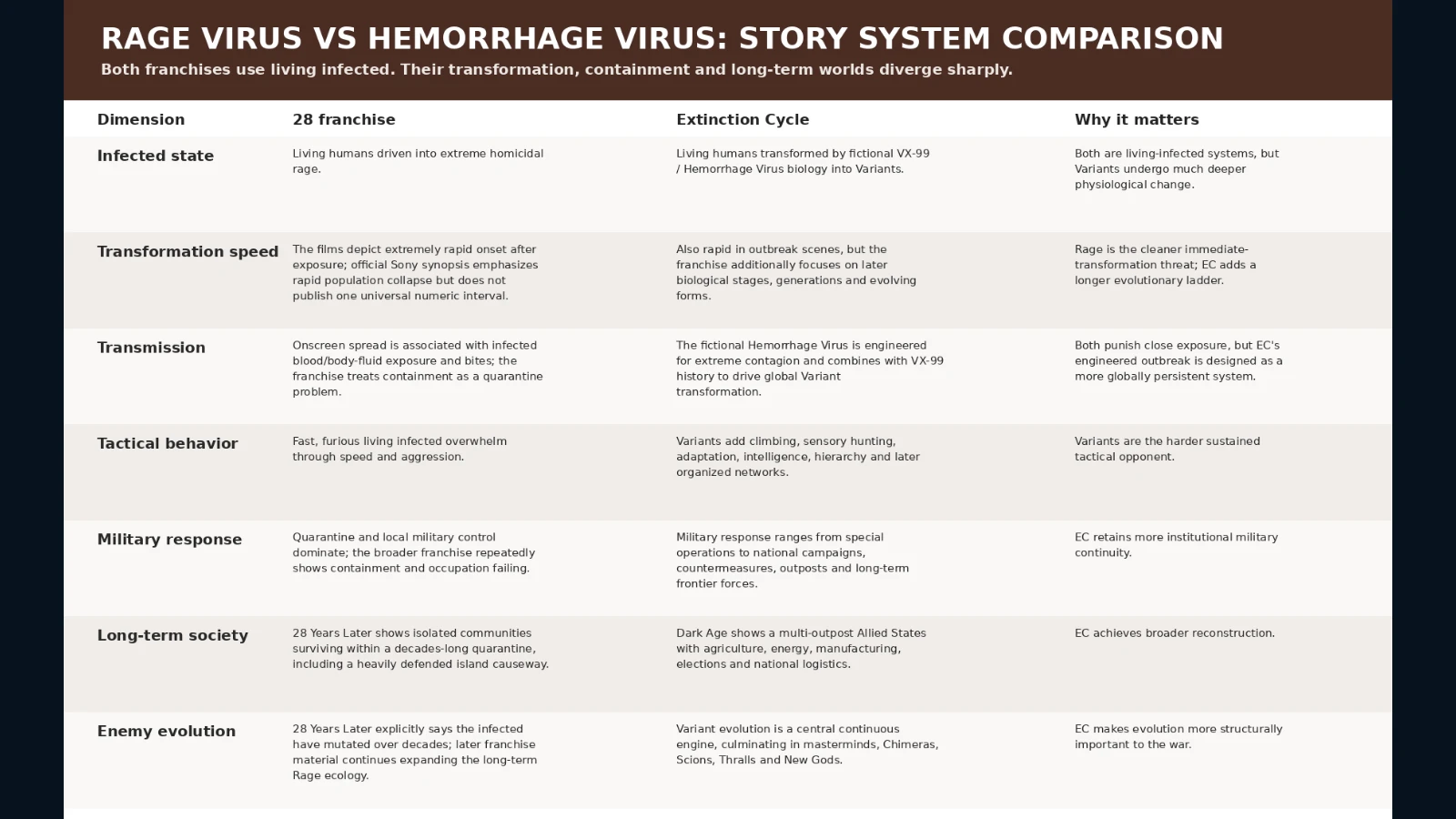
Rage, in principle.
The decades-long quarantine suggests geography can matter at national scale.
The infected remain devastating inside the zone, but the rest of the world can apparently maintain the boundary.
The Extinction Cycle's Hemorrhage Virus becomes a global catastrophe too quickly for that approach.
Containment gives way to species survival.
Which Infected Are More Dangerous?
In the first five minutes
Rage infected.
The almost immediate behavioral conversion makes close contact astonishingly unforgiving.
Over a long campaign
Variants.
They add physical enhancement, adaptation, hierarchy, specialized forms and organized systems.
To civilization as a whole
The answer depends on whether containment works.
Rage can destroy a dense society incredibly fast.
Variants are more capable of staying a strategic enemy after the first wave.
The Role of Human Enemies
Both worlds eventually discover that infection is not the only danger.
The 28 franchise repeatedly uses human brutality, exploitation and social breakdown as a second horror.
Sony's 2026 material for The Bone Temple makes the theme explicit: the infected are no longer necessarily the greatest threat, and surviving human factions can become stranger and more terrifying.
The Extinction Cycle reaches a similar conclusion through ROT, collaborators and the New Gods.
The distinction is that the New Gods blur the boundary between human political enemy and biological enemy.
They are not simply survivors behaving badly.
They are building a rival post-human order.
Final Comparison
Rage Virus advantages as a fictional threat
- extraordinarily fast behavioral conversion
- catastrophic crowd dynamics
- living infected capable of sprinting
- rapid destruction of trust
- terrifying close-contact transmission logic
Hemorrhage Virus / Variant advantages
- engineered global outbreak system
- enhanced physical capabilities
- continued biological evolution
- intelligent hunting
- organized hierarchy
- specialized forms
- long-term capacity to attack rebuilt civilization
Which World Has the Better Chance to Rebuild?
The Extinction Cycle proves it can.
That is the decisive evidence.
By Dark Age, the Allied States has farms, outposts, infrastructure, manufacturing, political institutions and national military capability.
The 28 world proves local communities can survive for decades.
It has not, by 28 Years Later, demonstrated an equivalent national reconstruction inside the quarantined zone.
That does not mean it never can.
It means its recovery is at a different stage.
Starvation and Metabolism Change the Long Game
Living infected create a strategic possibility that classic undead do not.
They can fail biologically.
The original 28 films use that fact as part of the world's logic.
The infected are terrifying, but they are still living bodies.
That means the passage of time itself can become part of containment.
The Extinction Cycle refuses to provide that same simple long-term relief.
Variants reproduce, adapt, persist in hidden environments and later develop structures that allow them to remain strategic enemies years after the first war.
That is one reason the eight-year gap produces such different worlds.
In the Rage setting, long quarantine can reduce contact and allow survivor communities to emerge around geography.
In the Extinction Cycle, time gives humanity an opportunity to rebuild but gives the enemy time to evolve too.
Urban Britain vs Frontier America
The visual geography of the two franchises shapes survival strategy.
28 Days Later
An emptied London is frightening because a dense urban system has suddenly become useless.
The roads exist.
The hospital exists.
The shops exist.
The public spaces exist.
The people who made those systems meaningful are gone.
The horror is abandonment.
Extinction Cycle
Cities become hunting terrain.
New York tunnels, ruined urban corridors and later hidden enemy infrastructure are active spaces rather than simply empty ones.
The danger is occupation.
28 Years Later
The story moves toward a more primordial, rural and isolated Britain.
The island community survives because geography is readable.
The mainland is dangerous, but the causeway produces a simple rule:
control the connection.
Dark Age
The Allied States uses a different geography.
It does not rely on one isolated sanctuary.
It links multiple defended population centers across a damaged continent.
That creates more economic power and more attack surfaces.
The Social Meaning of Quarantine
Quarantine sounds like a medical word.
After decades, it becomes political geography.
The 28 Years world is defined partly by separation between the infected zone and the outside.
People inside that territory inherit a condition created before many of them were born.
That has consequences for identity.
A survivor community on an island is not merely hiding.
It is building culture inside a border enforced by the history of infection.
The Extinction Cycle has almost the opposite political problem.
There is no clean outside.
The Allied States exists inside the same continent where Variants remain.
The government's legitimacy therefore depends on proving it can maintain corridors, outposts and trade while the threat remains physically nearby.
One world is politically shaped by containment.
The other is politically shaped by coexistence with a frontier.
Which World Has the Better Early-Warning Problem?
Rage is easier to recognize once the rule is understood.
Exposure can create a violent transformation so quickly that behavior itself becomes the alarm.
That is terrible for the people nearby but relatively clear for everyone who sees it.
Variants create a worse intelligence problem over time.
An outpost can think it understands the enemy.
A patrol can think one form is dying out.
A commander can believe a city is clear.
Then new behavior appears.
The 28 world punishes slow reaction.
The Extinction Cycle punishes outdated certainty.
Could the 28 World Build an Allied States?
In principle, yes.
Nothing about the surviving communities makes larger cooperation impossible.
The obstacles are structural.
Secure transport
A single defended causeway works locally.
A national state needs many routes.
Surplus food
Small communities can survive.
A state needs reliable production above subsistence.
Communications
Information has to travel faster than rumor.
Political coordination
Separate communities have to accept some shared authority.
Mainland control
The infected territory cannot remain an unknown strategic void forever.
The Extinction Cycle spends four Dark Age books showing how difficult those requirements remain even after the Allied States achieves them.
The 28 world has survived long enough to attempt reconstruction.
It has not yet demonstrated the same scale inside the quarantined zone.
Could the Extinction Cycle Use Ruthless Quarantine Instead of War?
Only early.
Once the Hemorrhage Virus spreads globally, geography stops offering the same solution.
Even islands are not guaranteed permanent safety because later Variant forms undermine assumptions about water and isolation.
That means EC humanity has to solve the enemy rather than merely isolate it.
This is a crucial difference.
The 28 franchise can ask:
Can we keep the infected zone contained?
The Extinction Cycle quickly has to ask:
How do we build civilization in a world where the infected zone is everywhere?
The Science Problem
The Rage franchise keeps the infection scientifically suggestive but narratively simple.
The virus creates rage.
Long-term mutation complicates the later world.
The science does not dominate the early plot.
The Extinction Cycle makes scientific intervention part of every strategic era.
VX-99 creates the historical problem.
The Hemorrhage Virus creates the outbreak.
VariantX9H9 alters the infected population.
Kryptonite targets healing.
Later work investigates webbing and gene-delivery systems.
This makes the EC world more technologically active and more morally dangerous.
Its scientists can change the war.
They can also change the enemy.
Which World Produces the Better Survivor Culture?
The 28 world may produce harder local survivors.
A small isolated community cannot assume distant institutions will save it.
People need practical competence and strong local rules.
The Extinction Cycle produces a stronger network culture by Dark Age.
A person can specialize.
A farmer does not need to be Team Ghost.
A scientist does not need to patrol every wall.
A child can grow up in a community where survival skills matter but are not the only available identity.
That division of labor is one of the strongest signs that reconstruction has gone further.
Final Verdict
The Rage Virus is the more terrifying outbreak accelerator.
The Hemorrhage Virus and VX-99 system creates the more dangerous long-term enemy.
Rage destroys normal social response by making the newly infected immediately violent.
Variants destroy long-term strategic confidence by refusing to remain one kind of enemy.
The 28 world responds by quarantining geography and building pockets of survival.
The Extinction Cycle responds by rebuilding institutions inside the contaminated world and creating a permanent military-scientific frontier.
Which is harder?
If you are standing in a room when exposure happens, Rage.
If you are trying to run a country ten years later, Variants.
That difference is the heart of the comparison.
FAQ
Are the infected in 28 Days Later zombies?
They are living humans infected by the fictional Rage Virus, not reanimated corpses.
Are Extinction Cycle Variants alive?
Yes. They are living transformed humans in the story's fictional biology.
Which infection changes people faster?
The 28 films depict extremely rapid Rage conversion. The Extinction Cycle also moves quickly, but its larger threat comes from what infected biology becomes over time.
Does 28 Years Later show civilization rebuilding?
It shows long-term survivor communities, including a defended island connected by a causeway, inside a continuing quarantine. That is more localized than the Allied States reconstruction in Dark Age.
Which infected are more intelligent?
Variants develop much more explicit hunting intelligence, hierarchy and organization.
Could Team Ghost handle Rage infected?
A trained unit with warning would have advantages, but rapid close-contact conversion would create severe identification and contamination risks.
Could a 28 Years Later island survive Variants?
The location would help, but Variant climbing, adaptation and later environmental flexibility would make permanent isolation less reliable.
Source Scope
28-franchise claims use Sony Pictures' official 28 Days Later and 28 Years Later descriptions, with The Bone Temple used only as supplemental context for the current long-term franchise direction.
Extinction Cycle claims are grounded in the uploaded novels and source-backed Variant, Team Ghost, reconstruction and Dark Age material.