
Event Arcs
Puerto Rico Command Crisis
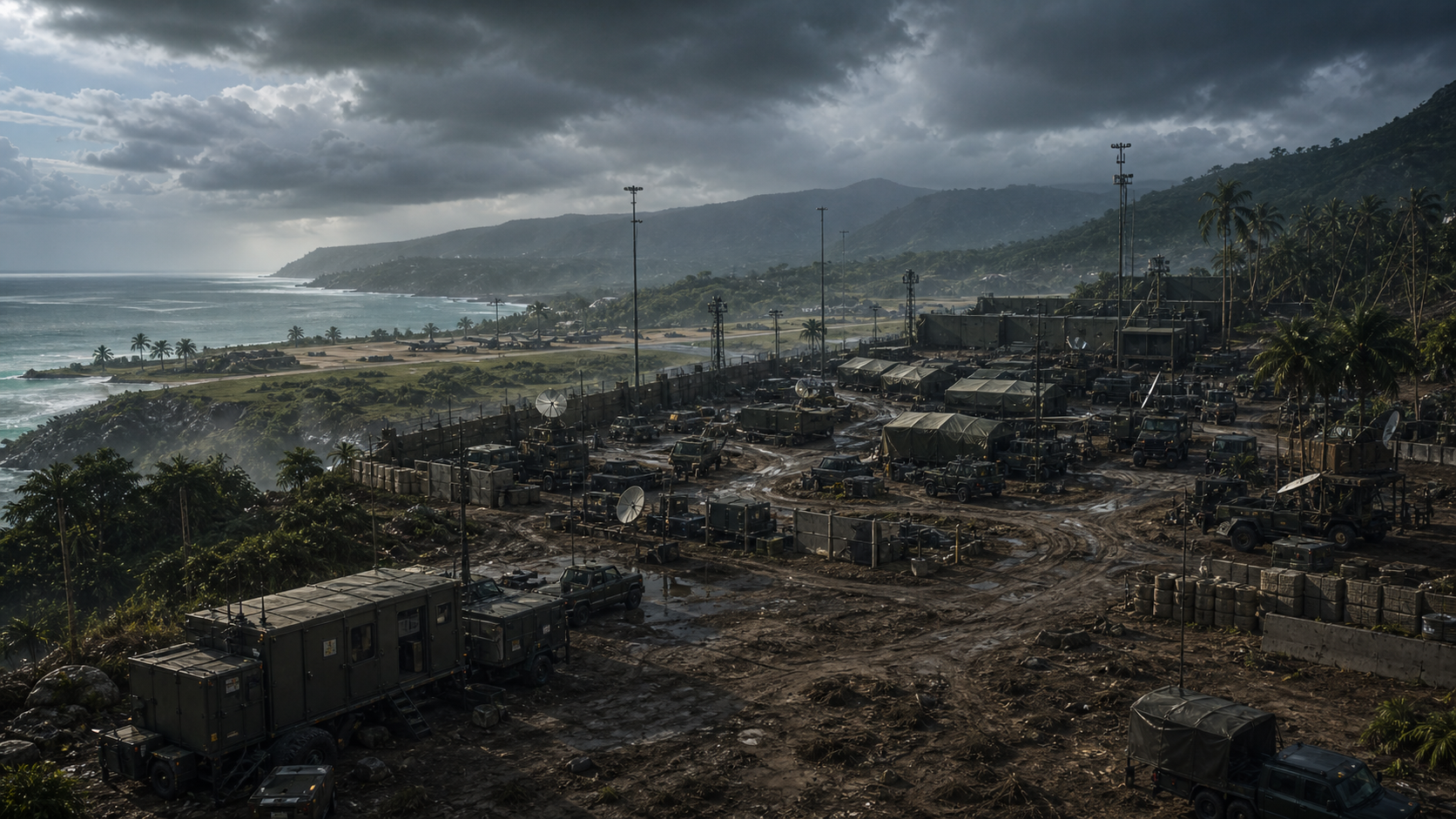
The Puerto Rico command crisis is a late Dark Age political and military emergency in which the Allied States attempts to preserve continuity of government through geographic separation, naval mobility, and fallback command arrangements. Puerto Rico appears to offer distance from the collapsing mainland outpost network and a defensible position connected to surviving naval assets. Instead, the crisis demonstrates that relocation is not the same as security. The New Gods possess enough reach, intelligence, collaborators, and command discipline to threaten islands, ships, and political leaders as effectively as isolated settlements.
Quick Facts
- Role
- Event Arcs
Overview
The crisis is closely associated with President Jan Ringgold, Vice President Dan Lemke, Azrael, survivor command, the USS George Johnson, and the transition toward Galveston as the final center of organized resistance. Lemke's role makes the event more than a disrupted military plan. He is Ringgold's expected successor and the presidential candidate representing continuity with her reconstruction program. When the fallback structure fails and Lemke is captured, the Allied States loses both immediate command capacity and its planned political future.
Puerto Rico therefore marks the point at which the New Gods campaign becomes a war against government itself. Outpost attacks destroy communities and resources. The command crisis attacks the ability to coordinate those communities, maintain lawful succession, and convince survivors that a human republic can still protect them.
Crisis information
- Field: Event; Detail: Puerto Rico command crisis
- Field: Era; Detail: Late Extinction Cycle: Dark Age
- Field: Principal work; Detail: Extinction Darkness
- Field: Wider sequence; Detail: Follows expanding New Gods attacks and precedes the Battle of Galveston
- Field: Location; Detail: Puerto Rico and connected maritime command routes
- Field: Political authority; Detail: President Jan Ringgold and Vice President Dan Lemke
- Field: Principal enemy; Detail: Azrael and the New Gods hierarchy
- Field: Important naval connection; Detail: USS George Johnson and the wider Navy survivor network
- Field: Strategic purpose; Detail: Preserve leadership, communications, military coordination, and lawful succession away from threatened mainland positions
- Field: Central failure; Detail: The enemy compromises the assumption that island and naval distance can provide a secure rear area
- Field: Principal political loss; Detail: Lemke is captured and later executed by Azrael
- Field: Following strategic center; Detail: Galveston
- Field: Long-term consequence; Detail: Ringgold is isolated, ordinary succession collapses, and the Allied States enters a constitutional as well as military endgame
Background
The Allied States enters the Dark Age period with approximately one hundred fortified outposts, restored agricultural and manufacturing capacity, portions of an energy grid, rail connections, and a national political system. Its achievements are substantial, but its geography remains compressed. Outposts are islands of defended life within a continent containing ruined cities, independent survivors, collaborators, and evolved enemies.
The first coordinated New Gods attacks expose weaknesses in this structure. A fortified community can be studied, infiltrated, isolated, or overwhelmed before distant reinforcements arrive. Specialized creatures and human collaborators bypass assumptions developed during the original Variant war. Living webbing and mastermind activity add forms of communication that ordinary signals intelligence does not immediately understand.
The government faces two linked problems. It must direct a widening war, and it must preserve leaders capable of giving lawful orders if a headquarters falls. Concentrating the president, vice president, military staff, communications, and scientific advisers in one threatened location invites decapitation. Dividing them preserves redundancy but can weaken coordination and protection.
Puerto Rico enters this problem as part of a fallback logic. An island separated from mainland attack corridors appears less vulnerable than an inland outpost. Naval access allows personnel and information to move without relying on compromised roads or rail. Existing military and maritime resources can support communications, evacuation, and defense.
The plan is reasonable by the standards of earlier wars. The New Gods are not limited by those standards.
Continuity-of-government strategy
Continuity of government means more than keeping one officeholder alive. The Allied States must retain the ability to authenticate orders, contact outposts, allocate ships and aircraft, move refugees and supplies, protect scientific work, and establish who assumes authority after a death or capture.
Ringgold embodies the state because she led the survivors through the first war and reconstruction. That symbolic value also makes her a target. Lemke provides the expected succession path.
The fallback strategy therefore has three layers:
Each layer depends on reliable intelligence. Geographic separation helps only if the enemy cannot follow. Ships provide mobility only if routes, crews, and command systems remain secure. Political redundancy works only if the successor can communicate, survive, and be recognized by the communities he is meant to govern.
Puerto Rico reveals that none of those conditions can be assumed.
- Geographic separation: Move or prepare to move essential functions away from the most threatened mainland zones.
- Maritime support: Use ships and island routes to preserve mobility, communications, and evacuation options.
- Political redundancy: Keep Lemke capable of succeeding Ringgold if the president is killed or cut off.
Strategic value of Puerto Rico
Puerto Rico offers several apparent advantages. Water creates distance from large mainland hordes. Ports can support naval movement. Aircraft and ships can connect the island to scattered forces. A command presence there can remain within the surviving American political sphere while operating away from the most heavily contested continental corridors.
The location also provides symbolic depth. If the mainland government loses an outpost or headquarters, national authority can continue from another inhabited territory rather than appearing to vanish into an anonymous bunker. A visible fallback can reassure communities that the state has prepared for catastrophe.
Those strengths carry vulnerabilities. Ports and airfields are predictable. Ships require fuel, maintenance, trained crews, secure navigation, and uncontaminated supply. An island can be difficult to invade while also being difficult to reinforce. If communications are disrupted, distance becomes isolation.
The Variant war has already shown that water is not a guaranteed barrier. Aquatic forms operate around Key West and later threats exploit maritime approaches. Human collaborators can pilot boats, handle weapons, recognize procedures, and enter spaces where an obviously altered creature would be detected. By Dark Age, the enemy can combine evolved bodies with human use of old infrastructure.
Puerto Rico is therefore defensible, but it is not outside the war.
Naval command and the USS George Johnson
The USS George Johnson is associated with the maritime side of the crisis. Its presence links Puerto Rico to the larger tradition of Navy survivors preserving government after land commands collapse. Earlier in the continuity, the USS George Washington serves as a carrier, refuge, command platform, aviation base, and political center. The later fleet inherits both the value and the dangers of that model.
A major ship can move leadership and communications, support aircraft, shelter personnel, and project force across distances that outpost garrisons cannot cross quickly. It can also become a single high-value target. Damage, infiltration, command compromise, or loss of contact affects every community relying on it.
The USS George Johnson functions in the Puerto Rico crisis as a naval node tied to the attempted fallback. The established record does not provide a complete deck-by-deck chronology, ship manifest, or verified casualty list. Its strategic meaning is clear: the Allied States attempts to use surviving maritime power as depth, and the New Gods demonstrate that naval depth can be threatened.
This development completes a recurring series pattern. During the first war, ships seem safer because the mainland is overrun. ROT later turns the USS George Washington into a contested political weapon. Dark Age shows that even a rebuilt fleet remains vulnerable when the enemy understands human command and logistics.
Breakdown of the fallback assumption
The crisis develops after multiple outpost failures make ordinary mainland command increasingly dangerous. Leadership prepares or uses a Puerto Rico-centered fallback supported by naval information and movement. The enemy's reach compromises the plan.
The exact failure is larger than one breached wall. Reports and communications indicate that the New Gods can threaten the supposedly safer command structure. The government must reconsider whether its leaders, ships, and routes are concealed, whether information has been intercepted, and whether collaborators have provided access.
This uncertainty is itself a weapon. A government cannot coordinate confidently when it does not know which channel, platform, or destination remains secure. Delayed reports may mean equipment failure, enemy action, or total loss. Moving another leader may preserve that person or deliver the person into a prepared trap.
Once that confidence breaks, leaders must concentrate around the strongest remaining defense even if concentration increases the consequence of defeat.
Galveston becomes necessary partly because Puerto Rico no longer provides the expected alternative.
Dan Lemke and political succession
Lemke is a retired Navy rear admiral, vice president, New America Coalition leader, and Ringgold's intended successor. His biography connects military credibility to political restraint. He supports defending the outposts, preserving reconstruction, and avoiding a mass campaign that could consume the young generation.
His involvement gives the command crisis a constitutional dimension. If Ringgold dies while Lemke remains secure and connected, the government has a recognizable path forward. If both are removed, the Allied States must improvise leadership while fighting an existential war.
The failure of the fallback structure exposes Lemke to enemy control. His later capture and execution by Azrael are not isolated atrocities disconnected from command planning. They are the culmination of a campaign that reaches through outposts, maritime systems, and political arrangements.
Azrael uses Lemke's death as spectacle. Killing the vice president removes a leader. Public execution attacks the survivors' belief that human law has a future. It tells voters, soldiers, and outpost families that the expected successor can be seized and that the New Gods, rather than the Allied States, determine who lives.
Lemke's refusal to submit prevents the spectacle from becoming a voluntary transfer of legitimacy. His death creates a martyr and preserves the moral distinction between lawful succession and Azrael's hierarchy, but it still leaves Ringgold without the person she expected to continue the government.
Jan Ringgold's isolation
Ringgold has survived the original government collapse, the Variant war, ROT, and years of reconstruction. Her leadership depends on relationships with military commanders, scientists, outposts, naval forces, staff, and the public. The Puerto Rico crisis removes layers of that support.
The loss of a fallback narrows her options. The loss of Lemke removes the ordinary successor. Continued enemy advances make every relocation more dangerous. She must lead while knowing that preserving herself may no longer preserve the government and that dispersing her remaining allies may expose them individually.
This isolation helps explain the later moral force of Galveston. Ringgold does not arrive there with a hidden safe capital still available. The retreat and continuity options have been progressively stripped away. Her refusal of Azrael is therefore not a choice made from secure distance. It is the decision of a president whose system has been attacked down to its final visible stand.
Puerto Rico changes the meaning of presidential protection. The Secret Service and military can move a person, harden a room, and screen an approach. They cannot guarantee political continuity when the vice president is gone, communications are unstable, and the enemy attacks the idea of human government.
Enemy strategy
Azrael's campaign differs from the behavior of early Variant packs. A horde attacks prey or territory. The New Gods target functions and symbols. Outposts produce food and citizens. Laboratories produce knowledge. Ships produce mobility and command. Political leaders produce legitimacy.
Puerto Rico is valuable because it combines several of those functions. Compromising it yields more than casualties. It shows that islands are penetrable, naval systems are vulnerable, and the government's contingency plans are known or predictable.
Human collaborators are central to this capability. They can read maps, operate radios, pilot craft, impersonate personnel, maintain prisoners, and interpret the value of a title such as vice president. Specialized altered forms add strength and environmental adaptation. The resulting organization can pursue a political objective across terrain that would divide a less coordinated enemy.
The crisis also demonstrates intelligence. The New Gods do not merely stumble across a remote position. Their pressure follows the Allied States' effort to preserve command. Even where the precise intelligence channel is not established, the pattern requires commanders to assume that movement and fallback planning can be observed.
Communications and legitimacy
Communication is both a technical system and a political relationship. An outpost must know that an order is genuine, that another settlement still exists, and that national leaders understand the local threat. A delayed or falsified message can split the state without destroying a wall.
Puerto Rico increases the distance between central leaders and mainland communities. That distance can protect command from direct attack while making it harder to show presence. When the fallback is compromised, the same separation becomes evidence that the government may be unable to protect or even contact its members.
The New Gods exploit this gap through terror and public acts. Lemke's execution communicates more directly than a policy statement. It creates a simple image of enemy power at the exact moment lawful channels are failing.
The Allied States response depends on maintaining truth. Leaders must acknowledge loss, avoid claiming control they no longer possess, and direct remaining forces through authenticated networks. Concealing the scale of the crisis might prevent immediate panic, but the history of VX-99 and ROT shows how quickly secrecy destroys trust once reality becomes visible.
Transition to Galveston
Galveston becomes the next strategic and symbolic center after other options narrow. It concentrates political survivors, military capability, Cornelius's regional power, Team Ghost connections, naval resources, and civilians around a final defense.
The move solves one problem and creates another. Concentration allows coordination and mutual protection. It also offers Azrael a single battlefield on which to destroy the surviving government or force its surrender.
Puerto Rico explains why the defenders accept that risk. A distributed fallback has failed to guarantee continuity. Lemke is lost. The enemy can reach islands and ships.
The Battle of Galveston is therefore not a disconnected climax. It is the endpoint of shrinking strategic depth. Each failed outpost, compromised route, and lost command option makes the final stand more likely.
Military lessons
The crisis produces several lessons for survivor command:
These lessons do not mean relocation was a mistake. Remaining in a known mainland headquarters could have made decapitation easier. The failure lies in treating relocation as a complete solution rather than one layer of defense.
- Distance is not concealment: An island can be found, watched, and approached.
- Mobility is not immunity: Ships remain dependent on crews, fuel, maintenance, and secure information.
- Succession is an operational asset: Protecting the vice president matters as much as protecting weapons or communications.
- Redundancy requires authentication: Multiple command nodes help only when each can verify orders and detect compromise.
- Collaborators erase simple terrain barriers: Human agents can cross ports, ladders, checkpoints, and control rooms.
- Political symbols are military targets: Capturing a leader may damage resistance more than destroying an isolated garrison.
Political and thematic significance
The Puerto Rico crisis tests whether a state can exist without secure geography. The pre-outbreak United States derives authority from continuous territory, institutions, and communications. The Allied States is a network built after most of those conditions disappear. Its government must remain legitimate even when leaders move and borders are uncertain.
Azrael offers a competing answer. His hierarchy does not depend on elections or civil equality. It promises survival through submission to a biological order. By capturing leaders and reaching fallback sites, he tries to make that structure appear more durable than Ringgold's republic.
Lemke and Ringgold reject the conclusion. Their losses do not prove the New Gods morally legitimate. They prove that human government is vulnerable. The distinction matters because the series defines civilization through how it treats vulnerability. The Allied States attempts to preserve citizens and succession. Azrael uses bodies and offices as instruments of domination.
The crisis also turns hope from an emotion into a command problem. A government needs people to believe resistance has a future. Puerto Rico removes one version of that future, forcing survivors to create another at Galveston.
Important connections
- Dan Lemke: Vice president and expected successor whose capture turns command failure into a succession crisis.
- Jan Ringgold: President increasingly isolated as fallback options and senior allies are lost.
- Azrael: New Gods leader who attacks political continuity as well as military targets.
- USS George Johnson: Naval node associated with the attempted maritime fallback.
- Navy survivors: Personnel and platforms providing mobility, communications, and command depth.
- Allied States: Rebuilt polity whose distributed structure is tested by coordinated war.
- New Gods: Rival hierarchy capable of striking outposts, ships, islands, and leaders.
- Galveston: Following center of resistance made necessary by the collapse of safer alternatives.
- Mark Cornelius: Political and military rival whose regional strength becomes essential in the final coalition.
- Reed Beckham: Veteran whose later unity role gains importance after the expected succession is destroyed.
Chronology and consequences
- Extinction Shadow - Establishes the Allied States, outpost network, election, and succession structure that the later crisis threatens.
- Extinction Inferno - Expands coordinated attacks and demonstrates that the enemy is operating beyond isolated frontier violence.
- Extinction Ashes - Develops the New Gods hierarchy, command pressure, and the approach to national crisis.
- Extinction Darkness - Contains the Puerto Rico command crisis, Lemke's fate, the collapse of fallback assumptions, and the transition toward Galveston.
- Battle of Galveston continuity - Completes the political and military consequences of the failed fallback.
Continue Exploring
Connected Universe
Books and Stories
Groups and Factions
Sources
- Extinction Cycle: Dark Age Box Set, Extinction Darkness - Chapter 14
- Extinction Cycle: Dark Age Box Set, Extinction Darkness - Chapter 15
- Extinction Cycle: Dark Age Box Set, Extinction Darkness - Chapter 16
- Extinction Cycle: Dark Age Box Set, Extinction Darkness - Chapter 17
- Extinction Cycle: Dark Age Box Set, Extinction Darkness - Chapter 18
- Extinction Cycle: Dark Age Box Set, Extinction Darkness - Chapter 19
- Extinction Cycle: Dark Age Box Set, Extinction Darkness - Chapter 20
- Extinction Cycle: Dark Age Box Set, Extinction Darkness - Chapter 23
- Extinction Cycle: Dark Age Box Set, Extinction Darkness - Chapter 24
- Extinction Cycle: Dark Age Box Set, Extinction Darkness - Chapter 25